






"Middle Africa" region includes following countries:
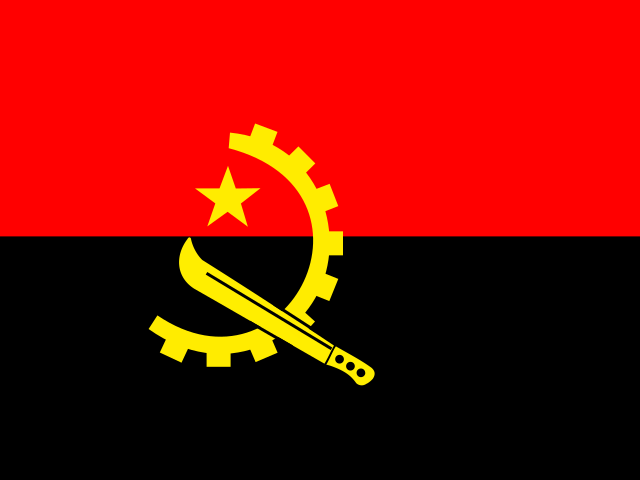 Angola
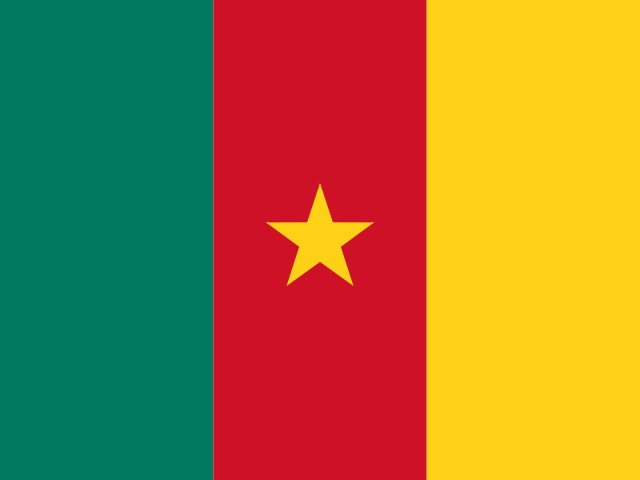 Cameroon
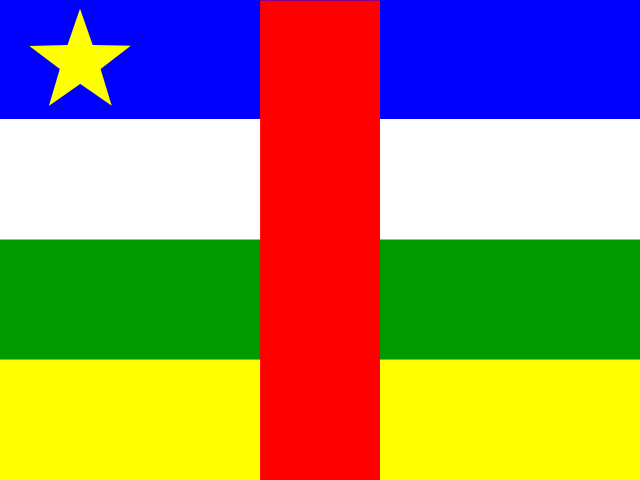 Central African Republic
 Chad
Chad Congo
Congo Democratic Republic of the Congo
 Equatorial Guinea
 Gabon
Gabon Sao Tome and Principe
Earlier Report Observations
Between 2018 and 2020, production and market volume of unroasted coffee in Middle Africa expanded significantly. This growth was driven by the establishment of post-harvest processing excellence centers, modernization of seed centers, and training programs for farmers, which improved quality and increased output. Market liberalization also contributed to more efficient operations.
From 2021 to 2023, the upward trend continued due to initiatives boosting domestic consumption. The installation of coffee sales kiosks in government buildings and airports, along with barista training for hospitality staff, stimulated local demand. The launch of the Coffee Sector Revival Support Project (PARF-CAFE) in 2023 reinforced optimism and aimed at long-term production increases in key growing regions.
In 2024, favorable conditions persisted, supported by high international coffee prices and ongoing upgrades to processing equipment. Efforts to comply with new European standards and further structuring of farmers into cooperatives maintained quality and volume growth.
Table of content
- 1. Disclaimer
- 2. Terms of use of the report
- 3. Product codes in the statistical classifications used in the report
-
4. Key Market Indicators and Trends
-
4.1. Key Market Indicators
-
4.1.1. In kind
- 4.1.1.1. Production, 2018-2023
- 4.1.1.2. Imports, 2018-2024
- 4.1.1.3. Exports, 2018-2024
- 4.1.1.4. Market size, 2018-2023
-
4.1.2. In value
- 4.1.2.1. Production, 2018-2023
- 4.1.2.2. Imports, 2018-2024
- 4.1.2.3. Exports, 2018-2024
- 4.1.2.4. Market size, 2018-2023
-
4.1.1. In kind
- 4.2. Market Trends and Factors
-
4.1. Key Market Indicators
-
5. Production
-
5.1. Production in Middle Africa
- 5.1.1. Annual dynamics of production in Middle Africa in kind, 2018-2023, K t
-
5.2. Global production by Country, 2018-2023
- 5.2.1. Annual dynamics of production by macroregions in kind, 2018-2023, K t
- 5.2.2. Dynamics of production structure by macroregions in kind, 2018-2023
- 5.2.3. Annual dynamics of production by country in kind, 2018-2023, K t
- 5.2.4. Structure of production by countries in kind, 2018-2023
- 5.2.5. Dynamics of peoduction structure by countries in kind, 2018-2023
-
5.1. Production in Middle Africa
-
6. Imports
-
6.1. Imports (Direct Data*)
- 6.1.1. Imports - Total information
-
6.1.2. Imports in kind, t
- 6.1.2.1. Annual dynamics of product's imports to Angola in kind, 2018-2024, t
- 6.1.2.2. Dynamics of product's imports in kind to Angola by countries, 2018-2024, t
- 6.1.2.3. Structure of product's imports in kind by countries, 2018-2024
-
6.1.3. Imports in value, K $ US
- 6.1.3.1. Annual dynamics of product's imports to Angola in value, 2018-2024, K $ US
- 6.1.3.2. Dynamics of product's imports in value to Angola by countries, 2018-2024, K $ US
- 6.1.3.3. Structure of product's imports in value by countries, 2018-2024
-
6.1.4. Average price of product's imports, $ US/t
- 6.1.4.1. Annual dynamics of average price of product's imports to Angola, 2018-2024, $ US/t
- 6.1.4.2. Dynamics of average price of product's imports to Angola by countries, 2018-2024, $ US/t
-
6.2. Imports (Mirror Data)
- 6.2.1. Imports - Total information
-
6.2.2. Imports in kind, t
- 6.2.2.1. Annual dynamics of product's imports to Angola in kind, 2018-2024, t
- 6.2.2.2. Dynamics of product's imports in kind to Angola by countries, 2018-2024, t
- 6.2.2.3. Structure of product's imports in kind by countries, 2018-2024
-
6.2.3. Imports in value, K $ US
- 6.2.3.1. Annual dynamics of product's imports to Angola in value, 2018-2024, K $ US
- 6.2.3.2. Dynamics of product's imports in value to Angola by countries, 2018-2024, K $ US
- 6.2.3.3. Structure of product's imports in value by countries, 2018-2024
-
6.2.4. Average price of product's imports, $ US/t
- 6.2.4.1. Annual dynamics of average price of product's imports to Angola, 2018-2024, $ US/t
- 6.2.4.2. Dynamics of average price of product's imports to Angola by countries, 2018-2024, $ US/t
-
6.1. Imports (Direct Data*)
-
7. Exports
-
7.1. Exports (Direct Data*)
- 7.1.1. Exports - Total information
-
7.1.2. Exports in kind, t
- 7.1.2.1. Annual dynamics of product's exports from Angola in kind, 2018-2024, t
- 7.1.2.2. Dynamics of product's exports in kind from Angola by countries, 2018-2024, t
- 7.1.2.3. Structure of product's exports in kind by countries, 2018-2024
-
7.1.3. Exports in value, K $ US
- 7.1.3.1. Annual dynamics of product's exports from Angola in value, 2018-2024, K $ US
- 7.1.3.2. Dynamics of product's exports in value from Angola by countries, 2018-2024, K $ US
- 7.1.3.3. Structure of product's exports in value by countries, 2018-2024
-
7.1.4. Average price of product's exports, $ US/t
- 7.1.4.1. Annual dynamics of average price of product's exports from Angola, 2018-2024, $ US/t
- 7.1.4.2. Dynamics of average price of product's exports from Angola by countries, 2018-2024, $ US/t
-
7.2. Exports (Mirror Data)
- 7.2.1. Exports - Total information
-
7.2.2. Exports in kind, t
- 7.2.2.1. Annual dynamics of product's exports from Angola in kind, 2018-2024, t
- 7.2.2.2. Dynamics of product's exports in kind from Angola by countries, 2018-2024, t
- 7.2.2.3. Structure of product's exports in kind by countries, 2018-2024
-
7.2.3. Exports in value, K $ US
- 7.2.3.1. Annual dynamics of product's exports from Angola in value, 2018-2024, K $ US
- 7.2.3.2. Dynamics of product's exports in value from Angola by countries, 2018-2024, K $ US
- 7.2.3.3. Structure of product's exports in value by countries, 2018-2024
-
7.2.4. Average price of product's exports, $ US/t
- 7.2.4.1. Annual dynamics of average price of product's exports from Angola, 2018-2024, $ US/t
- 7.2.4.2. Dynamics of average price of product's exports from Angola by countries, 2018-2024, $ US/t
-
7.1. Exports (Direct Data*)
-
8. Trade balance
-
8.1. Trade balance (Direct Data)
- 8.1.1. In kind, t
- 8.1.2. In value, K $ US
-
8.2. Trade balance (Mirror Data)
- 8.2.1. In kind, t
- 8.2.2. In value, K $ US
-
8.1. Trade balance (Direct Data)
-
9. Top buying and selling countries, 2018-2024
-
9.1. Direct Data
- 9.1.1. Import in Value by Countries-buyers
- 9.1.2. Export in Value by Countries-suppliers
-
9.2. Mirror Data
- 9.2.1. Import in Value by Countries-buyers
- 9.2.2. Export in Value by Countries-suppliers
-
9.1. Direct Data
Production unroasted, not decaffeinated coffee in Middle Africa
In kind, 2017-2020, K t
Top producers of unroasted, not decaffeinated coffee, 2017-2020
World map of production of unroasted, not decaffeinated coffee, 2017-2020
Middle Africa's production of unroasted, non-decaffeinated coffee has grown for the third year in a row. In 2020, the region produced 398.0 thousand tons, marking a significant 25.4% increase from the previous year. Looking at the period from 2017 to 2020, production surged by 251.7%, which translates to an average annual growth rate of 52.1%.
Annual dynamics of production in Middle Africa in kind, 2017-2020, K t
| Parameter | 2018 | 2019 | 2020 | CAGR | |
|---|---|---|---|---|---|
| 1 | Change from last year | 79.6% | 56.1% | 25.4% | 52.1% |
In value, 2017-2020, M $ US
The value of Middle Africa's unroasted, non-decaffeinated coffee production has also risen for three consecutive years. In 2020, output was valued at 519.8 million US dollars, representing a 25.0% increase compared to 2019. From 2017 to 2020, production value grew by 197.3%, with an annualized rate of 43.8%.
Annual dynamics of production in Middle Africa in value, 2017-2020, M $ US
| Parameter | 2018 | 2019 | 2020 | CAGR | |
|---|---|---|---|---|---|
| 1 | Change from last year | 90.0% | 25.2% | 25.0% | 43.8% |
Exports unroasted, not decaffeinated coffee from Middle Africa
Exports in kind, t
Following a two-year decline, Middle Africa's exports of unroasted, non-decaffeinated coffee rebounded in 2020. Exports reached 34 054 tons, showing an 11.4% rise from the previous year. However, over the 2017-2020 period, exports decreased by 14.2%, averaging a 5.0% annual decline. The lowest point was in 2019 at 30 567 tons, with the largest drop occurring in 2018 at 18.7%.
Annual dynamics of product's exports from Middle Africa in kind, 2017-2020, t
| Parameter | 2018 | 2019 | 2020 | CAGR | |
|---|---|---|---|---|---|
| 1 | Change from last year | (18.7%) | (5.3%) | 11.4% | (5.0%) |
Between 2017 and 2020, Middle Africa's export partners for unroasted, non-decaffeinated coffee were diverse. Belgium accounted for 20.7% of exports in volume, Italy for 12.0%, and Algeria for 11.6%, together making up 44.3% of total flows. The remaining 55.7% was distributed among numerous other countries.
Structure of product's exports in kind by countries, 2017-2020
World map of product's exports from Middle Africa in kind, 2017-2020
Exports in value, K $ US
After two years of decline, Middle Africa's unroasted, non-decaffeinated coffee exports increased in value in 2020. Exports stood at 44 481 thousand US dollars, up 11.0% from 2019. Over the 2017-2020 period, export value fell by 27.5%, with a compound annual growth rate of -10.2%. The lowest value was recorded in 2019 at 40 074 thousand US dollars, which also saw the largest decline of 24.0%.
Annual dynamics of product's exports from Middle Africa in value, 2017-2020, K $ US
| Parameter | 2018 | 2019 | 2020 | CAGR | |
|---|---|---|---|---|---|
| 1 | Change from last year | (14.0%) | (24.0%) | 11.0% | (10.2%) |
From 2017 to 2020, Middle Africa's export market for unroasted, non-decaffeinated coffee was broad in terms of value. Belgium contributed 20.3% of export value, France 12.2%, and Italy 11.7%, together accounting for 44.3% of total exports. Many other countries held smaller but notable shares.
Structure of product's exports in value by countries, 2017-2020
World map of product's exports from Middle Africa in value, 2017-2020
Imports unroasted, not decaffeinated coffee to Middle Africa
Imports in kind, t
Imports of unroasted, non-decaffeinated coffee into Middle Africa showed notable fluctuations from 2017 to 2020. The period began with a peak in 2017 and ended with a low in 2020, resulting in a 3.4-fold difference between these years. In 2020, imports totaled 89 tons, a 54.5% decrease from 2019. The largest increase occurred in 2019 at 14.1%.
Annual dynamics of product's imports to Middle Africa in kind, 2017-2020, t
| Parameter | 2018 | 2019 | 2020 | CAGR | |
|---|---|---|---|---|---|
| 1 | Change from last year | (43.2%) | 14.1% | (54.5%) | (33.5%) |
During 2017-2020, the main sources of unroasted, non-decaffeinated coffee imports into Middle Africa were China with 22.4% of import volume, India with 21.9%, and South Africa with 20.3%. Together, these three countries accounted for 64.6% of total imports.
Structure of product's imports in kind by countries, 2017-2020
World map of product's imports to Middle Africa in kind, 2017-2020
Imports in value, K $ US
The value of unroasted, non-decaffeinated coffee imports into Middle Africa was volatile from 2017 to 2020. Imports peaked in 2018 at 607 thousand US dollars and hit a low in 2017, showing a two-fold variation. In 2020, imports amounted to 466 thousand US dollars, up 33.1% from the previous year. The largest decline was in 2019 at 42.3%, while the largest increase was in 2018 at 102.8%.
Annual dynamics of product's imports to Middle Africa in value, 2017-2020, K $ US
| Parameter | 2018 | 2019 | 2020 | CAGR | |
|---|---|---|---|---|---|
| 1 | Change from last year | 102.8% | (42.3%) | 33.1% | 15.9% |
From 2017 to 2020, the primary suppliers of unroasted, non-decaffeinated coffee to Middle Africa in value terms were Portugal with 35.0% of import value, India with 28.2%, and China with 7.8%. These three countries jointly accounted for 71.0% of total imports.
Structure of product's imports in value by countries, 2017-2020
World map of product's imports to Middle Africa in value, 2017-2020
Related Reports





Why Choose Us?
Only Verified Data
No Hidden Costs or Separate Fees
Smarter Subscription Pricing
Contact Our Team
Submit your inquiry using the form below — our team will get back to you within 24 hours.