






"Middle Africa" region includes following countries:
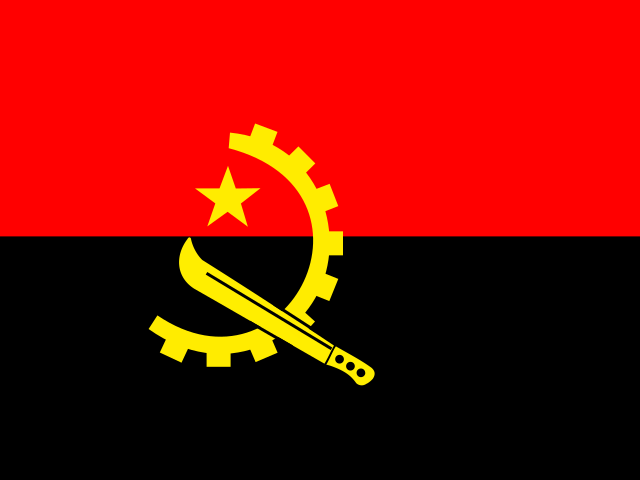 Angola
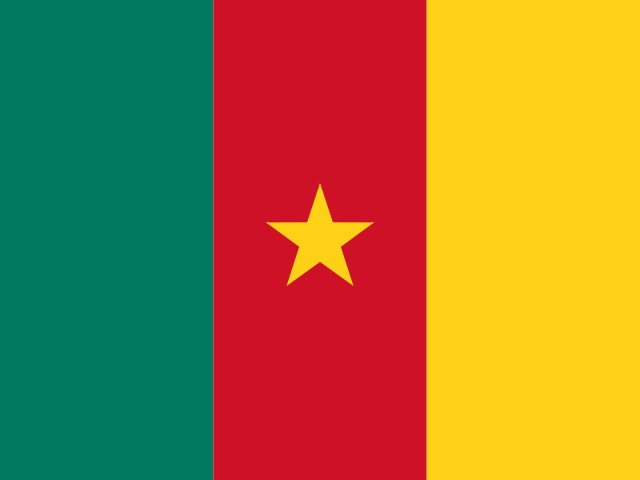 Cameroon
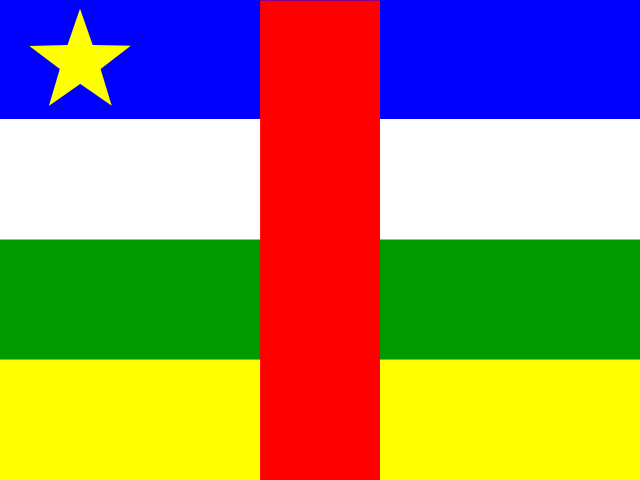 Central African Republic
 Chad
Chad Congo
Congo Democratic Republic of the Congo
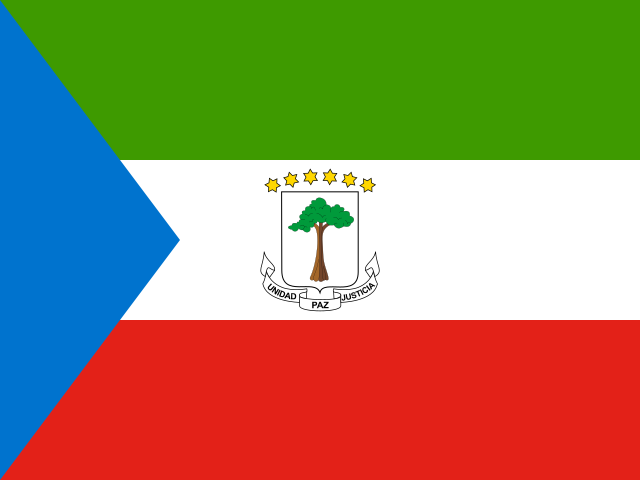 Equatorial Guinea
 Gabon
Gabon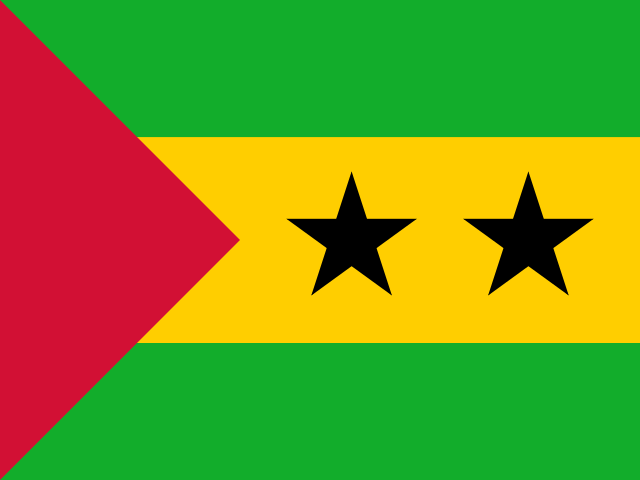 Sao Tome and Principe
Earlier Report Observations
The pepper market in Middle Africa displayed significant volume swings from 2018 to 2023. Total consumption began at 316 t in 2018, surged to 394 t in 2019, then fell to 348 t in 2020 before recovering to 385 t in 2021. A sharp drop to 284 t followed in 2022, with a strong rebound to 425 t concluding the period.
Domestic production remained stable between 96 t and 99 t annually throughout these years. The market's volatility was primarily driven by varying import levels, which ranged from 286 t to 364 t, and export volumes that fluctuated widely between 39 t and 143 t.
In 2024, the International Pepper Festival in France, organized by the major player Terre Exotique, highlighted peppers from Congo and other African origins. The event promoted pepper diversity, gastronomic value, and traditional know-how, aiming to elevate global awareness and demand for these regional varieties.
Table of content
- 1. Disclaimer
- 2. Terms of use of the report
- 3. Product codes in the statistical classifications used in the report
-
4. Key Market Indicators and Trends
-
4.1. Key Market Indicators
-
4.1.1. In kind
- 4.1.1.1. Production, 2018-2023
- 4.1.1.2. Imports, 2018-2024
- 4.1.1.3. Exports, 2018-2024
- 4.1.1.4. Market size, 2018-2023
-
4.1.1. In kind
- 4.2. Market Trends and Factors
-
4.1. Key Market Indicators
-
5. Production
-
5.1. Production in Middle Africa
- 5.1.1. Annual dynamics of production in Middle Africa in kind, 2018-2023, kg
-
5.2. Global production by Country, 2018-2023
- 5.2.1. Annual dynamics of production by macroregions in kind, 2018-2023, kg
- 5.2.2. Dynamics of production structure by macroregions in kind, 2018-2023
- 5.2.3. Annual dynamics of production by country in kind, 2018-2023, kg
- 5.2.4. Structure of production by countries in kind, 2018-2023
- 5.2.5. Dynamics of peoduction structure by countries in kind, 2018-2023
-
5.1. Production in Middle Africa
-
6. Imports
-
6.1. Imports (Direct Data*)
- 6.1.1. Imports - Total information
-
6.1.2. Imports in kind, t
- 6.1.2.1. Annual dynamics of product's imports to Angola in kind, 2018-2024, t
- 6.1.2.2. Dynamics of product's imports in kind to Angola by countries, 2018-2024, t
- 6.1.2.3. Structure of product's imports in kind by countries, 2018-2024
-
6.1.3. Imports in value, K $ US
- 6.1.3.1. Annual dynamics of product's imports to Angola in value, 2018-2024, K $ US
- 6.1.3.2. Dynamics of product's imports in value to Angola by countries, 2018-2024, K $ US
- 6.1.3.3. Structure of product's imports in value by countries, 2018-2024
-
6.1.4. Average price of product's imports, $ US/t
- 6.1.4.1. Annual dynamics of average price of product's imports to Angola, 2018-2024, $ US/t
- 6.1.4.2. Dynamics of average price of product's imports to Angola by countries, 2018-2024, $ US/t
-
6.2. Imports (Mirror Data)
- 6.2.1. Imports - Total information
-
6.2.2. Imports in kind, t
- 6.2.2.1. Annual dynamics of product's imports to Angola in kind, 2018-2024, t
- 6.2.2.2. Dynamics of product's imports in kind to Angola by countries, 2018-2024, t
- 6.2.2.3. Structure of product's imports in kind by countries, 2018-2024
-
6.2.3. Imports in value, K $ US
- 6.2.3.1. Annual dynamics of product's imports to Angola in value, 2018-2024, K $ US
- 6.2.3.2. Dynamics of product's imports in value to Angola by countries, 2018-2024, K $ US
- 6.2.3.3. Structure of product's imports in value by countries, 2018-2024
-
6.2.4. Average price of product's imports, $ US/t
- 6.2.4.1. Annual dynamics of average price of product's imports to Angola, 2018-2024, $ US/t
- 6.2.4.2. Dynamics of average price of product's imports to Angola by countries, 2018-2024, $ US/t
-
6.1. Imports (Direct Data*)
-
7. Exports
-
7.1. Exports (Direct Data*)
- 7.1.1. Exports - Total information
-
7.1.2. Exports in kind, t
- 7.1.2.1. Annual dynamics of product's exports from Angola in kind, 2018-2024, t
- 7.1.2.2. Dynamics of product's exports in kind from Angola by countries, 2018-2024, t
- 7.1.2.3. Structure of product's exports in kind by countries, 2018-2024
-
7.1.3. Exports in value, K $ US
- 7.1.3.1. Annual dynamics of product's exports from Angola in value, 2018-2024, K $ US
- 7.1.3.2. Dynamics of product's exports in value from Angola by countries, 2018-2024, K $ US
- 7.1.3.3. Structure of product's exports in value by countries, 2018-2024
-
7.1.4. Average price of product's exports, $ US/t
- 7.1.4.1. Annual dynamics of average price of product's exports from Angola, 2018-2024, $ US/t
- 7.1.4.2. Dynamics of average price of product's exports from Angola by countries, 2018-2024, $ US/t
-
7.2. Exports (Mirror Data)
- 7.2.1. Exports - Total information
-
7.2.2. Exports in kind, t
- 7.2.2.1. Annual dynamics of product's exports from Angola in kind, 2018-2024, t
- 7.2.2.2. Dynamics of product's exports in kind from Angola by countries, 2018-2024, t
- 7.2.2.3. Structure of product's exports in kind by countries, 2018-2024
-
7.2.3. Exports in value, K $ US
- 7.2.3.1. Annual dynamics of product's exports from Angola in value, 2018-2024, K $ US
- 7.2.3.2. Dynamics of product's exports in value from Angola by countries, 2018-2024, K $ US
- 7.2.3.3. Structure of product's exports in value by countries, 2018-2024
-
7.2.4. Average price of product's exports, $ US/t
- 7.2.4.1. Annual dynamics of average price of product's exports from Angola, 2018-2024, $ US/t
- 7.2.4.2. Dynamics of average price of product's exports from Angola by countries, 2018-2024, $ US/t
-
7.1. Exports (Direct Data*)
-
8. Trade balance
-
8.1. Trade balance (Direct Data)
- 8.1.1. In kind, t
- 8.1.2. In value, K $ US
-
8.2. Trade balance (Mirror Data)
- 8.2.1. In kind, t
- 8.2.2. In value, K $ US
-
8.1. Trade balance (Direct Data)
-
9. Top buying and selling countries, 2018-2024
-
9.1. Direct Data
- 9.1.1. Import in Value by Countries-buyers
- 9.1.2. Export in Value by Countries-suppliers
-
9.2. Mirror Data
- 9.2.1. Import in Value by Countries-buyers
- 9.2.2. Export in Value by Countries-suppliers
-
9.1. Direct Data
Production pepper in Middle Africa
In kind, 2017-2020, kg
Top producers of pepper, 2017-2020
World map of production of pepper, 2017-2020
Pepper production in Middle Africa has increased for the third consecutive year. In 2020, the region produced 97 750 kg of pepper, marking a slight increase of 0.7% compared to 2019. Over the period from 2017 to 2020, production grew by 2.4%, with a compound annual growth rate of 0.8%.
Annual dynamics of production in Middle Africa in kind, 2017-2020, kg
| Parameter | 2018 | 2019 | 2020 | CAGR | |
|---|---|---|---|---|---|
| 1 | Change from last year | 1.0% | 0.7% | 0.7% | 0.8% |
Exports pepper from Middle Africa
Exports in kind, t
The export market showed an unstable trend during this period. The maximum export volume was recorded in 2018 at 143.4 t, while the minimum occurred in 2019 at 40.6 t, representing a 3.5-fold difference. In 2020, pepper exports from Middle Africa reached 54.0 t, up by 32.9% from the previous year. The largest decline was observed in 2019, with a drop of 71.7%.
Annual dynamics of product's exports from Middle Africa in kind, 2017-2020, t
| Parameter | 2018 | 2019 | 2020 | CAGR | |
|---|---|---|---|---|---|
| 1 | Change from last year | 5.0% | (71.7%) | 32.9% | (26.6%) |
From 2017 to 2020, Nigeria, France, and Mali were the top buyers of pepper from Middle Africa, accounting for 38.3%, 22.1%, and 18.3% of exports in kind, respectively. Together, these three countries represented 78.6% of total exports in kind.
Structure of product's exports in kind by countries, 2017-2020
World map of product's exports from Middle Africa in kind, 2017-2020
Exports in value, K $ US
Cross-border shipments of pepper from Middle Africa declined for the second consecutive year. In 2020, the region exported 273 K $ US of pepper, reflecting a small decrease of 1.0% compared to 2019. Over the period from 2017 to 2020, exports fell by 55.8%, with a compound annual decline rate of 23.8%. The highest value was recorded in 2018 at 640 K $ US. The largest decline occurred in 2019, with a drop of 57.0%, while the largest increase was in 2018, at 3.7%.
Annual dynamics of product's exports from Middle Africa in value, 2017-2020, K $ US
| Parameter | 2018 | 2019 | 2020 | CAGR | |
|---|---|---|---|---|---|
| 1 | Change from last year | 3.7% | (57.0%) | (1.0%) | (23.8%) |
Between 2017 and 2020, the structure of exports in value terms was dominated by France, which absorbed 76.3% of total flows, alongside a large number of minor partners.
Structure of product's exports in value by countries, 2017-2020
World map of product's exports from Middle Africa in value, 2017-2020
Imports pepper to Middle Africa
Imports in kind, t
Pepper imports into Middle Africa declined for the third consecutive year. In 2020, imports amounted to 304.2 t, down by 9.9% year-over-year. Over the period from 2017 to 2020, imports decreased by 34.7%, with a compound annual decline rate of 13.3%.
Annual dynamics of product's imports to Middle Africa in kind, 2017-2020, t
| Parameter | 2018 | 2019 | 2020 | CAGR | |
|---|---|---|---|---|---|
| 1 | Change from last year | (22.0%) | (7.1%) | (9.9%) | (13.3%) |
From 2017 to 2020, Portugal, the United Arab Emirates, and South Africa were the leading suppliers of pepper to Middle Africa, accounting for 30.7%, 22.6%, and 11.6% of imports in kind, respectively. Together, these three countries made up 64.9% of total imports in kind.
Structure of product's imports in kind by countries, 2017-2020
World map of product's imports to Middle Africa in kind, 2017-2020
Imports in value, K $ US
Imported pepper volumes into Middle Africa declined for the third consecutive year. In 2020, imports amounted to 546 K $ US, down by 45.8% from the previous year. Over the period from 2017 to 2020, imports fell by 57.3%, with a compound annual decline rate of 24.7%.
Annual dynamics of product's imports to Middle Africa in value, 2017-2020, K $ US
| Parameter | 2018 | 2019 | 2020 | CAGR | |
|---|---|---|---|---|---|
| 1 | Change from last year | (3.7%) | (18.3%) | (45.8%) | (24.7%) |
Throughout 2017 to 2020, Portugal, Germany, and South Africa were the key sources for imports in value terms, accounting for 37.0%, 13.6%, and 8.7% of imports, respectively. Together, they represented 59.3% of total flows.
Structure of product's imports in value by countries, 2017-2020
World map of product's imports to Middle Africa in value, 2017-2020
Related Reports




Why Choose Us?
Only Verified Data
No Hidden Costs or Separate Fees
Smarter Subscription Pricing
Contact Our Team
Submit your inquiry using the form below — our team will get back to you within 24 hours.