






"Middle Africa" region includes following countries:
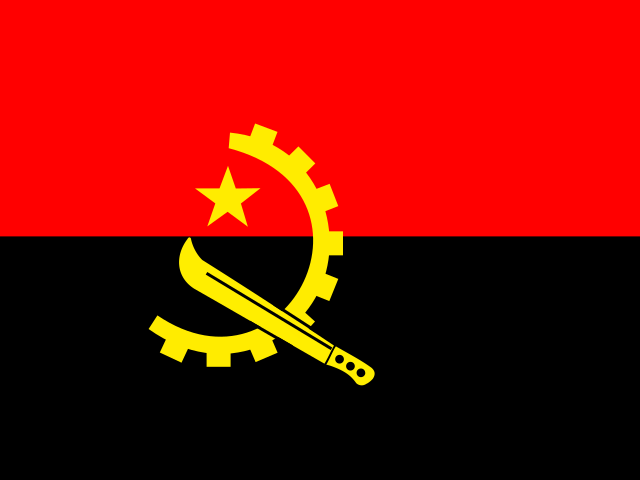 Angola
 Cameroon
 Central African Republic
 Chad
Chad Congo
Congo Democratic Republic of the Congo
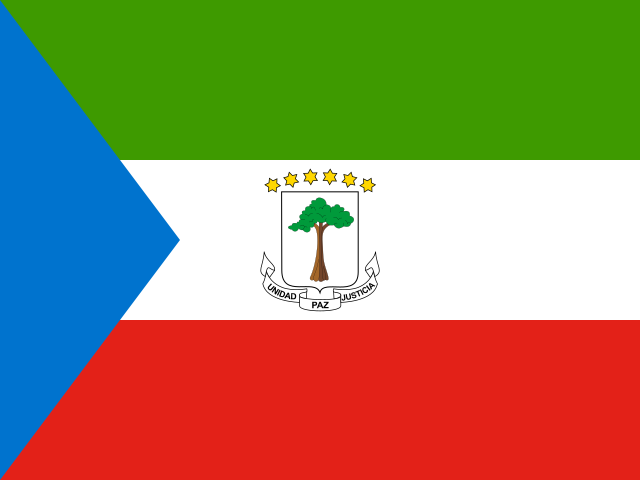 Equatorial Guinea
 Gabon
Gabon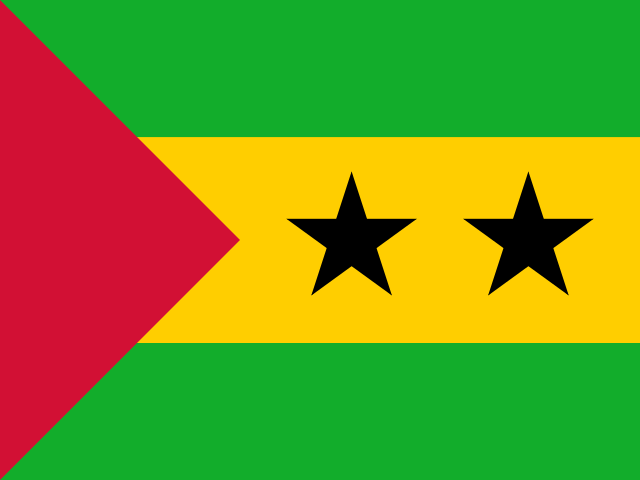 Sao Tome and Principe
Earlier Report Observations
The tea market in Middle Africa, measured by volume, decreased from 8 598 t in 2018 to 7 088 t in 2023. This overall decline was not linear, with a sharp drop in 2020 to 6 791 t, followed by a recovery in 2021 and 2022, before falling again in 2023.
Domestic production of tea increased steadily from 5 340 t in 2018 to 5 949 t in 2022, then dipped to 5 680 t in 2023. Meanwhile, imports fell significantly from 3 289 t in 2018 to 1 415 t in 2023, which contributed to the reduction in total market volume despite higher local output.
The market contraction was most pronounced between 2018 and 2020, when volume shrank by over 1 800 t. Although partial rebounds occurred, the market remained below its 2018 level throughout the period.
Table of content
- 1. Disclaimer
- 2. Terms of use of the report
- 3. Product codes in the statistical classifications used in the report
-
4. Key Market Indicators and Trends
-
4.1. Key Market Indicators
-
4.1.1. In kind
- 4.1.1.1. Production, 2018-2023
- 4.1.1.2. Imports, 2018-2024
- 4.1.1.3. Exports, 2018-2024
- 4.1.1.4. Market size, 2018-2023
-
4.1.1. In kind
- 4.2. Market Trends and Factors
-
4.1. Key Market Indicators
-
5. Production
-
5.1. Production in Middle Africa
- 5.1.1. Annual dynamics of production in Middle Africa in kind, 2018-2023, t
-
5.2. Global production by Country, 2018-2023
- 5.2.1. Annual dynamics of production by macroregions in kind, 2018-2023, t
- 5.2.2. Dynamics of production structure by macroregions in kind, 2018-2023
- 5.2.3. Annual dynamics of production by country in kind, 2018-2023, t
- 5.2.4. Structure of production by countries in kind, 2018-2023
- 5.2.5. Dynamics of peoduction structure by countries in kind, 2018-2023
-
5.1. Production in Middle Africa
-
6. Imports
-
6.1. Imports (Direct Data*)
- 6.1.1. Imports - Total information
-
6.1.2. Imports in kind, t
- 6.1.2.1. Annual dynamics of product's imports to Angola in kind, 2018-2024, t
- 6.1.2.2. Dynamics of product's imports in kind to Angola by countries, 2018-2024, t
- 6.1.2.3. Structure of product's imports in kind by countries, 2018-2024
-
6.1.3. Imports in value, K $ US
- 6.1.3.1. Annual dynamics of product's imports to Angola in value, 2018-2024, K $ US
- 6.1.3.2. Dynamics of product's imports in value to Angola by countries, 2018-2024, K $ US
- 6.1.3.3. Structure of product's imports in value by countries, 2018-2024
-
6.1.4. Average price of product's imports, $ US/kg
- 6.1.4.1. Annual dynamics of average price of product's imports to Angola, 2018-2024, $ US/kg
- 6.1.4.2. Dynamics of average price of product's imports to Angola by countries, 2018-2024, $ US/kg
-
6.2. Imports (Mirror Data)
- 6.2.1. Imports - Total information
-
6.2.2. Imports in kind, t
- 6.2.2.1. Annual dynamics of product's imports to Angola in kind, 2018-2024, t
- 6.2.2.2. Dynamics of product's imports in kind to Angola by countries, 2018-2024, t
- 6.2.2.3. Structure of product's imports in kind by countries, 2018-2024
-
6.2.3. Imports in value, K $ US
- 6.2.3.1. Annual dynamics of product's imports to Angola in value, 2018-2024, K $ US
- 6.2.3.2. Dynamics of product's imports in value to Angola by countries, 2018-2024, K $ US
- 6.2.3.3. Structure of product's imports in value by countries, 2018-2024
-
6.2.4. Average price of product's imports, $ US/kg
- 6.2.4.1. Annual dynamics of average price of product's imports to Angola, 2018-2024, $ US/kg
- 6.2.4.2. Dynamics of average price of product's imports to Angola by countries, 2018-2024, $ US/kg
-
6.1. Imports (Direct Data*)
-
7. Exports
-
7.1. Exports (Direct Data*)
- 7.1.1. Exports - Total information
-
7.1.2. Exports in kind, t
- 7.1.2.1. Annual dynamics of product's exports from Angola in kind, 2018-2024, t
- 7.1.2.2. Dynamics of product's exports in kind from Angola by countries, 2018-2024, t
- 7.1.2.3. Structure of product's exports in kind by countries, 2018-2024
-
7.1.3. Exports in value, K $ US
- 7.1.3.1. Annual dynamics of product's exports from Angola in value, 2018-2024, K $ US
- 7.1.3.2. Dynamics of product's exports in value from Angola by countries, 2018-2024, K $ US
- 7.1.3.3. Structure of product's exports in value by countries, 2018-2024
-
7.1.4. Average price of product's exports, $ US/kg
- 7.1.4.1. Annual dynamics of average price of product's exports from Angola, 2018-2024, $ US/kg
- 7.1.4.2. Dynamics of average price of product's exports from Angola by countries, 2018-2024, $ US/kg
-
7.2. Exports (Mirror Data)
- 7.2.1. Exports - Total information
-
7.2.2. Exports in kind, t
- 7.2.2.1. Annual dynamics of product's exports from Angola in kind, 2018-2024, t
- 7.2.2.2. Dynamics of product's exports in kind from Angola by countries, 2018-2024, t
- 7.2.2.3. Structure of product's exports in kind by countries, 2018-2024
-
7.2.3. Exports in value, K $ US
- 7.2.3.1. Annual dynamics of product's exports from Angola in value, 2018-2024, K $ US
- 7.2.3.2. Dynamics of product's exports in value from Angola by countries, 2018-2024, K $ US
- 7.2.3.3. Structure of product's exports in value by countries, 2018-2024
-
7.2.4. Average price of product's exports, $ US/kg
- 7.2.4.1. Annual dynamics of average price of product's exports from Angola, 2018-2024, $ US/kg
- 7.2.4.2. Dynamics of average price of product's exports from Angola by countries, 2018-2024, $ US/kg
-
7.1. Exports (Direct Data*)
-
8. Trade balance
-
8.1. Trade balance (Direct Data)
- 8.1.1. In kind, t
- 8.1.2. In value, K $ US
-
8.2. Trade balance (Mirror Data)
- 8.2.1. In kind, t
- 8.2.2. In value, K $ US
-
8.1. Trade balance (Direct Data)
-
9. Top buying and selling countries, 2018-2024
-
9.1. Direct Data
- 9.1.1. Import in Value by Countries-buyers
- 9.1.2. Export in Value by Countries-suppliers
-
9.2. Mirror Data
- 9.2.1. Import in Value by Countries-buyers
- 9.2.2. Export in Value by Countries-suppliers
-
9.1. Direct Data
Production tea in packings ≤3 kg in Middle Africa
In kind, 2017-2020, t
Top producers of tea in packings ≤3 kg, 2017-2020
World map of production of tea in packings ≤3 kg, 2017-2020
Middle Africa's production of tea in packings of 3 kg or less has increased for the third year in a row. In 2020, the region produced 5 471 tonnes of this tea, marking a slight rise of 1.5% compared to 2019. Looking at the period from 2017 to 2020, overall production grew by 3.8%, which translates to an average annual increase of 1.3%.
Annual dynamics of production in Middle Africa in kind, 2017-2020, t
| Parameter | 2018 | 2019 | 2020 | CAGR | |
|---|---|---|---|---|---|
| 1 | Change from last year | 1.3% | 0.9% | 1.5% | 1.3% |
Exports tea in packings ≤3 kg from Middle Africa
Exports in kind, t
Exports of tea in packings of 3 kg or less from Middle Africa have fallen for the third consecutive year. In 2020, exports amounted to just 1 tonne, representing a sharp decline of 58.1% from the previous year. Over the 2017-2020 period, exports plummeted by 99.9%, with an average annual decrease of 89.6%.
Annual dynamics of product's exports from Middle Africa in kind, 2017-2020, t
| Parameter | 2018 | 2019 | 2020 | CAGR | |
|---|---|---|---|---|---|
| 1 | Change from last year | (94.5%) | (95.2%) | (58.1%) | (89.6%) |
From 2017 to 2020, the United Arab Emirates, Kenya, and Uganda were the primary destinations for Middle Africa's tea exports in packings of 3 kg or less. The UAE accounted for 66.5% of exports in kind, Kenya for 12.4%, and Uganda for 3.0%, together making up 81.9% of the total export volume.
Structure of product's exports in kind by countries, 2017-2020
World map of product's exports from Middle Africa in kind, 2017-2020
Exports in value, K $ US
The market exhibited volatility during the observed period. The lowest value was recorded in 2019 at 11 thousand US dollars, while the highest occurred in 2017, resulting in a peak-to-trough ratio of 64 times. In 2020, exports of tea in packings of 3 kg or less from Middle Africa reached 11 thousand US dollars, showing a modest increase of 1.3% compared to 2019. The largest decline was in 2019, at 91.5%.
Annual dynamics of product's exports from Middle Africa in value, 2017-2020, K $ US
| Parameter | 2018 | 2019 | 2020 | CAGR | |
|---|---|---|---|---|---|
| 1 | Change from last year | (81.5%) | (91.5%) | 1.3% | (74.8%) |
Between 2017 and 2020, the United Arab Emirates, Kenya, and Uganda remained the leading destinations in terms of export value for Middle Africa's tea in packings of 3 kg or less. The UAE contributed 30.6% of exports in value terms, Kenya 4.9%, and Uganda 1.5%, collectively accounting for 37.1% of total export flows.
Structure of product's exports in value by countries, 2017-2020
World map of product's exports from Middle Africa in value, 2017-2020
Imports tea in packings ≤3 kg to Middle Africa
Imports in kind, t
Market performance showed noticeable fluctuations over the period. The maximum volume was recorded in 2018 at 3 289 tonnes, while the minimum was in 2020, representing a 2.5-fold difference. In 2020, Middle Africa imported 1 320 tonnes of tea in packings of 3 kg or less, reflecting a sharp drop of 46.5% from 2019. The largest increase was in 2018, at 71.3%.
Annual dynamics of product's imports to Middle Africa in kind, 2017-2020, t
| Parameter | 2018 | 2019 | 2020 | CAGR | |
|---|---|---|---|---|---|
| 1 | Change from last year | 71.3% | (25.0%) | (46.5%) | (11.7%) |
From 2017 to 2020, Sri Lanka, India, and China were the main sources of tea imports in packings of 3 kg or less to Middle Africa. Sri Lanka accounted for 43.0% of imports in kind, India for 15.8%, and China for 10.4%, together comprising 69.1% of total import volumes.
Structure of product's imports in kind by countries, 2017-2020
World map of product's imports to Middle Africa in kind, 2017-2020
Imports in value, K $ US
Imports of tea in packings of 3 kg or less into Middle Africa declined for the second year in a row. In 2020, imports totaled approximately 3 952 thousand US dollars, down by 50.6% compared to 2019. Over the 2017-2020 period, imports decreased by 49.7%, with an average annual decline of 20.5%. The maximum value was recorded in 2018 at 8 062 thousand US dollars, while the largest increase was in 2018 at 2.6%.
Annual dynamics of product's imports to Middle Africa in value, 2017-2020, K $ US
| Parameter | 2018 | 2019 | 2020 | CAGR | |
|---|---|---|---|---|---|
| 1 | Change from last year | 2.6% | (0.7%) | (50.6%) | (20.5%) |
During 2017-2020, Sri Lanka, Portugal, and the United Arab Emirates continued to be the primary suppliers of tea in packings of 3 kg or less to Middle Africa in value terms. Sri Lanka made up 56.6% of imports in value terms, Portugal 11.0%, and the UAE 6.8%, jointly forming 74.4% of total import value.
Structure of product's imports in value by countries, 2017-2020
World map of product's imports to Middle Africa in value, 2017-2020
Related Reports

Tea in packings ≤3 kg market in Nepal
2026-03-30
Tea in packings ≤3 kg market in Rwanda
2026-03-30
Tea in packings ≤3 kg market in Brazil
2026-03-30

Pepper market in Middle Africa
2026-03-28



2026-03-28
Why Choose Us?
Only Verified Data
No Hidden Costs or Separate Fees
Smarter Subscription Pricing
Contact Our Team
Submit your inquiry using the form below — our team will get back to you within 24 hours.