






"Middle Africa" region includes following countries:
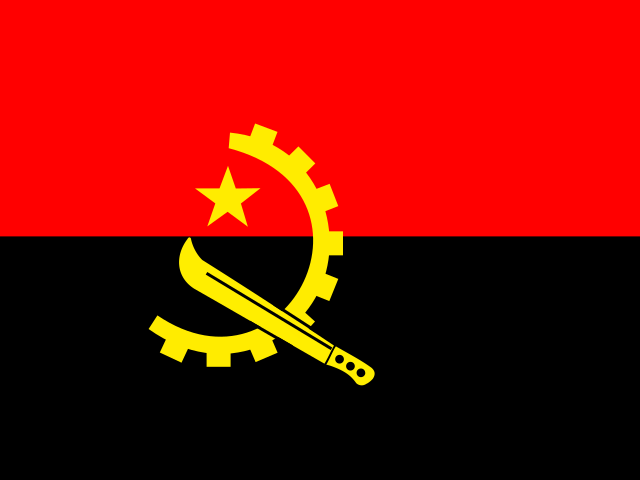 Angola
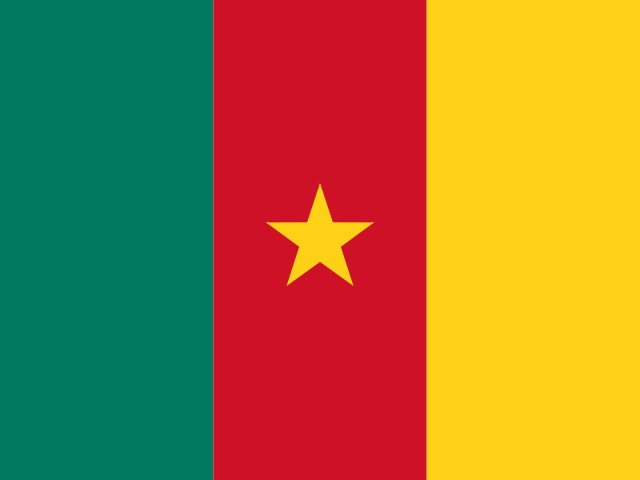 Cameroon
 Central African Republic
 Chad
Chad Congo
Congo Democratic Republic of the Congo
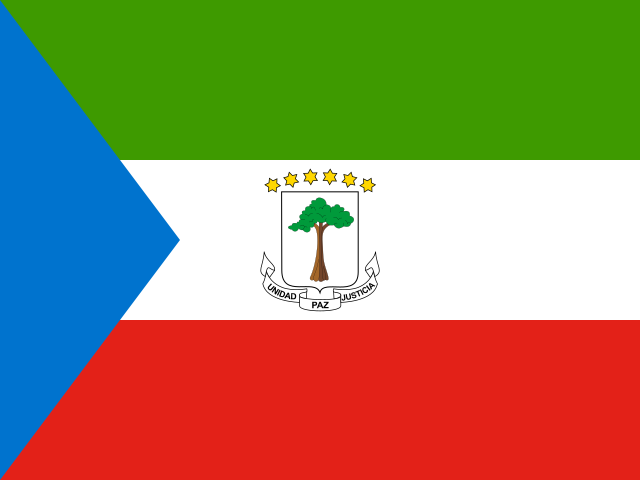 Equatorial Guinea
 Gabon
Gabon Sao Tome and Principe
Earlier Report Observations
The tea market in Middle Africa saw modest growth in 2018 and 2019, with volume reaching 31 200 metric tons. This was supported by the rising consumption of tea across the continent and efficient auction systems in key producing nations like Kenya, although local production in some areas faced funding shortages and political instability that kept capacity utilization low.
Market volume contracted in 2020 to 29 746 metric tons but rebounded in 2021 to 30 712 metric tons, coinciding with the development of the specialty tea segment and increasing urbanization, which boosted demand for premium products. During this period, consumer preferences also shifted toward healthier and organic options.
From 2022 onward, the market declined steadily, falling to 28 960 metric tons by 2023. This trend was exacerbated by severe droughts in East Africa, which reduced the availability of imported tea from major suppliers like Kenya, while a growing emphasis on sustainability and plastic-free packaging further influenced supply and demand dynamics.
Table of content
- 1. Disclaimer
- 2. Terms of use of the report
- 3. Product codes in the statistical classifications used in the report
-
4. Key Market Indicators and Trends
-
4.1. Key Market Indicators
-
4.1.1. In kind
- 4.1.1.1. Production, 2018-2023
- 4.1.1.2. Imports, 2018-2024
- 4.1.1.3. Exports, 2018-2024
- 4.1.1.4. Market size, 2018-2023
-
4.1.1. In kind
- 4.2. Market Trends and Factors
-
4.1. Key Market Indicators
-
5. Production
-
5.1. Production in Middle Africa
- 5.1.1. Annual dynamics of production in Middle Africa in kind, 2018-2023, t
-
5.2. Global production by Country, 2018-2023
- 5.2.1. Annual dynamics of production by macroregions in kind, 2018-2023, t
- 5.2.2. Dynamics of production structure by macroregions in kind, 2018-2023
- 5.2.3. Annual dynamics of production by country in kind, 2018-2023, t
- 5.2.4. Structure of production by countries in kind, 2018-2023
- 5.2.5. Dynamics of peoduction structure by countries in kind, 2018-2023
-
5.1. Production in Middle Africa
-
6. Imports
-
6.1. Imports (Direct Data*)
- 6.1.1. Imports - Total information
-
6.1.2. Imports in kind, t
- 6.1.2.1. Annual dynamics of product's imports to Angola in kind, 2018-2024, t
- 6.1.2.2. Dynamics of product's imports in kind to Angola by countries, 2018-2024, t
- 6.1.2.3. Structure of product's imports in kind by countries, 2018-2024
-
6.1.3. Imports in value, K $ US
- 6.1.3.1. Annual dynamics of product's imports to Angola in value, 2018-2024, K $ US
- 6.1.3.2. Dynamics of product's imports in value to Angola by countries, 2018-2024, K $ US
- 6.1.3.3. Structure of product's imports in value by countries, 2018-2024
-
6.1.4. Average price of product's imports, $ US/t
- 6.1.4.1. Annual dynamics of average price of product's imports to Angola, 2018-2024, $ US/t
- 6.1.4.2. Dynamics of average price of product's imports to Angola by countries, 2018-2024, $ US/t
-
6.2. Imports (Mirror Data)
- 6.2.1. Imports - Total information
-
6.2.2. Imports in kind, t
- 6.2.2.1. Annual dynamics of product's imports to Angola in kind, 2018-2024, t
- 6.2.2.2. Dynamics of product's imports in kind to Angola by countries, 2018-2024, t
- 6.2.2.3. Structure of product's imports in kind by countries, 2018-2024
-
6.2.3. Imports in value, K $ US
- 6.2.3.1. Annual dynamics of product's imports to Angola in value, 2018-2024, K $ US
- 6.2.3.2. Dynamics of product's imports in value to Angola by countries, 2018-2024, K $ US
- 6.2.3.3. Structure of product's imports in value by countries, 2018-2024
-
6.2.4. Average price of product's imports, $ US/t
- 6.2.4.1. Annual dynamics of average price of product's imports to Angola, 2018-2024, $ US/t
- 6.2.4.2. Dynamics of average price of product's imports to Angola by countries, 2018-2024, $ US/t
-
6.1. Imports (Direct Data*)
-
7. Exports
-
7.1. Exports (Direct Data*)
- 7.1.1. Exports - Total information
-
7.1.2. Exports in kind, t
- 7.1.2.1. Annual dynamics of product's exports from Angola in kind, 2018-2024, t
- 7.1.2.2. Dynamics of product's exports in kind from Angola by countries, 2018-2024, t
- 7.1.2.3. Structure of product's exports in kind by countries, 2018-2024
-
7.1.3. Exports in value, K $ US
- 7.1.3.1. Annual dynamics of product's exports from Angola in value, 2018-2024, K $ US
- 7.1.3.2. Dynamics of product's exports in value from Angola by countries, 2018-2024, K $ US
- 7.1.3.3. Structure of product's exports in value by countries, 2018-2024
-
7.1.4. Average price of product's exports, $ US/t
- 7.1.4.1. Annual dynamics of average price of product's exports from Angola, 2018-2024, $ US/t
- 7.1.4.2. Dynamics of average price of product's exports from Angola by countries, 2018-2024, $ US/t
-
7.2. Exports (Mirror Data)
- 7.2.1. Exports - Total information
-
7.2.2. Exports in kind, t
- 7.2.2.1. Annual dynamics of product's exports from Angola in kind, 2018-2024, t
- 7.2.2.2. Dynamics of product's exports in kind from Angola by countries, 2018-2024, t
- 7.2.2.3. Structure of product's exports in kind by countries, 2018-2024
-
7.2.3. Exports in value, K $ US
- 7.2.3.1. Annual dynamics of product's exports from Angola in value, 2018-2024, K $ US
- 7.2.3.2. Dynamics of product's exports in value from Angola by countries, 2018-2024, K $ US
- 7.2.3.3. Structure of product's exports in value by countries, 2018-2024
-
7.2.4. Average price of product's exports, $ US/t
- 7.2.4.1. Annual dynamics of average price of product's exports from Angola, 2018-2024, $ US/t
- 7.2.4.2. Dynamics of average price of product's exports from Angola by countries, 2018-2024, $ US/t
-
7.1. Exports (Direct Data*)
-
8. Trade balance
-
8.1. Trade balance (Direct Data)
- 8.1.1. In kind, t
- 8.1.2. In value, K $ US
-
8.2. Trade balance (Mirror Data)
- 8.2.1. In kind, t
- 8.2.2. In value, K $ US
-
8.1. Trade balance (Direct Data)
-
9. Top buying and selling countries, 2018-2024
-
9.1. Direct Data
- 9.1.1. Import in Value by Countries-buyers
- 9.1.2. Export in Value by Countries-suppliers
-
9.2. Mirror Data
- 9.2.1. Import in Value by Countries-buyers
- 9.2.2. Export in Value by Countries-suppliers
-
9.1. Direct Data
Production tea in Middle Africa
In kind, 2017-2020, t
Top producers of tea, 2017-2020
World map of production of tea, 2017-2020
Tea production in Middle Africa has grown for the third year in a row. In 2020, the region produced 27 864 tonnes of tea, marking a slight increase of 0.8% compared to 2019. Looking at the period from 2017 to 2020, production rose by 17.3%, with an average annual growth rate of 5.5%.
Annual dynamics of production in Middle Africa in kind, 2017-2020, t
| Parameter | 2018 | 2019 | 2020 | CAGR | |
|---|---|---|---|---|---|
| 1 | Change from last year | 15.0% | 1.2% | 0.8% | 5.5% |
Exports tea from Middle Africa
Exports in kind, t
Tea exports from Middle Africa have fallen for the third consecutive year. In 2020, export volume totaled just 3 tonnes, which represents a sharp decline of 45.0% from 2019. Between 2017 and 2020, exports plummeted by 99.6%, translating to an annualized decrease of 83.8%.
Annual dynamics of product's exports from Middle Africa in kind, 2017-2020, t
| Parameter | 2018 | 2019 | 2020 | CAGR | |
|---|---|---|---|---|---|
| 1 | Change from last year | (43.9%) | (98.6%) | (45.0%) | (83.8%) |
From 2017 to 2020, the main destinations for Middle Africa's tea exports were the United Arab Emirates, accounting for 38.3% of export volume, Uganda with 21.2%, and Kenya at 10.2%. Together, these three markets made up 69.7% of total export flows.
Structure of product's exports in kind by countries, 2017-2020
World map of product's exports from Middle Africa in kind, 2017-2020
Exports in value, K $ US
The data shows irregular fluctuations, pointing to a volatile market environment. The highest export value was recorded in 2017, while the lowest occurred in 2019, with a peak-to-trough ratio of 48 times. In 2020, Middle Africa exported tea worth 35 000 US dollars, a sudden jump of 58.7% from 2019. The minimum value was 22 000 US dollars in 2019, and the largest decline of 93.4% also took place that year.
Annual dynamics of product's exports from Middle Africa in value, 2017-2020, K $ US
| Parameter | 2018 | 2019 | 2020 | CAGR | |
|---|---|---|---|---|---|
| 1 | Change from last year | (68.4%) | (93.4%) | 58.7% | (67.9%) |
Between 2017 and 2020, the partner portfolio for tea exports in value terms from Middle Africa was quite diverse. The United Arab Emirates contributed 21.0% of export value, Kenya 5.5%, and Uganda 3.3%, but together they represented only 29.9% of total flows.
Structure of product's exports in value by countries, 2017-2020
World map of product's exports from Middle Africa in value, 2017-2020
Imports tea to Middle Africa
Imports in kind, t
Tea imports into Middle Africa have decreased for the second year in a row. In 2020, imports stood at 1 885 tonnes, down by 46.9% compared to 2019. Over the period from 2017 to 2020, imports fell by 27.7%, with an annualized rate of decline of 10.3%. The peak import volume was 4 144 tonnes in 2018, which also saw the largest increase of 58.9%.
Annual dynamics of product's imports to Middle Africa in kind, 2017-2020, t
| Parameter | 2018 | 2019 | 2020 | CAGR | |
|---|---|---|---|---|---|
| 1 | Change from last year | 58.9% | (14.3%) | (46.9%) | (10.3%) |
From 2017 to 2020, the primary suppliers of tea to Middle Africa were Sri Lanka, providing 33.9% of import volume, India with 18.0%, and China at 11.9%. Combined, these three countries accounted for 63.7% of total imports in kind.
Structure of product's imports in kind by countries, 2017-2020
World map of product's imports to Middle Africa in kind, 2017-2020
Imports in value, K $ US
In 2020, Middle Africa imported tea worth 4 935 000 US dollars, reflecting a decrease of 52.5% from the previous year. Over the 2017-2020 period, imports dropped by 51%, with a compound annual growth rate of -21.2%. The maximum value was recorded in 2019 at 10 400 000 US dollars, which also experienced the largest increase of 4.3%.
Annual dynamics of product's imports to Middle Africa in value, 2017-2020, K $ US
| Parameter | 2018 | 2019 | 2020 | CAGR | |
|---|---|---|---|---|---|
| 1 | Change from last year | (1.1%) | 4.3% | (52.5%) | (21.2%) |
Between 2017 and 2020, the main suppliers of tea to Middle Africa in value terms were Sri Lanka, accounting for 48.9% of import value, Portugal with 14.8%, and India at 8.9%. Together, these three countries comprised 72.6% of total imports in value terms.
Structure of product's imports in value by countries, 2017-2020
World map of product's imports to Middle Africa in value, 2017-2020
Related Reports

2026-03-28
2026-03-28
2026-03-28



Ginger market in Middle Africa
2026-03-28

Pepper market in Middle Africa
2026-03-28
Why Choose Us?
Only Verified Data
No Hidden Costs or Separate Fees
Smarter Subscription Pricing
Contact Our Team
Submit your inquiry using the form below — our team will get back to you within 24 hours.