






"Middle Africa" region includes following countries:
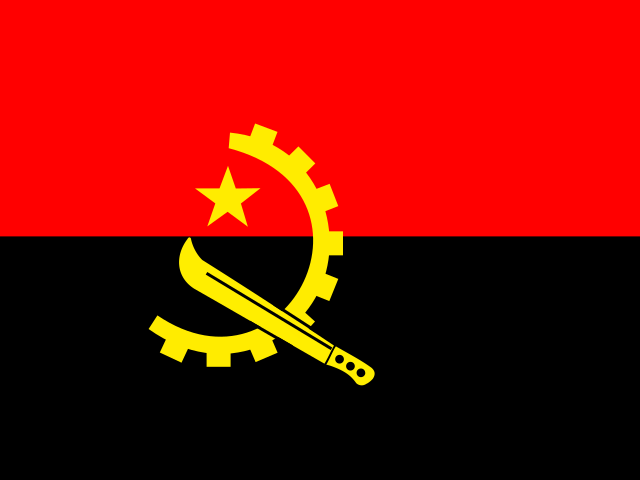 Angola
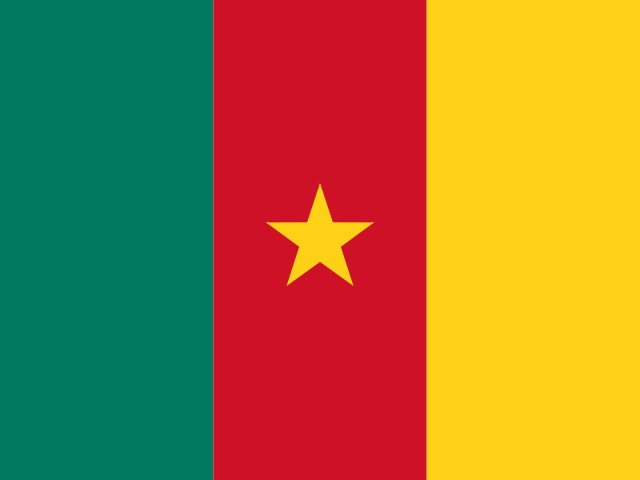 Cameroon
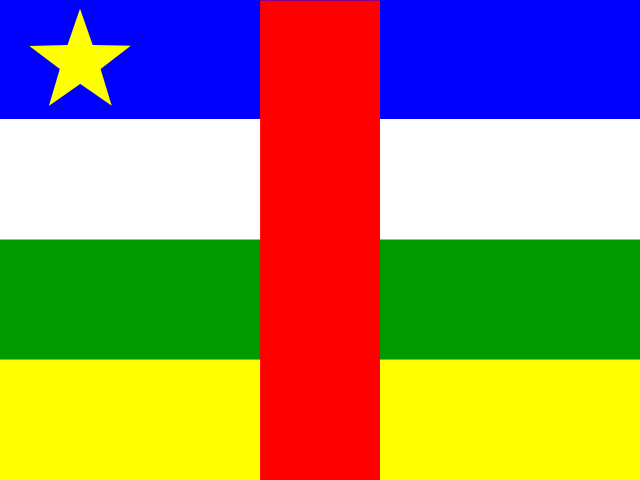 Central African Republic
 Chad
Chad Congo
Congo Democratic Republic of the Congo
 Equatorial Guinea
 Gabon
Gabon Sao Tome and Principe
Earlier Report Observations
From 2018 to 2020, coffee production in Middle Africa jumped from 203 thousand tons to 398 thousand tons, while the market volume expanded from 173 thousand tons to 364 thousand tons. This rapid growth was enabled by the promotion of hybrid coffee varieties for higher yields and the 'New Generation' program that trained 230 young farmers and established 234 hectares of new coffee plantations, directly boosting productivity and cultivated area.
After 2020, production continued to rise, reaching 423 thousand tons in 2023, with the market volume growing to 402 thousand tons. The 2022-2023 coffee cultivation campaign, led jointly by the Ministry of Trade and the Ministry of Agriculture, provided additional government support. In 2023, an international scientific conference on cocoa and coffee in Yaoundé and participation in the G25 Coffee Summit helped the sector adapt to climate challenges and promote domestic consumption, sustaining production growth.
Table of content
- 1. Disclaimer
- 2. Terms of use of the report
- 3. Product codes in the statistical classifications used in the report
-
4. Key Market Indicators and Trends
-
4.1. Key Market Indicators
-
4.1.1. In kind
- 4.1.1.1. Production, 2018-2023
- 4.1.1.2. Imports, 2018-2024
- 4.1.1.3. Exports, 2018-2024
- 4.1.1.4. Market size, 2018-2023
-
4.1.1. In kind
- 4.2. Market Trends and Factors
-
4.1. Key Market Indicators
-
5. Production
-
5.1. Production in Middle Africa
- 5.1.1. Annual dynamics of production in Middle Africa in kind, 2018-2023, K t
-
5.2. Global production by Country, 2018-2023
- 5.2.1. Annual dynamics of production by macroregions in kind, 2018-2023, K t
- 5.2.2. Dynamics of production structure by macroregions in kind, 2018-2023
- 5.2.3. Annual dynamics of production by country in kind, 2018-2023, K t
- 5.2.4. Structure of production by countries in kind, 2018-2023
- 5.2.5. Dynamics of peoduction structure by countries in kind, 2018-2023
-
5.1. Production in Middle Africa
-
6. Imports
-
6.1. Imports (Direct Data*)
- 6.1.1. Imports - Total information
-
6.1.2. Imports in kind, t
- 6.1.2.1. Annual dynamics of product's imports to Angola in kind, 2018-2024, t
- 6.1.2.2. Dynamics of product's imports in kind to Angola by countries, 2018-2024, t
- 6.1.2.3. Structure of product's imports in kind by countries, 2018-2024
-
6.1.3. Imports in value, M $ US
- 6.1.3.1. Annual dynamics of product's imports to Angola in value, 2018-2024, M $ US
- 6.1.3.2. Dynamics of product's imports in value to Angola by countries, 2018-2024, M $ US
- 6.1.3.3. Structure of product's imports in value by countries, 2018-2024
-
6.1.4. Average price of product's imports, $ US/t
- 6.1.4.1. Annual dynamics of average price of product's imports to Angola, 2018-2024, $ US/t
- 6.1.4.2. Dynamics of average price of product's imports to Angola by countries, 2018-2024, $ US/t
-
6.2. Imports (Mirror Data)
- 6.2.1. Imports - Total information
-
6.2.2. Imports in kind, t
- 6.2.2.1. Annual dynamics of product's imports to Angola in kind, 2018-2024, t
- 6.2.2.2. Dynamics of product's imports in kind to Angola by countries, 2018-2024, t
- 6.2.2.3. Structure of product's imports in kind by countries, 2018-2024
-
6.2.3. Imports in value, M $ US
- 6.2.3.1. Annual dynamics of product's imports to Angola in value, 2018-2024, M $ US
- 6.2.3.2. Dynamics of product's imports in value to Angola by countries, 2018-2024, M $ US
- 6.2.3.3. Structure of product's imports in value by countries, 2018-2024
-
6.2.4. Average price of product's imports, $ US/t
- 6.2.4.1. Annual dynamics of average price of product's imports to Angola, 2018-2024, $ US/t
- 6.2.4.2. Dynamics of average price of product's imports to Angola by countries, 2018-2024, $ US/t
-
6.1. Imports (Direct Data*)
-
7. Exports
-
7.1. Exports (Direct Data*)
- 7.1.1. Exports - Total information
-
7.1.2. Exports in kind, t
- 7.1.2.1. Annual dynamics of product's exports from Angola in kind, 2018-2024, t
- 7.1.2.2. Dynamics of product's exports in kind from Angola by countries, 2018-2024, t
- 7.1.2.3. Structure of product's exports in kind by countries, 2018-2024
-
7.1.3. Exports in value, M $ US
- 7.1.3.1. Annual dynamics of product's exports from Angola in value, 2018-2024, M $ US
- 7.1.3.2. Dynamics of product's exports in value from Angola by countries, 2018-2024, M $ US
- 7.1.3.3. Structure of product's exports in value by countries, 2018-2024
-
7.1.4. Average price of product's exports, $ US/t
- 7.1.4.1. Annual dynamics of average price of product's exports from Angola, 2018-2024, $ US/t
- 7.1.4.2. Dynamics of average price of product's exports from Angola by countries, 2018-2024, $ US/t
-
7.2. Exports (Mirror Data)
- 7.2.1. Exports - Total information
-
7.2.2. Exports in kind, t
- 7.2.2.1. Annual dynamics of product's exports from Angola in kind, 2018-2024, t
- 7.2.2.2. Dynamics of product's exports in kind from Angola by countries, 2018-2024, t
- 7.2.2.3. Structure of product's exports in kind by countries, 2018-2024
-
7.2.3. Exports in value, M $ US
- 7.2.3.1. Annual dynamics of product's exports from Angola in value, 2018-2024, M $ US
- 7.2.3.2. Dynamics of product's exports in value from Angola by countries, 2018-2024, M $ US
- 7.2.3.3. Structure of product's exports in value by countries, 2018-2024
-
7.2.4. Average price of product's exports, $ US/t
- 7.2.4.1. Annual dynamics of average price of product's exports from Angola, 2018-2024, $ US/t
- 7.2.4.2. Dynamics of average price of product's exports from Angola by countries, 2018-2024, $ US/t
-
7.1. Exports (Direct Data*)
-
8. Trade balance
-
8.1. Trade balance (Direct Data)
- 8.1.1. In kind, t
- 8.1.2. In value, M $ US
-
8.2. Trade balance (Mirror Data)
- 8.2.1. In kind, t
- 8.2.2. In value, M $ US
-
8.1. Trade balance (Direct Data)
-
9. Top buying and selling countries, 2018-2024
-
9.1. Direct Data
- 9.1.1. Import in Value by Countries-buyers
- 9.1.2. Export in Value by Countries-suppliers
-
9.2. Mirror Data
- 9.2.1. Import in Value by Countries-buyers
- 9.2.2. Export in Value by Countries-suppliers
-
9.1. Direct Data
Production coffee, husks, skins and substitutes in Middle Africa
In kind, 2017-2020, K t
Top producers of coffee, husks, skins and substitutes, 2017-2020
World map of production of coffee, husks, skins and substitutes, 2017-2020
Middle Africa's production of coffee, husks, skins, and substitutes has grown for the third year in a row. In 2020, the region produced 398.0 K t, marking a significant 25.4% increase from 2019. From 2017 to 2020, production surged by 251.7%, which translates to an average annual growth rate of 52.1%.
Annual dynamics of production in Middle Africa in kind, 2017-2020, K t
| Parameter | 2018 | 2019 | 2020 | CAGR | |
|---|---|---|---|---|---|
| 1 | Change from last year | 79.6% | 56.1% | 25.4% | 52.1% |
In value, 2017-2020, M $ US
The value of coffee, husks, skins, and substitutes production in Middle Africa has risen for the third consecutive year. In 2020, output was valued at 527.9 M $ US, up 26.1% year-on-year. Between 2017 and 2020, production value increased by 200.4%, averaging a 44.3% annual growth rate.
Annual dynamics of production in Middle Africa in value, 2017-2020, M $ US
| Parameter | 2018 | 2019 | 2020 | CAGR | |
|---|---|---|---|---|---|
| 1 | Change from last year | 90.0% | 25.3% | 26.1% | 44.3% |
Exports coffee, husks, skins and substitutes from Middle Africa
Exports in kind, t
After two years of decline, Middle Africa's exports of coffee, husks, skins, and substitutes rebounded in volume. In 2020, exports reached 35 116 t, a strong 11.3% increase from 2019. However, from 2017 to 2020, overall exports fell by 11.9%, with an average annual decline of 4.1%. The lowest volume was recorded in 2019 at 31 552 t, and the largest drop occurred in 2018 with an 18.7% decrease.
Annual dynamics of product's exports from Middle Africa in kind, 2017-2020, t
| Parameter | 2018 | 2019 | 2020 | CAGR | |
|---|---|---|---|---|---|
| 1 | Change from last year | (18.7%) | (2.6%) | 11.3% | (4.1%) |
Between 2017 and 2020, Middle Africa exported coffee, husks, skins, and substitutes to a diverse range of markets. Belgium accounted for 20.7% of exports in kind, Italy for 11.8%, and Algeria for 11.4%, together making up 43.9% of total exports. The remaining 56.1% was distributed among numerous smaller destinations.
Structure of product's exports in kind by countries, 2017-2020
World map of product's exports from Middle Africa in kind, 2017-2020
Exports in value, K $ US
Following a two-year decrease, Middle Africa's exports of coffee, husks, skins, and substitutes in value terms saw an uptick. In 2020, exports totaled 46 584 K $ US, an 11.9% rise from the previous year. Over the 2017-2020 period, export value declined by 24.8%, averaging a 9.1% annual decrease. The lowest value was in 2019 at 41 628 K $ US, with the steepest drop that year at 21.8%.
Annual dynamics of product's exports from Middle Africa in value, 2017-2020, K $ US
| Parameter | 2018 | 2019 | 2020 | CAGR | |
|---|---|---|---|---|---|
| 1 | Change from last year | (14.1%) | (21.8%) | 11.9% | (9.1%) |
From 2017 to 2020, Middle Africa's exports of coffee, husks, skins, and substitutes in value terms were spread across many partner countries. Belgium held 20.2% of exports in value, France 12.1%, and Italy 11.4%, collectively representing 43.7% of total flows.
Structure of product's exports in value by countries, 2017-2020
World map of product's exports from Middle Africa in value, 2017-2020
Imports coffee, husks, skins and substitutes to Middle Africa
Imports in kind, t
Middle Africa's imports of coffee, husks, skins, and substitutes in volume have fallen for the third year in a row. In 2020, imports stood at 797 t, a sharp 55.0% decrease from 2019. From 2017 to 2020, import volume dropped by 75.7%, with a compound annual growth rate of -37.6%.
Annual dynamics of product's imports to Middle Africa in kind, 2017-2020, t
| Parameter | 2018 | 2019 | 2020 | CAGR | |
|---|---|---|---|---|---|
| 1 | Change from last year | (40.0%) | (9.8%) | (55.0%) | (37.6%) |
During 2017-2020, three key markets—Portugal, South Korea, and Brazil—collectively supplied 63.8% of Middle Africa's total imports in kind of coffee, husks, skins, and substitutes.
Structure of product's imports in kind by countries, 2017-2020
World map of product's imports to Middle Africa in kind, 2017-2020
Imports in value, K $ US
Middle Africa's imports of coffee, husks, skins, and substitutes in value terms declined for the second consecutive year. In 2020, imports amounted to 4 488 K $ US, down 34.4% from the previous year. Over the 2017-2020 period, import value decreased by 39.8%, with an average annual decline of 15.5%. The peak value was in 2018 at 9 403 K $ US, which also saw the largest increase that year at 26.2%.
Annual dynamics of product's imports to Middle Africa in value, 2017-2020, K $ US
| Parameter | 2018 | 2019 | 2020 | CAGR | |
|---|---|---|---|---|---|
| 1 | Change from last year | 26.2% | (27.3%) | (34.4%) | (15.5%) |
From 2017 to 2020, Portugal, South Korea, and Brazil were the main sources for Middle Africa's imports of coffee, husks, skins, and substitutes in value terms. Portugal accounted for 54.4%, South Korea for 11.4%, and Brazil for 8.6%, together making up 74.4% of total imports.
Structure of product's imports in value by countries, 2017-2020
World map of product's imports to Middle Africa in value, 2017-2020
Related Reports





Why Choose Us?
Only Verified Data
No Hidden Costs or Separate Fees
Smarter Subscription Pricing
Contact Our Team
Submit your inquiry using the form below — our team will get back to you within 24 hours.