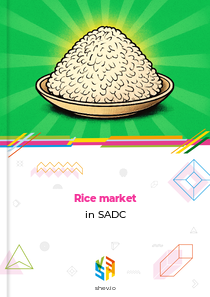







"SADC" region includes following countries:
 Angola
 Botswana
 Comoros
 Democratic Republic of the Congo
 Eswatini
 Lesotho
 Madagascar
 Malawi
 Mauritius
 Mozambique
 Namibia
 Seychelles
 South Africa
 Tanzania
 Zambia
 Zimbabwe
Earlier Report Observations
Rice production in the SADC region showed a clear upward trend, rising from 9.1 million tons in 2018 to over 11 million tons by 2022. This growth was supported by various government initiatives, such as Botswana's efforts to support local farmers and reduce import reliance, and the launch of the LIFINCA financing line in Mozambique to bolster the rice value chain. The adoption of improved technologies, including Chinese hybrid seed technology in Mozambique and adaptive research trials for new rice varieties in Malawi, contributed to higher yields and production volumes.
The total rice market size experienced significant fluctuations, primarily driven by volatile import levels. Imports fell sharply in 2019 and 2020, then surged to 7.2 million tons in 2022 before declining again in 2023. Several countries implemented measures to curb import dependency, including Botswana's protectionist steps like banning certain vegetable imports and Mozambique's policy to centralize rice and wheat imports through the Instituto de Cereais de Moçambique starting in 2026, aimed at stabilizing supply and prices.
Regional strategies focused on long-term market development, such as Malawi's revised National Rice Development Strategy aiming to double production by 2030 and SADC's emphasis on agricultural value addition. However, challenges like high inflation in Malawi affecting input costs and consumer prices, alongside operational failures in Namibia's rice production projects due to machinery and funding issues, presented hurdles to consistent growth across the region.
Table of content
- 1. Disclaimer
- 2. Terms of use of the report
- 3. Product codes in the statistical classifications used in the report
-
4. Key Market Indicators and Trends
-
4.1. Key Market Indicators
-
4.1.1. In kind
- 4.1.1.1. Production, 2018-2023
- 4.1.1.2. Imports, 2018-2024
- 4.1.1.3. Exports, 2018-2024
- 4.1.1.4. Market size, 2018-2023
-
4.1.1. In kind
- 4.2. Market Trends and Factors
-
4.1. Key Market Indicators
-
5. Production
-
5.1. Production in SADC
- 5.1.1. Annual dynamics of production in SADC in kind, 2018-2023, K t
-
5.2. Global production by Country, 2018-2023
- 5.2.1. Annual dynamics of production by macroregions in kind, 2018-2023, K t
- 5.2.2. Dynamics of production structure by macroregions in kind, 2018-2023
- 5.2.3. Annual dynamics of production by country in kind, 2018-2023, K t
- 5.2.4. Structure of production by countries in kind, 2018-2023
- 5.2.5. Dynamics of peoduction structure by countries in kind, 2018-2023
-
5.1. Production in SADC
-
6. Imports
-
6.1. Imports (Direct Data*)
- 6.1.1. Imports - Total information
-
6.1.2. Imports in kind, K t
- 6.1.2.1. Annual dynamics of product's imports to Angola in kind, 2018-2024, K t
- 6.1.2.2. Dynamics of product's imports in kind to Angola by countries, 2018-2024, K t
- 6.1.2.3. Structure of product's imports in kind by countries, 2018-2024
-
6.1.3. Imports in value, M $ US
- 6.1.3.1. Annual dynamics of product's imports to Angola in value, 2018-2024, M $ US
- 6.1.3.2. Dynamics of product's imports in value to Angola by countries, 2018-2024, M $ US
- 6.1.3.3. Structure of product's imports in value by countries, 2018-2024
-
6.1.4. Average price of product's imports, $ US/t
- 6.1.4.1. Annual dynamics of average price of product's imports to Angola, 2018-2024, $ US/t
- 6.1.4.2. Dynamics of average price of product's imports to Angola by countries, 2018-2024, $ US/t
-
6.2. Imports (Mirror Data)
- 6.2.1. Imports - Total information
-
6.2.2. Imports in kind, K t
- 6.2.2.1. Annual dynamics of product's imports to Angola in kind, 2018-2024, K t
- 6.2.2.2. Dynamics of product's imports in kind to Angola by countries, 2018-2024, K t
- 6.2.2.3. Structure of product's imports in kind by countries, 2018-2024
-
6.2.3. Imports in value, M $ US
- 6.2.3.1. Annual dynamics of product's imports to Angola in value, 2018-2024, M $ US
- 6.2.3.2. Dynamics of product's imports in value to Angola by countries, 2018-2024, M $ US
- 6.2.3.3. Structure of product's imports in value by countries, 2018-2024
-
6.2.4. Average price of product's imports, $ US/t
- 6.2.4.1. Annual dynamics of average price of product's imports to Angola, 2018-2024, $ US/t
- 6.2.4.2. Dynamics of average price of product's imports to Angola by countries, 2018-2024, $ US/t
-
6.1. Imports (Direct Data*)
-
7. Exports
-
7.1. Exports (Direct Data*)
- 7.1.1. Exports - Total information
-
7.1.2. Exports in kind, K t
- 7.1.2.1. Annual dynamics of product's exports from Angola in kind, 2018-2024, K t
- 7.1.2.2. Dynamics of product's exports in kind from Angola by countries, 2018-2024, K t
- 7.1.2.3. Structure of product's exports in kind by countries, 2018-2024
-
7.1.3. Exports in value, M $ US
- 7.1.3.1. Annual dynamics of product's exports from Angola in value, 2018-2024, M $ US
- 7.1.3.2. Dynamics of product's exports in value from Angola by countries, 2018-2024, M $ US
- 7.1.3.3. Structure of product's exports in value by countries, 2018-2024
-
7.1.4. Average price of product's exports, $ US/t
- 7.1.4.1. Annual dynamics of average price of product's exports from Angola, 2018-2024, $ US/t
- 7.1.4.2. Dynamics of average price of product's exports from Angola by countries, 2018-2024, $ US/t
-
7.2. Exports (Mirror Data)
- 7.2.1. Exports - Total information
-
7.2.2. Exports in kind, K t
- 7.2.2.1. Annual dynamics of product's exports from Angola in kind, 2018-2024, K t
- 7.2.2.2. Dynamics of product's exports in kind from Angola by countries, 2018-2024, K t
- 7.2.2.3. Structure of product's exports in kind by countries, 2018-2024
-
7.2.3. Exports in value, M $ US
- 7.2.3.1. Annual dynamics of product's exports from Angola in value, 2018-2024, M $ US
- 7.2.3.2. Dynamics of product's exports in value from Angola by countries, 2018-2024, M $ US
- 7.2.3.3. Structure of product's exports in value by countries, 2018-2024
-
7.2.4. Average price of product's exports, $ US/t
- 7.2.4.1. Annual dynamics of average price of product's exports from Angola, 2018-2024, $ US/t
- 7.2.4.2. Dynamics of average price of product's exports from Angola by countries, 2018-2024, $ US/t
-
7.1. Exports (Direct Data*)
-
8. Trade balance
-
8.1. Trade balance (Direct Data)
- 8.1.1. In kind, K t
- 8.1.2. In value, M $ US
-
8.2. Trade balance (Mirror Data)
- 8.2.1. In kind, K t
- 8.2.2. In value, M $ US
-
8.1. Trade balance (Direct Data)
-
9. Top buying and selling countries, 2018-2024
-
9.1. Direct Data
- 9.1.1. Import in Value by Countries-buyers
- 9.1.2. Export in Value by Countries-suppliers
-
9.2. Mirror Data
- 9.2.1. Import in Value by Countries-buyers
- 9.2.2. Export in Value by Countries-suppliers
-
9.1. Direct Data
Production rice in SADC
In kind, 2017-2020, K t
Top producers of rice, 2017-2020
World map of production of rice, 2017-2020
Rice production in SADC has grown for the third year in a row. In 2019, the region produced 10 602 thousand tons of rice, and by 2020, this figure had increased by 16.2%. Looking at the period from 2017 to 2020, production rose by 39.2%, with an average annual growth rate of 11.7%.
Annual dynamics of production in SADC in kind, 2017-2020, K t
| Parameter | 2018 | 2019 | 2020 | CAGR | |
|---|---|---|---|---|---|
| 1 | Change from last year | 19.1% | 0.5% | 16.2% | 11.7% |
Exports rice from SADC
Exports in kind, K t
The export data shows significant fluctuations, pointing to a volatile market. In 2018, rice exports from SADC hit their lowest point at 17 thousand tons, but then surged by 618.4% in 2019 to reach 413 thousand tons in 2020, which is 233.9% higher than in 2019. The peak-to-trough difference between 2018 and 2020 was 24-fold, with the largest decline of 75.2% occurring in 2018.
Annual dynamics of product's exports from SADC in kind, 2017-2020, K t
| Parameter | 2018 | 2019 | 2020 | CAGR | |
|---|---|---|---|---|---|
| 1 | Change from last year | (75.2%) | 618.4% | 233.9% | 81.3% |
From 2017 to 2020, Uganda, Rwanda, and Kenya were the top destinations for SADC's rice exports in volume terms. Uganda accounted for 32.0% of exports, Rwanda for 7.8%, and Kenya for 7.1%, together making up 46.9% of total export flows.
Structure of product's exports in kind by countries, 2017-2020
World map of product's exports from SADC in kind, 2017-2020
Exports in value, M $ US
The value of rice exports from SADC has risen for the third consecutive year. In 2020, exports reached 218 million US dollars, marking a sharp increase of 87.3% compared to the previous year. Over the 2017-2020 period, export value grew by 214.2%, with an average annual growth rate of 46.5%.
Annual dynamics of product's exports from SADC in value, 2017-2020, M $ US
| Parameter | 2018 | 2019 | 2020 | CAGR | |
|---|---|---|---|---|---|
| 1 | Change from last year | 19.3% | 40.6% | 87.3% | 46.5% |
Between 2017 and 2020, Uganda, Rwanda, and Kenya led in the value of rice exports from SADC. Uganda contributed 23.0% of export value, Rwanda 9.5%, and Kenya 6.3%, collectively representing 38.8% of total export flows.
Structure of product's exports in value by countries, 2017-2020
World map of product's exports from SADC in value, 2017-2020
Imports rice to SADC
Imports in kind, K t
Rice imports into SADC have fallen for the second year in a row. In 2020, imports totaled 2 676 thousand tons, down 15.7% from the previous year. Over the 2017-2020 period, imports decreased by 14.3%, with an average annual decline of 5.0%. The highest import volume was recorded in 2018 at 4 145 thousand tons, which saw a 32.7% increase, while the largest drop of 23.4% occurred in 2019.
Annual dynamics of product's imports to SADC in kind, 2017-2020, K t
| Parameter | 2018 | 2019 | 2020 | CAGR | |
|---|---|---|---|---|---|
| 1 | Change from last year | 32.7% | (23.4%) | (15.7%) | (5.0%) |
From 2017 to 2020, Thailand, India, and Pakistan were the main sources of rice imports into SADC in volume terms. Thailand supplied 47.8% of imports, India 18.8%, and Pakistan 11.3%, together accounting for 77.9% of total import flows.
Structure of product's imports in kind by countries, 2017-2020
World map of product's imports to SADC in kind, 2017-2020
Imports in value, M $ US
In 2020, the value of rice imports into SADC amounted to 1 660 million US dollars, up 19.8% from the previous year. Between 2017 and 2020, import value increased by 31%, equivalent to an average annual growth rate of 9.4%. The largest decline of 14.0% was in 2019, while the biggest increase of 27.1% occurred in 2018.
Annual dynamics of product's imports to SADC in value, 2017-2020, M $ US
| Parameter | 2018 | 2019 | 2020 | CAGR | |
|---|---|---|---|---|---|
| 1 | Change from last year | 27.1% | (14.0%) | 19.8% | 9.4% |
During 2017-2020, Thailand, India, and Pakistan dominated the value of rice imports into SADC. Thailand accounted for 46.5% of import value, India for 19.3%, and Pakistan for 12.4%, with their combined share reaching 78.2% of total import flows.
Structure of product's imports in value by countries, 2017-2020
World map of product's imports to SADC in value, 2017-2020
Related Reports

2026-03-28
Rice market in Central America
2026-03-28
2026-03-28
2026-03-28

2026-03-28
2026-03-28

2026-03-28

2026-03-28
In-depth market research on this product
Global Rice Cakes Market 2021–2031: Size, Share, Trends and Forecast
Global market report: size, trends and forecast to 2031 · 198 pages
Global Rice Bran Oil Market 2021–2031: Size, Share, Trends and Forecast
Global market report: size, trends and forecast to 2031 · 186 pages
Global Broken Rice Market 2021–2031: Size, Share, Trends and Forecast
Global market report: size, trends and forecast to 2031 · 192 pages
Why Choose Us?
Only Verified Data
No Hidden Costs or Separate Fees
Smarter Subscription Pricing
Contact Our Team
Submit your inquiry using the form below — our team will get back to you within 24 hours.