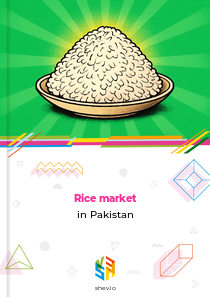







Earlier Report Observations
From 2018 to 2019, the Pakistani rice market volume decreased from 6.8 million t to 6.5 million t. This contraction coincided with a rise in exports, which was facilitated by India's ban on rice exports and its minimum price policy, allowing Pakistan to capture better international prices and ship more rice abroad.
The market then expanded sharply, reaching 10.0 million t in 2021 as production climbed, but fell back to 6.4 million t in 2022 when harvests declined and export volumes increased.
In 2023, domestic market volume rebounded to 10.2 million t, driven by a production high of 14.8 million t. During this period, India's imposition of a 20% export duty on rice to secure domestic supply further bolstered Pakistan's export environment, contributing to record export revenues of $4 billion.
Table of content
- 1. Disclaimer
- 2. Terms of use of the report
- 3. Product codes in the statistical classifications used in the report
-
4. Key Market Indicators and Trends
-
4.1. Key Market Indicators
-
4.1.1. In kind
- 4.1.1.1. Production, 2018-2023
- 4.1.1.2. Imports, 2018-2024
- 4.1.1.3. Exports, 2018-2024
- 4.1.1.4. Market size, 2018-2023
-
4.1.1. In kind
- 4.2. Market Trends and Factors
-
4.1. Key Market Indicators
-
5. Production
-
5.1. Production in Pakistan
- 5.1.1. Annual dynamics of production in Pakistan in kind, 2018-2023, K t
- 5.1.2. Annual dynamics of production in Pakistan in value, 2018-2023, $ US
-
5.2. Global production by Country, 2018-2023
- 5.2.1. Annual dynamics of production by macroregions in kind, 2018-2023, K t
- 5.2.2. Dynamics of production structure by macroregions in kind, 2018-2023
- 5.2.3. Annual dynamics of production by country in kind, 2018-2023, K t
- 5.2.4. Structure of production by countries in kind, 2018-2023
- 5.2.5. Dynamics of peoduction structure by countries in kind, 2018-2023
-
5.1. Production in Pakistan
-
6. Exports
-
6.1. Exports (Direct Data)
- 6.1.1. Exports - Total information
-
6.1.2. Exports in kind, K t
- 6.1.2.1. Annual dynamics of product's exports from Pakistan in kind, 2018-2024, K t
- 6.1.2.2. Dynamics of product's exports in kind from Pakistan by countries, 2018-2024, K t
- 6.1.2.3. Structure of product's exports in kind by countries, 2018-2024
-
6.1.3. Exports in value, M $ US
- 6.1.3.1. Annual dynamics of product's exports from Pakistan in value, 2018-2024, M $ US
- 6.1.3.2. Dynamics of product's exports in value from Pakistan by countries, 2018-2024, M $ US
- 6.1.3.3. Structure of product's exports in value by countries, 2018-2024
-
6.1.4. Average price of product's exports, $ US/t
- 6.1.4.1. Annual dynamics of average price of product's exports from Pakistan, 2018-2024, $ US/t
- 6.1.4.2. Dynamics of average price of product's exports from Pakistan by countries, 2018-2024, $ US/t
-
6.2. Exports (Mirror Data)
- 6.2.1. Exports - Total information
-
6.2.2. Exports in kind, K t
- 6.2.2.1. Annual dynamics of product's exports from Pakistan in kind, 2018-2024, K t
- 6.2.2.2. Dynamics of product's exports in kind from Pakistan by countries, 2018-2024, K t
- 6.2.2.3. Structure of product's exports in kind by countries, 2018-2024
-
6.2.3. Exports in value, M $ US
- 6.2.3.1. Annual dynamics of product's exports from Pakistan in value, 2018-2024, M $ US
- 6.2.3.2. Dynamics of product's exports in value from Pakistan by countries, 2018-2024, M $ US
- 6.2.3.3. Structure of product's exports in value by countries, 2018-2024
-
6.2.4. Average price of product's exports, $ US/t
- 6.2.4.1. Annual dynamics of average price of product's exports from Pakistan, 2018-2024, $ US/t
- 6.2.4.2. Dynamics of average price of product's exports from Pakistan by countries, 2018-2024, $ US/t
-
6.1. Exports (Direct Data)
-
7. Imports
-
7.1. Imports (Direct Data)
- 7.1.1. Imports - Total information
-
7.1.2. Imports in kind, K t
- 7.1.2.1. Annual dynamics of product's imports to Pakistan in kind, 2018-2024, K t
- 7.1.2.2. Dynamics of product's imports in kind to Pakistan by countries, 2018-2024, K t
- 7.1.2.3. Structure of product's imports in kind by countries, 2018-2024
-
7.1.3. Imports in value, M $ US
- 7.1.3.1. Annual dynamics of product's imports to Pakistan in value, 2018-2024, M $ US
- 7.1.3.2. Dynamics of product's imports in value to Pakistan by countries, 2018-2024, M $ US
- 7.1.3.3. Structure of product's imports in value by countries, 2018-2024
-
7.1.4. Average price of product's imports, $ US/t
- 7.1.4.1. Annual dynamics of average price of product's imports to Pakistan, 2018-2024, $ US/t
- 7.1.4.2. Dynamics of average price of product's imports to Pakistan by countries, 2018-2024, $ US/t
-
7.2. Imports (Mirror Data)
- 7.2.1. Imports - Total information
-
7.2.2. Imports in kind, K t
- 7.2.2.1. Annual dynamics of product's imports to Pakistan in kind, 2018-2024, K t
- 7.2.2.2. Dynamics of product's imports in kind to Pakistan by countries, 2018-2024, K t
- 7.2.2.3. Structure of product's imports in kind by countries, 2018-2024
-
7.2.3. Imports in value, M $ US
- 7.2.3.1. Annual dynamics of product's imports to Pakistan in value, 2018-2024, M $ US
- 7.2.3.2. Dynamics of product's imports in value to Pakistan by countries, 2018-2024, M $ US
- 7.2.3.3. Structure of product's imports in value by countries, 2018-2024
-
7.2.4. Average price of product's imports, $ US/t
- 7.2.4.1. Annual dynamics of average price of product's imports to Pakistan, 2018-2024, $ US/t
- 7.2.4.2. Dynamics of average price of product's imports to Pakistan by countries, 2018-2024, $ US/t
-
7.1. Imports (Direct Data)
-
8. Trade balance
-
8.1. Trade balance (Direct Data)
- 8.1.1. In kind, K t
- 8.1.2. In value, M $ US
-
8.2. Trade balance (Mirror Data)
- 8.2.1. In kind, K t
- 8.2.2. In value, M $ US
-
8.1. Trade balance (Direct Data)
-
9. Top buying and selling countries, 2018-2024
-
9.1. Direct Data
- 9.1.1. Import in Value by Countries-buyers
- 9.1.2. Export in Value by Countries-suppliers
-
9.2. Mirror Data
- 9.2.1. Import in Value by Countries-buyers
- 9.2.2. Export in Value by Countries-suppliers
-
9.1. Direct Data
Production rice in Pakistan
In kind, 2017-2020, K t
From 2017 to 2020, Pakistan ranked as the 10th largest producer of rice globally.
Top producers of rice, 2017-2020
World map of production of rice, 2017-2020
Rice production in Pakistan rose for the second year in a row. In 2020, the country produced 12 630 K t of rice, marking a 13.6% year-on-year increase. Over the 2017-2020 period, production grew by 13%, with a compound annual growth rate (CAGR) of 4.2%. The lowest output was recorded in 2018 at 10 798 K t, which saw the largest decline of 3.4% that year.
Annual dynamics of production in Pakistan in kind, 2017-2020, K t
| Parameter | 2018 | 2019 | 2020 | CAGR | |
|---|---|---|---|---|---|
| 1 | Change from last year | (3.4%) | 3.0% | 13.6% | 4.2% |
In value, 2017-2020, M $ US
Rice production in Pakistan increased for the third consecutive year. In 2020, the output was valued at 6 658 M $ US, representing a 21.0% gain compared to the previous year. Between 2017 and 2020, production rose by 25%, equating to an annualized rate of 7.7%.
Annual dynamics of production in Pakistan in value, 2017-2020, M $ US
| Parameter | 2018 | 2019 | 2020 | CAGR | |
|---|---|---|---|---|---|
| 1 | Change from last year | 1.8% | 1.4% | 21.0% | 7.7% |
Exports rice from Pakistan
Exports in kind, K t
Following a two-year rise, rice exports from Pakistan fell. In 2020, exports reached 3 986 K t, showing a sharp decline of 13.1% from the previous year. Over the 2017-2020 period, exports increased by 9%, with an annualized rate of 2.9%. The peak was in 2019 at 4 589 K t, which also saw the largest increase of 15.2% that year.
Annual dynamics of product's exports from Pakistan in kind, 2017-2020, K t
| Parameter | 2018 | 2019 | 2020 | CAGR | |
|---|---|---|---|---|---|
| 1 | Change from last year | 8.9% | 15.2% | (13.1%) | 2.9% |
From 2017 to 2020, Pakistan's export structure in kind was highly diversified. China (12.3% of exports in kind), Kenya (11.5%), and Afghanistan (7.1%) together accounted for only 30.9% of total flows, while a long tail of smaller markets made up the remaining 69.1%.
Structure of product's exports in kind by countries, 2017-2020
World map of product's exports from Pakistan in kind, 2017-2020
Exports in value, M $ US
After a two-year increase, rice shipments from Pakistan declined. In 2020, Pakistan exported 2 101 M $ US of rice, down 7.4% from 2019. Over the 2017-2020 period, exports grew by 20.5%, with a CAGR of 6.4%. The highest value was recorded in 2019 at 2 270 M $ US, and the largest increase occurred in 2018 at 14.8%.
Annual dynamics of product's exports from Pakistan in value, 2017-2020, M $ US
| Parameter | 2018 | 2019 | 2020 | CAGR | |
|---|---|---|---|---|---|
| 1 | Change from last year | 14.8% | 13.4% | (7.4%) | 6.4% |
From 2017 to 2020, Pakistan's rice exports in value terms were spread broadly across markets. China (9.8% of exports in value terms), Kenya (9.4%), and the United Arab Emirates (8.4%) together accounted for only 27.5% of total flows.
Structure of product's exports in value by countries, 2017-2020
World map of product's exports from Pakistan in value, 2017-2020
Imports rice to Pakistan
Imports in kind, K t
Rice import volumes in Pakistan dropped for the second consecutive year. In 2020, Pakistan imported 9 K t of rice, a decrease of 10.4% from the previous year. The highest volume was in 2018 at 12 K t, which saw the largest increase of 28.1% that year. The largest decline occurred in 2019 at 12.6%.
Annual dynamics of product's imports to Pakistan in kind, 2017-2020, K t
| Parameter | 2018 | 2019 | 2020 | CAGR | |
|---|---|---|---|---|---|
| 1 | Change from last year | 28.1% | (12.6%) | (10.4%) | 0.1% |
From 2017 to 2020, rice imports in kind to Pakistan were highly concentrated, with China accounting for 94.8% of total flows.
Structure of product's imports in kind by countries, 2017-2020
World map of product's imports to Pakistan in kind, 2017-2020
Imports in value, M $ US
Following a two-year gain, imported rice volumes in Pakistan declined. In 2020, imports totaled 33 M $ US, 2.6% lower than in 2019. Over the 2017-2020 period, imports increased by 53.9%, with a CAGR of 15.4%. The peak value was in 2019 at 34 M $ US, and the largest increase was in 2018 at 39.4%.
Annual dynamics of product's imports to Pakistan in value, 2017-2020, M $ US
| Parameter | 2018 | 2019 | 2020 | CAGR | |
|---|---|---|---|---|---|
| 1 | Change from last year | 39.4% | 13.3% | (2.6%) | 15.4% |
From 2017 to 2020, 99.0% of Pakistan's rice imports in value terms were directed to China, making this market overwhelmingly dominant.
Structure of product's imports in value by countries, 2017-2020
World map of product's imports to Pakistan in value, 2017-2020
Related Reports
2026-03-28
2026-03-28
2026-03-28
2026-03-28

2026-03-28

2026-03-28

2026-03-28
In-depth market research on this product
Global Rice Cakes Market 2021–2031: Size, Share, Trends and Forecast
Global market report: size, trends and forecast to 2031 · 198 pages
Global Rice Bran Oil Market 2021–2031: Size, Share, Trends and Forecast
Global market report: size, trends and forecast to 2031 · 186 pages
Global Broken Rice Market 2021–2031: Size, Share, Trends and Forecast
Global market report: size, trends and forecast to 2031 · 192 pages
Why Choose Us?
Only Verified Data
No Hidden Costs or Separate Fees
Smarter Subscription Pricing
Contact Our Team
Submit your inquiry using the form below — our team will get back to you within 24 hours.