






"SADC" region includes following countries:
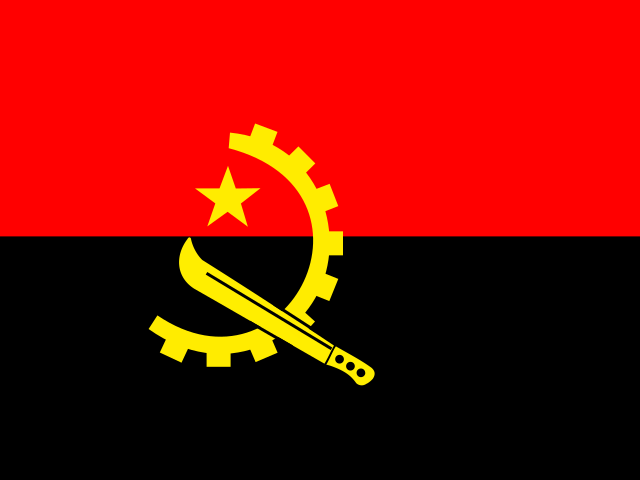 Angola
 Botswana
 Comoros
 Democratic Republic of the Congo
 Eswatini
 Lesotho
 Madagascar
 Malawi
 Mauritius
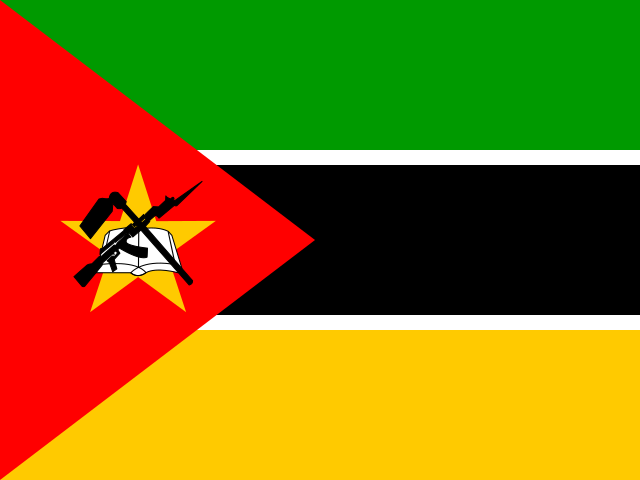 Mozambique
 Namibia
 Seychelles
 South Africa
 Tanzania
 Zambia
 Zimbabwe
Earlier Report Observations
The paddy rice market in the SADC region experienced a substantial expansion from 2018 to 2022, with a notable surge of over 1.4 million tons in 2020 that pushed the total volume above 10.6 million tons. This growth phase elevated the market from 9.1 million tons at the start of the period to a peak of 11.2 million tons by 2022.
Following the peak, the market volume contracted modestly to 10.9 million tons in 2023, a decrease of roughly 2%. Despite this recent dip, the overall market size increased by nearly 2 million tons across the six-year span from 2018 to 2023.
Table of content
- 1. Disclaimer
- 2. Terms of use of the report
- 3. Product codes in the statistical classifications used in the report
-
4. Key Market Indicators and Trends
-
4.1. Key Market Indicators
-
4.1.1. In kind
- 4.1.1.1. Production, 2018-2023
- 4.1.1.2. Imports, 2018-2024
- 4.1.1.3. Exports, 2018-2024
- 4.1.1.4. Market size, 2018-2023
-
4.1.1. In kind
- 4.2. Market Trends and Factors
-
4.1. Key Market Indicators
-
5. Production
-
5.1. Production in SADC
- 5.1.1. Annual dynamics of production in SADC in kind, 2018-2023, K t
-
5.2. Global production by Country, 2018-2023
- 5.2.1. Annual dynamics of production by macroregions in kind, 2018-2023, K t
- 5.2.2. Dynamics of production structure by macroregions in kind, 2018-2023
- 5.2.3. Annual dynamics of production by country in kind, 2018-2023, K t
- 5.2.4. Structure of production by countries in kind, 2018-2023
- 5.2.5. Dynamics of peoduction structure by countries in kind, 2018-2023
-
5.1. Production in SADC
-
6. Imports
-
6.1. Imports (Direct Data*)
- 6.1.1. Imports - Total information
-
6.1.2. Imports in kind, t
- 6.1.2.1. Annual dynamics of product's imports to Angola in kind, 2018-2024, t
- 6.1.2.2. Dynamics of product's imports in kind to Angola by countries, 2018-2024, t
- 6.1.2.3. Structure of product's imports in kind by countries, 2018-2024
-
6.1.3. Imports in value, K $ US
- 6.1.3.1. Annual dynamics of product's imports to Angola in value, 2018-2024, K $ US
- 6.1.3.2. Dynamics of product's imports in value to Angola by countries, 2018-2024, K $ US
- 6.1.3.3. Structure of product's imports in value by countries, 2018-2024
-
6.1.4. Average price of product's imports, $ US/t
- 6.1.4.1. Annual dynamics of average price of product's imports to Angola, 2018-2024, $ US/t
- 6.1.4.2. Dynamics of average price of product's imports to Angola by countries, 2018-2024, $ US/t
-
6.2. Imports (Mirror Data)
- 6.2.1. Imports - Total information
-
6.2.2. Imports in kind, t
- 6.2.2.1. Annual dynamics of product's imports to Angola in kind, 2018-2024, t
- 6.2.2.2. Dynamics of product's imports in kind to Angola by countries, 2018-2024, t
- 6.2.2.3. Structure of product's imports in kind by countries, 2018-2024
-
6.2.3. Imports in value, K $ US
- 6.2.3.1. Annual dynamics of product's imports to Angola in value, 2018-2024, K $ US
- 6.2.3.2. Dynamics of product's imports in value to Angola by countries, 2018-2024, K $ US
- 6.2.3.3. Structure of product's imports in value by countries, 2018-2024
-
6.2.4. Average price of product's imports, $ US/t
- 6.2.4.1. Annual dynamics of average price of product's imports to Angola, 2018-2024, $ US/t
- 6.2.4.2. Dynamics of average price of product's imports to Angola by countries, 2018-2024, $ US/t
-
6.1. Imports (Direct Data*)
-
7. Exports
-
7.1. Exports (Direct Data*)
- 7.1.1. Exports - Total information
-
7.1.2. Exports in kind, t
- 7.1.2.1. Annual dynamics of product's exports from Angola in kind, 2018-2024, t
- 7.1.2.2. Dynamics of product's exports in kind from Angola by countries, 2018-2024, t
- 7.1.2.3. Structure of product's exports in kind by countries, 2018-2024
-
7.1.3. Exports in value, K $ US
- 7.1.3.1. Annual dynamics of product's exports from Angola in value, 2018-2024, K $ US
- 7.1.3.2. Dynamics of product's exports in value from Angola by countries, 2018-2024, K $ US
- 7.1.3.3. Structure of product's exports in value by countries, 2018-2024
-
7.1.4. Average price of product's exports, $ US/t
- 7.1.4.1. Annual dynamics of average price of product's exports from Angola, 2018-2024, $ US/t
- 7.1.4.2. Dynamics of average price of product's exports from Angola by countries, 2018-2024, $ US/t
-
7.2. Exports (Mirror Data)
- 7.2.1. Exports - Total information
-
7.2.2. Exports in kind, t
- 7.2.2.1. Annual dynamics of product's exports from Angola in kind, 2018-2024, t
- 7.2.2.2. Dynamics of product's exports in kind from Angola by countries, 2018-2024, t
- 7.2.2.3. Structure of product's exports in kind by countries, 2018-2024
-
7.2.3. Exports in value, K $ US
- 7.2.3.1. Annual dynamics of product's exports from Angola in value, 2018-2024, K $ US
- 7.2.3.2. Dynamics of product's exports in value from Angola by countries, 2018-2024, K $ US
- 7.2.3.3. Structure of product's exports in value by countries, 2018-2024
-
7.2.4. Average price of product's exports, $ US/t
- 7.2.4.1. Annual dynamics of average price of product's exports from Angola, 2018-2024, $ US/t
- 7.2.4.2. Dynamics of average price of product's exports from Angola by countries, 2018-2024, $ US/t
-
7.1. Exports (Direct Data*)
-
8. Trade balance
-
8.1. Trade balance (Direct Data)
- 8.1.1. In kind, t
- 8.1.2. In value, K $ US
-
8.2. Trade balance (Mirror Data)
- 8.2.1. In kind, t
- 8.2.2. In value, K $ US
-
8.1. Trade balance (Direct Data)
-
9. Top buying and selling countries, 2018-2024
-
9.1. Direct Data
- 9.1.1. Import in Value by Countries-buyers
- 9.1.2. Export in Value by Countries-suppliers
-
9.2. Mirror Data
- 9.2.1. Import in Value by Countries-buyers
- 9.2.2. Export in Value by Countries-suppliers
-
9.1. Direct Data
Production paddy rice in SADC
In kind, 2017-2020, K t
Top producers of paddy rice, 2017-2020
World map of production of paddy rice, 2017-2020
Paddy rice production in SADC has increased for the third consecutive year. In 2020, SADC produced 10,602 thousand tonnes of paddy rice, marking a 16.2% increase compared to 2019. Between 2017 and 2020, production grew by 39.2%, which translates to an annualized growth rate of 11.7%.
Annual dynamics of production in SADC in kind, 2017-2020, K t
| Parameter | 2018 | 2019 | 2020 | CAGR | |
|---|---|---|---|---|---|
| 1 | Change from last year | 19.1% | 0.5% | 16.2% | 11.7% |
Exports paddy rice from SADC
Exports in kind, t
SADC's volume of paddy rice exports has risen for the third year in a row. In 2020, exports reached 20,029 tonnes, representing a 98.3% increase over the previous year. From 2017 to 2020, exports surged by 11,382.3%, with an annualized growth rate of 386.0%.
Annual dynamics of product's exports from SADC in kind, 2017-2020, t
| Parameter | 2018 | 2019 | 2020 | CAGR | |
|---|---|---|---|---|---|
| 1 | Change from last year | 255.4% | 1 529.6% | 98.3% | 386.0% |
From 2017 to 2020, Uganda, Rwanda, and Kenya consistently held the top positions in the country structure of exports in kind. Uganda accounted for 55.4% of exports, Rwanda for 7.2%, and Kenya for 2.5%. Together, these three countries represented 65.1% of total export flows.
Structure of product's exports in kind by countries, 2017-2020
World map of product's exports from SADC in kind, 2017-2020
Exports in value, K $ US
Cross-border shipments of paddy rice from SADC have grown for the third consecutive year. In 2020, exports amounted to 8,377 thousand US dollars, showing a sharp increase of 143.3% compared to the previous year. Over the period from 2017 to 2020, exports rose by 246.3%, with a compound annual growth rate (CAGR) of 51.3%.
Annual dynamics of product's exports from SADC in value, 2017-2020, K $ US
| Parameter | 2018 | 2019 | 2020 | CAGR | |
|---|---|---|---|---|---|
| 1 | Change from last year | 11.9% | 27.2% | 143.3% | 51.3% |
Throughout 2017 to 2020, Uganda, Rwanda, and Kenya formed the core group of markets for exports in value terms. Uganda contributed 30.9% of exports, Rwanda 13.8%, and Kenya 0.9%. Collectively, these countries accounted for 45.6% of total export flows.
Structure of product's exports in value by countries, 2017-2020
World map of product's exports from SADC in value, 2017-2020
Imports paddy rice to SADC
Imports in kind, t
The market for paddy rice imports in SADC showed significant volatility during these years. The minimum value was recorded in 2019 at 7,147 tonnes, while the maximum was in 2018 at 18,799 tonnes, resulting in a 2.6-fold variation between these two years. In 2020, SADC imported a total of paddy rice, reflecting a 72.3% increase compared to the previous year. The largest decline occurred in 2019, with a drop of 62.0%, and the largest increase was in 2018, with a rise of 98.0%.
Annual dynamics of product's imports to SADC in kind, 2017-2020, t
| Parameter | 2018 | 2019 | 2020 | CAGR | |
|---|---|---|---|---|---|
| 1 | Change from last year | 98.0% | (62.0%) | 72.3% | 9.0% |
From 2017 to 2020, Thailand, Pakistan, and India formed the core group of markets for imports in kind. Thailand accounted for 30.8% of imports, Pakistan for 10.7%, and India for 9.4%. Together, these three countries represented 51.0% of total import flows.
Structure of product's imports in kind by countries, 2017-2020
World map of product's imports to SADC in kind, 2017-2020
Imports in value, K $ US
The market for paddy rice imports in SADC exhibited volatility during these years. The minimum value was recorded in 2019 at 6,760 thousand US dollars, while the maximum was in 2018 at 13,887 thousand US dollars, reflecting a 2.1-fold gap. In 2020, the volume of paddy rice imports to SADC reached 12,927 thousand US dollars, constituting a 91.2% increase compared to 2019. The largest decline was in 2019, with a decrease of 51.3%.
Annual dynamics of product's imports to SADC in value, 2017-2020, K $ US
| Parameter | 2018 | 2019 | 2020 | CAGR | |
|---|---|---|---|---|---|
| 1 | Change from last year | 49.8% | (51.3%) | 91.2% | 11.7% |
Over the period from 2017 to 2020, imports of paddy rice to SADC in value terms were widely dispersed across partner countries. Thailand accounted for 18.8% of imports, India for 13.0%, and China for 12.9%. Together, these three countries represented only 44.7% of total import flows.
Structure of product's imports in value by countries, 2017-2020
World map of product's imports to SADC in value, 2017-2020
Related Reports

Paddy rice market in Western Asia
2026-03-28
2026-03-28
2026-03-28
Paddy rice market in Central America
2026-03-28

2026-03-28

2026-03-28

2026-03-28

2026-03-28
Why Choose Us?
Only Verified Data
No Hidden Costs or Separate Fees
Smarter Subscription Pricing
Contact Our Team
Submit your inquiry using the form below — our team will get back to you within 24 hours.