






"Western Africa" region includes following countries:
 Cabo Verde
 Benin
Benin Gambia
 Ghana
Ghana Guinea
 Côte d'Ivoire
 Liberia
 Mali
Mali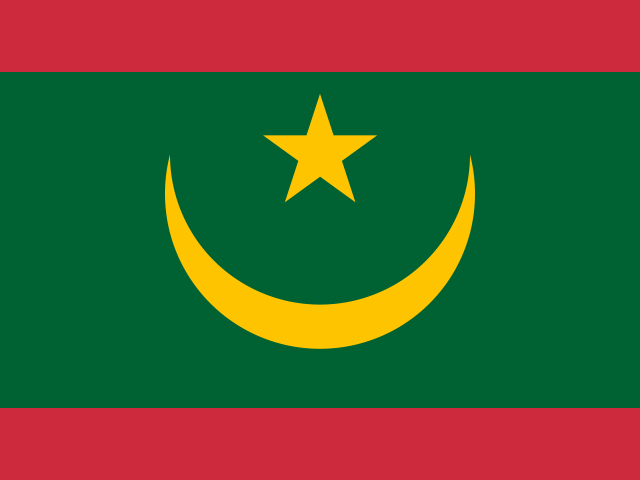 Mauritania
 Niger
Niger Nigeria
 Guinea-Bissau
 Saint Helena, Ascension and Tristan da Cunha
 Senegal
 Sierra Leone
 Togo
Togo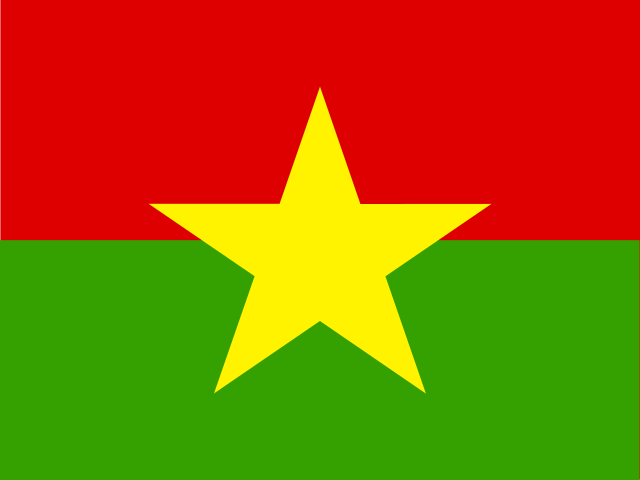 Burkina Faso
Earlier Report Observations
The market for wheat bran, sharps, and residues in Western Africa experienced notable shifts between 2018 and 2023. Early in the period, agricultural initiatives such as Ghana's Planting for Food and Jobs program supported cereal production, influencing the supply of milling by-products. The market volume reached its highest point at 1 944 thousand tons in 2020, a significant increase from 1 760 thousand tons in 2018.
This peak in 2020 was largely attributable to the COVID-19 pandemic, which spurred greater consumer interest in health and nutrition, boosting demand for wheat bran. Simultaneously, pandemic-related labor shortages and supply chain disruptions affected production and distribution networks. In subsequent years, ongoing global supply chain constraints and inflationary pressures on commodity prices contributed to a contraction, with the market declining to 1 880 thousand tons in 2021 and 1 784 thousand tons in 2022.
By 2023, the market volume fell further to 1 550 thousand tons, marking a continued downward trend. While global patterns indicated rising demand for sustainable and clean-label wheat bran products, the regional market faced persistent logistical and economic challenges throughout the post-pandemic period.
Table of content
- 1. Disclaimer
- 2. Terms of use of the report
- 3. Product codes in the statistical classifications used in the report
-
4. Key Market Indicators and Trends
-
4.1. Key Market Indicators
-
4.1.1. In kind
- 4.1.1.1. Production, 2018-2023
- 4.1.1.2. Imports, 2018-2024
- 4.1.1.3. Exports, 2018-2024
- 4.1.1.4. Market size, 2018-2023
-
4.1.1. In kind
- 4.2. Market Trends and Factors
-
4.1. Key Market Indicators
-
5. Production
-
5.1. Production in Western Africa
- 5.1.1. Annual dynamics of production in Western Africa in kind, 2018-2023, K t
-
5.2. Global production by Country, 2018-2023
- 5.2.1. Annual dynamics of production by macroregions in kind, 2018-2023, K t
- 5.2.2. Dynamics of production structure by macroregions in kind, 2018-2023
- 5.2.3. Annual dynamics of production by country in kind, 2018-2023, K t
- 5.2.4. Structure of production by countries in kind, 2018-2023
- 5.2.5. Dynamics of peoduction structure by countries in kind, 2018-2023
-
5.1. Production in Western Africa
-
6. Imports
-
6.1. Imports (Direct Data*)
- 6.1.1. Imports - Total information
-
6.1.2. Imports in kind, K t
- 6.1.2.1. Annual dynamics of product's imports to Cabo Verde in kind, 2018-2024, K t
- 6.1.2.2. Dynamics of product's imports in kind to Cabo Verde by countries, 2018-2024, K t
- 6.1.2.3. Structure of product's imports in kind by countries, 2018-2024
-
6.1.3. Imports in value, K $ US
- 6.1.3.1. Annual dynamics of product's imports to Cabo Verde in value, 2018-2024, K $ US
- 6.1.3.2. Dynamics of product's imports in value to Cabo Verde by countries, 2018-2024, K $ US
- 6.1.3.3. Structure of product's imports in value by countries, 2018-2024
-
6.1.4. Average price of product's imports, $ US/t
- 6.1.4.1. Annual dynamics of average price of product's imports to Cabo Verde, 2018-2024, $ US/t
- 6.1.4.2. Dynamics of average price of product's imports to Cabo Verde by countries, 2018-2024, $ US/t
-
6.2. Imports (Mirror Data)
- 6.2.1. Imports - Total information
-
6.2.2. Imports in kind, K t
- 6.2.2.1. Annual dynamics of product's imports to Cabo Verde in kind, 2018-2024, K t
- 6.2.2.2. Dynamics of product's imports in kind to Cabo Verde by countries, 2018-2024, K t
- 6.2.2.3. Structure of product's imports in kind by countries, 2018-2024
-
6.2.3. Imports in value, K $ US
- 6.2.3.1. Annual dynamics of product's imports to Cabo Verde in value, 2018-2024, K $ US
- 6.2.3.2. Dynamics of product's imports in value to Cabo Verde by countries, 2018-2024, K $ US
- 6.2.3.3. Structure of product's imports in value by countries, 2018-2024
-
6.2.4. Average price of product's imports, $ US/t
- 6.2.4.1. Annual dynamics of average price of product's imports to Cabo Verde, 2018-2024, $ US/t
- 6.2.4.2. Dynamics of average price of product's imports to Cabo Verde by countries, 2018-2024, $ US/t
-
6.1. Imports (Direct Data*)
-
7. Exports
-
7.1. Exports (Direct Data*)
- 7.1.1. Exports - Total information
-
7.1.2. Exports in kind, K t
- 7.1.2.1. Annual dynamics of product's exports from Cabo Verde in kind, 2018-2024, K t
- 7.1.2.2. Dynamics of product's exports in kind from Cabo Verde by countries, 2018-2024, K t
- 7.1.2.3. Structure of product's exports in kind by countries, 2018-2024
-
7.1.3. Exports in value, K $ US
- 7.1.3.1. Annual dynamics of product's exports from Cabo Verde in value, 2018-2024, K $ US
- 7.1.3.2. Dynamics of product's exports in value from Cabo Verde by countries, 2018-2024, K $ US
- 7.1.3.3. Structure of product's exports in value by countries, 2018-2024
-
7.1.4. Average price of product's exports, $ US/t
- 7.1.4.1. Annual dynamics of average price of product's exports from Cabo Verde, 2018-2024, $ US/t
- 7.1.4.2. Dynamics of average price of product's exports from Cabo Verde by countries, 2018-2024, $ US/t
-
7.2. Exports (Mirror Data)
- 7.2.1. Exports - Total information
-
7.2.2. Exports in kind, K t
- 7.2.2.1. Annual dynamics of product's exports from Cabo Verde in kind, 2018-2024, K t
- 7.2.2.2. Dynamics of product's exports in kind from Cabo Verde by countries, 2018-2024, K t
- 7.2.2.3. Structure of product's exports in kind by countries, 2018-2024
-
7.2.3. Exports in value, K $ US
- 7.2.3.1. Annual dynamics of product's exports from Cabo Verde in value, 2018-2024, K $ US
- 7.2.3.2. Dynamics of product's exports in value from Cabo Verde by countries, 2018-2024, K $ US
- 7.2.3.3. Structure of product's exports in value by countries, 2018-2024
-
7.2.4. Average price of product's exports, $ US/t
- 7.2.4.1. Annual dynamics of average price of product's exports from Cabo Verde, 2018-2024, $ US/t
- 7.2.4.2. Dynamics of average price of product's exports from Cabo Verde by countries, 2018-2024, $ US/t
-
7.1. Exports (Direct Data*)
-
8. Trade balance
-
8.1. Trade balance (Direct Data)
- 8.1.1. In kind, K t
- 8.1.2. In value, K $ US
-
8.2. Trade balance (Mirror Data)
- 8.2.1. In kind, K t
- 8.2.2. In value, K $ US
-
8.1. Trade balance (Direct Data)
-
9. Top buying and selling countries, 2018-2024
-
9.1. Direct Data
- 9.1.1. Import in Value by Countries-buyers
- 9.1.2. Export in Value by Countries-suppliers
-
9.2. Mirror Data
- 9.2.1. Import in Value by Countries-buyers
- 9.2.2. Export in Value by Countries-suppliers
-
9.1. Direct Data
Production wheat bran, sharps and residues in Western Africa
In kind, 2017-2020, K t
Top producers of wheat bran, sharps and residues, 2017-2020
World map of production of wheat bran, sharps and residues, 2017-2020
In 2019, Western Africa produced 1 805 K t of wheat bran, sharps and residues, marking the lowest output during the period. Production then rose to 2 018 K t in 2020, representing an 11.8% increase from the previous year. Over the full 2017-2020 timeframe, production grew by 11.6%, which translates to an average annual growth rate of 3.7%. The most significant decline occurred in 2019, when production fell by 1.6%.
Annual dynamics of production in Western Africa in kind, 2017-2020, K t
| Parameter | 2018 | 2019 | 2020 | CAGR | |
|---|---|---|---|---|---|
| 1 | Change from last year | 1.5% | (1.6%) | 11.8% | 3.7% |
In value, 2017-2020, M $ US
Following two years of decline, Western Africa's production of wheat bran, sharps and residues rebounded in value terms. In 2019, output was valued at 226.7 M $ US, the lowest point in the period. By 2020, this figure had climbed to 294.5 M $ US, reflecting a substantial 29.9% year-over-year gain. From 2017 to 2020, production value increased by 19.6%, with a compound annual growth rate of 6.1%. The sharpest drop was recorded in 2019, when value fell by 4.9%.
Annual dynamics of production in Western Africa in value, 2017-2020, M $ US
| Parameter | 2018 | 2019 | 2020 | CAGR | |
|---|---|---|---|---|---|
| 1 | Change from last year | (3.2%) | (4.9%) | 29.9% | 6.1% |
Exports wheat bran, sharps and residues from Western Africa
Exports in kind, K t
Wheat bran, sharps and residues exports from Western Africa grew for the second consecutive year. In 2018, exports hit their lowest point at 133.0 K t, after a significant 49.6% decline. They then recovered to 164.0 K t in 2020, showing a modest 7.4% increase from 2019. Over the 2017-2020 period, exports decreased by 37.9%, averaging an annual decline of 14.7%. The largest increase was in 2019, with a 14.8% rise.
Annual dynamics of product's exports from Western Africa in kind, 2017-2020, K t
| Parameter | 2018 | 2019 | 2020 | CAGR | |
|---|---|---|---|---|---|
| 1 | Change from last year | (49.6%) | 14.8% | 7.4% | (14.7%) |
Between 2017 and 2020, Western Africa's exports of wheat bran, sharps and residues in kind were distributed across a diverse range of partner countries. Morocco accounted for 26.1% of these exports, Portugal for 15.6%, and the United States for 4.4%. Together, these three countries represented 46.1% of total export flows, indicating a relatively fragmented market structure.
Structure of product's exports in kind by countries, 2017-2020
World map of product's exports from Western Africa in kind, 2017-2020
Exports in value, K $ US
Exports of wheat bran, sharps and residues from Western Africa in value terms increased for the second year in a row. In 2018, exports reached their minimum at 17 282 K $ US, following a sharp 52.0% decline. By 2020, exports had risen to 23 939 K $ US, up 24.8% compared to 2019. Overall, from 2017 to 2020, exports decreased by 33.5%, with an average annual decline of 12.7%.
Annual dynamics of product's exports from Western Africa in value, 2017-2020, K $ US
| Parameter | 2018 | 2019 | 2020 | CAGR | |
|---|---|---|---|---|---|
| 1 | Change from last year | (52.0%) | 11.0% | 24.8% | (12.7%) |
From 2017 to 2020, Morocco, Portugal, and Norway were consistently the top destinations for Western Africa's exports of wheat bran, sharps and residues in value terms. Morocco held a 35.1% share, Portugal 13.9%, and Norway 5.8%. Combined, these three countries accounted for 54.8% of total export value, highlighting their dominant role in the market.
Structure of product's exports in value by countries, 2017-2020
World map of product's exports from Western Africa in value, 2017-2020
Imports wheat bran, sharps and residues to Western Africa
Imports in kind, K t
Imports of wheat bran, sharps and residues into Western Africa showed volatility during the observed period. In 2017, imports were at their lowest point, then surged to 90.3 K t in 2020, marking a 98.9% increase from 2019. Over this timeframe, imports varied by 2.4 times between the high in 2020 and the low in 2017. The largest decline occurred in 2019, with a 21.2% drop.
Annual dynamics of product's imports to Western Africa in kind, 2017-2020, K t
| Parameter | 2018 | 2019 | 2020 | CAGR | |
|---|---|---|---|---|---|
| 1 | Change from last year | 52.0% | (21.2%) | 98.9% | 33.5% |
Data from 2017 to 2020 reveal that imports in kind of wheat bran, sharps and residues to Western Africa were not heavily concentrated among a few suppliers. Argentina contributed 5.7% of imports, Russia 4.6%, and the Democratic Republic of the Congo 3.5%. Together, these three countries made up only 13.8% of total import flows, indicating a highly diversified sourcing pattern.
Structure of product's imports in kind by countries, 2017-2020
World map of product's imports to Western Africa in kind, 2017-2020
Imports in value, K $ US
Imports of wheat bran, sharps and residues into Western Africa in value terms displayed an unstable trend. In 2017, imports bottomed out, then peaked at 15 760 K $ US in 2020, representing a 111.1% increase from the previous year. Over the period, imports varied by 2.3 times between the high in 2020 and the low in 2017. The most significant decline was in 2019, with a 32.0% decrease.
Annual dynamics of product's imports to Western Africa in value, 2017-2020, K $ US
| Parameter | 2018 | 2019 | 2020 | CAGR | |
|---|---|---|---|---|---|
| 1 | Change from last year | 58.8% | (32.0%) | 111.1% | 31.6% |
During 2017-2020, Argentina, Russia, and Portugal were key suppliers of wheat bran, sharps and residues to Western Africa in value terms. Argentina accounted for 7.3% of imports, Russia for 6.5%, and Portugal for 4.8%. However, their combined share reached only 18.6% of total import value, with the remaining 81.4% spread across numerous other trading partners, underscoring the market's diversity.
Structure of product's imports in value by countries, 2017-2020
World map of product's imports to Western Africa in value, 2017-2020
Related Reports


Coconut oilcake market in Western Africa
2026-03-29


Groundnutoil-cake market in Western Africa
2026-03-29
Why Choose Us?
Only Verified Data
No Hidden Costs or Separate Fees
Smarter Subscription Pricing
Contact Our Team
Submit your inquiry using the form below — our team will get back to you within 24 hours.