






"Western Africa" region includes following countries:
 Cabo Verde
 Benin
Benin Gambia
 Ghana
Ghana Guinea
 Côte d'Ivoire
 Liberia
 Mali
Mali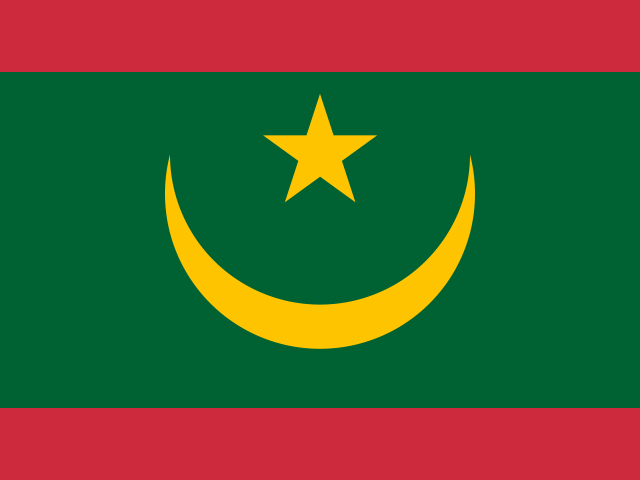 Mauritania
 Niger
Niger Nigeria
 Guinea-Bissau
 Saint Helena, Ascension and Tristan da Cunha
 Senegal
 Sierra Leone
 Togo
Togo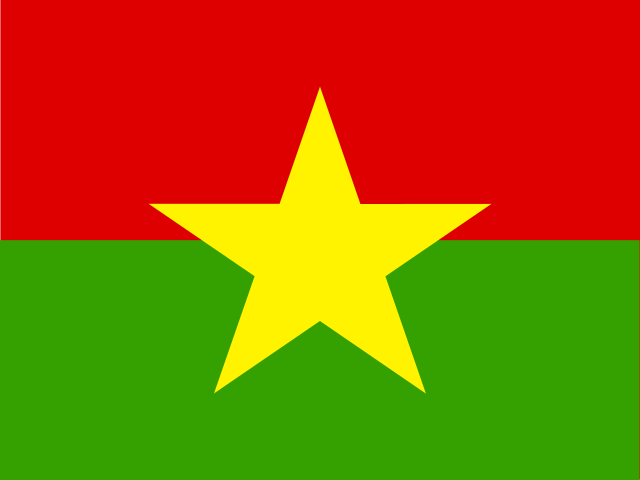 Burkina Faso
Earlier Report Observations
From 2018 to 2020, the market for maize bran, sharps and residues in Western Africa was shaped by Ghana's agricultural policy expansion. The launch of the 'Planting for Food and Jobs' program supplied improved seeds and extension services, raising maize yields and supporting steady production of milling by-products. Continued program growth in 2019, with nearly one million farmers and increased input subsidies, maintained raw material flow. By 2020, targeting 1.4 million participants, these efforts contributed to a 4.6% rise in market volume to 784.7 thousand tons.
Market volume dropped 33.7% to 520.1 thousand tons in 2021 due to a surge in exports, which reached 276.2 thousand tons and reduced domestic availability. As exports normalized to 25.3 thousand tons in 2022, the market rebounded 48.6% to 773.1 thousand tons. Growth continued in 2023, with volume increasing 4.7% to 809.7 thousand tons, reflecting consistent production of maize processing residues.
Table of content
- 1. Disclaimer
- 2. Terms of use of the report
- 3. Product codes in the statistical classifications used in the report
-
4. Key Market Indicators and Trends
-
4.1. Key Market Indicators
-
4.1.1. In kind
- 4.1.1.1. Production, 2018-2023
- 4.1.1.2. Imports, 2018-2024
- 4.1.1.3. Exports, 2018-2024
- 4.1.1.4. Market size, 2018-2023
-
4.1.1. In kind
- 4.2. Market Trends and Factors
-
4.1. Key Market Indicators
-
5. Production
-
5.1. Production in Western Africa
- 5.1.1. Annual dynamics of production in Western Africa in kind, 2018-2023, K t
-
5.2. Global production by Country, 2018-2023
- 5.2.1. Annual dynamics of production by macroregions in kind, 2018-2023, K t
- 5.2.2. Dynamics of production structure by macroregions in kind, 2018-2023
- 5.2.3. Annual dynamics of production by country in kind, 2018-2023, K t
- 5.2.4. Structure of production by countries in kind, 2018-2023
- 5.2.5. Dynamics of peoduction structure by countries in kind, 2018-2023
-
5.1. Production in Western Africa
-
6. Imports
-
6.1. Imports (Direct Data*)
- 6.1.1. Imports - Total information
-
6.1.2. Imports in kind, K t
- 6.1.2.1. Annual dynamics of product's imports to Cabo Verde in kind, 2018-2024, K t
- 6.1.2.2. Dynamics of product's imports in kind to Cabo Verde by countries, 2018-2024, K t
- 6.1.2.3. Structure of product's imports in kind by countries, 2018-2024
-
6.1.3. Imports in value, K $ US
- 6.1.3.1. Annual dynamics of product's imports to Cabo Verde in value, 2018-2024, K $ US
- 6.1.3.2. Dynamics of product's imports in value to Cabo Verde by countries, 2018-2024, K $ US
- 6.1.3.3. Structure of product's imports in value by countries, 2018-2024
-
6.1.4. Average price of product's imports, $ US/t
- 6.1.4.1. Annual dynamics of average price of product's imports to Cabo Verde, 2018-2024, $ US/t
- 6.1.4.2. Dynamics of average price of product's imports to Cabo Verde by countries, 2018-2024, $ US/t
-
6.2. Imports (Mirror Data)
- 6.2.1. Imports - Total information
-
6.2.2. Imports in kind, K t
- 6.2.2.1. Annual dynamics of product's imports to Cabo Verde in kind, 2018-2024, K t
- 6.2.2.2. Dynamics of product's imports in kind to Cabo Verde by countries, 2018-2024, K t
- 6.2.2.3. Structure of product's imports in kind by countries, 2018-2024
-
6.2.3. Imports in value, K $ US
- 6.2.3.1. Annual dynamics of product's imports to Cabo Verde in value, 2018-2024, K $ US
- 6.2.3.2. Dynamics of product's imports in value to Cabo Verde by countries, 2018-2024, K $ US
- 6.2.3.3. Structure of product's imports in value by countries, 2018-2024
-
6.2.4. Average price of product's imports, $ US/t
- 6.2.4.1. Annual dynamics of average price of product's imports to Cabo Verde, 2018-2024, $ US/t
- 6.2.4.2. Dynamics of average price of product's imports to Cabo Verde by countries, 2018-2024, $ US/t
-
6.1. Imports (Direct Data*)
-
7. Exports
-
7.1. Exports (Direct Data*)
- 7.1.1. Exports - Total information
-
7.1.2. Exports in kind, K t
- 7.1.2.1. Annual dynamics of product's exports from Cabo Verde in kind, 2018-2024, K t
- 7.1.2.2. Dynamics of product's exports in kind from Cabo Verde by countries, 2018-2024, K t
- 7.1.2.3. Structure of product's exports in kind by countries, 2018-2024
-
7.1.3. Exports in value, K $ US
- 7.1.3.1. Annual dynamics of product's exports from Cabo Verde in value, 2018-2024, K $ US
- 7.1.3.2. Dynamics of product's exports in value from Cabo Verde by countries, 2018-2024, K $ US
- 7.1.3.3. Structure of product's exports in value by countries, 2018-2024
-
7.1.4. Average price of product's exports, $ US/t
- 7.1.4.1. Annual dynamics of average price of product's exports from Cabo Verde, 2018-2024, $ US/t
- 7.1.4.2. Dynamics of average price of product's exports from Cabo Verde by countries, 2018-2024, $ US/t
-
7.2. Exports (Mirror Data)
- 7.2.1. Exports - Total information
-
7.2.2. Exports in kind, K t
- 7.2.2.1. Annual dynamics of product's exports from Cabo Verde in kind, 2018-2024, K t
- 7.2.2.2. Dynamics of product's exports in kind from Cabo Verde by countries, 2018-2024, K t
- 7.2.2.3. Structure of product's exports in kind by countries, 2018-2024
-
7.2.3. Exports in value, K $ US
- 7.2.3.1. Annual dynamics of product's exports from Cabo Verde in value, 2018-2024, K $ US
- 7.2.3.2. Dynamics of product's exports in value from Cabo Verde by countries, 2018-2024, K $ US
- 7.2.3.3. Structure of product's exports in value by countries, 2018-2024
-
7.2.4. Average price of product's exports, $ US/t
- 7.2.4.1. Annual dynamics of average price of product's exports from Cabo Verde, 2018-2024, $ US/t
- 7.2.4.2. Dynamics of average price of product's exports from Cabo Verde by countries, 2018-2024, $ US/t
-
7.1. Exports (Direct Data*)
-
8. Trade balance
-
8.1. Trade balance (Direct Data)
- 8.1.1. In kind, K t
- 8.1.2. In value, K $ US
-
8.2. Trade balance (Mirror Data)
- 8.2.1. In kind, K t
- 8.2.2. In value, K $ US
-
8.1. Trade balance (Direct Data)
-
9. Top buying and selling countries, 2018-2024
-
9.1. Direct Data
- 9.1.1. Import in Value by Countries-buyers
- 9.1.2. Export in Value by Countries-suppliers
-
9.2. Mirror Data
- 9.2.1. Import in Value by Countries-buyers
- 9.2.2. Export in Value by Countries-suppliers
-
9.1. Direct Data
Production maize bran, sharps and residues in Western Africa
In kind, 2017-2020, K t
Top producers of maize bran, sharps and residues, 2017-2020
World map of production of maize bran, sharps and residues, 2017-2020
In Western Africa, production of maize bran, sharps and residues reached 787.0 K t in 2020, marking a moderate increase of 4.9% compared to the previous year. Looking at the period from 2017 to 2020, overall production grew by 4.2%, which translates to an average annual growth rate of 1.4%. The lowest production level was recorded in 2019 at 750.0 K t, with the largest decline of 1.0% occurring that same year.
Annual dynamics of production in Western Africa in kind, 2017-2020, K t
| Parameter | 2018 | 2019 | 2020 | CAGR | |
|---|---|---|---|---|---|
| 1 | Change from last year | 0.4% | (1.0%) | 4.9% | 1.4% |
In value, 2017-2020, M $ US
Western Africa's production value of maize bran, sharps and residues declined for the second year in a row. In 2020, the output was valued at 142.9 M $ US, showing a significant contraction of 15.2% from 2019. Over the 2017-2020 period, production value decreased by 14.2%, with a compound annual growth rate of -5.0%. The highest value was recorded in 2018 at 180.2 M $ US, which also saw the largest increase of 8.1% that year.
Annual dynamics of production in Western Africa in value, 2017-2020, M $ US
| Parameter | 2018 | 2019 | 2020 | CAGR | |
|---|---|---|---|---|---|
| 1 | Change from last year | 8.1% | (6.5%) | (15.2%) | (5.0%) |
Exports maize bran, sharps and residues from Western Africa
Exports in kind, t
Export volumes of maize bran, sharps and residues from Western Africa increased for the third consecutive year. In 2020, exports totaled 3 887 t, representing a sharp year-over-year rise of 1 547.3%. From 2017 to 2020, exports surged by 7 469.3%, with a compound annual growth rate of 323.0%.
Annual dynamics of product's exports from Western Africa in kind, 2017-2020, t
| Parameter | 2018 | 2019 | 2020 | CAGR | |
|---|---|---|---|---|---|
| 1 | Change from last year | 88.8% | 143.3% | 1 547.3% | 323.0% |
Between 2017 and 2020, the Philippines and India consistently held the top positions in the export structure by volume, together accounting for 60.4% of total flows.
Structure of product's exports in kind by countries, 2017-2020
World map of product's exports from Western Africa in kind, 2017-2020
Exports in value, K $ US
Western Africa's exports of maize bran, sharps and residues in value terms grew for the third year in a row. In 2020, exports amounted to 706 K $ US, which is 1 231.9% higher than the previous year. From 2017 to 2020, export value increased by 6 131.8%, equating to an annualized growth rate of 296.5%.
Annual dynamics of product's exports from Western Africa in value, 2017-2020, K $ US
| Parameter | 2018 | 2019 | 2020 | CAGR | |
|---|---|---|---|---|---|
| 1 | Change from last year | 103.5% | 130.0% | 1 231.9% | 296.5% |
During the 2017-2020 period, the Philippines, India, and Sweden formed the key group of export partners in value terms for maize bran, sharps and residues from Western Africa. The Philippines accounted for 56.3% of exports, India for 4.2%, and Sweden for 2.1%, together representing 62.5% of total flows.
Structure of product's exports in value by countries, 2017-2020
World map of product's exports from Western Africa in value, 2017-2020
Imports maize bran, sharps and residues to Western Africa
Imports in kind, t
The import market showed an unstable trend over the timeframe. Imports reached their lowest point in 2018 at 255 t, with the largest decline of 95.2% recorded that year. In 2020, import volume stood at 1 601 t, indicating a steep increase of 232.8% compared to 2019. The maximum volume in 2017 was 21 times higher than the 2018 minimum.
Annual dynamics of product's imports to Western Africa in kind, 2017-2020, t
| Parameter | 2018 | 2019 | 2020 | CAGR | |
|---|---|---|---|---|---|
| 1 | Change from last year | (95.2%) | 88.3% | 232.8% | (33.0%) |
From 2017 to 2020, Ukraine, Bulgaria, and Belgium remained the key sources for imports by volume. Ukraine accounted for 55.4% of imports, Bulgaria for 11.1%, and Belgium for 1.2%, together making up 67.7% of total flows.
Structure of product's imports in kind by countries, 2017-2020
World map of product's imports to Western Africa in kind, 2017-2020
Imports in value, K $ US
The import market exhibited volatility throughout the period. The lowest value was recorded in 2018 at 68 K $ US, with the largest decline of 93.9% occurring that year. In 2019, imports saw the largest increase of 157.6%. By 2020, Western Africa imported approximately 404 K $ US of maize bran, sharps and residues, corresponding to an abrupt year-over-year gain of 131.5%. The peak value in 2017 was 16 times higher than the 2018 trough.
Annual dynamics of product's imports to Western Africa in value, 2017-2020, K $ US
| Parameter | 2018 | 2019 | 2020 | CAGR | |
|---|---|---|---|---|---|
| 1 | Change from last year | (93.9%) | 157.6% | 131.5% | (28.6%) |
In the 2017-2020 period, three main markets—Ukraine, Bulgaria, and Belgium—together absorbed 73.5% of total import value for maize bran, sharps and residues into Western Africa.
Structure of product's imports in value by countries, 2017-2020
World map of product's imports to Western Africa in value, 2017-2020
Related Reports


Coconut oilcake market in Western Africa
2026-03-29

Soybean oilcake market in Western Africa
2026-03-29


Groundnutoil-cake market in Western Africa
2026-03-29
Why Choose Us?
Only Verified Data
No Hidden Costs or Separate Fees
Smarter Subscription Pricing
Contact Our Team
Submit your inquiry using the form below — our team will get back to you within 24 hours.