






Earlier Report Observations
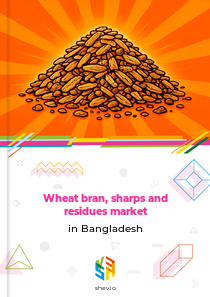
The market for wheat bran, sharps, and residues in Bangladesh experienced significant expansion between 2018 and 2023, with its total volume more than doubling from 306 thousand tonnes to 834 thousand tonnes. This growth was not linear, however. Following a dip to 253 thousand tonnes in 2019, the market recovered and then entered a phase of accelerated expansion starting in 2021. The most striking feature of this period was the changing structure of supply, where a sharp increase in imports became the dominant force shaping the market size.
Domestic production showed considerable volatility throughout the period, peaking at 310 thousand tonnes in 2021 before declining to 187 thousand tonnes by 2023. In contrast, import volumes surged from a negligible 2 thousand tonnes in 2018 to 648 thousand tonnes in 2023. By the end of the period, imports accounted for over 75% of the total market volume, fundamentally shifting the supply base and driving the overall market growth despite the contraction in local output.
Table of content
- 1. Disclaimer
- 2. Terms of use of the report
- 3. Product codes in the statistical classifications used in the report
-
4. Key Market Indicators and Trends
-
4.1. Key Market Indicators
-
4.1.1. In kind
- 4.1.1.1. Production, 2018-2023
- 4.1.1.2. Imports, 2018-2024
- 4.1.1.3. Exports, 2018-2024
- 4.1.1.4. Market size, 2018-2023
-
4.1.1. In kind
- 4.2. Market Trends and Factors
-
4.1. Key Market Indicators
-
5. Production
-
5.1. Production in Bangladesh
- 5.1.1. Annual dynamics of production in Bangladesh in kind, 2018-2023, K t
- 5.1.2. Annual dynamics of production in Bangladesh in value, 2018-2023, $ US
-
5.2. Global production by Country, 2018-2023
- 5.2.1. Annual dynamics of production by macroregions in kind, 2018-2023, K t
- 5.2.2. Dynamics of production structure by macroregions in kind, 2018-2023
- 5.2.3. Annual dynamics of production by country in kind, 2018-2023, K t
- 5.2.4. Structure of production by countries in kind, 2018-2023
- 5.2.5. Dynamics of peoduction structure by countries in kind, 2018-2023
-
5.1. Production in Bangladesh
-
6. Imports
-
6.1. Imports (Direct Data*)
- 6.1.1. Imports - Total information
-
6.1.2. Imports in kind, K t
- 6.1.2.1. Annual dynamics of product's imports to Bangladesh in kind, 2018-2024, K t
- 6.1.2.2. Dynamics of product's imports in kind to Bangladesh by countries, 2018-2024, K t
- 6.1.2.3. Structure of product's imports in kind by countries, 2018-2024
-
6.1.3. Imports in value, M $ US
- 6.1.3.1. Annual dynamics of product's imports to Bangladesh in value, 2018-2024, M $ US
- 6.1.3.2. Dynamics of product's imports in value to Bangladesh by countries, 2018-2024, M $ US
- 6.1.3.3. Structure of product's imports in value by countries, 2018-2024
-
6.1.4. Average price of product's imports, $ US/t
- 6.1.4.1. Annual dynamics of average price of product's imports to Bangladesh, 2018-2024, $ US/t
- 6.1.4.2. Dynamics of average price of product's imports to Bangladesh by countries, 2018-2024, $ US/t
-
6.2. Imports (Mirror Data)
- 6.2.1. Imports - Total information
-
6.2.2. Imports in kind, K t
- 6.2.2.1. Annual dynamics of product's imports to Bangladesh in kind, 2018-2024, K t
- 6.2.2.2. Dynamics of product's imports in kind to Bangladesh by countries, 2018-2024, K t
- 6.2.2.3. Structure of product's imports in kind by countries, 2018-2024
-
6.2.3. Imports in value, M $ US
- 6.2.3.1. Annual dynamics of product's imports to Bangladesh in value, 2018-2024, M $ US
- 6.2.3.2. Dynamics of product's imports in value to Bangladesh by countries, 2018-2024, M $ US
- 6.2.3.3. Structure of product's imports in value by countries, 2018-2024
-
6.2.4. Average price of product's imports, $ US/t
- 6.2.4.1. Annual dynamics of average price of product's imports to Bangladesh, 2018-2024, $ US/t
- 6.2.4.2. Dynamics of average price of product's imports to Bangladesh by countries, 2018-2024, $ US/t
-
6.1. Imports (Direct Data*)
-
7. Trade balance
-
7.1. Trade balance (Direct Data)
- 7.1.1. In kind, K t
- 7.1.2. In value, M $ US
-
7.2. Trade balance (Mirror Data)
- 7.2.1. In kind, K t
- 7.2.2. In value, M $ US
-
7.1. Trade balance (Direct Data)
-
8. Top buying and selling countries, 2018-2024
-
8.1. Direct Data
- 8.1.1. Import in Value by Countries-buyers
- 8.1.2. Export in Value by Countries-suppliers
-
8.2. Mirror Data
- 8.2.1. Import in Value by Countries-buyers
- 8.2.2. Export in Value by Countries-suppliers
-
8.1. Direct Data
Production wheat bran, sharps and residues in Bangladesh
In kind, 2017-2020, K t
Top producers of wheat bran, sharps and residues, 2017-2020
World map of production of wheat bran, sharps and residues, 2017-2020
Bangladesh's production of wheat bran, sharps and residues reached 298.8 thousand tonnes in 2020, representing a 22.2% increase compared to the previous year. Production was at its lowest in 2019 at 244.4 thousand tonnes, while the highest level was recorded in 2018 at 304.4 thousand tonnes. The most significant production decline occurred in 2019, when output fell by 19.7%.
Annual dynamics of production in Bangladesh in kind, 2017-2020, K t
| Parameter | 2018 | 2019 | 2020 | CAGR | |
|---|---|---|---|---|---|
| 1 | Change from last year | 2.2% | (19.7%) | 22.2% | 0.1% |
Exports wheat bran, sharps and residues from Bangladesh
According to industry reports, Bangladesh did not export any wheat bran, sharps and residues between 2017 and 2020.
Imports wheat bran, sharps and residues to Bangladesh
Imports in kind, t
Import volumes showed considerable volatility during this period. The lowest import level was recorded in 2018 at 1 870 tonnes, while imports peaked in 2020 at 15 984 tonnes - representing an 8.5-fold difference between these years. In 2020, imports surged by 98.6% compared to the previous year. The most substantial decline occurred in 2018 with a 26.8% decrease, while the largest increase was recorded in 2019 when imports grew by 330.4%.
Annual dynamics of product's imports to Bangladesh in kind, 2017-2020, t
| Parameter | 2018 | 2019 | 2020 | CAGR | |
|---|---|---|---|---|---|
| 1 | Change from last year | (26.8%) | 330.4% | 98.6% | 84.3% |
Between 2017 and 2020, Pakistan was the leading supplier of wheat bran, sharps and residues to Bangladesh, accounting for 43.6% of imports by volume. The United Arab Emirates followed with 21.1% of imports, and Kenya contributed 9.5%. Together, these three countries supplied 74.1% of Bangladesh's total imports of these products during this period.
Structure of product's imports in kind by countries, 2017-2020
World map of product's imports to Bangladesh in kind, 2017-2020
Imports in value, K $ US
Import values demonstrated significant volatility throughout the observed period. The lowest value was recorded in 2018 at 322 thousand US dollars, while the highest occurred in 2020 at 3 439 thousand US dollars - representing a 10.7-fold difference between these years. In 2020, import values increased dramatically by 231.3% compared to the previous year. The most substantial decline was recorded in 2018 with a 41.0% decrease.
Annual dynamics of product's imports to Bangladesh in value, 2017-2020, K $ US
| Parameter | 2018 | 2019 | 2020 | CAGR | |
|---|---|---|---|---|---|
| 1 | Change from last year | (41.0%) | 222.7% | 231.3% | 84.8% |
From 2017 to 2020, Pakistan was the primary source of wheat bran, sharps and residues imports to Bangladesh in value terms, accounting for 35.8% of total import value. The United Arab Emirates followed with 23.8%, and India contributed 8.7%. Collectively, these three countries accounted for 68.3% of Bangladesh's total import value for these products during this period.
Structure of product's imports in value by countries, 2017-2020
World map of product's imports to Bangladesh in value, 2017-2020
Related Reports


Linseed oil-cake market in Bangladesh
2026-03-29

Groundnutoil-cake market in Bangladesh
2026-03-29

Soybean oilcake market in Bangladesh
2026-03-29
Why Choose Us?
Only Verified Data
No Hidden Costs or Separate Fees
Smarter Subscription Pricing
Contact Our Team
Submit your inquiry using the form below — our team will get back to you within 24 hours.