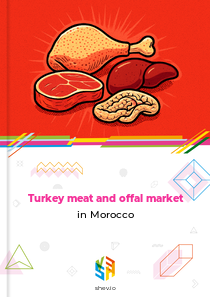







Earlier Report Observations
The turkey meat market in Morocco started from a solid base of self-sufficiency in 2018, supported by the Plan Maroc Vert which introduced aggregation models to strengthen the poultry sector's structure and commercialization. Market volume grew to 106.8 thousand tons in 2019, though value dipped, before volume settled back at 99.5 thousand tons in 2020. During this period, Morocco affirmed its position as a leading turkey producer in Africa, accounting for a significant portion of the continent's output.
From 2021, the market entered a phase of robust expansion. Volume jumped to 114.2 thousand tons in 2021 and continued rising to 119.6 thousand tons in 2022, supported by the sector's deep transformation under earlier plans. This included the development of modern infrastructure like approved slaughterhouses and processing units, achieving full self-sufficiency in poultry meat. Growth accelerated in 2023 with turkey production rising by 13% to 135 thousand tons, pushing market volume to 134.1 thousand tons and value to $162.2 million, alongside a 5% increase in per capita poultry consumption.
In 2024, the sector encountered rising production costs driven by high international prices for poultry feed, which directly impacted turkey meat prices. Broader drought conditions also affected the meat industry, leading to government interventions such as temporary tariff reductions on red meat imports to stabilize markets.
Table of content
- 1. Disclaimer
- 2. Terms of use of the report
- 3. Product codes in the statistical classifications used in the report
-
4. Key Market Indicators and Trends
-
4.1. Key Market Indicators
-
4.1.1. In kind
- 4.1.1.1. Production, 2018-2023
- 4.1.1.2. Imports, 2018-2024
- 4.1.1.3. Exports, 2018-2024
- 4.1.1.4. Market size, 2018-2023
-
4.1.2. In value
- 4.1.2.1. Production, 2018-2023
- 4.1.2.2. Imports, 2018-2024
- 4.1.2.3. Exports, 2018-2024
- 4.1.2.4. Market size, 2018-2023
-
4.1.1. In kind
- 4.2. Market Trends and Factors
-
4.1. Key Market Indicators
-
5. Production
-
5.1. Production in Morocco
- 5.1.1. Annual dynamics of production in Morocco in kind, 2018-2023, K t
- 5.1.2. Annual dynamics of production in Morocco in value, 2018-2023, $ US
-
5.2. Global production by Country, 2018-2023
- 5.2.1. Annual dynamics of production by macroregions in kind, 2018-2023, K t
- 5.2.2. Dynamics of production structure by macroregions in kind, 2018-2023
- 5.2.3. Annual dynamics of production by country in kind, 2018-2023, K t
- 5.2.4. Structure of production by countries in kind, 2018-2023
- 5.2.5. Dynamics of peoduction structure by countries in kind, 2018-2023
-
5.1. Production in Morocco
-
6. Exports
-
6.1. Exports (Direct Data)
- 6.1.1. Exports - Total information
-
6.1.2. Exports in kind, t
- 6.1.2.1. Annual dynamics of product's exports from Morocco in kind, 2018-2024, t
- 6.1.2.2. Dynamics of product's exports in kind from Morocco by countries, 2018-2024, t
- 6.1.2.3. Structure of product's exports in kind by countries, 2018-2024
-
6.1.3. Exports in value, K $ US
- 6.1.3.1. Annual dynamics of product's exports from Morocco in value, 2018-2024, K $ US
- 6.1.3.2. Dynamics of product's exports in value from Morocco by countries, 2018-2024, K $ US
- 6.1.3.3. Structure of product's exports in value by countries, 2018-2024
-
6.1.4. Average price of product's exports, $ US/t
- 6.1.4.1. Annual dynamics of average price of product's exports from Morocco, 2018-2024, $ US/t
- 6.1.4.2. Dynamics of average price of product's exports from Morocco by countries, 2018-2024, $ US/t
-
6.2. Exports (Mirror Data)
- 6.2.1. Exports - Total information
-
6.2.2. Exports in kind, t
- 6.2.2.1. Annual dynamics of product's exports from Morocco in kind, 2018-2024, t
- 6.2.2.2. Dynamics of product's exports in kind from Morocco by countries, 2018-2024, t
- 6.2.2.3. Structure of product's exports in kind by countries, 2018-2024
-
6.2.3. Exports in value, K $ US
- 6.2.3.1. Annual dynamics of product's exports from Morocco in value, 2018-2024, K $ US
- 6.2.3.2. Dynamics of product's exports in value from Morocco by countries, 2018-2024, K $ US
- 6.2.3.3. Structure of product's exports in value by countries, 2018-2024
-
6.2.4. Average price of product's exports, $ US/t
- 6.2.4.1. Annual dynamics of average price of product's exports from Morocco, 2018-2024, $ US/t
- 6.2.4.2. Dynamics of average price of product's exports from Morocco by countries, 2018-2024, $ US/t
-
6.1. Exports (Direct Data)
-
7. Imports
-
7.1. Imports (Direct Data)
- 7.1.1. Imports - Total information
-
7.1.2. Imports in kind, t
- 7.1.2.1. Annual dynamics of product's imports to Morocco in kind, 2018-2024, t
- 7.1.2.2. Dynamics of product's imports in kind to Morocco by countries, 2018-2024, t
- 7.1.2.3. Structure of product's imports in kind by countries, 2018-2024
-
7.1.3. Imports in value, K $ US
- 7.1.3.1. Annual dynamics of product's imports to Morocco in value, 2018-2024, K $ US
- 7.1.3.2. Dynamics of product's imports in value to Morocco by countries, 2018-2024, K $ US
- 7.1.3.3. Structure of product's imports in value by countries, 2018-2024
-
7.1.4. Average price of product's imports, $ US/t
- 7.1.4.1. Annual dynamics of average price of product's imports to Morocco, 2018-2024, $ US/t
- 7.1.4.2. Dynamics of average price of product's imports to Morocco by countries, 2018-2024, $ US/t
-
7.2. Imports (Mirror Data)
- 7.2.1. Imports - Total information
-
7.2.2. Imports in kind, t
- 7.2.2.1. Annual dynamics of product's imports to Morocco in kind, 2018-2024, t
- 7.2.2.2. Dynamics of product's imports in kind to Morocco by countries, 2018-2024, t
- 7.2.2.3. Structure of product's imports in kind by countries, 2018-2024
-
7.2.3. Imports in value, K $ US
- 7.2.3.1. Annual dynamics of product's imports to Morocco in value, 2018-2024, K $ US
- 7.2.3.2. Dynamics of product's imports in value to Morocco by countries, 2018-2024, K $ US
- 7.2.3.3. Structure of product's imports in value by countries, 2018-2024
-
7.2.4. Average price of product's imports, $ US/t
- 7.2.4.1. Annual dynamics of average price of product's imports to Morocco, 2018-2024, $ US/t
- 7.2.4.2. Dynamics of average price of product's imports to Morocco by countries, 2018-2024, $ US/t
-
7.1. Imports (Direct Data)
-
8. Trade balance
-
8.1. Trade balance (Direct Data)
- 8.1.1. In kind, t
- 8.1.2. In value, K $ US
-
8.2. Trade balance (Mirror Data)
- 8.2.1. In kind, t
- 8.2.2. In value, K $ US
-
8.1. Trade balance (Direct Data)
-
9. Top buying and selling countries, 2018-2024
-
9.1. Direct Data
- 9.1.1. Import in Value by Countries-buyers
- 9.1.2. Export in Value by Countries-suppliers
-
9.2. Mirror Data
- 9.2.1. Import in Value by Countries-buyers
- 9.2.2. Export in Value by Countries-suppliers
-
9.1. Direct Data
Production turkey meat and offal in Morocco
In kind, 2017-2020, K t
Between 2017 and 2020, Morocco ranked as the 10th largest global producer of turkey meat and offal by volume.
Top producers of turkey meat and offal, 2017-2020
World map of production of turkey meat and offal, 2017-2020
Morocco's production of turkey meat and offal declined in 2020 after two consecutive years of growth. The country produced 100.0 K t that year, marking a 6.5% decrease from 2019. Over the entire 2017-2020 period, production rose by 11.1%, averaging an annual growth rate of 3.6%. The peak was reached in 2019 with 107.0 K t, while the most significant annual increase occurred in 2018 at 11.1%.
Annual dynamics of production in Morocco in kind, 2017-2020, K t
| Parameter | 2018 | 2019 | 2020 | CAGR | |
|---|---|---|---|---|---|
| 1 | Change from last year | 11.1% | 7.0% | (6.5%) | 3.6% |
In value, 2017-2020, M $ US
In 2020, the value of Morocco's turkey meat and offal output stood at 101.5 M $ US, up 9.4% year-over-year. From 2017 to 2020, production value increased by 10.2%, with a compound annual growth rate of 3.3%. The largest annual decline was recorded in 2019 at 8.4%, while the biggest increase came in 2018 with 9.9% growth.
Annual dynamics of production in Morocco in value, 2017-2020, M $ US
| Parameter | 2018 | 2019 | 2020 | CAGR | |
|---|---|---|---|---|---|
| 1 | Change from last year | 9.9% | (8.4%) | 9.4% | 3.3% |
Exports turkey meat and offal from Morocco
Exports in kind, t
Morocco's exports of turkey meat and offal remained stable in 2020 at 586.3 t, showing little change from the previous year. Over the 2017-2020 period, exports grew by 11.1%, averaging 3.6% annually. The lowest volume was recorded in 2018 at 508.8 t, while the peak occurred in 2019 with 587.7 t. Exports saw their largest decline in 2018 at 3.6%, followed by the biggest increase in 2019 at 15.5%.
Annual dynamics of product's exports from Morocco in kind, 2017-2020, t
| Parameter | 2018 | 2019 | 2020 | CAGR | |
|---|---|---|---|---|---|
| 1 | Change from last year | (3.6%) | 15.5% | (0.2%) | 3.6% |
From 2017 to 2020, Liberia, Guinea, and Benin were Morocco's primary markets for turkey meat and offal exports by volume. Liberia accounted for 48.0% of exports, Guinea for 13.3%, and Benin for 10.9%. Together, these three countries represented 72.2% of Morocco's total exports in this category.
Structure of product's exports in kind by countries, 2017-2020
World map of product's exports from Morocco in kind, 2017-2020
Exports in value, K $ US
After two years of decline, Morocco's export value of turkey meat and offal rebounded in 2020 to 595.1 K $ US, a 16.8% increase from the previous year. Between 2017 and 2020, export value rose by 10.1%, with an annualized growth rate of 3.3%. The lowest value was recorded in 2019 at 509.5 K $ US, while the largest annual decline occurred in 2018 at 4.7%.
Annual dynamics of product's exports from Morocco in value, 2017-2020, K $ US
| Parameter | 2018 | 2019 | 2020 | CAGR | |
|---|---|---|---|---|---|
| 1 | Change from last year | (4.7%) | (1.1%) | 16.8% | 3.3% |
In value terms, Liberia, Guinea, and Benin dominated Morocco's turkey meat and offal exports from 2017 to 2020. Liberia represented 48.1% of export value, Guinea 14.4%, and Benin 14.1%. Collectively, these three markets accounted for 76.5% of Morocco's total export value in this sector.
Structure of product's exports in value by countries, 2017-2020
World map of product's exports from Morocco in value, 2017-2020
Imports turkey meat and offal to Morocco
Imports in kind, t
Import volumes of turkey meat and offal into Morocco showed significant volatility between 2017 and 2020. In 2020, imports dropped sharply to 108.0 t, a 69.2% decrease from 2019. The peak was recorded in 2019 at 350.9 t, while the trough occurred in 2018. Imports surged by 1 261.6% in 2019, creating a 13.6-fold difference between the 2018 low and 2019 high.
Annual dynamics of product's imports to Morocco in kind, 2017-2020, t
| Parameter | 2018 | 2019 | 2020 | CAGR | |
|---|---|---|---|---|---|
| 1 | Change from last year | n/a | 1 261.6% | (69.2%) | - |
From 2017 to 2020, Morocco's imports of turkey meat and offal by volume were heavily concentrated on two suppliers: Turkey and France. Together, they accounted for 99.9% of total import volumes during this period.
Structure of product's imports in kind by countries, 2017-2020
World map of product's imports to Morocco in kind, 2017-2020
Imports in value, K $ US
The value of turkey meat and offal imports into Morocco exhibited considerable volatility from 2017 to 2020. In 2020, import value fell to 56.5 K $ US, down 73.6% from the previous year. The highest value was recorded in 2019 at 214.2 K $ US, while the lowest was in 2018. Imports jumped by 1 331.0% in 2019, resulting in a 14.3-fold difference between the 2018 trough and 2019 peak.
Annual dynamics of product's imports to Morocco in value, 2017-2020, K $ US
| Parameter | 2018 | 2019 | 2020 | CAGR | |
|---|---|---|---|---|---|
| 1 | Change from last year | n/a | 1 331.0% | (73.6%) | - |
Between 2017 and 2020, Turkey dominated Morocco's imports of turkey meat and offal in value terms, consistently accounting for 79.4% of total import value. The remaining share was distributed among other countries, highlighting a high degree of market concentration.
Structure of product's imports in value by countries, 2017-2020
World map of product's imports to Morocco in value, 2017-2020
Related Reports

Turkey meat and offal market in Madagascar
2026-03-27
Turkey meat and offal market in Asia
2026-03-27
Turkey meat and offal market in Tunisia
2026-03-27
Turkey meat and offal market in Sweden
2026-03-27


2026-03-30

Chicken meat and offal market in Morocco
2026-03-27
Why Choose Us?
Only Verified Data
No Hidden Costs or Separate Fees
Smarter Subscription Pricing
Contact Our Team
Submit your inquiry using the form below — our team will get back to you within 24 hours.