






"SADC" region includes following countries:
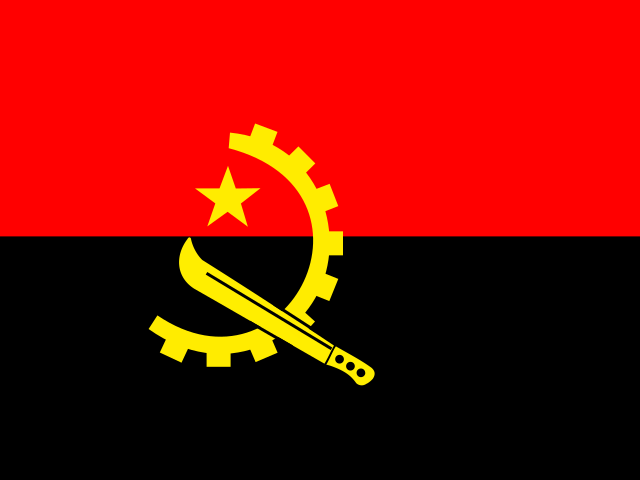 Angola
 Botswana
 Comoros
 Democratic Republic of the Congo
 Eswatini
 Lesotho
 Madagascar
 Malawi
 Mauritius
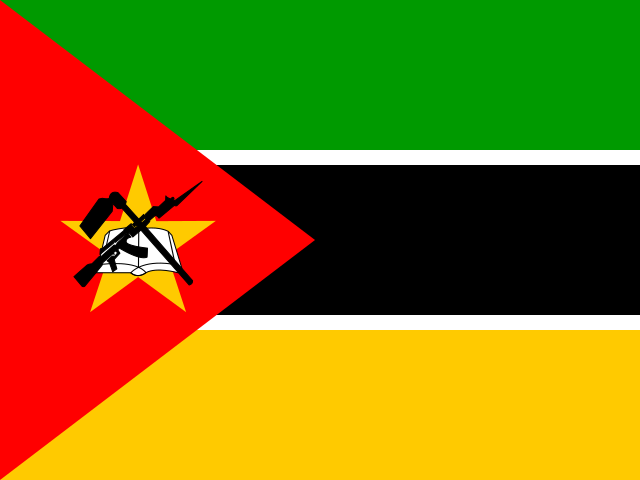 Mozambique
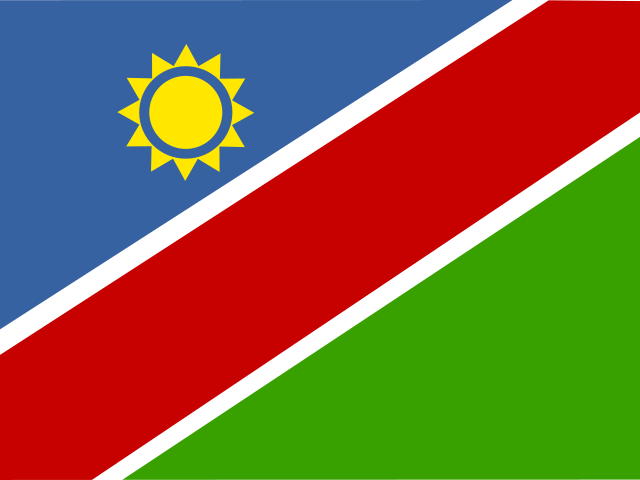 Namibia
 Seychelles
 South Africa
 Tanzania
 Zambia
 Zimbabwe
Earlier Report Observations
The SADC sheep and goat meat market expanded from 883 thousand tons in 2018 to 917 thousand tons in 2019. This initial growth was supported by a reported significant increase in regional goat meat production and rising incomes that enhanced meat affordability, even though cultural preferences continued to favor lamb and mutton for specific consumer groups. Market volume then experienced a modest contraction to 897 thousand tons in 2020.
Volume recovered to 915 thousand tons in 2021, although the market value declined to 4 394 million US dollars. A sharp upturn followed in 2022, with volume rising to 971 thousand tons and value surging to 5 251 million US dollars. This expansion coincided with a global context of tight meat supplies and strong demand that elevated prices, while a persistent Foot-and-Mouth Disease outbreak introduced challenges for the livestock sector.
Growth accelerated further in 2023, as the market reached 1 062 thousand tons valued at 5 740 million US dollars. This period was characterized by rising global demand for goat meat, driven by health, cultural, and religious factors, which stimulated production and trade activity within the region.
Table of content
- 1. Disclaimer
- 2. Terms of use of the report
- 3. Product codes in the statistical classifications used in the report
-
4. Key Market Indicators and Trends
-
4.1. Key Market Indicators
-
4.1.1. In kind
- 4.1.1.1. Production, 2018-2023
- 4.1.1.2. Imports, 2018-2024
- 4.1.1.3. Exports, 2018-2024
- 4.1.1.4. Market size, 2018-2023
-
4.1.2. In value
- 4.1.2.1. Production, 2018-2023
- 4.1.2.2. Imports, 2018-2024
- 4.1.2.3. Exports, 2018-2024
- 4.1.2.4. Market size, 2018-2023
-
4.1.1. In kind
- 4.2. Market Trends and Factors
-
4.1. Key Market Indicators
-
5. Production
-
5.1. Production in SADC
- 5.1.1. Annual dynamics of production in SADC in kind, 2018-2023, K t
-
5.2. Global production by Country, 2018-2023
- 5.2.1. Annual dynamics of production by macroregions in kind, 2018-2023, K t
- 5.2.2. Dynamics of production structure by macroregions in kind, 2018-2023
- 5.2.3. Annual dynamics of production by country in kind, 2018-2023, K t
- 5.2.4. Structure of production by countries in kind, 2018-2023
- 5.2.5. Dynamics of peoduction structure by countries in kind, 2018-2023
-
5.1. Production in SADC
-
6. Imports
-
6.1. Imports (Direct Data*)
- 6.1.1. Imports - Total information
-
6.1.2. Imports in kind, t
- 6.1.2.1. Annual dynamics of product's imports to Angola in kind, 2018-2024, t
- 6.1.2.2. Dynamics of product's imports in kind to Angola by countries, 2018-2024, t
- 6.1.2.3. Structure of product's imports in kind by countries, 2018-2024
-
6.1.3. Imports in value, M $ US
- 6.1.3.1. Annual dynamics of product's imports to Angola in value, 2018-2024, M $ US
- 6.1.3.2. Dynamics of product's imports in value to Angola by countries, 2018-2024, M $ US
- 6.1.3.3. Structure of product's imports in value by countries, 2018-2024
-
6.1.4. Average price of product's imports, $ US/t
- 6.1.4.1. Annual dynamics of average price of product's imports to Angola, 2018-2024, $ US/t
- 6.1.4.2. Dynamics of average price of product's imports to Angola by countries, 2018-2024, $ US/t
-
6.2. Imports (Mirror Data)
- 6.2.1. Imports - Total information
-
6.2.2. Imports in kind, t
- 6.2.2.1. Annual dynamics of product's imports to Angola in kind, 2018-2024, t
- 6.2.2.2. Dynamics of product's imports in kind to Angola by countries, 2018-2024, t
- 6.2.2.3. Structure of product's imports in kind by countries, 2018-2024
-
6.2.3. Imports in value, M $ US
- 6.2.3.1. Annual dynamics of product's imports to Angola in value, 2018-2024, M $ US
- 6.2.3.2. Dynamics of product's imports in value to Angola by countries, 2018-2024, M $ US
- 6.2.3.3. Structure of product's imports in value by countries, 2018-2024
-
6.2.4. Average price of product's imports, $ US/t
- 6.2.4.1. Annual dynamics of average price of product's imports to Angola, 2018-2024, $ US/t
- 6.2.4.2. Dynamics of average price of product's imports to Angola by countries, 2018-2024, $ US/t
-
6.1. Imports (Direct Data*)
-
7. Exports
-
7.1. Exports (Direct Data*)
- 7.1.1. Exports - Total information
-
7.1.2. Exports in kind, t
- 7.1.2.1. Annual dynamics of product's exports from Angola in kind, 2018-2024, t
- 7.1.2.2. Dynamics of product's exports in kind from Angola by countries, 2018-2024, t
- 7.1.2.3. Structure of product's exports in kind by countries, 2018-2024
-
7.1.3. Exports in value, M $ US
- 7.1.3.1. Annual dynamics of product's exports from Angola in value, 2018-2024, M $ US
- 7.1.3.2. Dynamics of product's exports in value from Angola by countries, 2018-2024, M $ US
- 7.1.3.3. Structure of product's exports in value by countries, 2018-2024
-
7.1.4. Average price of product's exports, $ US/t
- 7.1.4.1. Annual dynamics of average price of product's exports from Angola, 2018-2024, $ US/t
- 7.1.4.2. Dynamics of average price of product's exports from Angola by countries, 2018-2024, $ US/t
-
7.2. Exports (Mirror Data)
- 7.2.1. Exports - Total information
-
7.2.2. Exports in kind, t
- 7.2.2.1. Annual dynamics of product's exports from Angola in kind, 2018-2024, t
- 7.2.2.2. Dynamics of product's exports in kind from Angola by countries, 2018-2024, t
- 7.2.2.3. Structure of product's exports in kind by countries, 2018-2024
-
7.2.3. Exports in value, M $ US
- 7.2.3.1. Annual dynamics of product's exports from Angola in value, 2018-2024, M $ US
- 7.2.3.2. Dynamics of product's exports in value from Angola by countries, 2018-2024, M $ US
- 7.2.3.3. Structure of product's exports in value by countries, 2018-2024
-
7.2.4. Average price of product's exports, $ US/t
- 7.2.4.1. Annual dynamics of average price of product's exports from Angola, 2018-2024, $ US/t
- 7.2.4.2. Dynamics of average price of product's exports from Angola by countries, 2018-2024, $ US/t
-
7.1. Exports (Direct Data*)
-
8. Trade balance
-
8.1. Trade balance (Direct Data)
- 8.1.1. In kind, t
- 8.1.2. In value, M $ US
-
8.2. Trade balance (Mirror Data)
- 8.2.1. In kind, t
- 8.2.2. In value, M $ US
-
8.1. Trade balance (Direct Data)
-
9. Top buying and selling countries, 2018-2024
-
9.1. Direct Data
- 9.1.1. Import in Value by Countries-buyers
- 9.1.2. Export in Value by Countries-suppliers
-
9.2. Mirror Data
- 9.2.1. Import in Value by Countries-buyers
- 9.2.2. Export in Value by Countries-suppliers
-
9.1. Direct Data
Production sheep and goat meat in SADC
In kind, 2017-2020, K t
Top producers of sheep and goat meat, 2017-2020
World map of production of sheep and goat meat, 2017-2020
Following two years of growth, SADC's sheep and goat meat production volume experienced a decline. In 2020, the region produced 892.6 K t of sheep and goat meat, representing a year-on-year decrease of 1.9%. From 2017 to 2020, production increased by 8.4%, which translates to an annualized growth rate of 2.7%. The peak production level was reached in 2019 at 910.2 K t, while the most significant annual increase occurred in 2018 at 6.3%.
Annual dynamics of production in SADC in kind, 2017-2020, K t
| Parameter | 2018 | 2019 | 2020 | CAGR | |
|---|---|---|---|---|---|
| 1 | Change from last year | 6.3% | 4.0% | (1.9%) | 2.7% |
In value, 2017-2020, M $ US
SADC's sheep and goat meat production value continued to rise for the second consecutive year. In 2020, the output was valued at 5 070 M $ US, marking a gradual increase of 6.2% compared to the previous year. However, over the 2017-2020 period, production value decreased by 11.2%, with a compound annual growth rate (CAGR) of -3.9%. The lowest value was recorded in 2018 at 4 577 M $ US, which also saw the largest decline of 19.9%.
Annual dynamics of production in SADC in value, 2017-2020, M $ US
| Parameter | 2018 | 2019 | 2020 | CAGR | |
|---|---|---|---|---|---|
| 1 | Change from last year | (19.9%) | 4.3% | 6.2% | (3.9%) |
Exports sheep and goat meat from SADC
Exports in kind, t
Sheep and goat meat exports from SADC declined for the second year in a row. In 2020, exports totaled 2 032 t, reflecting an 11.2% decrease from 2019. Over the 2017-2020 period, exports fell by 39.5%, with a CAGR of -15.4%. The highest export volume was recorded in 2018 at 3 661 t, while the most significant drop occurred in 2019 at 37.5%. The largest increase was observed in 2018 at 9.1%.
Annual dynamics of product's exports from SADC in kind, 2017-2020, t
| Parameter | 2018 | 2019 | 2020 | CAGR | |
|---|---|---|---|---|---|
| 1 | Change from last year | 9.1% | (37.5%) | (11.2%) | (15.4%) |
The partner structure for exports in kind remained fragmented during 2017–2020. The United Arab Emirates accounted for 15.3% of exports, Oman for 5.1%, and Qatar for 4.1%. Together, these three countries represented only 24.4% of total export flows, with no single country achieving a dominant share.
Structure of product's exports in kind by countries, 2017-2020
World map of product's exports from SADC in kind, 2017-2020
Exports in value, K $ US
Sheep and goat meat export values from SADC declined for the third consecutive year. In 2020, exports amounted to 11 542 K $ US, down by 3.8% from the previous year. Over the 2017-2020 period, export values decreased by 50.5%, with a CAGR of -20.9%.
Annual dynamics of product's exports from SADC in value, 2017-2020, K $ US
| Parameter | 2018 | 2019 | 2020 | CAGR | |
|---|---|---|---|---|---|
| 1 | Change from last year | (17.8%) | (37.4%) | (3.8%) | (20.9%) |
From 2017 to 2020, SADC's sheep and goat meat exports in value terms were distributed across a wide range of partner countries. The United Arab Emirates accounted for 11.8% of export value, Qatar for 7.4%, and Iraq for 4.3%. Collectively, these three countries represented just 23.5% of total export flows.
Structure of product's exports in value by countries, 2017-2020
World map of product's exports from SADC in value, 2017-2020
Imports sheep and goat meat to SADC
Imports in kind, t
Sheep and goat meat imports into SADC declined for the third consecutive year. In 2020, SADC imported 6 568 t of sheep and goat meat, representing a substantial decline of 24.9% compared to the previous year. Over the 2017-2020 period, imports decreased by 50.2%, with a CAGR of -20.7%.
Annual dynamics of product's imports to SADC in kind, 2017-2020, t
| Parameter | 2018 | 2019 | 2020 | CAGR | |
|---|---|---|---|---|---|
| 1 | Change from last year | (10.4%) | (25.9%) | (24.9%) | (20.7%) |
During 2017–2020, Australia remained the dominant supplier of sheep and goat meat to SADC, accounting for 50.7% of imports in kind. New Zealand followed with 11.3%, and India with 2.9%. Together, these three countries constituted 64.9% of total imports in kind.
Structure of product's imports in kind by countries, 2017-2020
World map of product's imports to SADC in kind, 2017-2020
Imports in value, K $ US
Sheep and goat meat import values into SADC declined for the second consecutive year. In 2020, SADC imported a total of 35 098 K $ US of sheep and goat meat, representing a substantial decline of 20.6% compared to 2019. Over the 2017-2020 period, import values decreased by 41.8%, with a CAGR of -16.5%. The peak import value was recorded in 2018 at 60 343 K $ US, which also saw the largest increase of 0.1%. The most significant decline occurred in 2019 at 26.7%.
Annual dynamics of product's imports to SADC in value, 2017-2020, K $ US
| Parameter | 2018 | 2019 | 2020 | CAGR | |
|---|---|---|---|---|---|
| 1 | Change from last year | 0.1% | (26.7%) | (20.6%) | (16.5%) |
From 2017 to 2020, Australia remained the principal supplier of sheep and goat meat to SADC in value terms, accounting for 58.5% of imports. New Zealand followed with 11.3%, and Spain with 3.1%. Together, these three countries represented 73.0% of total import value.
Structure of product's imports in value by countries, 2017-2020
World map of product's imports to SADC in value, 2017-2020
Related Reports

Sheep and goat meat market in Libya
2026-03-27
Sheep and goat meat market in Middle Africa
2026-03-27
Sheep and goat meat market in Tunisia
2026-03-27

2026-03-27

Fresh or chilled goose meat market in SADC
2026-03-30

Chicken meat and offal market in SADC
2026-03-27

Why Choose Us?
Only Verified Data
No Hidden Costs or Separate Fees
Smarter Subscription Pricing
Contact Our Team
Submit your inquiry using the form below — our team will get back to you within 24 hours.