






"Middle Africa" region includes following countries:
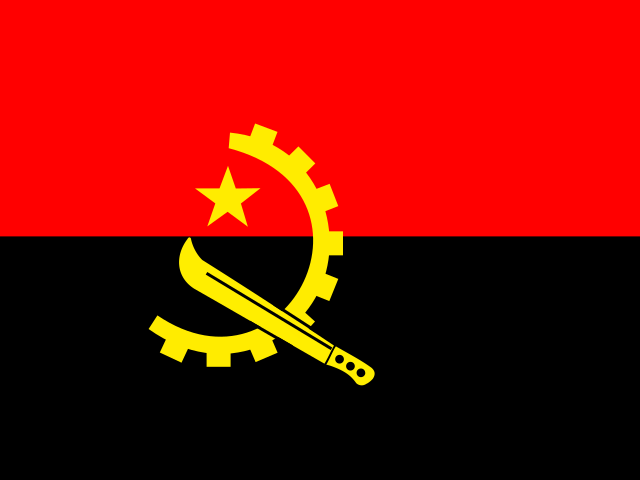 Angola
 Cameroon
 Central African Republic
 Chad
Chad Congo
Congo Democratic Republic of the Congo
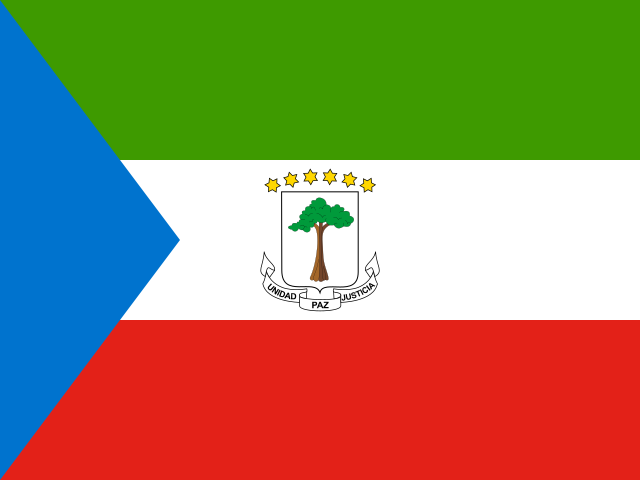 Equatorial Guinea
 Gabon
Gabon Sao Tome and Principe
Earlier Report Observations
The market volume for sheep and goat meat in Middle Africa rose consistently from 788 thousand tons in 2018 to 1 040 thousand tons in 2023, supported by steady production growth while imports and exports played a minor role.
The production increase in 2023 was notably driven by herd recovery and substantial investments in livestock infrastructure in Cameroon, including vaccination programs and artificial insemination, which boosted meat output by 7% during the first eight months of the year.
In 2024, regulatory developments came into force, such as the mandatory application of 29 agro-food standards and origin labeling requirements for meat served in out-of-home dining, aiming to enhance product quality and consumer transparency.
Table of content
- 1. Disclaimer
- 2. Terms of use of the report
- 3. Product codes in the statistical classifications used in the report
-
4. Key Market Indicators and Trends
-
4.1. Key Market Indicators
-
4.1.1. In kind
- 4.1.1.1. Production, 2018-2023
- 4.1.1.2. Imports, 2018-2024
- 4.1.1.3. Exports, 2018-2024
- 4.1.1.4. Market size, 2018-2023
-
4.1.1. In kind
- 4.2. Market Trends and Factors
-
4.1. Key Market Indicators
-
5. Production
-
5.1. Production in Middle Africa
- 5.1.1. Annual dynamics of production in Middle Africa in kind, 2018-2023, K t
-
5.2. Global production by Country, 2018-2023
- 5.2.1. Annual dynamics of production by macroregions in kind, 2018-2023, K t
- 5.2.2. Dynamics of production structure by macroregions in kind, 2018-2023
- 5.2.3. Annual dynamics of production by country in kind, 2018-2023, K t
- 5.2.4. Structure of production by countries in kind, 2018-2023
- 5.2.5. Dynamics of peoduction structure by countries in kind, 2018-2023
-
5.1. Production in Middle Africa
-
6. Imports
-
6.1. Imports (Direct Data*)
- 6.1.1. Imports - Total information
-
6.1.2. Imports in kind, t
- 6.1.2.1. Annual dynamics of product's imports to Angola in kind, 2018-2024, t
- 6.1.2.2. Dynamics of product's imports in kind to Angola by countries, 2018-2024, t
- 6.1.2.3. Structure of product's imports in kind by countries, 2018-2024
-
6.1.3. Imports in value, K $ US
- 6.1.3.1. Annual dynamics of product's imports to Angola in value, 2018-2024, K $ US
- 6.1.3.2. Dynamics of product's imports in value to Angola by countries, 2018-2024, K $ US
- 6.1.3.3. Structure of product's imports in value by countries, 2018-2024
-
6.1.4. Average price of product's imports, $ US/t
- 6.1.4.1. Annual dynamics of average price of product's imports to Angola, 2018-2024, $ US/t
- 6.1.4.2. Dynamics of average price of product's imports to Angola by countries, 2018-2024, $ US/t
-
6.2. Imports (Mirror Data)
- 6.2.1. Imports - Total information
-
6.2.2. Imports in kind, t
- 6.2.2.1. Annual dynamics of product's imports to Angola in kind, 2018-2024, t
- 6.2.2.2. Dynamics of product's imports in kind to Angola by countries, 2018-2024, t
- 6.2.2.3. Structure of product's imports in kind by countries, 2018-2024
-
6.2.3. Imports in value, K $ US
- 6.2.3.1. Annual dynamics of product's imports to Angola in value, 2018-2024, K $ US
- 6.2.3.2. Dynamics of product's imports in value to Angola by countries, 2018-2024, K $ US
- 6.2.3.3. Structure of product's imports in value by countries, 2018-2024
-
6.2.4. Average price of product's imports, $ US/t
- 6.2.4.1. Annual dynamics of average price of product's imports to Angola, 2018-2024, $ US/t
- 6.2.4.2. Dynamics of average price of product's imports to Angola by countries, 2018-2024, $ US/t
-
6.1. Imports (Direct Data*)
-
7. Exports
-
7.1. Exports (Direct Data*)
- 7.1.1. Exports - Total information
-
7.1.2. Exports in kind, t
- 7.1.2.1. Annual dynamics of product's exports from Angola in kind, 2018-2024, t
- 7.1.2.2. Dynamics of product's exports in kind from Angola by countries, 2018-2024, t
- 7.1.2.3. Structure of product's exports in kind by countries, 2018-2024
-
7.1.3. Exports in value, K $ US
- 7.1.3.1. Annual dynamics of product's exports from Angola in value, 2018-2024, K $ US
- 7.1.3.2. Dynamics of product's exports in value from Angola by countries, 2018-2024, K $ US
- 7.1.3.3. Structure of product's exports in value by countries, 2018-2024
-
7.1.4. Average price of product's exports, $ US/t
- 7.1.4.1. Annual dynamics of average price of product's exports from Angola, 2018-2024, $ US/t
- 7.1.4.2. Dynamics of average price of product's exports from Angola by countries, 2018-2024, $ US/t
-
7.2. Exports (Mirror Data)
- 7.2.1. Exports - Total information
-
7.2.2. Exports in kind, t
- 7.2.2.1. Annual dynamics of product's exports from Angola in kind, 2018-2024, t
- 7.2.2.2. Dynamics of product's exports in kind from Angola by countries, 2018-2024, t
- 7.2.2.3. Structure of product's exports in kind by countries, 2018-2024
-
7.2.3. Exports in value, K $ US
- 7.2.3.1. Annual dynamics of product's exports from Angola in value, 2018-2024, K $ US
- 7.2.3.2. Dynamics of product's exports in value from Angola by countries, 2018-2024, K $ US
- 7.2.3.3. Structure of product's exports in value by countries, 2018-2024
-
7.2.4. Average price of product's exports, $ US/t
- 7.2.4.1. Annual dynamics of average price of product's exports from Angola, 2018-2024, $ US/t
- 7.2.4.2. Dynamics of average price of product's exports from Angola by countries, 2018-2024, $ US/t
-
7.1. Exports (Direct Data*)
-
8. Trade balance
-
8.1. Trade balance (Direct Data)
- 8.1.1. In kind, t
- 8.1.2. In value, K $ US
-
8.2. Trade balance (Mirror Data)
- 8.2.1. In kind, t
- 8.2.2. In value, K $ US
-
8.1. Trade balance (Direct Data)
-
9. Top buying and selling countries, 2018-2024
-
9.1. Direct Data
- 9.1.1. Import in Value by Countries-buyers
- 9.1.2. Export in Value by Countries-suppliers
-
9.2. Mirror Data
- 9.2.1. Import in Value by Countries-buyers
- 9.2.2. Export in Value by Countries-suppliers
-
9.1. Direct Data
Production sheep and goat meat in Middle Africa
In kind, 2017-2020, K t
Top producers of sheep and goat meat, 2017-2020
World map of production of sheep and goat meat, 2017-2020
Sheep and goat meat production in Middle Africa has grown for the third year in a row. In 2020, the region produced 865.0 thousand tons, marking a 5.0% increase from 2019. From 2017 to 2020, production rose by 14.8%, with an average annual growth rate of 4.7%.
Annual dynamics of production in Middle Africa in kind, 2017-2020, K t
| Parameter | 2018 | 2019 | 2020 | CAGR | |
|---|---|---|---|---|---|
| 1 | Change from last year | 4.4% | 4.7% | 5.0% | 4.7% |
Exports sheep and goat meat from Middle Africa
Exports in kind, t
The market showed significant volatility during this period. Export volumes fluctuated dramatically, changing 52 times from the peak in 2019 to the low in 2018. In 2020, Middle Africa exported 0.0 tons of sheep and goat meat, a sharp 97.0% drop year-over-year. The lowest volume was 0.0 tons in 2018, while the highest was 1 ton in 2019. The most significant decline occurred in 2018 at 97.1%, and the largest increase was in 2019 at 5 141.9%.
Annual dynamics of product's exports from Middle Africa in kind, 2017-2020, t
| Parameter | 2018 | 2019 | 2020 | CAGR | |
|---|---|---|---|---|---|
| 1 | Change from last year | (97.1%) | 5 141.9% | (97.0%) | (64.1%) |
From 2017 to 2020, sheep and goat meat exports from Middle Africa were distributed across many markets. France accounted for 17.7% of exports, the Bahamas for 4.6%, and Portugal for 1.6%, together making up just 23.9% of total export flows.
Structure of product's exports in kind by countries, 2017-2020
World map of product's exports from Middle Africa in kind, 2017-2020
Exports in value, K $ US
The market was highly volatile in these years. Export values peaked in 2017 and hit a low in 2020, shifting 108-fold. In 2020, sheep and goat meat exports from Middle Africa totaled 0.1 thousand US dollars, a steep 99.0% decrease from the previous year. The largest increase was recorded in 2019 at 8 335.6%.
Annual dynamics of product's exports from Middle Africa in value, 2017-2020, K $ US
| Parameter | 2018 | 2019 | 2020 | CAGR | |
|---|---|---|---|---|---|
| 1 | Change from last year | (98.9%) | 8 335.6% | (99.0%) | (79.0%) |
Between 2017 and 2020, France, the Bahamas, and Portugal were the top destinations for Middle Africa's sheep and goat meat exports by value. France held 40.5% of export value, the Bahamas 12.2%, and Portugal 3.3%, together accounting for 56.0% of total export flows.
Structure of product's exports in value by countries, 2017-2020
World map of product's exports from Middle Africa in value, 2017-2020
Imports sheep and goat meat to Middle Africa
Imports in kind, t
After two years of growth, sheep and goat meat imports into Middle Africa fell. In 2020, imports reached 866 tons, a substantial 23.7% decline from the previous year. From 2017 to 2020, imports decreased by 9.1%, equivalent to an annualized rate of 3.1%. The highest volume was 1 135 tons in 2019, and the largest increase was 11.4% in 2018.
Annual dynamics of product's imports to Middle Africa in kind, 2017-2020, t
| Parameter | 2018 | 2019 | 2020 | CAGR | |
|---|---|---|---|---|---|
| 1 | Change from last year | 11.4% | 7.0% | (23.7%) | (3.1%) |
During 2017–2020, sheep and goat meat imports to Middle Africa came from a wide range of countries. Spain contributed 14.2% of imports, Belgium 8.2%, and Portugal 7.4%, together representing only 29.8% of total import flows.
Structure of product's imports in kind by countries, 2017-2020
World map of product's imports to Middle Africa in kind, 2017-2020
Imports in value, K $ US
Imports of sheep and goat meat into Middle Africa declined for the second consecutive year. In 2020, the region imported 4 350 thousand US dollars worth of sheep and goat meat, a modest 6.7% decrease from the year before. Over the 2017–2020 period, imports increased by 13%, with an average annual growth rate of 4.1%. The highest value was 5 360 thousand US dollars in 2018. The largest decline was 13.0% in 2019, and the largest increase was 39.2% in 2018.
Annual dynamics of product's imports to Middle Africa in value, 2017-2020, K $ US
| Parameter | 2018 | 2019 | 2020 | CAGR | |
|---|---|---|---|---|---|
| 1 | Change from last year | 39.2% | (13.0%) | (6.7%) | 4.1% |
From 2017 to 2020, Spain, New Zealand, and France were the leading suppliers of sheep and goat meat to Middle Africa by value. Spain accounted for 13.2% of import value, New Zealand for 10.4%, and France for 10.2%, but their combined share was just 33.8% of total imports, indicating a diversified supplier base.
Structure of product's imports in value by countries, 2017-2020
World map of product's imports to Middle Africa in value, 2017-2020
Related Reports

Sheep and goat meat market in Hong Kong
2026-03-27
Sheep and goat meat market in Tunisia
2026-03-27
Sheep and goat meat market in Botswana
2026-03-27
Sheep and goat meat market in Cuba
2026-03-27

Pig offal market in Middle Africa
2026-03-30



Goat meat market in Middle Africa
2026-03-27
Why Choose Us?
Only Verified Data
No Hidden Costs or Separate Fees
Smarter Subscription Pricing
Contact Our Team
Submit your inquiry using the form below — our team will get back to you within 24 hours.