






"Middle Africa" region includes following countries:
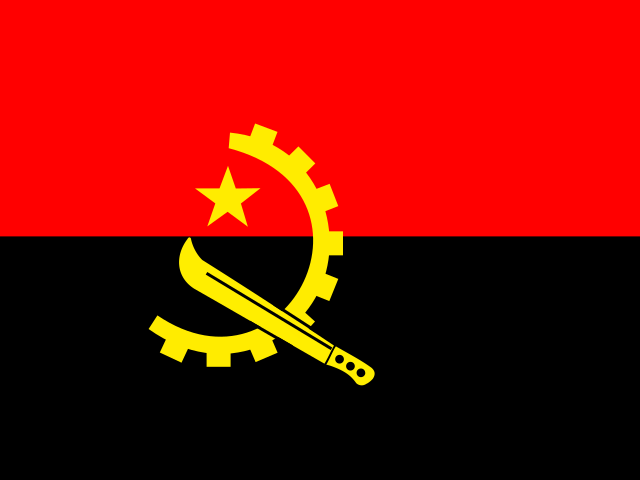 Angola
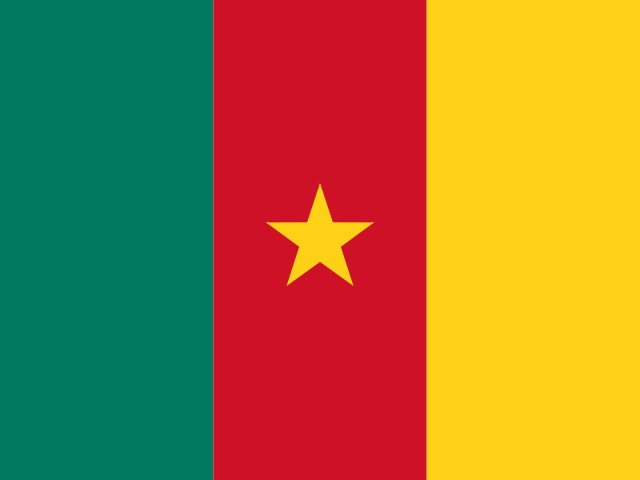 Cameroon
 Central African Republic
 Chad
Chad Congo
Congo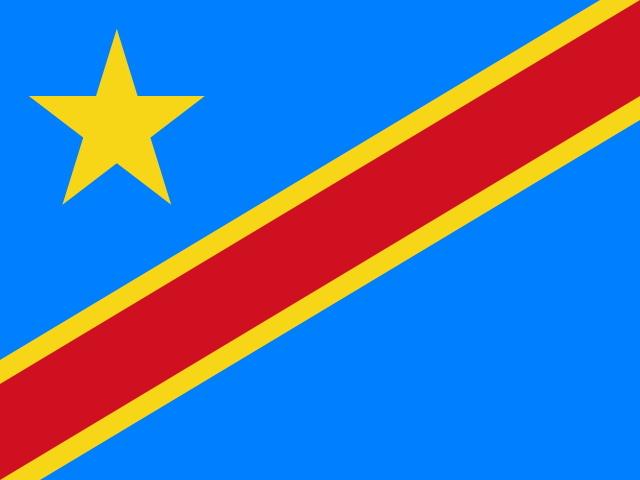 Democratic Republic of the Congo
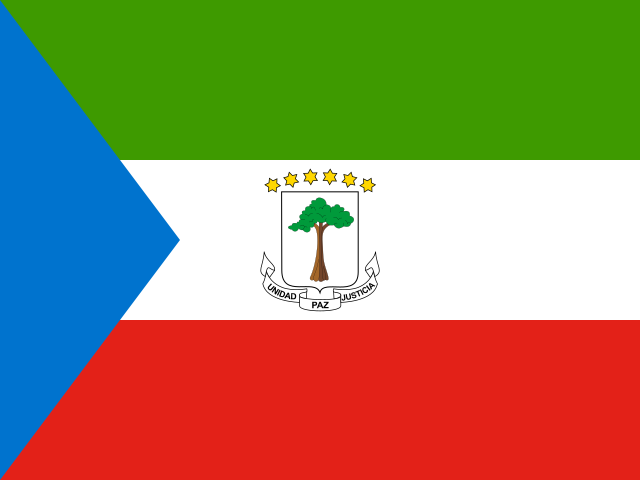 Equatorial Guinea
 Gabon
Gabon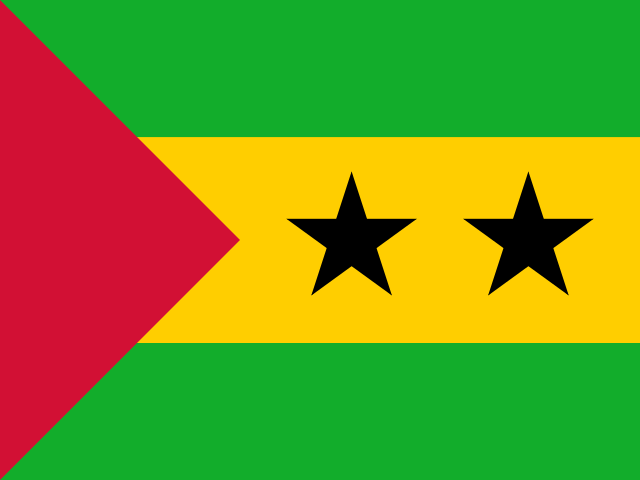 Sao Tome and Principe
Earlier Report Observations
The palm oil market in Middle Africa expanded significantly in 2019, surpassing 1.1 million tons, as the Cameroonian government authorized imports of 100,000 tons to cover a domestic production deficit. This move was supported by national fertilization programs to improve smallholder yields and increased supply from regional producers like Olam Palm Gabon. However, growth faced headwinds from community pressures against large-scale land acquisitions for industrial plantations, which began to constrain new project development.
Following a market contraction in 2021, volumes recovered strongly from 2022 onward. The announcement of four new refineries in Cameroon, with investments over 50 billion CFA francs, aimed to boost local processing capacity against industrial demand exceeding one million tons annually. Simultaneously, global supply shocks from the war in Ukraine and Indonesia's export restrictions caused a sharp rise in palm oil prices, incentivizing increased regional production and import activity to meet consumption needs.
By 2024, Cameroonian production rose by nearly 12%, reflecting ongoing sector investments and a new regional strategy for sustainable palm oil development. The entry of new industrial refiners and persistent demand growth, driven by demographics and efforts to reduce import dependency, continued to support the market, despite ongoing social challenges related to land use.
Table of content
- 1. Disclaimer
- 2. Terms of use of the report
- 3. Product codes in the statistical classifications used in the report
-
4. Key Market Indicators and Trends
-
4.1. Key Market Indicators
-
4.1.1. In kind
- 4.1.1.1. Production, 2018-2023
- 4.1.1.2. Imports, 2018-2024
- 4.1.1.3. Exports, 2018-2024
- 4.1.1.4. Market size, 2018-2023
-
4.1.1. In kind
- 4.2. Market Trends and Factors
-
4.1. Key Market Indicators
-
5. Production
-
5.1. Production in Middle Africa
- 5.1.1. Annual dynamics of production in Middle Africa in kind, 2018-2023, K t
-
5.2. Global production by Country, 2018-2023
- 5.2.1. Annual dynamics of production by macroregions in kind, 2018-2023, K t
- 5.2.2. Dynamics of production structure by macroregions in kind, 2018-2023
- 5.2.3. Annual dynamics of production by country in kind, 2018-2023, K t
- 5.2.4. Structure of production by countries in kind, 2018-2023
- 5.2.5. Dynamics of peoduction structure by countries in kind, 2018-2023
-
5.1. Production in Middle Africa
-
6. Imports
-
6.1. Imports (Direct Data*)
- 6.1.1. Imports - Total information
-
6.1.2. Imports in kind, K t
- 6.1.2.1. Annual dynamics of product's imports to Angola in kind, 2018-2024, K t
- 6.1.2.2. Dynamics of product's imports in kind to Angola by countries, 2018-2024, K t
- 6.1.2.3. Structure of product's imports in kind by countries, 2018-2024
-
6.1.3. Imports in value, M $ US
- 6.1.3.1. Annual dynamics of product's imports to Angola in value, 2018-2024, M $ US
- 6.1.3.2. Dynamics of product's imports in value to Angola by countries, 2018-2024, M $ US
- 6.1.3.3. Structure of product's imports in value by countries, 2018-2024
-
6.1.4. Average price of product's imports, $ US/t
- 6.1.4.1. Annual dynamics of average price of product's imports to Angola, 2018-2024, $ US/t
- 6.1.4.2. Dynamics of average price of product's imports to Angola by countries, 2018-2024, $ US/t
-
6.2. Imports (Mirror Data)
- 6.2.1. Imports - Total information
-
6.2.2. Imports in kind, K t
- 6.2.2.1. Annual dynamics of product's imports to Angola in kind, 2018-2024, K t
- 6.2.2.2. Dynamics of product's imports in kind to Angola by countries, 2018-2024, K t
- 6.2.2.3. Structure of product's imports in kind by countries, 2018-2024
-
6.2.3. Imports in value, M $ US
- 6.2.3.1. Annual dynamics of product's imports to Angola in value, 2018-2024, M $ US
- 6.2.3.2. Dynamics of product's imports in value to Angola by countries, 2018-2024, M $ US
- 6.2.3.3. Structure of product's imports in value by countries, 2018-2024
-
6.2.4. Average price of product's imports, $ US/t
- 6.2.4.1. Annual dynamics of average price of product's imports to Angola, 2018-2024, $ US/t
- 6.2.4.2. Dynamics of average price of product's imports to Angola by countries, 2018-2024, $ US/t
-
6.1. Imports (Direct Data*)
-
7. Exports
-
7.1. Exports (Direct Data*)
- 7.1.1. Exports - Total information
-
7.1.2. Exports in kind, K t
- 7.1.2.1. Annual dynamics of product's exports from Angola in kind, 2018-2024, K t
- 7.1.2.2. Dynamics of product's exports in kind from Angola by countries, 2018-2024, K t
- 7.1.2.3. Structure of product's exports in kind by countries, 2018-2024
-
7.1.3. Exports in value, M $ US
- 7.1.3.1. Annual dynamics of product's exports from Angola in value, 2018-2024, M $ US
- 7.1.3.2. Dynamics of product's exports in value from Angola by countries, 2018-2024, M $ US
- 7.1.3.3. Structure of product's exports in value by countries, 2018-2024
-
7.1.4. Average price of product's exports, $ US/t
- 7.1.4.1. Annual dynamics of average price of product's exports from Angola, 2018-2024, $ US/t
- 7.1.4.2. Dynamics of average price of product's exports from Angola by countries, 2018-2024, $ US/t
-
7.2. Exports (Mirror Data)
- 7.2.1. Exports - Total information
-
7.2.2. Exports in kind, K t
- 7.2.2.1. Annual dynamics of product's exports from Angola in kind, 2018-2024, K t
- 7.2.2.2. Dynamics of product's exports in kind from Angola by countries, 2018-2024, K t
- 7.2.2.3. Structure of product's exports in kind by countries, 2018-2024
-
7.2.3. Exports in value, M $ US
- 7.2.3.1. Annual dynamics of product's exports from Angola in value, 2018-2024, M $ US
- 7.2.3.2. Dynamics of product's exports in value from Angola by countries, 2018-2024, M $ US
- 7.2.3.3. Structure of product's exports in value by countries, 2018-2024
-
7.2.4. Average price of product's exports, $ US/t
- 7.2.4.1. Annual dynamics of average price of product's exports from Angola, 2018-2024, $ US/t
- 7.2.4.2. Dynamics of average price of product's exports from Angola by countries, 2018-2024, $ US/t
-
7.1. Exports (Direct Data*)
-
8. Trade balance
-
8.1. Trade balance (Direct Data)
- 8.1.1. In kind, K t
- 8.1.2. In value, M $ US
-
8.2. Trade balance (Mirror Data)
- 8.2.1. In kind, K t
- 8.2.2. In value, M $ US
-
8.1. Trade balance (Direct Data)
-
9. Top buying and selling countries, 2018-2024
-
9.1. Direct Data
- 9.1.1. Import in Value by Countries-buyers
- 9.1.2. Export in Value by Countries-suppliers
-
9.2. Mirror Data
- 9.2.1. Import in Value by Countries-buyers
- 9.2.2. Export in Value by Countries-suppliers
-
9.1. Direct Data
Production palm oil and fractions in Middle Africa
In kind, 2017-2020, K t
Top producers of palm oil and fractions, 2017-2020
World map of production of palm oil and fractions, 2017-2020
Middle Africa's production of palm oil and fractions has increased following a two-year decline. In 2020, the region produced 838.1 K t, marking a year-on-year increase of 7.8%. Over the 2017-2020 period, production grew by 6.5%, with a compound annual growth rate (CAGR) of 2.1%. The lowest production level was recorded in 2019 at 777.2 K t, which also saw the largest decline of 0.8%.
Annual dynamics of production in Middle Africa in kind, 2017-2020, K t
| Parameter | 2018 | 2019 | 2020 | CAGR | |
|---|---|---|---|---|---|
| 1 | Change from last year | (0.5%) | (0.8%) | 7.8% | 2.1% |
In value, 2017-2020, M $ US
After two years of decline, palm oil and fractions production in Middle Africa has rebounded. In 2020, the output was valued at 578.0 M $ US, representing a 19.7% increase compared to 2019. From 2017 to 2020, production rose by 7.7%, with a CAGR of 2.5%. The lowest value was recorded in 2019 at 483.0 M $ US, which experienced the most significant decline of 5.8%.
Annual dynamics of production in Middle Africa in value, 2017-2020, M $ US
| Parameter | 2018 | 2019 | 2020 | CAGR | |
|---|---|---|---|---|---|
| 1 | Change from last year | (4.5%) | (5.8%) | 19.7% | 2.5% |
Exports palm oil and fractions from Middle Africa
Exports in kind, K t
Middle Africa's exports of palm oil and fractions have grown for the third consecutive year. In 2020, exports reached 57.0 K t, a 42.8% increase from the previous year. Over the 2017-2020 period, exports surged by 446%, with a CAGR of 76.1%.
Annual dynamics of product's exports from Middle Africa in kind, 2017-2020, K t
| Parameter | 2018 | 2019 | 2020 | CAGR | |
|---|---|---|---|---|---|
| 1 | Change from last year | 146.5% | 55.1% | 42.8% | 76.1% |
The export market for palm oil and fractions in kind was highly diversified from 2017 to 2020. Rwanda (7.7% of exports in kind), the Netherlands (7.5%), and Spain (6.6%) together accounted for just 21.8% of total flows, while the remaining 78.2% was distributed among numerous other countries.
Structure of product's exports in kind by countries, 2017-2020
World map of product's exports from Middle Africa in kind, 2017-2020
Exports in value, M $ US
Middle Africa's export value of palm oil and fractions has risen for the third year in a row. In 2020, exports totaled 39.3 M $ US, up 58.5% from the previous year. Between 2017 and 2020, exports increased by 452.5%, with a CAGR of 76.8%.
Annual dynamics of product's exports from Middle Africa in value, 2017-2020, M $ US
| Parameter | 2018 | 2019 | 2020 | CAGR | |
|---|---|---|---|---|---|
| 1 | Change from last year | 136.6% | 47.4% | 58.5% | 76.8% |
The structure of exports in value terms was diversified during 2017-2020. The Netherlands (8.6% of exports in value terms), Spain (7.5%), and Italy (4.3%) collectively represented only 20.4% of total flows, with no single country holding a dominant position.
Structure of product's exports in value by countries, 2017-2020
World map of product's exports from Middle Africa in value, 2017-2020
Imports palm oil and fractions to Middle Africa
Imports in kind, K t
Following two years of growth, palm oil and fractions imports into Middle Africa declined. In 2020, imports amounted to 354.2 K t, down 12.2% from 2019. Over the 2017-2020 period, imports increased by 84%, with a CAGR of 22.5%. The peak was in 2019 at 403.5 K t, which also saw the largest increase of 61.0%.
Annual dynamics of product's imports to Middle Africa in kind, 2017-2020, K t
| Parameter | 2018 | 2019 | 2020 | CAGR | |
|---|---|---|---|---|---|
| 1 | Change from last year | 30.2% | 61.0% | (12.2%) | 22.5% |
From 2017 to 2020, Malaysia (46.4% of imports in kind), Indonesia (32.2%), and Singapore (4.3%) were the primary sources for palm oil and fractions imports into Middle Africa, together accounting for 83.0% of total flows.
Structure of product's imports in kind by countries, 2017-2020
World map of product's imports to Middle Africa in kind, 2017-2020
Imports in value, M $ US
After two years of increase, Middle Africa's imports of palm oil and fractions in value terms declined. In 2020, imports were valued at 320.0 M $ US, a decrease of 2.8% from the previous year. Between 2017 and 2020, imports grew by 105.1%, equating to an annualized rate of 27.1%. The highest value was recorded in 2019 at 329.1 M $ US, with the largest increase occurring in 2018 at 66.8%.
Annual dynamics of product's imports to Middle Africa in value, 2017-2020, M $ US
| Parameter | 2018 | 2019 | 2020 | CAGR | |
|---|---|---|---|---|---|
| 1 | Change from last year | 66.8% | 26.5% | (2.8%) | 27.1% |
In 2017-2020, Malaysia (47.5% of imports in value terms), Indonesia (31.6%), and Singapore (5.2%) formed the main group of sources for palm oil and fractions imports into Middle Africa, with a combined share of 84.2% of total flows.
Structure of product's imports in value by countries, 2017-2020
World map of product's imports to Middle Africa in value, 2017-2020
Related Reports

Palm oil and fractions market in Senegal
2026-03-28
Palm oil and fractions market in Burundi
2026-03-28
Palm oil and fractions market in Caribbean
2026-03-28




Non-vegetable waxes market in Middle Africa
2026-03-28
Why Choose Us?
Only Verified Data
No Hidden Costs or Separate Fees
Smarter Subscription Pricing
Contact Our Team
Submit your inquiry using the form below — our team will get back to you within 24 hours.