






"Middle Africa" region includes following countries:
 Angola
 Cameroon
 Central African Republic
 Chad
Chad Congo
Congo Democratic Republic of the Congo
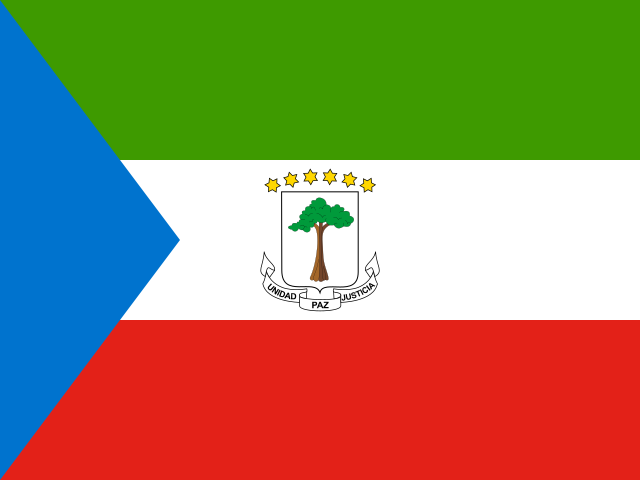 Equatorial Guinea
 Gabon
Gabon Sao Tome and Principe
Earlier Report Observations
The market for coconut oil and fractions in Middle Africa contracted sharply from 3.9 million $ in 2018 to 1.2 million $ in 2021. This decline coincided with a major increase in the local supply of palm oil in Cameroon, which reached 413 000 tonnes in 2018, providing a cheaper alternative for industrial users and reducing demand for coconut oil. Regional market disruptions, including reported unfair competition and large unsold inventories of oil in Burkina Faso, further hampered trade and contributed to the falling market value.
A recovery emerged from 2022, with the market growing to 1.7 million $ and then to 2.0 million $ in 2023. This rebound was fueled by shifting consumer preferences towards natural, organic, and cold-pressed vegetable oils, which bolstered demand for virgin coconut oil. The sector also benefited from organizational initiatives, such as Côte d'Ivoire's accession to the International Coconut Community in 2023, aimed at improving industry coordination and promoting value-added products.
The market's structure continued to evolve with the announcement of four new palm oil refineries in Cameroon in 2023, reflecting broader investment in oil processing capacity in the region. Furthermore, 2024 saw the extension of legal regulations for the coconut sector in Côte d'Ivoire and the entry of new refining players like the Société de raffinage du Cameroun, signaling a move towards a more formalized and transparent supply chain for coconut oil in Middle Africa.
Table of content
- 1. Disclaimer
- 2. Terms of use of the report
- 3. Product codes in the statistical classifications used in the report
-
4. Key Market Indicators and Trends
-
4.1. Key Market Indicators
-
4.1.1. In value
- 4.1.1.1. Production, 2018-2023
- 4.1.1.2. Imports, 2018-2024
- 4.1.1.3. Exports, 2018-2024
- 4.1.1.4. Market size, 2018-2023
-
4.1.1. In value
- 4.2. Market Trends and Factors
-
4.1. Key Market Indicators
-
5. Production
-
5.1. Production in Middle Africa
- 5.1.1. Annual dynamics of production in Middle Africa in kind, 2018-2023, t
-
5.2. Global production by Country, 2018-2023
- 5.2.1. Annual dynamics of production by macroregions in kind, 2018-2023, t
- 5.2.2. Dynamics of production structure by macroregions in kind, 2018-2023
- 5.2.3. Annual dynamics of production by country in kind, 2018-2023, t
- 5.2.4. Structure of production by countries in kind, 2018-2023
- 5.2.5. Dynamics of peoduction structure by countries in kind, 2018-2023
-
5.1. Production in Middle Africa
-
6. Imports
-
6.1. Imports (Direct Data*)
- 6.1.1. Imports - Total information
-
6.1.2. Imports in kind, t
- 6.1.2.1. Annual dynamics of product's imports to Angola in kind, 2018-2024, t
- 6.1.2.2. Dynamics of product's imports in kind to Angola by countries, 2018-2024, t
- 6.1.2.3. Structure of product's imports in kind by countries, 2018-2024
-
6.1.3. Imports in value, K $ US
- 6.1.3.1. Annual dynamics of product's imports to Angola in value, 2018-2024, K $ US
- 6.1.3.2. Dynamics of product's imports in value to Angola by countries, 2018-2024, K $ US
- 6.1.3.3. Structure of product's imports in value by countries, 2018-2024
-
6.1.4. Average price of product's imports, $ US/t
- 6.1.4.1. Annual dynamics of average price of product's imports to Angola, 2018-2024, $ US/t
- 6.1.4.2. Dynamics of average price of product's imports to Angola by countries, 2018-2024, $ US/t
-
6.2. Imports (Mirror Data)
- 6.2.1. Imports - Total information
-
6.2.2. Imports in kind, t
- 6.2.2.1. Annual dynamics of product's imports to Angola in kind, 2018-2024, t
- 6.2.2.2. Dynamics of product's imports in kind to Angola by countries, 2018-2024, t
- 6.2.2.3. Structure of product's imports in kind by countries, 2018-2024
-
6.2.3. Imports in value, K $ US
- 6.2.3.1. Annual dynamics of product's imports to Angola in value, 2018-2024, K $ US
- 6.2.3.2. Dynamics of product's imports in value to Angola by countries, 2018-2024, K $ US
- 6.2.3.3. Structure of product's imports in value by countries, 2018-2024
-
6.2.4. Average price of product's imports, $ US/t
- 6.2.4.1. Annual dynamics of average price of product's imports to Angola, 2018-2024, $ US/t
- 6.2.4.2. Dynamics of average price of product's imports to Angola by countries, 2018-2024, $ US/t
-
6.1. Imports (Direct Data*)
-
7. Exports
-
7.1. Exports (Direct Data*)
- 7.1.1. Exports - Total information
-
7.1.2. Exports in kind, t
- 7.1.2.1. Annual dynamics of product's exports from Angola in kind, 2018-2024, t
- 7.1.2.2. Dynamics of product's exports in kind from Angola by countries, 2018-2024, t
- 7.1.2.3. Structure of product's exports in kind by countries, 2018-2024
-
7.1.3. Exports in value, K $ US
- 7.1.3.1. Annual dynamics of product's exports from Angola in value, 2018-2024, K $ US
- 7.1.3.2. Dynamics of product's exports in value from Angola by countries, 2018-2024, K $ US
- 7.1.3.3. Structure of product's exports in value by countries, 2018-2024
-
7.1.4. Average price of product's exports, $ US/t
- 7.1.4.1. Annual dynamics of average price of product's exports from Angola, 2018-2024, $ US/t
- 7.1.4.2. Dynamics of average price of product's exports from Angola by countries, 2018-2024, $ US/t
-
7.2. Exports (Mirror Data)
- 7.2.1. Exports - Total information
-
7.2.2. Exports in kind, t
- 7.2.2.1. Annual dynamics of product's exports from Angola in kind, 2018-2024, t
- 7.2.2.2. Dynamics of product's exports in kind from Angola by countries, 2018-2024, t
- 7.2.2.3. Structure of product's exports in kind by countries, 2018-2024
-
7.2.3. Exports in value, K $ US
- 7.2.3.1. Annual dynamics of product's exports from Angola in value, 2018-2024, K $ US
- 7.2.3.2. Dynamics of product's exports in value from Angola by countries, 2018-2024, K $ US
- 7.2.3.3. Structure of product's exports in value by countries, 2018-2024
-
7.2.4. Average price of product's exports, $ US/t
- 7.2.4.1. Annual dynamics of average price of product's exports from Angola, 2018-2024, $ US/t
- 7.2.4.2. Dynamics of average price of product's exports from Angola by countries, 2018-2024, $ US/t
-
7.1. Exports (Direct Data*)
-
8. Trade balance
-
8.1. Trade balance (Direct Data)
- 8.1.1. In kind, t
- 8.1.2. In value, K $ US
-
8.2. Trade balance (Mirror Data)
- 8.2.1. In kind, t
- 8.2.2. In value, K $ US
-
8.1. Trade balance (Direct Data)
-
9. Top buying and selling countries, 2018-2024
-
9.1. Direct Data
- 9.1.1. Import in Value by Countries-buyers
- 9.1.2. Export in Value by Countries-suppliers
-
9.2. Mirror Data
- 9.2.1. Import in Value by Countries-buyers
- 9.2.2. Export in Value by Countries-suppliers
-
9.1. Direct Data
Production coconut oil and fractions in Middle Africa
In kind, 2017-2020, t
Top producers of coconut oil and fractions, 2017-2020
World map of production of coconut oil and fractions, 2017-2020
Middle Africa's production of coconut oil and fractions has declined for the second year in a row. In 2020, the region produced 564 tonnes, which represents a 2.3% decrease compared to the previous year. Looking at the period from 2017 to 2020, production fell by 39%, averaging an annual decline of 15.2%. The highest production level was recorded in 2018 at 1 017 tonnes. The most significant drop occurred in 2019 with a 43.2% decrease, while the largest increase was seen in 2018 at 10.0%.
Annual dynamics of production in Middle Africa in kind, 2017-2020, t
| Parameter | 2018 | 2019 | 2020 | CAGR | |
|---|---|---|---|---|---|
| 1 | Change from last year | 10.0% | (43.2%) | (2.3%) | (15.2%) |
Exports coconut oil and fractions from Middle Africa
Exports in kind, t
Middle Africa's exports of coconut oil and fractions have increased for the second consecutive year. In 2020, export volume reached 84.6 tonnes, showing a 5.7% rise compared to the prior year. From 2018 to 2020, exports grew by 131.1%, with a compound annual growth rate of 32.2%.
Annual dynamics of product's exports from Middle Africa in kind, 2017-2020, t
| Parameter | 2018 | 2019 | 2020 | CAGR | |
|---|---|---|---|---|---|
| 1 | Change from last year | n/a | 118.6% | 5.7% | - |
Between 2017 and 2020, Belgium and Portugal consistently held the top positions in the export structure by volume, together accounting for 58.8% of total shipments.
Structure of product's exports in kind by countries, 2017-2020
World map of product's exports from Middle Africa in kind, 2017-2020
Exports in value, K $ US
Middle Africa's exports of coconut oil and fractions in value terms have risen for the second year in a row. In 2020, exports were valued at 268.1 thousand US dollars, reflecting a gradual increase of 5.4% year-over-year. From 2018 to 2020, export value grew by 91.2%, averaging an annual growth rate of 24.1%.
Annual dynamics of product's exports from Middle Africa in value, 2017-2020, K $ US
| Parameter | 2018 | 2019 | 2020 | CAGR | |
|---|---|---|---|---|---|
| 1 | Change from last year | n/a | 81.5% | 5.4% | - |
Throughout 2017 to 2020, Belgium and Portugal remained the primary buyers of coconut oil and fractions from Middle Africa in value terms, together making up 61.2% of total exports.
Structure of product's exports in value by countries, 2017-2020
World map of product's exports from Middle Africa in value, 2017-2020
Imports coconut oil and fractions to Middle Africa
Imports in kind, t
The market displayed volatility during the observed period. Import levels fluctuated significantly, with a 3.2-fold difference between the low in 2017 and the high in 2019. In 2020, Middle Africa imported approximately 86.5 tonnes of coconut oil and fractions, down by 22.3% from the previous year. The peak import volume was recorded in 2019 at 111.3 tonnes, which also saw the largest increase of 97.9%.
Annual dynamics of product's imports to Middle Africa in kind, 2017-2020, t
| Parameter | 2018 | 2019 | 2020 | CAGR | |
|---|---|---|---|---|---|
| 1 | Change from last year | 63.5% | 97.9% | (22.3%) | 36.0% |
From 2017 to 2020, no single market dominated imports by volume. Indonesia, Brazil, and Belgium were the top sources, accounting for 25.4%, 12.5%, and 11.6% of imports respectively, but together they represented only 49.4% of total volume. Many smaller partners each held modest individual shares.
Structure of product's imports in kind by countries, 2017-2020
World map of product's imports to Middle Africa in kind, 2017-2020
Imports in value, K $ US
Market performance showed noticeable fluctuations over the period. Imports reached their lowest point in 2017 and peaked in 2019, with a 3.6-fold gap between these years. In 2020, Middle Africa imported 147.3 thousand US dollars worth of coconut oil and fractions, marking a sharp contraction of 62.7% compared to the prior year. The highest import value was in 2019 at 394.5 thousand US dollars, which also experienced the largest increase of 164.8%.
Annual dynamics of product's imports to Middle Africa in value, 2017-2020, K $ US
| Parameter | 2018 | 2019 | 2020 | CAGR | |
|---|---|---|---|---|---|
| 1 | Change from last year | 37.3% | 164.8% | (62.7%) | 10.7% |
During 2017 to 2020, Brazil, Indonesia, and Belgium were the main sources for imports in value terms, contributing 37.2%, 15.7%, and 10.1% respectively. Together, they accounted for 63.1% of total import value.
Structure of product's imports in value by countries, 2017-2020
World map of product's imports to Middle Africa in value, 2017-2020
Related Reports

Coconut oil and fractions market in Ecuador
2026-03-28
Coconut oil and fractions market in Mexico
2026-03-28




Why Choose Us?
Only Verified Data
No Hidden Costs or Separate Fees
Smarter Subscription Pricing
Contact Our Team
Submit your inquiry using the form below — our team will get back to you within 24 hours.