






"Middle Africa" region includes following countries:
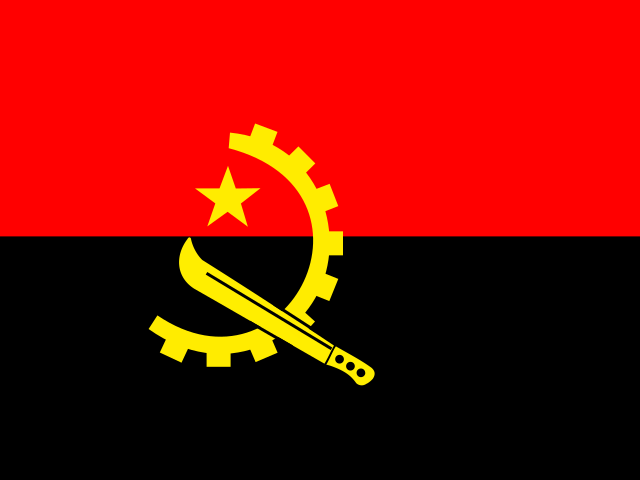 Angola
 Cameroon
 Central African Republic
 Chad
Chad Congo
Congo Democratic Republic of the Congo
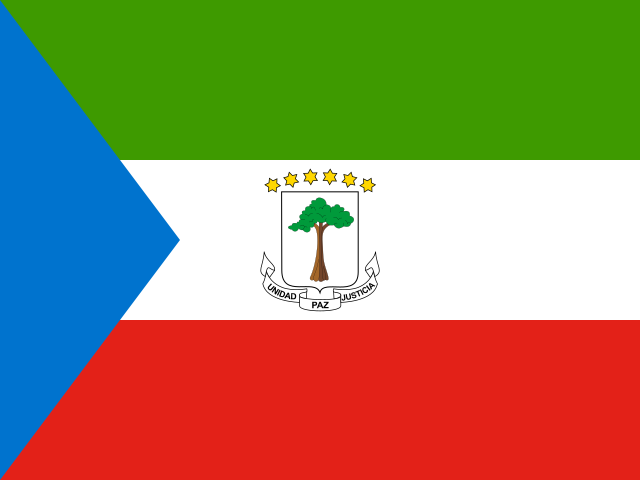 Equatorial Guinea
 Gabon
Gabon Sao Tome and Principe
Earlier Report Observations
Between 2018 and 2023, the market volume for sunflower, safflower or cottonseed oil in Middle Africa more than doubled, rising from 29 428 t to 66 974 t. This expansion was primarily fueled by a dramatic increase in local production, which surged from 17 368 t to 52 419 t over the same period.
After a slight contraction in 2019 to 27 191 t, the market entered a phase of rapid growth, jumping by 35% in 2020 and then by 63% in 2021. Production levels nearly doubled in 2020 and again in 2021, indicating a strong shift toward domestic output. Imports, while fluctuating, remained a substantial component, particularly as they climbed to 14 561 t in 2023.
By 2024, imports continued this upward trend, reaching 20 026 t. During this year, agricultural expansion in Cameroon, with over 50 hectares dedicated to organic sunflower cultivation, aimed to enhance local oil production. Simultaneously, global sunflower oil shortages linked to the Russia-Ukraine conflict and adverse weather in key producing regions created supply pressures, influencing import volumes and prices.
Table of content
- 1. Disclaimer
- 2. Terms of use of the report
- 3. Product codes in the statistical classifications used in the report
-
4. Key Market Indicators and Trends
-
4.1. Key Market Indicators
-
4.1.1. In kind
- 4.1.1.1. Production, 2018-2023
- 4.1.1.2. Imports, 2018-2024
- 4.1.1.3. Exports, 2018-2024
- 4.1.1.4. Market size, 2018-2023
-
4.1.1. In kind
- 4.2. Market Trends and Factors
-
4.1. Key Market Indicators
-
5. Production
-
5.1. Production in Middle Africa
- 5.1.1. Annual dynamics of production in Middle Africa in kind, 2018-2023, t
-
5.2. Global production by Country, 2018-2023
- 5.2.1. Annual dynamics of production by macroregions in kind, 2018-2023, t
- 5.2.2. Dynamics of production structure by macroregions in kind, 2018-2023
- 5.2.3. Annual dynamics of production by country in kind, 2018-2023, t
- 5.2.4. Structure of production by countries in kind, 2018-2023
- 5.2.5. Dynamics of peoduction structure by countries in kind, 2018-2023
-
5.1. Production in Middle Africa
-
6. Imports
-
6.1. Imports (Direct Data*)
- 6.1.1. Imports - Total information
-
6.1.2. Imports in kind, t
- 6.1.2.1. Annual dynamics of product's imports to Angola in kind, 2018-2024, t
- 6.1.2.2. Dynamics of product's imports in kind to Angola by countries, 2018-2024, t
- 6.1.2.3. Structure of product's imports in kind by countries, 2018-2024
-
6.1.3. Imports in value, K $ US
- 6.1.3.1. Annual dynamics of product's imports to Angola in value, 2018-2024, K $ US
- 6.1.3.2. Dynamics of product's imports in value to Angola by countries, 2018-2024, K $ US
- 6.1.3.3. Structure of product's imports in value by countries, 2018-2024
-
6.1.4. Average price of product's imports, $ US/t
- 6.1.4.1. Annual dynamics of average price of product's imports to Angola, 2018-2024, $ US/t
- 6.1.4.2. Dynamics of average price of product's imports to Angola by countries, 2018-2024, $ US/t
-
6.2. Imports (Mirror Data)
- 6.2.1. Imports - Total information
-
6.2.2. Imports in kind, t
- 6.2.2.1. Annual dynamics of product's imports to Angola in kind, 2018-2024, t
- 6.2.2.2. Dynamics of product's imports in kind to Angola by countries, 2018-2024, t
- 6.2.2.3. Structure of product's imports in kind by countries, 2018-2024
-
6.2.3. Imports in value, K $ US
- 6.2.3.1. Annual dynamics of product's imports to Angola in value, 2018-2024, K $ US
- 6.2.3.2. Dynamics of product's imports in value to Angola by countries, 2018-2024, K $ US
- 6.2.3.3. Structure of product's imports in value by countries, 2018-2024
-
6.2.4. Average price of product's imports, $ US/t
- 6.2.4.1. Annual dynamics of average price of product's imports to Angola, 2018-2024, $ US/t
- 6.2.4.2. Dynamics of average price of product's imports to Angola by countries, 2018-2024, $ US/t
-
6.1. Imports (Direct Data*)
-
7. Exports
-
7.1. Exports (Direct Data*)
- 7.1.1. Exports - Total information
-
7.1.2. Exports in kind, t
- 7.1.2.1. Annual dynamics of product's exports from Angola in kind, 2018-2024, t
- 7.1.2.2. Dynamics of product's exports in kind from Angola by countries, 2018-2024, t
- 7.1.2.3. Structure of product's exports in kind by countries, 2018-2024
-
7.1.3. Exports in value, K $ US
- 7.1.3.1. Annual dynamics of product's exports from Angola in value, 2018-2024, K $ US
- 7.1.3.2. Dynamics of product's exports in value from Angola by countries, 2018-2024, K $ US
- 7.1.3.3. Structure of product's exports in value by countries, 2018-2024
-
7.1.4. Average price of product's exports, $ US/t
- 7.1.4.1. Annual dynamics of average price of product's exports from Angola, 2018-2024, $ US/t
- 7.1.4.2. Dynamics of average price of product's exports from Angola by countries, 2018-2024, $ US/t
-
7.2. Exports (Mirror Data)
- 7.2.1. Exports - Total information
-
7.2.2. Exports in kind, t
- 7.2.2.1. Annual dynamics of product's exports from Angola in kind, 2018-2024, t
- 7.2.2.2. Dynamics of product's exports in kind from Angola by countries, 2018-2024, t
- 7.2.2.3. Structure of product's exports in kind by countries, 2018-2024
-
7.2.3. Exports in value, K $ US
- 7.2.3.1. Annual dynamics of product's exports from Angola in value, 2018-2024, K $ US
- 7.2.3.2. Dynamics of product's exports in value from Angola by countries, 2018-2024, K $ US
- 7.2.3.3. Structure of product's exports in value by countries, 2018-2024
-
7.2.4. Average price of product's exports, $ US/t
- 7.2.4.1. Annual dynamics of average price of product's exports from Angola, 2018-2024, $ US/t
- 7.2.4.2. Dynamics of average price of product's exports from Angola by countries, 2018-2024, $ US/t
-
7.1. Exports (Direct Data*)
-
8. Trade balance
-
8.1. Trade balance (Direct Data)
- 8.1.1. In kind, t
- 8.1.2. In value, K $ US
-
8.2. Trade balance (Mirror Data)
- 8.2.1. In kind, t
- 8.2.2. In value, K $ US
-
8.1. Trade balance (Direct Data)
-
9. Top buying and selling countries, 2018-2024
-
9.1. Direct Data
- 9.1.1. Import in Value by Countries-buyers
- 9.1.2. Export in Value by Countries-suppliers
-
9.2. Mirror Data
- 9.2.1. Import in Value by Countries-buyers
- 9.2.2. Export in Value by Countries-suppliers
-
9.1. Direct Data
Production sunflower, safflower or cottonseed oil and fractions in Middle Africa
In kind, 2017-2020, t
Top producers of sunflower, safflower or cottonseed oil and fractions, 2017-2020
World map of production of sunflower, safflower or cottonseed oil and fractions, 2017-2020
Middle Africa's production of sunflower, safflower, or cottonseed oil and fractions has grown for the second year in a row. In 2020, the region produced 27,946 tons, marking a 47.8% increase from the previous year. Looking at the period from 2017 to 2020, production rose by 29.4%, which translates to an average annual growth rate of 9.0%. The lowest production level was recorded in 2018 at 17,368 tons, with that year also seeing the largest decline of 19.6%.
Annual dynamics of production in Middle Africa in kind, 2017-2020, t
| Parameter | 2018 | 2019 | 2020 | CAGR | |
|---|---|---|---|---|---|
| 1 | Change from last year | (19.6%) | 8.9% | 47.8% | 9.0% |
Exports sunflower, safflower or cottonseed oil and fractions from Middle Africa
Exports in kind, t
The data shows irregular fluctuations, pointing to a volatile market environment. Export volumes reached their lowest point in 2020 at just 2 tons, which was a 93.2% drop from the previous year. In contrast, the peak occurred in 2018 with 228 tons, representing a massive 110-fold difference between the two years. The largest increase was recorded in 2018 at 6,069.7%.
Annual dynamics of product's exports from Middle Africa in kind, 2017-2020, t
| Parameter | 2018 | 2019 | 2020 | CAGR | |
|---|---|---|---|---|---|
| 1 | Change from last year | 6 069.7% | (86.7%) | (93.2%) | (17.6%) |
From 2017 to 2020, Mauritania and Uganda were the key destinations for Middle Africa's exports of sunflower, safflower, or cottonseed oil and fractions in kind, together accounting for 77.2% of total export flows.
Structure of product's exports in kind by countries, 2017-2020
World map of product's exports from Middle Africa in kind, 2017-2020
Exports in value, K $ US
The data reveals irregular changes, indicating a volatile market environment. Exports in value terms hit their lowest level in 2020 at 2,000 US dollars, reflecting a sharp decline of 93.5% compared to 2019. The peak was in 2018 with 110,000 US dollars, showing a 44-fold gap between these years. The largest increase occurred in 2018 at 2,333.5%.
Annual dynamics of product's exports from Middle Africa in value, 2017-2020, K $ US
| Parameter | 2018 | 2019 | 2020 | CAGR | |
|---|---|---|---|---|---|
| 1 | Change from last year | 2 333.5% | (65.6%) | (93.5%) | (18.2%) |
During 2017–2020, the largest buyers of sunflower, safflower, or cottonseed oil and fractions from Middle Africa in value terms were Mauritania (63.1% of exports), Namibia (2.7%), and Spain (1.7%). Together, these three countries made up 67.5% of total export value.
Structure of product's exports in value by countries, 2017-2020
World map of product's exports from Middle Africa in value, 2017-2020
Imports sunflower, safflower or cottonseed oil and fractions to Middle Africa
Imports in kind, t
The market displayed volatility over the observed period. Import volumes in kind were at their lowest in 2017, while the highest level was recorded in 2018 at 12,288 tons, resulting in a 1.8-fold difference between these extremes. In 2020, imports reached 8,699 tons, up by 4.6% from the previous year. The largest decline occurred in 2019 at 32.3%, and the largest increase was in 2018 at 77.4%.
Annual dynamics of product's imports to Middle Africa in kind, 2017-2020, t
| Parameter | 2018 | 2019 | 2020 | CAGR | |
|---|---|---|---|---|---|
| 1 | Change from last year | 77.4% | (32.3%) | 4.6% | 7.9% |
From 2017 to 2020, the main sources for imports in kind of sunflower, safflower, or cottonseed oil and fractions to Middle Africa were Ukraine (23.0% of imports), Portugal (15.8%), and Turkey (13.4%). Combined, these three countries accounted for 52.2% of total import flows.
Structure of product's imports in kind by countries, 2017-2020
World map of product's imports to Middle Africa in kind, 2017-2020
Imports in value, K $ US
Volatility characterized the market during these years. Import values in money terms were lowest in 2017 and peaked in 2018 at 19,311,000 US dollars, creating a 2.1-fold gap. In 2020, imports totaled 9,563,000 US dollars, showing a modest decrease of 4.4% from the previous year. The largest decline was in 2019 at 48.2%, while the largest increase occurred in 2018 at 106.8%.
Annual dynamics of product's imports to Middle Africa in value, 2017-2020, K $ US
| Parameter | 2018 | 2019 | 2020 | CAGR | |
|---|---|---|---|---|---|
| 1 | Change from last year | 106.8% | (48.2%) | (4.4%) | 0.8% |
In the period 2017–2020, the principal suppliers of sunflower, safflower, or cottonseed oil and fractions to Middle Africa in value terms were Ukraine (20.2% of imports), Portugal (20.2%), and Turkey (14.6%). Together, they represented 55.0% of total import value.
Structure of product's imports in value by countries, 2017-2020
World map of product's imports to Middle Africa in value, 2017-2020
Related Reports





In-depth market research on this product
Global Sunflower Seeds Market 2021–2031: Size, Share, Trends and Forecast
Global market report: size, trends and forecast to 2031 · 184 pages
Global Cottonseed Oil Market 2021–2031: Size, Share, Trends and Forecast
Global market report: size, trends and forecast to 2031 · 186 pages
Why Choose Us?
Only Verified Data
No Hidden Costs or Separate Fees
Smarter Subscription Pricing
Contact Our Team
Submit your inquiry using the form below — our team will get back to you within 24 hours.