






"Middle Africa" region includes following countries:
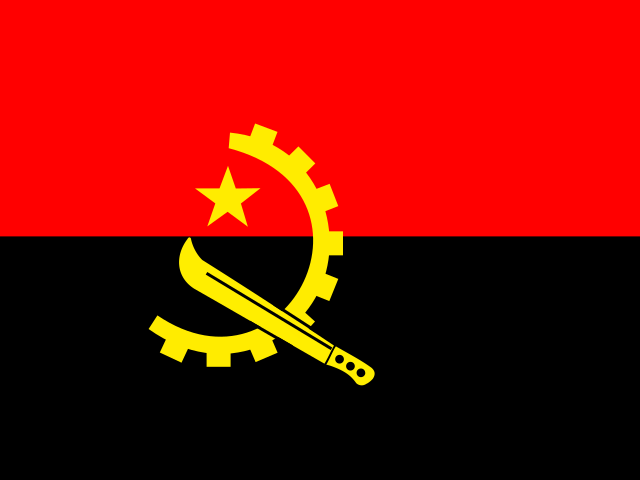 Angola
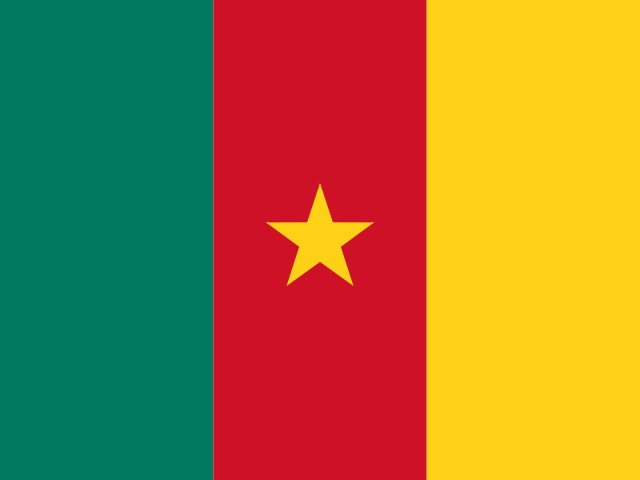 Cameroon
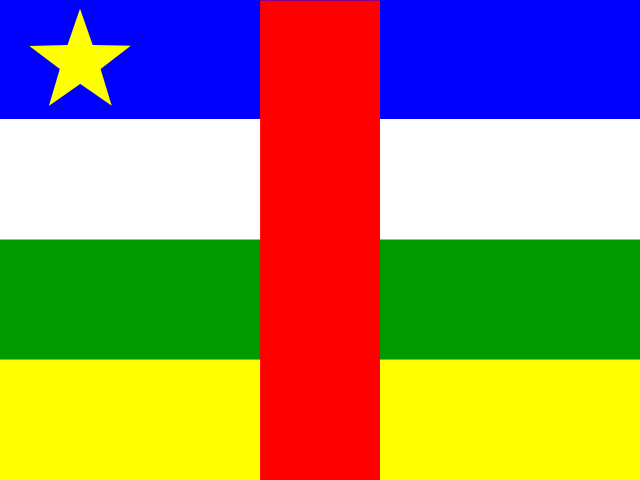 Central African Republic
 Chad
Chad Congo
Congo Democratic Republic of the Congo
 Equatorial Guinea
 Gabon
Gabon Sao Tome and Principe
Earlier Report Observations
The market volume for non-vegetable waxes in Middle Africa grew from 3 106 t in 2018 to a peak of 3 265 t in 2020, supported by consistent domestic production levels around 3 400 t annually and fluctuating imports.
A downward trend followed from 2021, with the market contracting to 2 881 t by 2023. This reduction was partly due to a significant rise in exports, which more than doubled to 573 t in 2023, leaving less supply for domestic consumption.
The year 2024 saw several developments: Cameroon revised its forest species classification, potentially impacting natural raw material supply like beeswax. Regional economic communities CEEAC and CEMAC advanced towards a unified Customs Code and Common External Tariff, which may alter trade conditions. Furthermore, a policy focus on economic diversification and innovation in Central Africa could influence future production and consumption patterns for natural waxes.
Table of content
- 1. Disclaimer
- 2. Terms of use of the report
- 3. Product codes in the statistical classifications used in the report
-
4. Key Market Indicators and Trends
-
4.1. Key Market Indicators
-
4.1.1. In kind
- 4.1.1.1. Production, 2018-2023
- 4.1.1.2. Imports, 2018-2024
- 4.1.1.3. Exports, 2018-2024
- 4.1.1.4. Market size, 2018-2023
-
4.1.1. In kind
- 4.2. Market Trends and Factors
-
4.1. Key Market Indicators
-
5. Production
-
5.1. Production in Middle Africa
- 5.1.1. Annual dynamics of production in Middle Africa in kind, 2018-2023, t
-
5.2. Global production by Country, 2018-2023
- 5.2.1. Annual dynamics of production by macroregions in kind, 2018-2023, t
- 5.2.2. Dynamics of production structure by macroregions in kind, 2018-2023
- 5.2.3. Annual dynamics of production by country in kind, 2018-2023, t
- 5.2.4. Structure of production by countries in kind, 2018-2023
- 5.2.5. Dynamics of peoduction structure by countries in kind, 2018-2023
-
5.1. Production in Middle Africa
-
6. Imports
-
6.1. Imports (Direct Data*)
- 6.1.1. Imports - Total information
-
6.1.2. Imports in kind, t
- 6.1.2.1. Annual dynamics of product's imports to Angola in kind, 2018-2024, t
- 6.1.2.2. Dynamics of product's imports in kind to Angola by countries, 2018-2024, t
- 6.1.2.3. Structure of product's imports in kind by countries, 2018-2024
-
6.1.3. Imports in value, K $ US
- 6.1.3.1. Annual dynamics of product's imports to Angola in value, 2018-2024, K $ US
- 6.1.3.2. Dynamics of product's imports in value to Angola by countries, 2018-2024, K $ US
- 6.1.3.3. Structure of product's imports in value by countries, 2018-2024
-
6.1.4. Average price of product's imports, $ US/t
- 6.1.4.1. Annual dynamics of average price of product's imports to Angola, 2018-2024, $ US/t
- 6.1.4.2. Dynamics of average price of product's imports to Angola by countries, 2018-2024, $ US/t
-
6.2. Imports (Mirror Data)
- 6.2.1. Imports - Total information
-
6.2.2. Imports in kind, t
- 6.2.2.1. Annual dynamics of product's imports to Angola in kind, 2018-2024, t
- 6.2.2.2. Dynamics of product's imports in kind to Angola by countries, 2018-2024, t
- 6.2.2.3. Structure of product's imports in kind by countries, 2018-2024
-
6.2.3. Imports in value, K $ US
- 6.2.3.1. Annual dynamics of product's imports to Angola in value, 2018-2024, K $ US
- 6.2.3.2. Dynamics of product's imports in value to Angola by countries, 2018-2024, K $ US
- 6.2.3.3. Structure of product's imports in value by countries, 2018-2024
-
6.2.4. Average price of product's imports, $ US/t
- 6.2.4.1. Annual dynamics of average price of product's imports to Angola, 2018-2024, $ US/t
- 6.2.4.2. Dynamics of average price of product's imports to Angola by countries, 2018-2024, $ US/t
-
6.1. Imports (Direct Data*)
-
7. Exports
-
7.1. Exports (Direct Data*)
- 7.1.1. Exports - Total information
-
7.1.2. Exports in kind, t
- 7.1.2.1. Annual dynamics of product's exports from Angola in kind, 2018-2024, t
- 7.1.2.2. Dynamics of product's exports in kind from Angola by countries, 2018-2024, t
- 7.1.2.3. Structure of product's exports in kind by countries, 2018-2024
-
7.1.3. Exports in value, K $ US
- 7.1.3.1. Annual dynamics of product's exports from Angola in value, 2018-2024, K $ US
- 7.1.3.2. Dynamics of product's exports in value from Angola by countries, 2018-2024, K $ US
- 7.1.3.3. Structure of product's exports in value by countries, 2018-2024
-
7.1.4. Average price of product's exports, $ US/t
- 7.1.4.1. Annual dynamics of average price of product's exports from Angola, 2018-2024, $ US/t
- 7.1.4.2. Dynamics of average price of product's exports from Angola by countries, 2018-2024, $ US/t
-
7.2. Exports (Mirror Data)
- 7.2.1. Exports - Total information
-
7.2.2. Exports in kind, t
- 7.2.2.1. Annual dynamics of product's exports from Angola in kind, 2018-2024, t
- 7.2.2.2. Dynamics of product's exports in kind from Angola by countries, 2018-2024, t
- 7.2.2.3. Structure of product's exports in kind by countries, 2018-2024
-
7.2.3. Exports in value, K $ US
- 7.2.3.1. Annual dynamics of product's exports from Angola in value, 2018-2024, K $ US
- 7.2.3.2. Dynamics of product's exports in value from Angola by countries, 2018-2024, K $ US
- 7.2.3.3. Structure of product's exports in value by countries, 2018-2024
-
7.2.4. Average price of product's exports, $ US/t
- 7.2.4.1. Annual dynamics of average price of product's exports from Angola, 2018-2024, $ US/t
- 7.2.4.2. Dynamics of average price of product's exports from Angola by countries, 2018-2024, $ US/t
-
7.1. Exports (Direct Data*)
-
8. Trade balance
-
8.1. Trade balance (Direct Data)
- 8.1.1. In kind, t
- 8.1.2. In value, K $ US
-
8.2. Trade balance (Mirror Data)
- 8.2.1. In kind, t
- 8.2.2. In value, K $ US
-
8.1. Trade balance (Direct Data)
-
9. Top buying and selling countries, 2018-2024
-
9.1. Direct Data
- 9.1.1. Import in Value by Countries-buyers
- 9.1.2. Export in Value by Countries-suppliers
-
9.2. Mirror Data
- 9.2.1. Import in Value by Countries-buyers
- 9.2.2. Export in Value by Countries-suppliers
-
9.1. Direct Data
Production non-vegetable waxes in Middle Africa
In kind, 2017-2020, t
Top producers of non-vegetable waxes, 2017-2020
World map of production of non-vegetable waxes, 2017-2020
Middle Africa's production of non-vegetable waxes has increased for the third consecutive year. In 2019, production remained nearly unchanged, and in 2020, it reached 3,418 tonnes, showing minimal growth compared to the previous year.
Annual dynamics of production in Middle Africa in kind, 2017-2020, t
| Parameter | 2018 | 2019 | 2020 | CAGR | |
|---|---|---|---|---|---|
| 1 | Change from last year | 0.1% | 0.1% | 0.1% | 0.1% |
In value, 2017-2020, K $ US
Middle Africa's production of non-vegetable waxes declined for the second consecutive year. In 2020, the output was valued at 1,508 thousand US dollars, down by 9.9% from 2019. Over the period from 2017 to 2020, production decreased by 11.4%, with a compound annual growth rate of 4.0%. The highest value was recorded in 2018 at 1,703 thousand US dollars, which also saw the largest increase of 0.1%.
Annual dynamics of production in Middle Africa in value, 2017-2020, K $ US
| Parameter | 2018 | 2019 | 2020 | CAGR | |
|---|---|---|---|---|---|
| 1 | Change from last year | 0.1% | (1.7%) | (9.9%) | (4.0%) |
Exports non-vegetable waxes from Middle Africa
Exports in kind, t
The export market showed an unstable trend throughout the period. Exports reached their lowest point in 2017 and peaked in 2018, with a 1.9-fold difference between these years. In 2020, exports from Middle Africa totalled 192.6 tonnes, marking a significant decline of 22.5% compared to 2019. The highest volume was recorded in 2018 at 320.1 tonnes, which also experienced the largest increase of 94.2%.
Annual dynamics of product's exports from Middle Africa in kind, 2017-2020, t
| Parameter | 2018 | 2019 | 2020 | CAGR | |
|---|---|---|---|---|---|
| 1 | Change from last year | 94.2% | (22.3%) | (22.5%) | 5.3% |
From 2017 to 2020, France, the United States, and Spain were the main destinations for Middle Africa's non-vegetable waxes exports in kind. France accounted for 29.5% of exports, the United States for 20.1%, and Spain for 13.4%, together representing 63.0% of total export flows.
Structure of product's exports in kind by countries, 2017-2020
World map of product's exports from Middle Africa in kind, 2017-2020
Exports in value, K $ US
The export market exhibited an unstable trend over the timeframe. Exports hit their lowest point in 2017 and peaked in 2018, with a 1.9-fold change between these years. In 2020, Middle Africa's export volume reached 85.0 thousand US dollars, down by 30.3% from the previous year. The maximum value was recorded in 2018 at 159.7 thousand US dollars, which also saw the largest increase of 94.1%.
Annual dynamics of product's exports from Middle Africa in value, 2017-2020, K $ US
| Parameter | 2018 | 2019 | 2020 | CAGR | |
|---|---|---|---|---|---|
| 1 | Change from last year | 94.1% | (23.7%) | (30.3%) | 1.1% |
Between 2017 and 2020, France, the United States, and Spain remained the leading destinations for Middle Africa's non-vegetable waxes exports in value terms. France contributed 24.1% of exports, the United States 22.3%, and Spain 14.5%, collectively accounting for 60.8% of total export flows.
Structure of product's exports in value by countries, 2017-2020
World map of product's exports from Middle Africa in value, 2017-2020
Imports non-vegetable waxes to Middle Africa
Imports in kind, t
Market performance showed noticeable fluctuations during the period. Imports reached their minimum in 2017 and peaked in 2020, with a 4-fold variation between these years. In 2020, Middle Africa's import volume stood at 39.6 tonnes, up by 224.6% from 2019. The largest decline was recorded in 2019 at 10.6%.
Annual dynamics of product's imports to Middle Africa in kind, 2017-2020, t
| Parameter | 2018 | 2019 | 2020 | CAGR | |
|---|---|---|---|---|---|
| 1 | Change from last year | 39.3% | (10.6%) | 224.6% | 59.3% |
From 2017 to 2020, Morocco, India, and Portugal were the top suppliers of non-vegetable waxes to Middle Africa in kind. Morocco accounted for 36.9% of imports, India for 34.6%, and Portugal for 11.4%, jointly representing 82.9% of total import flows.
Structure of product's imports in kind by countries, 2017-2020
World map of product's imports to Middle Africa in kind, 2017-2020
Imports in value, K $ US
After a two-year decline, Middle Africa's imports of non-vegetable waxes increased. In 2020, imports stood at 38.5 thousand US dollars, which is 25.9% higher than in 2019. Over the period from 2017 to 2020, imports decreased by 16.2%, with a compound annual growth rate of 5.7%. The lowest value was recorded in 2019 at 30.6 thousand US dollars, which also experienced the largest decline of 24.2%.
Annual dynamics of product's imports to Middle Africa in value, 2017-2020, K $ US
| Parameter | 2018 | 2019 | 2020 | CAGR | |
|---|---|---|---|---|---|
| 1 | Change from last year | (12.2%) | (24.2%) | 25.9% | (5.7%) |
Between 2017 and 2020, India, Portugal, and Germany were the primary suppliers of non-vegetable waxes to Middle Africa in value terms. India accounted for 36.7% of imports, Portugal for 29.9%, and Germany for 9.5%, together making up 76.1% of total import flows.
Structure of product's imports in value by countries, 2017-2020
World map of product's imports to Middle Africa in value, 2017-2020
Related Reports

Non-vegetable waxes market in Senegal
2026-03-28
Non-vegetable waxes market in Americas
2026-03-28
Non-vegetable waxes market in Eastern Africa
2026-03-28
Non-vegetable waxes market in Tanzania
2026-03-28




In-depth market research on this product
Global Beeswax Market 2021–2031: Size, Share, Trends and Forecast
Global market report: size, trends and forecast to 2031 · 190 pages
Why Choose Us?
Only Verified Data
No Hidden Costs or Separate Fees
Smarter Subscription Pricing
Contact Our Team
Submit your inquiry using the form below — our team will get back to you within 24 hours.