






"Western Africa" region includes following countries:
 Cabo Verde
 Benin
Benin Gambia
 Ghana
Ghana Guinea
 Côte d'Ivoire
 Liberia
 Mali
Mali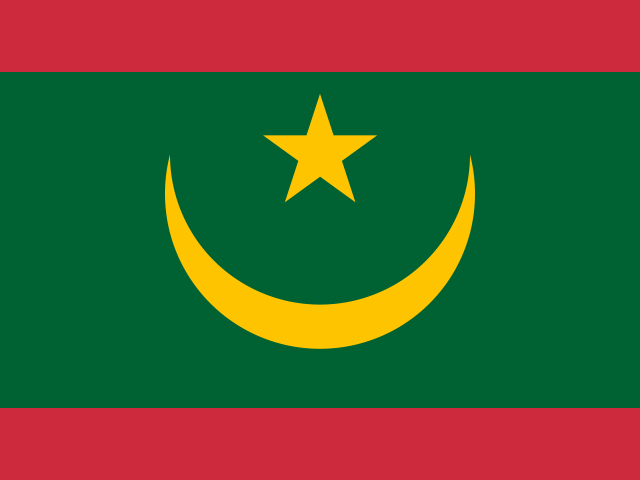 Mauritania
 Niger
Niger Nigeria
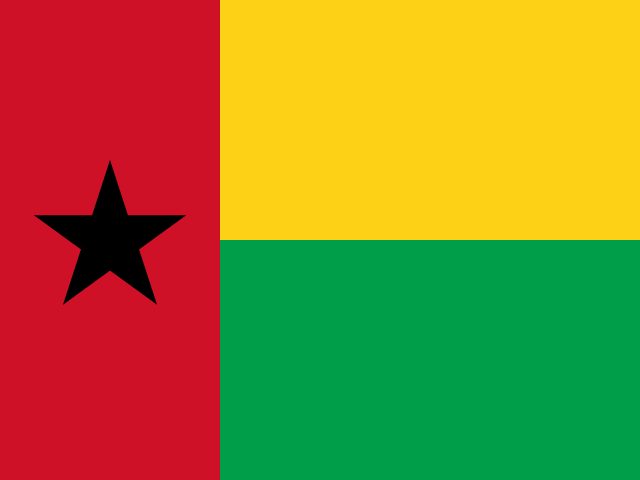 Guinea-Bissau
 Saint Helena, Ascension and Tristan da Cunha
 Senegal
 Sierra Leone
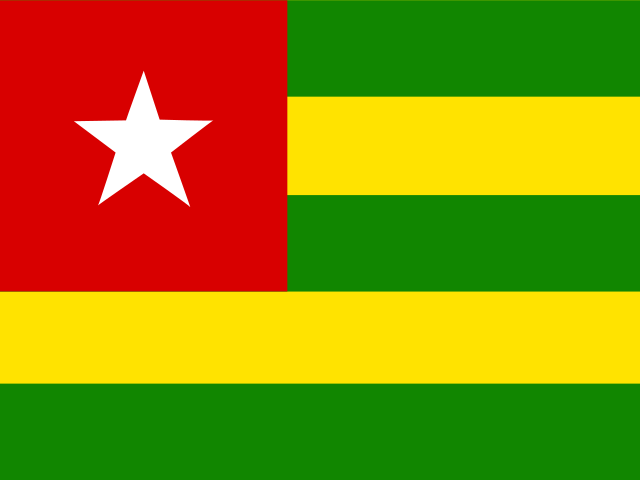 Togo
Togo Burkina Faso
Earlier Report Observations
Ginger production in West Africa showed consistent growth from 708.5 thousand tons in 2018 to 824.7 thousand tons in 2023. The market volume followed a similar upward path, reaching 739.1 thousand tons in 2023, though it saw a temporary dip in 2022. Over the same period, exports surged from 2.9 thousand tons to 86.5 thousand tons, reflecting increasing international shipments.
In 2024, Nigeria—the region's dominant producer—reportedly doubled its ginger output for the 2024/2025 season compared to the previous year. The Nigerian government formed an executive committee for the National Ginger Association to organize and support the sector, while Togo implemented an investment action plan to develop local production and processing. These measures responded to strong global demand for certified and organic ginger, aiming to enhance the region's export potential and value addition.
The market is underpinned by substantial domestic demand, estimated at 50,000 tons annually in parts of the region, while most ginger is still exported in raw form due to limited local processing capacity. The coordinated institutional efforts signal a shift toward greater sector organization and infrastructure development to capture more value from growing international interest.
Table of content
- 1. Disclaimer
- 2. Terms of use of the report
- 3. Product codes in the statistical classifications used in the report
-
4. Key Market Indicators and Trends
-
4.1. Key Market Indicators
-
4.1.1. In kind
- 4.1.1.1. Production, 2018-2023
- 4.1.1.2. Imports, 2018-2024
- 4.1.1.3. Exports, 2018-2024
- 4.1.1.4. Market size, 2018-2023
-
4.1.1. In kind
- 4.2. Market Trends and Factors
-
4.1. Key Market Indicators
-
5. Production
-
5.1. Production in Western Africa
- 5.1.1. Annual dynamics of production in Western Africa in kind, 2018-2023, K t
-
5.2. Global production by Country, 2018-2023
- 5.2.1. Annual dynamics of production by macroregions in kind, 2018-2023, K t
- 5.2.2. Dynamics of production structure by macroregions in kind, 2018-2023
- 5.2.3. Annual dynamics of production by country in kind, 2018-2023, K t
- 5.2.4. Structure of production by countries in kind, 2018-2023
- 5.2.5. Dynamics of peoduction structure by countries in kind, 2018-2023
-
5.1. Production in Western Africa
-
6. Imports
-
6.1. Imports (Direct Data*)
- 6.1.1. Imports - Total information
-
6.1.2. Imports in kind, t
- 6.1.2.1. Annual dynamics of product's imports to Cabo Verde in kind, 2018-2024, t
- 6.1.2.2. Dynamics of product's imports in kind to Cabo Verde by countries, 2018-2024, t
- 6.1.2.3. Structure of product's imports in kind by countries, 2018-2024
-
6.1.3. Imports in value, K $ US
- 6.1.3.1. Annual dynamics of product's imports to Cabo Verde in value, 2018-2024, K $ US
- 6.1.3.2. Dynamics of product's imports in value to Cabo Verde by countries, 2018-2024, K $ US
- 6.1.3.3. Structure of product's imports in value by countries, 2018-2024
-
6.1.4. Average price of product's imports, $ US/t
- 6.1.4.1. Annual dynamics of average price of product's imports to Cabo Verde, 2018-2024, $ US/t
- 6.1.4.2. Dynamics of average price of product's imports to Cabo Verde by countries, 2018-2024, $ US/t
-
6.2. Imports (Mirror Data)
- 6.2.1. Imports - Total information
-
6.2.2. Imports in kind, t
- 6.2.2.1. Annual dynamics of product's imports to Cabo Verde in kind, 2018-2024, t
- 6.2.2.2. Dynamics of product's imports in kind to Cabo Verde by countries, 2018-2024, t
- 6.2.2.3. Structure of product's imports in kind by countries, 2018-2024
-
6.2.3. Imports in value, K $ US
- 6.2.3.1. Annual dynamics of product's imports to Cabo Verde in value, 2018-2024, K $ US
- 6.2.3.2. Dynamics of product's imports in value to Cabo Verde by countries, 2018-2024, K $ US
- 6.2.3.3. Structure of product's imports in value by countries, 2018-2024
-
6.2.4. Average price of product's imports, $ US/t
- 6.2.4.1. Annual dynamics of average price of product's imports to Cabo Verde, 2018-2024, $ US/t
- 6.2.4.2. Dynamics of average price of product's imports to Cabo Verde by countries, 2018-2024, $ US/t
-
6.1. Imports (Direct Data*)
-
7. Exports
-
7.1. Exports (Direct Data*)
- 7.1.1. Exports - Total information
-
7.1.2. Exports in kind, t
- 7.1.2.1. Annual dynamics of product's exports from Cabo Verde in kind, 2018-2024, t
- 7.1.2.2. Dynamics of product's exports in kind from Cabo Verde by countries, 2018-2024, t
- 7.1.2.3. Structure of product's exports in kind by countries, 2018-2024
-
7.1.3. Exports in value, K $ US
- 7.1.3.1. Annual dynamics of product's exports from Cabo Verde in value, 2018-2024, K $ US
- 7.1.3.2. Dynamics of product's exports in value from Cabo Verde by countries, 2018-2024, K $ US
- 7.1.3.3. Structure of product's exports in value by countries, 2018-2024
-
7.1.4. Average price of product's exports, $ US/t
- 7.1.4.1. Annual dynamics of average price of product's exports from Cabo Verde, 2018-2024, $ US/t
- 7.1.4.2. Dynamics of average price of product's exports from Cabo Verde by countries, 2018-2024, $ US/t
-
7.2. Exports (Mirror Data)
- 7.2.1. Exports - Total information
-
7.2.2. Exports in kind, t
- 7.2.2.1. Annual dynamics of product's exports from Cabo Verde in kind, 2018-2024, t
- 7.2.2.2. Dynamics of product's exports in kind from Cabo Verde by countries, 2018-2024, t
- 7.2.2.3. Structure of product's exports in kind by countries, 2018-2024
-
7.2.3. Exports in value, K $ US
- 7.2.3.1. Annual dynamics of product's exports from Cabo Verde in value, 2018-2024, K $ US
- 7.2.3.2. Dynamics of product's exports in value from Cabo Verde by countries, 2018-2024, K $ US
- 7.2.3.3. Structure of product's exports in value by countries, 2018-2024
-
7.2.4. Average price of product's exports, $ US/t
- 7.2.4.1. Annual dynamics of average price of product's exports from Cabo Verde, 2018-2024, $ US/t
- 7.2.4.2. Dynamics of average price of product's exports from Cabo Verde by countries, 2018-2024, $ US/t
-
7.1. Exports (Direct Data*)
-
8. Trade balance
-
8.1. Trade balance (Direct Data)
- 8.1.1. In kind, t
- 8.1.2. In value, K $ US
-
8.2. Trade balance (Mirror Data)
- 8.2.1. In kind, t
- 8.2.2. In value, K $ US
-
8.1. Trade balance (Direct Data)
-
9. Top buying and selling countries, 2018-2024
-
9.1. Direct Data
- 9.1.1. Import in Value by Countries-buyers
- 9.1.2. Export in Value by Countries-suppliers
-
9.2. Mirror Data
- 9.2.1. Import in Value by Countries-buyers
- 9.2.2. Export in Value by Countries-suppliers
-
9.1. Direct Data
Production ginger in Western Africa
In kind, 2017-2020, K t
Top producers of ginger, 2017-2020
World map of production of ginger, 2017-2020
After a two-year decline, Western Africa's ginger production volume increased. In 2020, the region produced 723.2 thousand tonnes of ginger, which is 2.9% higher than the previous year. Over the period from 2017 to 2020, production decreased by 16.5%, with a compound annual growth rate of -5.8%. The lowest production was recorded in 2019 at 703.1 thousand tonnes. The largest decline occurred in 2018, with an 18.2% drop.
Annual dynamics of production in Western Africa in kind, 2017-2020, K t
| Parameter | 2018 | 2019 | 2020 | CAGR | |
|---|---|---|---|---|---|
| 1 | Change from last year | (18.2%) | (0.8%) | 2.9% | (5.8%) |
Exports ginger from Western Africa
Exports in kind, t
The market exhibited volatility during the observed period. From 2017 to 2020, exports showed significant fluctuations, with a peak-to-trough amplitude of 13.3 times. In 2020, Western Africa exported 8,242 tonnes of ginger, reflecting a dramatic increase of 193.7% compared to 2019. The largest decline was recorded in 2019 at 3.7%, while the largest increase occurred in 2018 with a 371.0% surge.
Annual dynamics of product's exports from Western Africa in kind, 2017-2020, t
| Parameter | 2018 | 2019 | 2020 | CAGR | |
|---|---|---|---|---|---|
| 1 | Change from last year | 371.0% | (3.7%) | 193.7% | 137.1% |
From 2017 to 2020, ginger exports from Western Africa were distributed across various markets. India accounted for 16.9% of exports in kind, the United Arab Emirates for 9.0%, and Germany for 4.5%. Together, these three countries represented only 30.5% of total export flows, indicating a broad spread without a dominant market.
Structure of product's exports in kind by countries, 2017-2020
World map of product's exports from Western Africa in kind, 2017-2020
Exports in value, K $ US
Volatility characterized the market behavior during these years. Export volumes reached their minimum in 2017 and peaked in 2020, with a top-to-bottom ratio of 13.2 times. In 2020, Western Africa's ginger exports reached 12,387 thousand US dollars, showing a steep gain of 317.6% year-over-year. The largest decline was recorded in 2019 at 13.8%.
Annual dynamics of product's exports from Western Africa in value, 2017-2020, K $ US
| Parameter | 2018 | 2019 | 2020 | CAGR | |
|---|---|---|---|---|---|
| 1 | Change from last year | 265.8% | (13.8%) | 317.6% | 136.1% |
During 2017 to 2020, ginger exports from Western Africa in value terms were spread relatively evenly. India contributed 21.2% of exports in value, the United Arab Emirates 14.1%, and Germany 12.4%. Collectively, these three markets accounted for 47.7% of total export flows.
Structure of product's exports in value by countries, 2017-2020
World map of product's exports from Western Africa in value, 2017-2020
Imports ginger to Western Africa
Imports in kind, t
The market showed signs of volatility over the observed period. Imports reached their lowest point in 2017 and peaked in 2019, changing by a factor of 12.1. In 2020, the volume of ginger imports into Western Africa totalled 568 tonnes, down by 74.3% compared to 2019. The maximum value was recorded in 2019 at 2,207 tonnes, with the largest increase also in 2019 at 276.1%.
Annual dynamics of product's imports to Western Africa in kind, 2017-2020, t
| Parameter | 2018 | 2019 | 2020 | CAGR | |
|---|---|---|---|---|---|
| 1 | Change from last year | 221.6% | 276.1% | (74.3%) | 46.0% |
From 2017 to 2020, imports in kind of ginger into Western Africa were scattered across countries. China accounted for 26.1% of imports in kind, India for 2.1%, and the United Kingdom for 1.1%. Together, these three partners represented just 29.3% of total import flows, with no single country emerging as clearly dominant.
Structure of product's imports in kind by countries, 2017-2020
World map of product's imports to Western Africa in kind, 2017-2020
Imports in value, K $ US
The market displayed volatility during the observed period. Import volumes dropped to their lowest point in 2017 and peaked in 2019, with a top-to-bottom ratio of 6.1 times. In 2020, Western Africa imported a total of 1,052 thousand US dollars of ginger, marking an abrupt decline of 55.9% year-over-year. The maximum value was recorded in 2019 at 2,386 thousand US dollars, with the largest increase also in 2019 at 354.9%.
Annual dynamics of product's imports to Western Africa in value, 2017-2020, K $ US
| Parameter | 2018 | 2019 | 2020 | CAGR | |
|---|---|---|---|---|---|
| 1 | Change from last year | 33.3% | 354.9% | (55.9%) | 38.8% |
Throughout 2017 to 2020, the three largest markets for ginger imports into Western Africa in value terms were China, India, and the United Kingdom. Together, they accounted for 67.6% of total import flows, indicating a more concentrated structure compared to exports.
Structure of product's imports in value by countries, 2017-2020
World map of product's imports to Western Africa in value, 2017-2020
Related Reports

2026-03-28
Ginger market in Eastern Africa
2026-03-28
2026-03-28
2026-03-28



Pepper market in Western Africa
2026-03-28

Citrus fruit market in Western Africa
2026-03-28
Why Choose Us?
Only Verified Data
No Hidden Costs or Separate Fees
Smarter Subscription Pricing
Contact Our Team
Submit your inquiry using the form below — our team will get back to you within 24 hours.