






"Western Africa" region includes following countries:
 Cabo Verde
 Benin
Benin Gambia
 Ghana
Ghana Guinea
 Côte d'Ivoire
 Liberia
 Mali
Mali Mauritania
 Niger
Niger Nigeria
 Guinea-Bissau
 Saint Helena, Ascension and Tristan da Cunha
 Senegal
 Sierra Leone
 Togo
Togo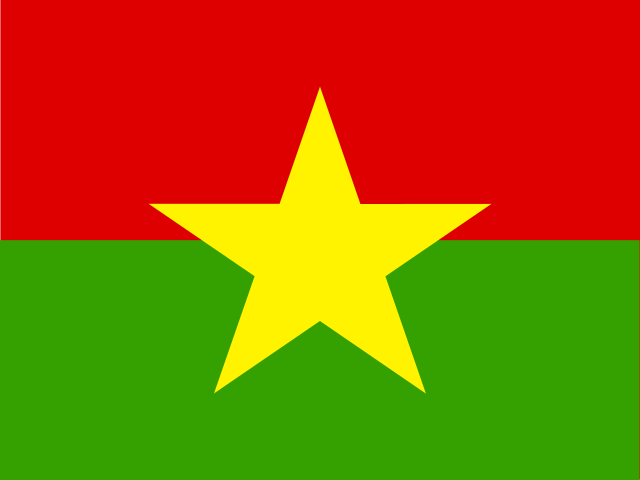 Burkina Faso
Earlier Report Observations
From 2018 to 2023, the citrus fruit market in Western Africa grew steadily, with market volume increasing from 11 188 thousand tons to 12 334 thousand tons. This expansion was supported by positive consumer demand in the region and the development of new production areas, which boosted local output. Favorable weather conditions without major climatic issues also helped maintain consistent production levels.
In 2024, imports of citrus fruit into Western Africa jumped to 90 thousand tons, a significant rise from previous years. This surge was facilitated by strengthened trade relations between Morocco and West African importers, along with a new maritime connection that reduced transport costs and improved logistic efficiency. Increased Moroccan citrus production, driven by advanced irrigation techniques and good weather, provided ample supply for export to the region.
Table of content
- 1. Disclaimer
- 2. Terms of use of the report
- 3. Product codes in the statistical classifications used in the report
-
4. Key Market Indicators and Trends
-
4.1. Key Market Indicators
-
4.1.1. In kind
- 4.1.1.1. Production, 2018-2023
- 4.1.1.2. Imports, 2018-2024
- 4.1.1.3. Exports, 2018-2024
- 4.1.1.4. Market size, 2018-2023
-
4.1.1. In kind
- 4.2. Market Trends and Factors
-
4.1. Key Market Indicators
-
5. Production
-
5.1. Production in Western Africa
- 5.1.1. Annual dynamics of production in Western Africa in kind, 2018-2023, K t
-
5.2. Global production by Country, 2018-2023
- 5.2.1. Annual dynamics of production by macroregions in kind, 2018-2023, K t
- 5.2.2. Dynamics of production structure by macroregions in kind, 2018-2023
- 5.2.3. Annual dynamics of production by country in kind, 2018-2023, K t
- 5.2.4. Structure of production by countries in kind, 2018-2023
- 5.2.5. Dynamics of peoduction structure by countries in kind, 2018-2023
-
5.1. Production in Western Africa
-
6. Imports
-
6.1. Imports (Direct Data*)
- 6.1.1. Imports - Total information
-
6.1.2. Imports in kind, K t
- 6.1.2.1. Annual dynamics of product's imports to Cabo Verde in kind, 2018-2024, K t
- 6.1.2.2. Dynamics of product's imports in kind to Cabo Verde by countries, 2018-2024, K t
- 6.1.2.3. Structure of product's imports in kind by countries, 2018-2024
-
6.1.3. Imports in value, M $ US
- 6.1.3.1. Annual dynamics of product's imports to Cabo Verde in value, 2018-2024, M $ US
- 6.1.3.2. Dynamics of product's imports in value to Cabo Verde by countries, 2018-2024, M $ US
- 6.1.3.3. Structure of product's imports in value by countries, 2018-2024
-
6.1.4. Average price of product's imports, $ US/t
- 6.1.4.1. Annual dynamics of average price of product's imports to Cabo Verde, 2018-2024, $ US/t
- 6.1.4.2. Dynamics of average price of product's imports to Cabo Verde by countries, 2018-2024, $ US/t
-
6.2. Imports (Mirror Data)
- 6.2.1. Imports - Total information
-
6.2.2. Imports in kind, K t
- 6.2.2.1. Annual dynamics of product's imports to Cabo Verde in kind, 2018-2024, K t
- 6.2.2.2. Dynamics of product's imports in kind to Cabo Verde by countries, 2018-2024, K t
- 6.2.2.3. Structure of product's imports in kind by countries, 2018-2024
-
6.2.3. Imports in value, M $ US
- 6.2.3.1. Annual dynamics of product's imports to Cabo Verde in value, 2018-2024, M $ US
- 6.2.3.2. Dynamics of product's imports in value to Cabo Verde by countries, 2018-2024, M $ US
- 6.2.3.3. Structure of product's imports in value by countries, 2018-2024
-
6.2.4. Average price of product's imports, $ US/t
- 6.2.4.1. Annual dynamics of average price of product's imports to Cabo Verde, 2018-2024, $ US/t
- 6.2.4.2. Dynamics of average price of product's imports to Cabo Verde by countries, 2018-2024, $ US/t
-
6.1. Imports (Direct Data*)
-
7. Exports
-
7.1. Exports (Direct Data*)
- 7.1.1. Exports - Total information
-
7.1.2. Exports in kind, K t
- 7.1.2.1. Annual dynamics of product's exports from Cabo Verde in kind, 2018-2024, K t
- 7.1.2.2. Dynamics of product's exports in kind from Cabo Verde by countries, 2018-2024, K t
- 7.1.2.3. Structure of product's exports in kind by countries, 2018-2024
-
7.1.3. Exports in value, M $ US
- 7.1.3.1. Annual dynamics of product's exports from Cabo Verde in value, 2018-2024, M $ US
- 7.1.3.2. Dynamics of product's exports in value from Cabo Verde by countries, 2018-2024, M $ US
- 7.1.3.3. Structure of product's exports in value by countries, 2018-2024
-
7.1.4. Average price of product's exports, $ US/t
- 7.1.4.1. Annual dynamics of average price of product's exports from Cabo Verde, 2018-2024, $ US/t
- 7.1.4.2. Dynamics of average price of product's exports from Cabo Verde by countries, 2018-2024, $ US/t
-
7.2. Exports (Mirror Data)
- 7.2.1. Exports - Total information
-
7.2.2. Exports in kind, K t
- 7.2.2.1. Annual dynamics of product's exports from Cabo Verde in kind, 2018-2024, K t
- 7.2.2.2. Dynamics of product's exports in kind from Cabo Verde by countries, 2018-2024, K t
- 7.2.2.3. Structure of product's exports in kind by countries, 2018-2024
-
7.2.3. Exports in value, M $ US
- 7.2.3.1. Annual dynamics of product's exports from Cabo Verde in value, 2018-2024, M $ US
- 7.2.3.2. Dynamics of product's exports in value from Cabo Verde by countries, 2018-2024, M $ US
- 7.2.3.3. Structure of product's exports in value by countries, 2018-2024
-
7.2.4. Average price of product's exports, $ US/t
- 7.2.4.1. Annual dynamics of average price of product's exports from Cabo Verde, 2018-2024, $ US/t
- 7.2.4.2. Dynamics of average price of product's exports from Cabo Verde by countries, 2018-2024, $ US/t
-
7.1. Exports (Direct Data*)
-
8. Trade balance
-
8.1. Trade balance (Direct Data)
- 8.1.1. In kind, K t
- 8.1.2. In value, M $ US
-
8.2. Trade balance (Mirror Data)
- 8.2.1. In kind, K t
- 8.2.2. In value, M $ US
-
8.1. Trade balance (Direct Data)
-
9. Top buying and selling countries, 2018-2024
-
9.1. Direct Data
- 9.1.1. Import in Value by Countries-buyers
- 9.1.2. Export in Value by Countries-suppliers
-
9.2. Mirror Data
- 9.2.1. Import in Value by Countries-buyers
- 9.2.2. Export in Value by Countries-suppliers
-
9.1. Direct Data
Production citrus fruit in Western Africa
In kind, 2017-2020, K t
Top producers of citrus fruit, 2017-2020
World map of production of citrus fruit, 2017-2020
Western Africa's citrus fruit production increased for the second consecutive year. In 2020, the region produced 12 111 thousand tonnes of citrus fruit, representing a controlled gain of 7.0% compared to 2019. Over the period from 2017 to 2020, production grew by 2.3%, with a compound annual growth rate of 0.8%. The lowest production level was recorded in 2018 at 11 172 thousand tonnes, which also marked the largest decline of 5.6% during this period.
Annual dynamics of production in Western Africa in kind, 2017-2020, K t
| Parameter | 2018 | 2019 | 2020 | CAGR | |
|---|---|---|---|---|---|
| 1 | Change from last year | (5.6%) | 1.4% | 7.0% | 0.8% |
Exports citrus fruit from Western Africa
Exports in kind, t
The market performance showed noticeable fluctuations during this period. Exports reached their lowest point in 2019 at 468 tonnes, then peaked in 2020 at 2 558 tonnes, representing a 5.5-fold increase between these years. The 2020 export volume showed a sharp increase of 446.5% compared to the previous year. The largest decline occurred in 2018, when exports fell by 38.9%.
Annual dynamics of product's exports from Western Africa in kind, 2017-2020, t
| Parameter | 2018 | 2019 | 2020 | CAGR | |
|---|---|---|---|---|---|
| 1 | Change from last year | (38.9%) | (38.6%) | 446.5% | 27.0% |
Between 2017 and 2020, Belarus and Germany played leading roles in Western Africa's citrus fruit exports by volume, together accounting for 2.9% of total export flows.
Structure of product's exports in kind by countries, 2017-2020
World map of product's exports from Western Africa in kind, 2017-2020
Exports in value, K $ US
The market exhibited an unstable trend throughout this timeframe. Export values reached their lowest point in 2019 at 810 thousand US dollars, then peaked in 2020 at 2 963 thousand US dollars, representing a 3.7-fold difference between these years. The 2020 export value showed a significant increase of 265.8% from 2019. The largest decline occurred in 2018, when export values fell by 30.5%.
Annual dynamics of product's exports from Western Africa in value, 2017-2020, K $ US
| Parameter | 2018 | 2019 | 2020 | CAGR | |
|---|---|---|---|---|---|
| 1 | Change from last year | (30.5%) | (26.0%) | 265.8% | 23.4% |
The market base for Western Africa's citrus fruit exports by value was quite broad between 2017 and 2020. Belarus accounted for 16.6% of export value, Germany for 14.9%, and France for 9.2%. Together, these three countries represented just 40.7% of total export flows, while the remaining 59.3% was distributed among numerous other countries.
Structure of product's exports in value by countries, 2017-2020
World map of product's exports from Western Africa in value, 2017-2020
Imports citrus fruit to Western Africa
Imports in kind, t
Western Africa's citrus fruit imports increased for the third consecutive year. In 2020, imports reached 28 187 tonnes, reflecting a steep rise of 31.2% compared to 2019. Between 2017 and 2020, imports grew by 73.9%, equating to an annualized growth rate of 20.3%.
Annual dynamics of product's imports to Western Africa in kind, 2017-2020, t
| Parameter | 2018 | 2019 | 2020 | CAGR | |
|---|---|---|---|---|---|
| 1 | Change from last year | 6.7% | 24.3% | 31.2% | 20.3% |
Between 2017 and 2020, Western Africa's citrus fruit imports by volume were characterized by a broad spread across markets. South Africa accounted for 23.7% of import volume, Morocco for 17.3%, and Portugal for 7.6%. Together, these three countries represented only 48.6% of total import flows.
Structure of product's imports in kind by countries, 2017-2020
World map of product's imports to Western Africa in kind, 2017-2020
Imports in value, K $ US
Western Africa's citrus fruit imports by value increased for the third consecutive year. In 2020, the region imported citrus fruit worth 2 963 thousand US dollars, which is 37.3% above the 2019 level. Over the period from 2017 to 2020, import values increased by 113.7%, with a compound annual growth rate of 28.8%.
Annual dynamics of product's imports to Western Africa in value, 2017-2020, K $ US
| Parameter | 2018 | 2019 | 2020 | CAGR | |
|---|---|---|---|---|---|
| 1 | Change from last year | 36.1% | 14.4% | 37.3% | 28.8% |
Between 2017 and 2020, South Africa, Portugal, and Morocco stood out as the main markets for Western Africa's citrus fruit imports by value. South Africa accounted for 37.6% of import value, Portugal for 18.1%, and Morocco for 16.2%. Together, these three countries represented 71.9% of total import flows.
Structure of product's imports in value by countries, 2017-2020
World map of product's imports to Western Africa in value, 2017-2020
Related Reports

Citrus fruit market in Pakistan
2026-03-28
Citrus fruit market in Tunisia
2026-03-28
2026-03-28
Citrus fruit market in Brunei Darussalam
2026-03-28



Coconuts market in Western Africa
2026-03-28

Melons market in Western Africa
2026-03-28
Why Choose Us?
Only Verified Data
No Hidden Costs or Separate Fees
Smarter Subscription Pricing
Contact Our Team
Submit your inquiry using the form below — our team will get back to you within 24 hours.