






"Western Africa" region includes following countries:
 Cabo Verde
 Benin
Benin Gambia
 Ghana
Ghana Guinea
 Côte d'Ivoire
 Liberia
 Mali
Mali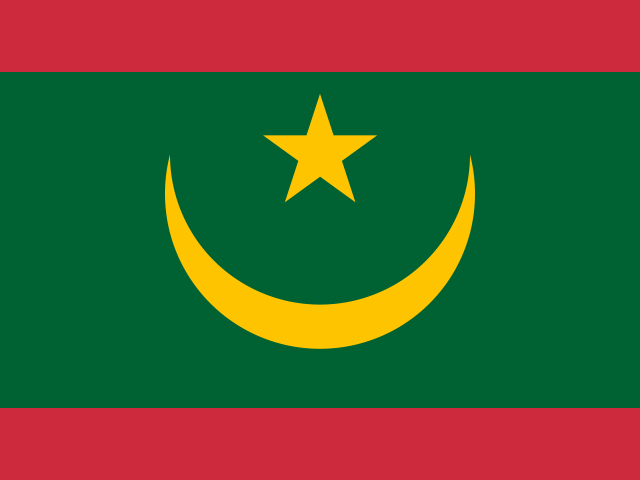 Mauritania
 Niger
Niger Nigeria
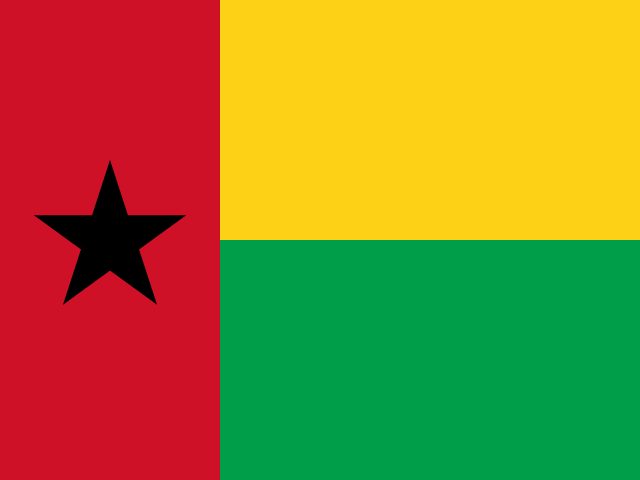 Guinea-Bissau
 Saint Helena, Ascension and Tristan da Cunha
 Senegal
 Sierra Leone
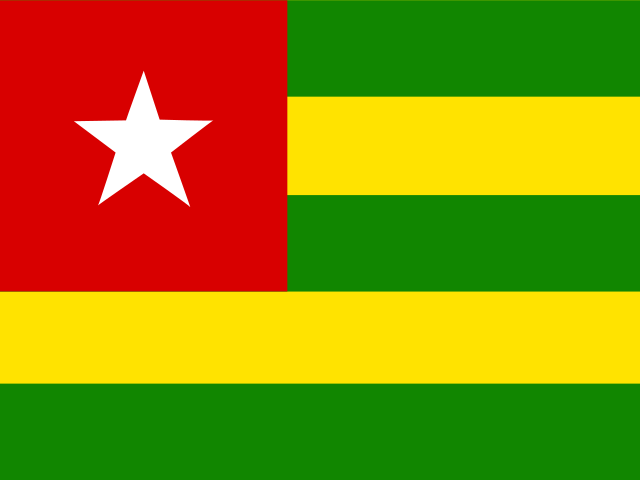 Togo
Togo Burkina Faso
Earlier Report Observations
In 2018, coffee production in Western Africa was underpinned by developing farming practices, including training for producers and the adoption of more productive, environmentally friendly techniques through specific standards for smallholders. The domestic market volume was 299.6 thousand tons that year. It then contracted to 254.5 thousand tons in 2019 before rising again to 284.0 thousand tons in 2020.
Market volume expanded significantly to 330.5 thousand tons in 2021, a period when growing robusta production in Uganda influenced regional supply and the qualitative recognition of West African coffee, particularly from Angola, may have supported demand. The market then stabilized at 310.9 thousand tons in 2022.
A sharp decline in market volume to 235.7 thousand tons occurred in 2023, primarily driven by adverse climatic conditions like prolonged droughts, which increased production costs and reduced local coffee output. Global price volatility, fueled by climate and geopolitical factors, further strained the market. In 2024, rising raw material and fertilizer costs, alongside the global impact of El Niño on production, continued to shape the sector's challenges.
Table of content
- 1. Disclaimer
- 2. Terms of use of the report
- 3. Product codes in the statistical classifications used in the report
-
4. Key Market Indicators and Trends
-
4.1. Key Market Indicators
-
4.1.1. In kind
- 4.1.1.1. Production, 2018-2023
- 4.1.1.2. Imports, 2018-2024
- 4.1.1.3. Exports, 2018-2024
- 4.1.1.4. Market size, 2018-2023
-
4.1.2. In value
- 4.1.2.1. Production, 2018-2023
- 4.1.2.2. Imports, 2018-2024
- 4.1.2.3. Exports, 2018-2024
- 4.1.2.4. Market size, 2018-2023
-
4.1.1. In kind
- 4.2. Market Trends and Factors
-
4.1. Key Market Indicators
-
5. Production
-
5.1. Production in Western Africa
- 5.1.1. Annual dynamics of production in Western Africa in kind, 2018-2023, K t
-
5.2. Global production by Country, 2018-2023
- 5.2.1. Annual dynamics of production by macroregions in kind, 2018-2023, K t
- 5.2.2. Dynamics of production structure by macroregions in kind, 2018-2023
- 5.2.3. Annual dynamics of production by country in kind, 2018-2023, K t
- 5.2.4. Structure of production by countries in kind, 2018-2023
- 5.2.5. Dynamics of peoduction structure by countries in kind, 2018-2023
-
5.1. Production in Western Africa
-
6. Imports
-
6.1. Imports (Direct Data*)
- 6.1.1. Imports - Total information
-
6.1.2. Imports in kind, K t
- 6.1.2.1. Annual dynamics of product's imports to Cabo Verde in kind, 2018-2024, K t
- 6.1.2.2. Dynamics of product's imports in kind to Cabo Verde by countries, 2018-2024, K t
- 6.1.2.3. Structure of product's imports in kind by countries, 2018-2024
-
6.1.3. Imports in value, M $ US
- 6.1.3.1. Annual dynamics of product's imports to Cabo Verde in value, 2018-2024, M $ US
- 6.1.3.2. Dynamics of product's imports in value to Cabo Verde by countries, 2018-2024, M $ US
- 6.1.3.3. Structure of product's imports in value by countries, 2018-2024
-
6.1.4. Average price of product's imports, $ US/t
- 6.1.4.1. Annual dynamics of average price of product's imports to Cabo Verde, 2018-2024, $ US/t
- 6.1.4.2. Dynamics of average price of product's imports to Cabo Verde by countries, 2018-2024, $ US/t
-
6.2. Imports (Mirror Data)
- 6.2.1. Imports - Total information
-
6.2.2. Imports in kind, K t
- 6.2.2.1. Annual dynamics of product's imports to Cabo Verde in kind, 2018-2024, K t
- 6.2.2.2. Dynamics of product's imports in kind to Cabo Verde by countries, 2018-2024, K t
- 6.2.2.3. Structure of product's imports in kind by countries, 2018-2024
-
6.2.3. Imports in value, M $ US
- 6.2.3.1. Annual dynamics of product's imports to Cabo Verde in value, 2018-2024, M $ US
- 6.2.3.2. Dynamics of product's imports in value to Cabo Verde by countries, 2018-2024, M $ US
- 6.2.3.3. Structure of product's imports in value by countries, 2018-2024
-
6.2.4. Average price of product's imports, $ US/t
- 6.2.4.1. Annual dynamics of average price of product's imports to Cabo Verde, 2018-2024, $ US/t
- 6.2.4.2. Dynamics of average price of product's imports to Cabo Verde by countries, 2018-2024, $ US/t
-
6.1. Imports (Direct Data*)
-
7. Exports
-
7.1. Exports (Direct Data*)
- 7.1.1. Exports - Total information
-
7.1.2. Exports in kind, K t
- 7.1.2.1. Annual dynamics of product's exports from Cabo Verde in kind, 2018-2024, K t
- 7.1.2.2. Dynamics of product's exports in kind from Cabo Verde by countries, 2018-2024, K t
- 7.1.2.3. Structure of product's exports in kind by countries, 2018-2024
-
7.1.3. Exports in value, M $ US
- 7.1.3.1. Annual dynamics of product's exports from Cabo Verde in value, 2018-2024, M $ US
- 7.1.3.2. Dynamics of product's exports in value from Cabo Verde by countries, 2018-2024, M $ US
- 7.1.3.3. Structure of product's exports in value by countries, 2018-2024
-
7.1.4. Average price of product's exports, $ US/t
- 7.1.4.1. Annual dynamics of average price of product's exports from Cabo Verde, 2018-2024, $ US/t
- 7.1.4.2. Dynamics of average price of product's exports from Cabo Verde by countries, 2018-2024, $ US/t
-
7.2. Exports (Mirror Data)
- 7.2.1. Exports - Total information
-
7.2.2. Exports in kind, K t
- 7.2.2.1. Annual dynamics of product's exports from Cabo Verde in kind, 2018-2024, K t
- 7.2.2.2. Dynamics of product's exports in kind from Cabo Verde by countries, 2018-2024, K t
- 7.2.2.3. Structure of product's exports in kind by countries, 2018-2024
-
7.2.3. Exports in value, M $ US
- 7.2.3.1. Annual dynamics of product's exports from Cabo Verde in value, 2018-2024, M $ US
- 7.2.3.2. Dynamics of product's exports in value from Cabo Verde by countries, 2018-2024, M $ US
- 7.2.3.3. Structure of product's exports in value by countries, 2018-2024
-
7.2.4. Average price of product's exports, $ US/t
- 7.2.4.1. Annual dynamics of average price of product's exports from Cabo Verde, 2018-2024, $ US/t
- 7.2.4.2. Dynamics of average price of product's exports from Cabo Verde by countries, 2018-2024, $ US/t
-
7.1. Exports (Direct Data*)
-
8. Trade balance
-
8.1. Trade balance (Direct Data)
- 8.1.1. In kind, K t
- 8.1.2. In value, M $ US
-
8.2. Trade balance (Mirror Data)
- 8.2.1. In kind, K t
- 8.2.2. In value, M $ US
-
8.1. Trade balance (Direct Data)
-
9. Top buying and selling countries, 2018-2024
-
9.1. Direct Data
- 9.1.1. Import in Value by Countries-buyers
- 9.1.2. Export in Value by Countries-suppliers
-
9.2. Mirror Data
- 9.2.1. Import in Value by Countries-buyers
- 9.2.2. Export in Value by Countries-suppliers
-
9.1. Direct Data
Production coffee, husks, skins and substitutes in Western Africa
In kind, 2017-2020, K t
Top producers of coffee, husks, skins and substitutes, 2017-2020
World map of production of coffee, husks, skins and substitutes, 2017-2020
Western Africa's production of coffee, husks, skins, and substitutes has declined for the second year in a row. In 2020, the region produced 352.7 thousand tons, marking a 3.6% decrease from 2019. Looking at the broader period from 2017 to 2020, production actually grew by 28.5%, which translates to an average annual increase of 8.7%. The highest production level was reached in 2018 at 384.0 thousand tons, with that year also seeing the largest annual increase of 40.0%. Conversely, the most significant drop occurred in 2019, when production fell by 4.7%.
Annual dynamics of production in Western Africa in kind, 2017-2020, K t
| Parameter | 2018 | 2019 | 2020 | CAGR | |
|---|---|---|---|---|---|
| 1 | Change from last year | 40.0% | (4.7%) | (3.6%) | 8.7% |
In value, 2017-2020, M $ US
For the second consecutive year, the value of coffee, husks, skins, and substitutes production in Western Africa has decreased. In 2020, the output was valued at 516.5 million US dollars, reflecting an 8.0% decline compared to 2019. Over the four-year span from 2017 to 2020, the value of production increased by 5.2%, averaging a 1.7% annual growth rate. The peak value was recorded in 2018 at 674.3 million US dollars, which also saw the largest annual increase of 37.4%. The most substantial decline happened in 2019, with a 16.8% drop.
Annual dynamics of production in Western Africa in value, 2017-2020, M $ US
| Parameter | 2018 | 2019 | 2020 | CAGR | |
|---|---|---|---|---|---|
| 1 | Change from last year | 37.4% | (16.8%) | (8.0%) | 1.7% |
Exports coffee, husks, skins and substitutes from Western Africa
Exports in kind, K t
The export data shows irregular fluctuations, pointing to a volatile market. Exports reached their lowest point in 2017 and peaked in 2019, with a 2.5-fold difference between these years. In 2020, the volume of coffee, husks, skins, and substitutes leaving Western Africa was 77.0 thousand tons, representing a sharp year-on-year decrease of 35.5%. The highest export volume was recorded in 2019 at 119.4 thousand tons, with the largest annual increase occurring in 2018 at 90.3%.
Annual dynamics of product's exports from Western Africa in kind, 2017-2020, K t
| Parameter | 2018 | 2019 | 2020 | CAGR | |
|---|---|---|---|---|---|
| 1 | Change from last year | 90.3% | 30.5% | (35.5%) | 17.0% |
From 2017 to 2020, Algeria, Spain, and Morocco were the primary markets for Western Africa's exports of coffee, husks, skins, and substitutes in volume terms. Algeria accounted for 40.0% of these exports, Spain for 12.8%, and Morocco for 7.9%. Together, these three countries represented 60.8% of the total export flows during this period.
Structure of product's exports in kind by countries, 2017-2020
World map of product's exports from Western Africa in kind, 2017-2020
Exports in value, M $ US
Export values exhibited irregular changes, signaling market volatility. The lowest point was in 2017, followed by a peak in 2019, with a 2.1-fold swing between these years. In 2020, Western Africa's exports of coffee, husks, skins, and substitutes were valued at 112.8 million US dollars, a 38.4% drop compared to the previous year. The highest value was recorded in 2019 at 183.2 million US dollars, and the largest annual increase took place in 2018 at 86.8%.
Annual dynamics of product's exports from Western Africa in value, 2017-2020, M $ US
| Parameter | 2018 | 2019 | 2020 | CAGR | |
|---|---|---|---|---|---|
| 1 | Change from last year | 86.8% | 14.0% | (38.4%) | 9.4% |
Between 2017 and 2020, Algeria, Spain, and Morocco were the leading destinations for Western Africa's exports of coffee, husks, skins, and substitutes in value terms. Algeria made up 44.4% of these exports, Spain 13.6%, and Morocco 8.3%. Collectively, these three markets accounted for 66.3% of the total export value during this timeframe.
Structure of product's exports in value by countries, 2017-2020
World map of product's exports from Western Africa in value, 2017-2020
Imports coffee, husks, skins and substitutes to Western Africa
Imports in kind, K t
Imports of coffee, husks, skins, and substitutes into Western Africa have risen for the third year in a row. In 2020, imports reached 8.3 thousand tons, a 3.9% increase from 2019. Over the period from 2017 to 2020, imports grew by 57.6%, which averages out to an annualized growth rate of 16.4%.
Annual dynamics of product's imports to Western Africa in kind, 2017-2020, K t
| Parameter | 2018 | 2019 | 2020 | CAGR | |
|---|---|---|---|---|---|
| 1 | Change from last year | 36.2% | 11.3% | 3.9% | 16.4% |
The sources of imports in volume terms were quite dispersed from 2017 to 2020. China accounted for 9.5% of imports, India for 8.1%, and Turkey for 4.7%. Together, these three countries represented just 22.4% of total import flows, with the remaining 77.6% spread across a wide array of other suppliers.
Structure of product's imports in kind by countries, 2017-2020
World map of product's imports to Western Africa in kind, 2017-2020
Imports in value, M $ US
For the third consecutive year, the value of coffee, husks, skins, and substitutes imports into Western Africa has increased. In 2020, imports totaled 16.3 million US dollars, up 3.5% from 2019. From 2017 to 2020, import value rose by 17.6%, corresponding to a compound annual growth rate of 5.5%.
Annual dynamics of product's imports to Western Africa in value, 2017-2020, M $ US
| Parameter | 2018 | 2019 | 2020 | CAGR | |
|---|---|---|---|---|---|
| 1 | Change from last year | 6.1% | 7.0% | 3.5% | 5.5% |
Between 2017 and 2020, Switzerland, France, and India were among the largest suppliers of coffee, husks, skins, and substitutes to Western Africa in value terms. Switzerland contributed 12.8% of imports, France 8.7%, and India 7.4%. However, even combined, these three countries represented only 28.9% of total import value, highlighting a highly diversified partner base.
Structure of product's imports in value by countries, 2017-2020
World map of product's imports to Western Africa in value, 2017-2020
Related Reports


Ginger market in Western Africa
2026-03-28


Pepper market in Western Africa
2026-03-28

Fonio market in Western Africa
2026-03-28
Why Choose Us?
Only Verified Data
No Hidden Costs or Separate Fees
Smarter Subscription Pricing
Contact Our Team
Submit your inquiry using the form below — our team will get back to you within 24 hours.