






"South-eastern Asia" region includes following countries:
 Brunei Darussalam
 Myanmar
 Cambodia
 Indonesia
 Laos
Laos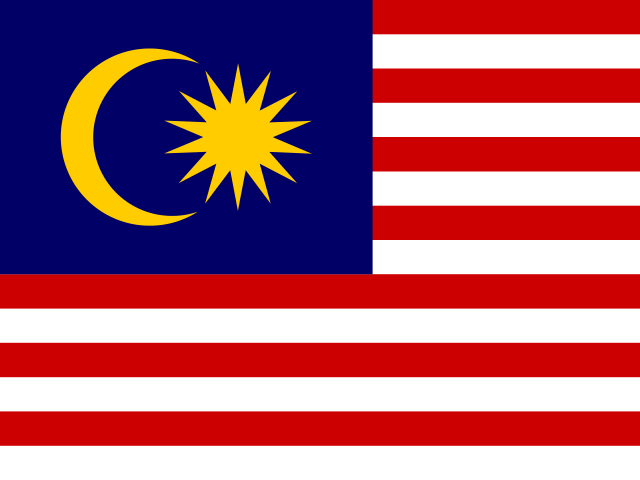 Malaysia
 the Philippines
 Timor-Leste
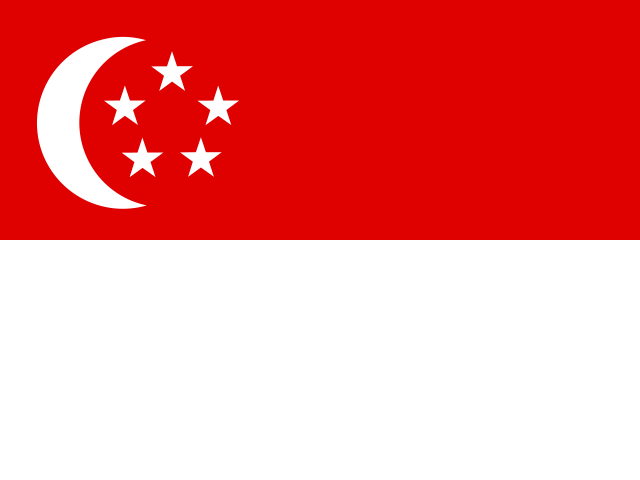 Singapore
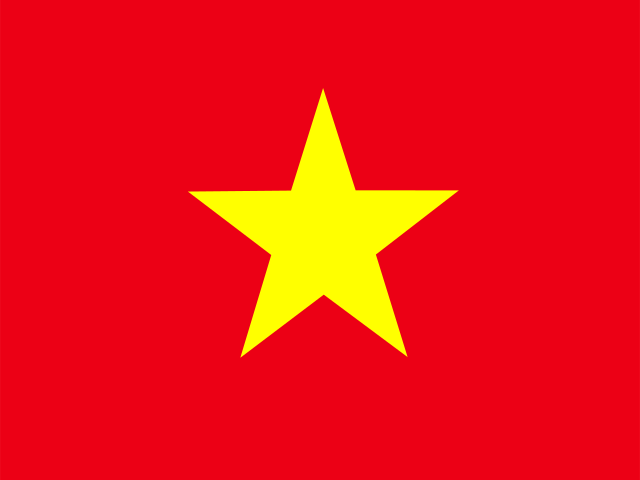 Vietnam
 Thailand
Earlier Report Observations
Ethyl alcohol market volume in South-eastern Asia contracted from 2 275 million liters in 2018 to 1 487 million liters in 2023. The sharpest decline was observed in 2020, followed by a temporary rebound in 2021 before further decreases in 2022 and 2023.
In 2024, the regional market was shaped by national biofuel blending mandates and energy security policies, particularly in Thailand and Vietnam, which boosted demand for denatured alcohol. High availability of feedstocks like sugar and cassava, coupled with a significant drop in import prices, supported market activity across Asia-Pacific. Imports into South-eastern Asia reached 931 million liters in 2024, reflecting increased supply flows.
Table of content
- 1. Disclaimer
- 2. Terms of use of the report
- 3. Product codes in the statistical classifications used in the report
-
4. Key Market Indicators and Trends
-
4.1. Key Market Indicators
-
4.1.1. In kind
- 4.1.1.1. Production, 2018-2023
- 4.1.1.2. Imports, 2018-2024
- 4.1.1.3. Exports, 2018-2024
- 4.1.1.4. Market size, 2018-2023
-
4.1.1. In kind
- 4.2. Market Trends and Factors
-
4.1. Key Market Indicators
-
5. Production
-
5.1. Production in South-eastern Asia
- 5.1.1. Annual dynamics of production in South-eastern Asia in kind, 2018-2023, M l
-
5.2. Global production by Country, 2018-2023
- 5.2.1. Annual dynamics of production by macroregions in kind, 2018-2023, M l
- 5.2.2. Dynamics of production structure by macroregions in kind, 2018-2023
- 5.2.3. Annual dynamics of production by country in kind, 2018-2023, M l
- 5.2.4. Structure of production by countries in kind, 2018-2023
- 5.2.5. Dynamics of peoduction structure by countries in kind, 2018-2023
-
5.1. Production in South-eastern Asia
-
6. Imports
-
6.1. Imports (Direct Data*)
- 6.1.1. Imports - Total information
-
6.1.2. Imports in kind, M l
- 6.1.2.1. Annual dynamics of product's imports to Brunei Darussalam in kind, 2018-2024, M l
- 6.1.2.2. Dynamics of product's imports in kind to Brunei Darussalam by countries, 2018-2024, M l
- 6.1.2.3. Structure of product's imports in kind by countries, 2018-2024
-
6.1.3. Imports in value, M $ US
- 6.1.3.1. Annual dynamics of product's imports to Brunei Darussalam in value, 2018-2024, M $ US
- 6.1.3.2. Dynamics of product's imports in value to Brunei Darussalam by countries, 2018-2024, M $ US
- 6.1.3.3. Structure of product's imports in value by countries, 2018-2024
-
6.1.4. Average price of product's imports, $ US/K l
- 6.1.4.1. Annual dynamics of average price of product's imports to Brunei Darussalam, 2018-2024, $ US/K l
- 6.1.4.2. Dynamics of average price of product's imports to Brunei Darussalam by countries, 2018-2024, $ US/K l
-
6.2. Imports (Mirror Data)
- 6.2.1. Imports - Total information
-
6.2.2. Imports in kind, M l
- 6.2.2.1. Annual dynamics of product's imports to Brunei Darussalam in kind, 2018-2024, M l
- 6.2.2.2. Dynamics of product's imports in kind to Brunei Darussalam by countries, 2018-2024, M l
- 6.2.2.3. Structure of product's imports in kind by countries, 2018-2024
-
6.2.3. Imports in value, M $ US
- 6.2.3.1. Annual dynamics of product's imports to Brunei Darussalam in value, 2018-2024, M $ US
- 6.2.3.2. Dynamics of product's imports in value to Brunei Darussalam by countries, 2018-2024, M $ US
- 6.2.3.3. Structure of product's imports in value by countries, 2018-2024
-
6.2.4. Average price of product's imports, $ US/K l
- 6.2.4.1. Annual dynamics of average price of product's imports to Brunei Darussalam, 2018-2024, $ US/K l
- 6.2.4.2. Dynamics of average price of product's imports to Brunei Darussalam by countries, 2018-2024, $ US/K l
-
6.1. Imports (Direct Data*)
-
7. Exports
-
7.1. Exports (Direct Data*)
- 7.1.1. Exports - Total information
-
7.1.2. Exports in kind, M l
- 7.1.2.1. Annual dynamics of product's exports from Brunei Darussalam in kind, 2018-2024, M l
- 7.1.2.2. Dynamics of product's exports in kind from Brunei Darussalam by countries, 2018-2024, M l
- 7.1.2.3. Structure of product's exports in kind by countries, 2018-2024
-
7.1.3. Exports in value, M $ US
- 7.1.3.1. Annual dynamics of product's exports from Brunei Darussalam in value, 2018-2024, M $ US
- 7.1.3.2. Dynamics of product's exports in value from Brunei Darussalam by countries, 2018-2024, M $ US
- 7.1.3.3. Structure of product's exports in value by countries, 2018-2024
-
7.1.4. Average price of product's exports, $ US/K l
- 7.1.4.1. Annual dynamics of average price of product's exports from Brunei Darussalam, 2018-2024, $ US/K l
- 7.1.4.2. Dynamics of average price of product's exports from Brunei Darussalam by countries, 2018-2024, $ US/K l
-
7.2. Exports (Mirror Data)
- 7.2.1. Exports - Total information
-
7.2.2. Exports in kind, M l
- 7.2.2.1. Annual dynamics of product's exports from Brunei Darussalam in kind, 2018-2024, M l
- 7.2.2.2. Dynamics of product's exports in kind from Brunei Darussalam by countries, 2018-2024, M l
- 7.2.2.3. Structure of product's exports in kind by countries, 2018-2024
-
7.2.3. Exports in value, M $ US
- 7.2.3.1. Annual dynamics of product's exports from Brunei Darussalam in value, 2018-2024, M $ US
- 7.2.3.2. Dynamics of product's exports in value from Brunei Darussalam by countries, 2018-2024, M $ US
- 7.2.3.3. Structure of product's exports in value by countries, 2018-2024
-
7.2.4. Average price of product's exports, $ US/K l
- 7.2.4.1. Annual dynamics of average price of product's exports from Brunei Darussalam, 2018-2024, $ US/K l
- 7.2.4.2. Dynamics of average price of product's exports from Brunei Darussalam by countries, 2018-2024, $ US/K l
-
7.1. Exports (Direct Data*)
-
8. Trade balance
-
8.1. Trade balance (Direct Data)
- 8.1.1. In kind, M l
- 8.1.2. In value, M $ US
-
8.2. Trade balance (Mirror Data)
- 8.2.1. In kind, M l
- 8.2.2. In value, M $ US
-
8.1. Trade balance (Direct Data)
-
9. Top buying and selling countries, 2018-2024
-
9.1. Direct Data
- 9.1.1. Import in Value by Countries-buyers
- 9.1.2. Export in Value by Countries-suppliers
-
9.2. Mirror Data
- 9.2.1. Import in Value by Countries-buyers
- 9.2.2. Export in Value by Countries-suppliers
-
9.1. Direct Data
Production ethyl alcohol in South-eastern Asia
In kind, 2017-2020, M l
Top producers of ethyl alcohol, 2017-2020
World map of production of ethyl alcohol, 2017-2020
Ethyl alcohol production in South-eastern Asia declined for the second year in a row. In 2020, the region produced 1 085 million liters, which represents a significant 37.8% decrease from the previous year. Looking at the period from 2017 to 2020, production fell by 37.8% overall, translating to an average annual decline of 14.7%. The highest production level was recorded in 2018 at 1 846 million liters, which also saw the largest annual increase of 5.7%.
Annual dynamics of production in South-eastern Asia in kind, 2017-2020, M l
| Parameter | 2018 | 2019 | 2020 | CAGR | |
|---|---|---|---|---|---|
| 1 | Change from last year | 5.7% | (5.4%) | (37.8%) | (14.7%) |
Exports ethyl alcohol from South-eastern Asia
Exports in kind, M l
In 2020, South-eastern Asia exported 92.4 million liters of ethyl alcohol, showing a moderate increase of 9.7% compared to 2019. Over the broader period from 2017 to 2020, however, exports dropped by 45.5%, averaging an 18.3% annual decline. The lowest export volume occurred in 2019 at 84.2 million liters, while the peak was in 2018 with 228.8 million liters. The most substantial decrease happened in 2019 at 63.2%, whereas the largest increase was recorded in 2018 at 35.0%.
Annual dynamics of product's exports from South-eastern Asia in kind, 2017-2020, M l
| Parameter | 2018 | 2019 | 2020 | CAGR | |
|---|---|---|---|---|---|
| 1 | Change from last year | 35.0% | (63.2%) | 9.7% | (18.3%) |
From 2017 to 2020, the distribution of export destinations for ethyl alcohol was quite fragmented. South Korea accounted for 11.6% of exports in volume, China for 8.6%, and Oman for 3.4%. Together, these three countries made up just 23.7% of total exports, with no single partner emerging as clearly dominant.
Structure of product's exports in kind by countries, 2017-2020
World map of product's exports from South-eastern Asia in kind, 2017-2020
Exports in value, M $ US
In 2020, ethyl alcohol exports from South-eastern Asia were valued at 94.4 million US dollars, marking a slight increase of 0.7% from the previous year. Over the period from 2017 to 2020, export value declined by 25.4%, with an average annual decrease of 9.3%. The lowest value was recorded in 2019 at 93.7 million US dollars, while the highest was in 2018 at 168.9 million US dollars. The most significant drop occurred in 2019 at 44.5%, and the largest rise was in 2018 at 33.5%.
Annual dynamics of product's exports from South-eastern Asia in value, 2017-2020, M $ US
| Parameter | 2018 | 2019 | 2020 | CAGR | |
|---|---|---|---|---|---|
| 1 | Change from last year | 33.5% | (44.5%) | 0.7% | (9.3%) |
Between 2017 and 2020, the geographical distribution of ethyl alcohol exports in value terms was highly diversified. South Korea represented 11.1% of export value, China 7.4%, and Japan 2.9%. Combined, these three countries accounted for only 21.3% of total export flows, with the remaining 78.7% spread across numerous smaller trading partners.
Structure of product's exports in value by countries, 2017-2020
World map of product's exports from South-eastern Asia in value, 2017-2020
Imports ethyl alcohol to South-eastern Asia
Imports in kind, M l
Ethyl alcohol imports into South-eastern Asia decreased for the second consecutive year. In 2020, imports totaled 448.3 million liters, reflecting a small decline of 1.9% from 2019. From 2017 to 2020, import volumes fell by 18.4%, averaging a 6.5% annual decrease. The highest import level was in 2018 at 574.7 million liters. The largest annual drop occurred in 2019 at 20.5%, while the biggest increase was in 2018 at 4.7%.
Annual dynamics of product's imports to South-eastern Asia in kind, 2017-2020, M l
| Parameter | 2018 | 2019 | 2020 | CAGR | |
|---|---|---|---|---|---|
| 1 | Change from last year | 4.7% | (20.5%) | (1.9%) | (6.5%) |
During the period from 2017 to 2020, the United States was the leading source of ethyl alcohol imports by volume, accounting for 49.1%. Pakistan followed with 10.8%, and South Africa with 5.3%. Together, these three countries comprised 65.2% of total import flows.
Structure of product's imports in kind by countries, 2017-2020
World map of product's imports to South-eastern Asia in kind, 2017-2020
Imports in value, M $ US
In 2020, the value of ethyl alcohol imports into South-eastern Asia reached 440.2 million US dollars, representing a substantial 20.8% increase from 2019. Over the 2017-2020 period, import value grew by 13.6%, with a compound annual growth rate of 4.3%. The lowest value was recorded in 2019 at 364.3 million US dollars, and the highest in 2018 at 472.3 million US dollars. The most significant decrease happened in 2019 at 22.9%, while the largest increase was in 2018 at 21.9%.
Annual dynamics of product's imports to South-eastern Asia in value, 2017-2020, M $ US
| Parameter | 2018 | 2019 | 2020 | CAGR | |
|---|---|---|---|---|---|
| 1 | Change from last year | 21.9% | (22.9%) | 20.8% | 4.3% |
From 2017 to 2020, the United States was the primary supplier of ethyl alcohol by value, making up 46.2% of imports. Pakistan contributed 11.2%, and South Africa 5.0%. Collectively, these three countries accounted for 62.3% of total import value.
Structure of product's imports in value by countries, 2017-2020
World map of product's imports to South-eastern Asia in value, 2017-2020
Related Reports

2026-03-29
2026-03-29
2026-03-29
2026-03-29

Grape wine market in South-eastern Asia
2026-03-29

Alcoholic beer market in South-eastern Asia
2026-03-29


Why Choose Us?
Only Verified Data
No Hidden Costs or Separate Fees
Smarter Subscription Pricing
Contact Our Team
Submit your inquiry using the form below — our team will get back to you within 24 hours.