






"ASEAN" region includes following countries:
 Brunei Darussalam
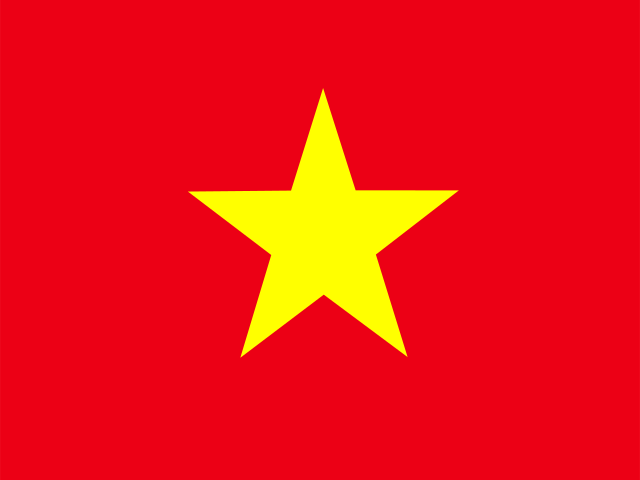 Vietnam
 Indonesia
 Cambodia
 Laos
Laos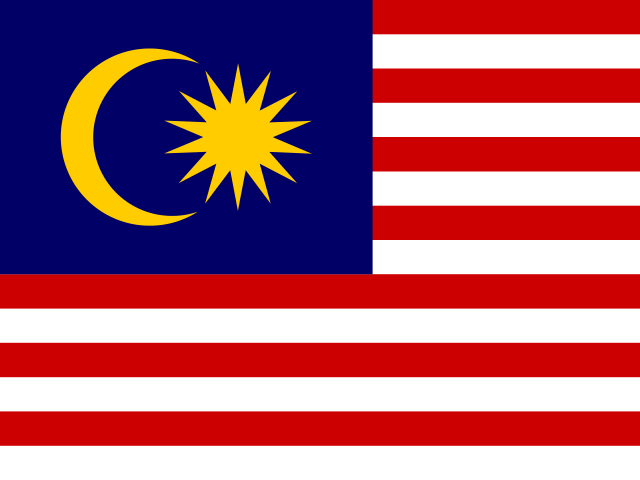 Malaysia
 Myanmar
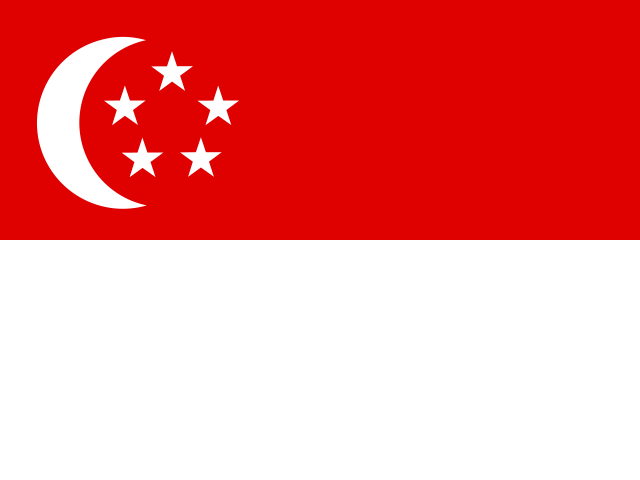 Singapore
 Thailand
 the Philippines
Earlier Report Observations
The ASEAN ethyl alcohol market began the period at 2 275 million liters in 2018, driven by notable growth in regional demand and a 62% increase in imports compared to the previous year. By 2020, however, market volume had fallen sharply to 1 441 million liters, as rising import prices in Asian markets reduced consumption and import activity.
A rebound occurred in 2021, with the market expanding to 1 562 million liters, fueled by renewed international purchases after two years of decline. The market then stabilized around 1 535 million liters in 2022, before dipping to 1 487 million liters in 2023. During this time, global suppliers formed strategic alliances to develop renewable chemicals based on ethyl alcohol, reflecting a broader industry shift toward innovation and sustainability.
In 2024, factors indicated continued growth in production and consumption across Asia, alongside regulatory changes and sustainability policies that further influenced the market environment.
Table of content
- 1. Disclaimer
- 2. Terms of use of the report
- 3. Product codes in the statistical classifications used in the report
-
4. Key Market Indicators and Trends
-
4.1. Key Market Indicators
-
4.1.1. In kind
- 4.1.1.1. Production, 2018-2023
- 4.1.1.2. Imports, 2018-2024
- 4.1.1.3. Exports, 2018-2024
- 4.1.1.4. Market size, 2018-2023
-
4.1.1. In kind
- 4.2. Market Trends and Factors
-
4.1. Key Market Indicators
-
5. Production
-
5.1. Production in ASEAN
- 5.1.1. Annual dynamics of production in ASEAN in kind, 2018-2023, M l
-
5.2. Global production by Country, 2018-2023
- 5.2.1. Annual dynamics of production by macroregions in kind, 2018-2023, M l
- 5.2.2. Dynamics of production structure by macroregions in kind, 2018-2023
- 5.2.3. Annual dynamics of production by country in kind, 2018-2023, M l
- 5.2.4. Structure of production by countries in kind, 2018-2023
- 5.2.5. Dynamics of peoduction structure by countries in kind, 2018-2023
-
5.1. Production in ASEAN
-
6. Imports
-
6.1. Imports (Direct Data*)
- 6.1.1. Imports - Total information
-
6.1.2. Imports in kind, M l
- 6.1.2.1. Annual dynamics of product's imports to Brunei Darussalam in kind, 2018-2024, M l
- 6.1.2.2. Dynamics of product's imports in kind to Brunei Darussalam by countries, 2018-2024, M l
- 6.1.2.3. Structure of product's imports in kind by countries, 2018-2024
-
6.1.3. Imports in value, M $ US
- 6.1.3.1. Annual dynamics of product's imports to Brunei Darussalam in value, 2018-2024, M $ US
- 6.1.3.2. Dynamics of product's imports in value to Brunei Darussalam by countries, 2018-2024, M $ US
- 6.1.3.3. Structure of product's imports in value by countries, 2018-2024
-
6.1.4. Average price of product's imports, $ US/K l
- 6.1.4.1. Annual dynamics of average price of product's imports to Brunei Darussalam, 2018-2024, $ US/K l
- 6.1.4.2. Dynamics of average price of product's imports to Brunei Darussalam by countries, 2018-2024, $ US/K l
-
6.2. Imports (Mirror Data)
- 6.2.1. Imports - Total information
-
6.2.2. Imports in kind, M l
- 6.2.2.1. Annual dynamics of product's imports to Brunei Darussalam in kind, 2018-2024, M l
- 6.2.2.2. Dynamics of product's imports in kind to Brunei Darussalam by countries, 2018-2024, M l
- 6.2.2.3. Structure of product's imports in kind by countries, 2018-2024
-
6.2.3. Imports in value, M $ US
- 6.2.3.1. Annual dynamics of product's imports to Brunei Darussalam in value, 2018-2024, M $ US
- 6.2.3.2. Dynamics of product's imports in value to Brunei Darussalam by countries, 2018-2024, M $ US
- 6.2.3.3. Structure of product's imports in value by countries, 2018-2024
-
6.2.4. Average price of product's imports, $ US/K l
- 6.2.4.1. Annual dynamics of average price of product's imports to Brunei Darussalam, 2018-2024, $ US/K l
- 6.2.4.2. Dynamics of average price of product's imports to Brunei Darussalam by countries, 2018-2024, $ US/K l
-
6.1. Imports (Direct Data*)
-
7. Exports
-
7.1. Exports (Direct Data*)
- 7.1.1. Exports - Total information
-
7.1.2. Exports in kind, M l
- 7.1.2.1. Annual dynamics of product's exports from Brunei Darussalam in kind, 2018-2024, M l
- 7.1.2.2. Dynamics of product's exports in kind from Brunei Darussalam by countries, 2018-2024, M l
- 7.1.2.3. Structure of product's exports in kind by countries, 2018-2024
-
7.1.3. Exports in value, M $ US
- 7.1.3.1. Annual dynamics of product's exports from Brunei Darussalam in value, 2018-2024, M $ US
- 7.1.3.2. Dynamics of product's exports in value from Brunei Darussalam by countries, 2018-2024, M $ US
- 7.1.3.3. Structure of product's exports in value by countries, 2018-2024
-
7.1.4. Average price of product's exports, $ US/K l
- 7.1.4.1. Annual dynamics of average price of product's exports from Brunei Darussalam, 2018-2024, $ US/K l
- 7.1.4.2. Dynamics of average price of product's exports from Brunei Darussalam by countries, 2018-2024, $ US/K l
-
7.2. Exports (Mirror Data)
- 7.2.1. Exports - Total information
-
7.2.2. Exports in kind, M l
- 7.2.2.1. Annual dynamics of product's exports from Brunei Darussalam in kind, 2018-2024, M l
- 7.2.2.2. Dynamics of product's exports in kind from Brunei Darussalam by countries, 2018-2024, M l
- 7.2.2.3. Structure of product's exports in kind by countries, 2018-2024
-
7.2.3. Exports in value, M $ US
- 7.2.3.1. Annual dynamics of product's exports from Brunei Darussalam in value, 2018-2024, M $ US
- 7.2.3.2. Dynamics of product's exports in value from Brunei Darussalam by countries, 2018-2024, M $ US
- 7.2.3.3. Structure of product's exports in value by countries, 2018-2024
-
7.2.4. Average price of product's exports, $ US/K l
- 7.2.4.1. Annual dynamics of average price of product's exports from Brunei Darussalam, 2018-2024, $ US/K l
- 7.2.4.2. Dynamics of average price of product's exports from Brunei Darussalam by countries, 2018-2024, $ US/K l
-
7.1. Exports (Direct Data*)
-
8. Trade balance
-
8.1. Trade balance (Direct Data)
- 8.1.1. In kind, M l
- 8.1.2. In value, M $ US
-
8.2. Trade balance (Mirror Data)
- 8.2.1. In kind, M l
- 8.2.2. In value, M $ US
-
8.1. Trade balance (Direct Data)
-
9. Top buying and selling countries, 2018-2024
-
9.1. Direct Data
- 9.1.1. Import in Value by Countries-buyers
- 9.1.2. Export in Value by Countries-suppliers
-
9.2. Mirror Data
- 9.2.1. Import in Value by Countries-buyers
- 9.2.2. Export in Value by Countries-suppliers
-
9.1. Direct Data
Production ethyl alcohol in ASEAN
In kind, 2017-2020, M l
Top producers of ethyl alcohol, 2017-2020
World map of production of ethyl alcohol, 2017-2020
ASEAN's ethyl alcohol production has declined for the second year in a row. In 2020, the region produced 1 085 million liters, which represents a significant 37.8% drop from 2019. Looking at the period from 2017 to 2020, production fell by 37.8%, with an average annual decline of 14.7%. The peak was in 2018, when output reached 1 846 million liters, marking the largest increase of 5.7% during this timeframe.
Annual dynamics of production in ASEAN in kind, 2017-2020, M l
| Parameter | 2018 | 2019 | 2020 | CAGR | |
|---|---|---|---|---|---|
| 1 | Change from last year | 5.7% | (5.4%) | (37.8%) | (14.7%) |
Exports ethyl alcohol from ASEAN
Exports in kind, M l
In 2020, ASEAN's ethyl alcohol exports amounted to 92.4 million liters, showing a modest 9.7% increase compared to 2019. Over the 2017-2020 period, exports decreased by 45.5%, with an average annual decline of 18.3%. The lowest point was in 2019 at 84.2 million liters, while the highest was in 2018 at 228.8 million liters. The largest drop occurred in 2019 with a 63.2% decrease, and the biggest rise was in 2018 with a 35.0% increase.
Annual dynamics of product's exports from ASEAN in kind, 2017-2020, M l
| Parameter | 2018 | 2019 | 2020 | CAGR | |
|---|---|---|---|---|---|
| 1 | Change from last year | 35.0% | (63.2%) | 9.7% | (18.3%) |
From 2017 to 2020, ASEAN's export structure in volume terms was quite diversified. South Korea accounted for 11.6% of exports, China for 8.6%, and Oman for 3.4%, together making up just 23.7% of total flows. No single country held a clearly dominant position in the market.
Structure of product's exports in kind by countries, 2017-2020
World map of product's exports from ASEAN in kind, 2017-2020
Exports in value, M $ US
In 2020, ASEAN's ethyl alcohol exports in value terms reached 94.4 million US dollars, reflecting a slight 0.7% year-on-year improvement. Between 2017 and 2020, exports decreased by 25.4%, with an average annual decline of 9.3%. The minimum value was recorded in 2019 at 93.7 million US dollars, while the maximum was in 2018 at 168.9 million US dollars. The largest decline occurred in 2019 with a 44.5% drop, and the largest increase was in 2018 with a 33.5% rise.
Annual dynamics of product's exports from ASEAN in value, 2017-2020, M $ US
| Parameter | 2018 | 2019 | 2020 | CAGR | |
|---|---|---|---|---|---|
| 1 | Change from last year | 33.5% | (44.5%) | 0.7% | (9.3%) |
Over the 2017-2020 period, the country breakdown of ASEAN's exports in value terms remained scattered. South Korea represented 11.1% of exports, China 7.4%, and Japan 2.9%, together accounting for just 21.3% of total flows. No trading partner stood out as clearly dominant in this segment.
Structure of product's exports in value by countries, 2017-2020
World map of product's exports from ASEAN in value, 2017-2020
Imports ethyl alcohol to ASEAN
Imports in kind, M l
ASEAN's ethyl alcohol imports have declined for the second consecutive year. In 2020, imports totaled 448.3 million liters, representing a small 1.9% decrease from 2019. Over the 2017-2020 period, imports fell by 18.4%, with an average annual decline of 6.5%. The peak was in 2018 at 574.7 million liters, with the largest increase of 4.7% that year. The largest decline occurred in 2019 with a 20.5% drop.
Annual dynamics of product's imports to ASEAN in kind, 2017-2020, M l
| Parameter | 2018 | 2019 | 2020 | CAGR | |
|---|---|---|---|---|---|
| 1 | Change from last year | 4.7% | (20.5%) | (1.9%) | (6.5%) |
From 2017 to 2020, the United States remained the top supplier of ethyl alcohol to ASEAN, accounting for 49.1% of imports in volume terms. Pakistan followed with 10.8%, and South Africa with 5.3%. Together, these three countries represented 65.2% of total imports in kind.
Structure of product's imports in kind by countries, 2017-2020
World map of product's imports to ASEAN in kind, 2017-2020
Imports in value, M $ US
In 2020, ASEAN's ethyl alcohol imports in value terms reached 440.2 million US dollars, reflecting a substantial 20.8% increase compared to the previous year. Between 2017 and 2020, imports grew by 13.6%, with an average annual increase of 4.3%. The minimum value was recorded in 2019 at 364.3 million US dollars, while the maximum was in 2018 at 472.3 million US dollars. The largest decline occurred in 2019 with a 22.9% drop, and the largest increase was in 2018 with a 21.9% rise.
Annual dynamics of product's imports to ASEAN in value, 2017-2020, M $ US
| Parameter | 2018 | 2019 | 2020 | CAGR | |
|---|---|---|---|---|---|
| 1 | Change from last year | 21.9% | (22.9%) | 20.8% | 4.3% |
Throughout 2017-2020, the United States continued to be the key partner for ASEAN's ethyl alcohol imports in value terms, accounting for 46.2% of the total. Pakistan followed with 11.2%, and South Africa with 5.0%. Together, these three partners represented 62.3% of total import flows.
Structure of product's imports in value by countries, 2017-2020
World map of product's imports to ASEAN in value, 2017-2020
Related Reports

Ethyl alcohol market in Africa
2026-03-29
Ethyl alcohol market in Middle Africa
2026-03-29
Ethyl alcohol market in Brazil
2026-03-29
Ethyl alcohol market in Eswatini
2026-03-29

Alcoholic beer market in ASEAN
2026-03-29

Wine and wine products market in ASEAN
2026-03-30

2026-03-29

Frozen preserved vegetables market in ASEAN
2026-03-30
Why Choose Us?
Only Verified Data
No Hidden Costs or Separate Fees
Smarter Subscription Pricing
Contact Our Team
Submit your inquiry using the form below — our team will get back to you within 24 hours.