






"MENA" region includes following countries:
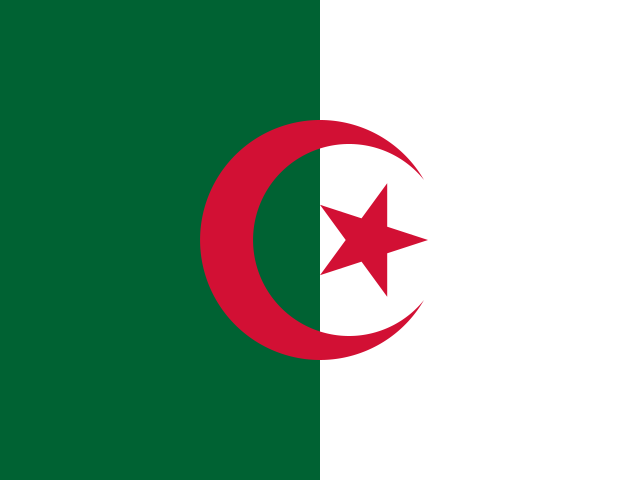 Algeria
 Bahrain
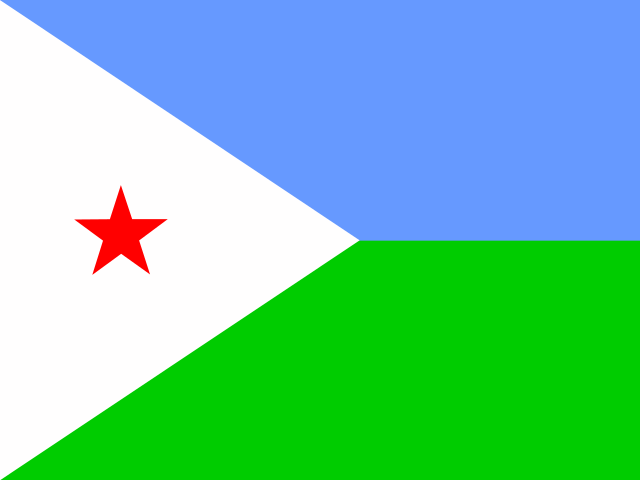 Djibouti
 Egypt
Egypt Israel
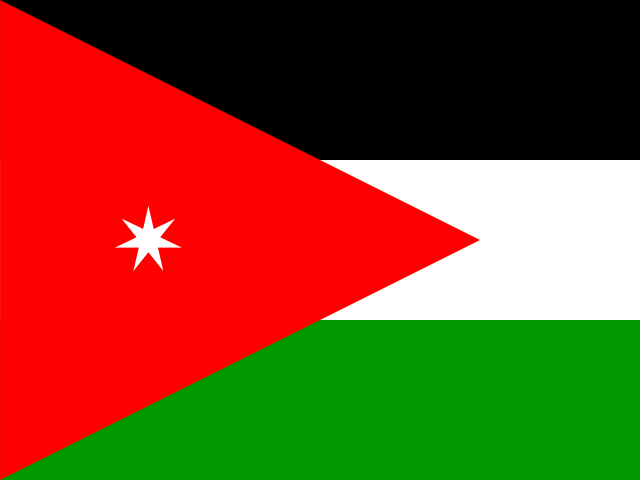 Jordan
 Iran
Iran Iraq
Iraq Qatar
Qatar Kuwait
 Lebanon
 Libya
Libya Malta
Malta Morocco
 the United Arab Emirates
 Oman
Oman Saudi Arabia
 Syria
Syria Tunisia
 Yemen
YemenEarlier Report Observations
Duck meat and offal production in the MENA region began the period at a high of 85 394 t in 2018. This output was supported by increased complexity in regional supply chains, which raised the need for meat products with longer shelf life and boosted demand for frozen meat, including duck. However, the market entered a contraction phase, with production falling to 60 530 t in 2019 and further to 54 865 t in 2020, while total market volume declined to 59 107 t.
A clear recovery emerged in 2021 as production rose to 64 937 t and market volume reached 70 030 t. This growth was influenced by the African swine fever outbreak, which disrupted beef supplies and prices regionally, shifting demand toward alternative poultry meats like duck. After a sharp drop in 2022 to 39 031 t of production and a market volume of 42 583 t, conditions improved in 2023. Production recovered to 45 043 t and market volume to 45 606 t, coinciding with the reported expansion of the regional poultry and frozen meat market at a 5% annual growth rate.
Table of content
- 1. Disclaimer
- 2. Terms of use of the report
- 3. Product codes in the statistical classifications used in the report
-
4. Key Market Indicators and Trends
-
4.1. Key Market Indicators
-
4.1.1. In kind
- 4.1.1.1. Production, 2018-2023
- 4.1.1.2. Imports, 2019-2024
- 4.1.1.3. Exports, 2019-2024
- 4.1.1.4. Market size, 2019-2023
-
4.1.1. In kind
- 4.2. Market Trends and Factors
-
4.1. Key Market Indicators
-
5. Production
-
5.1. Production in MENA
- 5.1.1. Annual dynamics of production in MENA in kind, 2018-2023, t
-
5.2. Global production by Country, 2018-2023
- 5.2.1. Annual dynamics of production by macroregions in kind, 2018-2023, t
- 5.2.2. Dynamics of production structure by macroregions in kind, 2018-2023
- 5.2.3. Annual dynamics of production by country in kind, 2018-2023, t
- 5.2.4. Structure of production by countries in kind, 2018-2023
- 5.2.5. Dynamics of peoduction structure by countries in kind, 2018-2023
-
5.1. Production in MENA
-
6. Imports
-
6.1. Imports (Direct Data*)
- 6.1.1. Imports - Total information
-
6.1.2. Imports in kind, t
- 6.1.2.1. Annual dynamics of product's imports to Algeria in kind, 2019-2024, t
- 6.1.2.2. Dynamics of product's imports in kind to Algeria by countries, 2019-2024, t
- 6.1.2.3. Structure of product's imports in kind by countries, 2019-2024
-
6.1.3. Imports in value, K $ US
- 6.1.3.1. Annual dynamics of product's imports to Algeria in value, 2019-2024, K $ US
- 6.1.3.2. Dynamics of product's imports in value to Algeria by countries, 2019-2024, K $ US
- 6.1.3.3. Structure of product's imports in value by countries, 2019-2024
-
6.1.4. Average price of product's imports, $ US/t
- 6.1.4.1. Annual dynamics of average price of product's imports to Algeria, 2019-2024, $ US/t
- 6.1.4.2. Dynamics of average price of product's imports to Algeria by countries, 2019-2024, $ US/t
-
6.2. Imports (Mirror Data)
- 6.2.1. Imports - Total information
-
6.2.2. Imports in kind, t
- 6.2.2.1. Annual dynamics of product's imports to Algeria in kind, 2019-2024, t
- 6.2.2.2. Dynamics of product's imports in kind to Algeria by countries, 2019-2024, t
- 6.2.2.3. Structure of product's imports in kind by countries, 2019-2024
-
6.2.3. Imports in value, K $ US
- 6.2.3.1. Annual dynamics of product's imports to Algeria in value, 2019-2024, K $ US
- 6.2.3.2. Dynamics of product's imports in value to Algeria by countries, 2019-2024, K $ US
- 6.2.3.3. Structure of product's imports in value by countries, 2019-2024
-
6.2.4. Average price of product's imports, $ US/t
- 6.2.4.1. Annual dynamics of average price of product's imports to Algeria, 2019-2024, $ US/t
- 6.2.4.2. Dynamics of average price of product's imports to Algeria by countries, 2019-2024, $ US/t
-
6.1. Imports (Direct Data*)
-
7. Exports
-
7.1. Exports (Direct Data*)
- 7.1.1. Exports - Total information
-
7.1.2. Exports in kind, t
- 7.1.2.1. Annual dynamics of product's exports from Algeria in kind, 2019-2024, t
- 7.1.2.2. Dynamics of product's exports in kind from Algeria by countries, 2019-2024, t
- 7.1.2.3. Structure of product's exports in kind by countries, 2019-2024
-
7.1.3. Exports in value, K $ US
- 7.1.3.1. Annual dynamics of product's exports from Algeria in value, 2019-2024, K $ US
- 7.1.3.2. Dynamics of product's exports in value from Algeria by countries, 2019-2024, K $ US
- 7.1.3.3. Structure of product's exports in value by countries, 2019-2024
-
7.1.4. Average price of product's exports, $ US/t
- 7.1.4.1. Annual dynamics of average price of product's exports from Algeria, 2019-2024, $ US/t
- 7.1.4.2. Dynamics of average price of product's exports from Algeria by countries, 2019-2024, $ US/t
-
7.2. Exports (Mirror Data)
- 7.2.1. Exports - Total information
-
7.2.2. Exports in kind, t
- 7.2.2.1. Annual dynamics of product's exports from Algeria in kind, 2019-2024, t
- 7.2.2.2. Dynamics of product's exports in kind from Algeria by countries, 2019-2024, t
- 7.2.2.3. Structure of product's exports in kind by countries, 2019-2024
-
7.2.3. Exports in value, K $ US
- 7.2.3.1. Annual dynamics of product's exports from Algeria in value, 2019-2024, K $ US
- 7.2.3.2. Dynamics of product's exports in value from Algeria by countries, 2019-2024, K $ US
- 7.2.3.3. Structure of product's exports in value by countries, 2019-2024
-
7.2.4. Average price of product's exports, $ US/t
- 7.2.4.1. Annual dynamics of average price of product's exports from Algeria, 2019-2024, $ US/t
- 7.2.4.2. Dynamics of average price of product's exports from Algeria by countries, 2019-2024, $ US/t
-
7.1. Exports (Direct Data*)
-
8. Trade balance
-
8.1. Trade balance (Direct Data)
- 8.1.1. In kind, t
- 8.1.2. In value, K $ US
-
8.2. Trade balance (Mirror Data)
- 8.2.1. In kind, t
- 8.2.2. In value, K $ US
-
8.1. Trade balance (Direct Data)
-
9. Top buying and selling countries, 2019-2024
-
9.1. Direct Data
- 9.1.1. Import in Value by Countries-buyers
- 9.1.2. Export in Value by Countries-suppliers
-
9.2. Mirror Data
- 9.2.1. Import in Value by Countries-buyers
- 9.2.2. Export in Value by Countries-suppliers
-
9.1. Direct Data
Production duck meat and offal in MENA
In kind, 2017-2020, t
Top producers of duck meat and offal, 2017-2020
World map of production of duck meat and offal, 2017-2020
Duck meat and offal production in the MENA region declined for the second year in a row. In 2020, production reached 54 865 tons, which is 9.4% lower than in 2019. Over the period from 2017 to 2020, production fell by 35.6%, with an average annual decline of 13.6%. The highest production level was recorded in 2018 at 85 394 tons. The largest year-over-year decrease occurred in 2019, when production dropped by 29.1%, while the smallest increase was seen in 2018 at just 0.3%.
Annual dynamics of production in MENA in kind, 2017-2020, t
| Parameter | 2018 | 2019 | 2020 | CAGR | |
|---|---|---|---|---|---|
| 1 | Change from last year | 0.3% | (29.1%) | (9.4%) | (13.6%) |
Exports duck meat and offal from MENA
Exports in kind, t
The export market for duck meat and offal from MENA showed significant volatility during this period. The lowest export volume was recorded in 2018 at 45 tons, while the peak occurred in 2019 with 156 tons, representing a 3.4-fold difference between these two years. In 2020, exports fell sharply to 49 tons, marking a dramatic 68.9% decline compared to 2019. The largest year-over-year increase was observed in 2019, when exports surged by 244.1%.
Annual dynamics of product's exports from MENA in kind, 2017-2020, t
| Parameter | 2018 | 2019 | 2020 | CAGR | |
|---|---|---|---|---|---|
| 1 | Change from last year | (54.5%) | 244.1% | (68.9%) | (21.3%) |
From 2017 to 2020, MENA's exports of duck meat and offal were not concentrated in a few key markets. The top three destinations—Pakistan (2.8% of exports), Tanzania (2.1%), and Maldives (1.8%)—together accounted for only 6.7% of total export flows.
Structure of product's exports in kind by countries, 2017-2020
World map of product's exports from MENA in kind, 2017-2020
Exports in value, K $ US
The value of duck meat and offal exports from MENA declined for the second consecutive year. In 2020, exports totaled 638 thousand US dollars, a sharp 52.7% drop compared to 2019. Over the 2017-2020 period, export value decreased by 47.4%, with an average annual decline of 19.3%. The highest export value was recorded in 2018 at 1 474 thousand US dollars, which also saw the largest year-over-year increase of 21.6%.
Annual dynamics of product's exports from MENA in value, 2017-2020, K $ US
| Parameter | 2018 | 2019 | 2020 | CAGR | |
|---|---|---|---|---|---|
| 1 | Change from last year | 21.6% | (8.4%) | (52.7%) | (19.3%) |
Between 2017 and 2020, the value of duck meat and offal exports from MENA was distributed across a wide range of partner countries. The top three markets—Pakistan (4.3% of export value), Maldives (3.4%), and Tanzania (2.3%)—together represented just 10.1% of total export flows.
Structure of product's exports in value by countries, 2017-2020
World map of product's exports from MENA in value, 2017-2020
Imports duck meat and offal to MENA
Imports in kind, t
Import volumes of duck meat and offal into MENA exhibited considerable volatility from 2017 to 2020. The peak import volume was recorded in 2019 at 15 456 tons, while the lowest was in 2017, creating a 3.8-fold difference between these years. In 2020, imports fell to 4 290 tons, a significant 72.2% decrease compared to 2019. The largest year-over-year increase occurred in 2019, when imports jumped by 263.8%.
Annual dynamics of product's imports to MENA in kind, 2017-2020, t
| Parameter | 2018 | 2019 | 2020 | CAGR | |
|---|---|---|---|---|---|
| 1 | Change from last year | 3.5% | 263.8% | (72.2%) | 1.5% |
From 2017 to 2020, Brazil remained the dominant source for duck meat and offal imports into MENA, accounting for 81.2% of total import volumes. The remaining share was distributed among various smaller markets.
Structure of product's imports in kind by countries, 2017-2020
World map of product's imports to MENA in kind, 2017-2020
Imports in value, K $ US
After increasing for two years, the value of duck meat and offal imports into MENA declined in 2020. Imports totaled 12 623 thousand US dollars that year, reflecting a solid 21.2% reduction compared to 2019. Over the 2017-2020 period, import value decreased by 9.2%, equivalent to an average annual decline of 3.2%. The highest import value was recorded in 2019 at 16 019 thousand US dollars, while the largest year-over-year increase was in 2018 at 11.2%.
Annual dynamics of product's imports to MENA in value, 2017-2020, K $ US
| Parameter | 2018 | 2019 | 2020 | CAGR | |
|---|---|---|---|---|---|
| 1 | Change from last year | 11.2% | 3.6% | (21.2%) | (3.2%) |
Between 2017 and 2020, Brazil, France, and Turkey were the primary suppliers of duck meat and offal to MENA in value terms. Brazil accounted for 54.0% of import value, France for 12.2%, and Turkey for 5.1%, with these three countries together representing 71.3% of total import flows.
Structure of product's imports in value by countries, 2017-2020
World map of product's imports to MENA in value, 2017-2020
Related Reports

Duck meat and offal market in Southern Asia
2026-03-27
Duck meat and offal market in South Korea
2026-03-27
Duck meat and offal market in Myanmar
2026-03-27
Duck meat and offal market in Europe
2026-03-27

Turkey meat and offal market in MENA
2026-03-27

Camel meat and offal market in MENA
2026-03-27

Not rendered poultry fat market in MENA
2026-03-27
Goose meat and offal market in MENA
2026-03-27
Why Choose Us?
Only Verified Data
No Hidden Costs or Separate Fees
Smarter Subscription Pricing
Contact Our Team
Submit your inquiry using the form below — our team will get back to you within 24 hours.