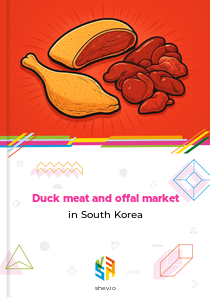







Earlier Report Observations
In 2019, the duck meat market volume in South Korea reached 93 951 tons, up from 89 002 tons the previous year. This growth occurred despite the introduction of duck breeding restrictions in key prevention zones under the revised Animal Infectious Disease Prevention Act in May 2018, aimed at curbing highly pathogenic avian influenza (HPAI). The industry argued these measures were temporary and called for compensation, signaling regulatory pressure on producers.
From 2020 onward, market volume consistently declined, falling to 60 653 tons by 2023. A supply-demand imbalance drove duck meat prices up by 73.1% in 2021, reflecting tight supply. In 2023, an HPAI outbreak reduced duck inventories by 12.2%, while heat-treated Chinese duck meat accelerated its inroads into the domestic market, further squeezing local production.
Regulatory changes continued in 2024 with tighter food labeling and safety standards, and a shift in AI prevention policy from restrictions to incentives for farmers. The market also saw growth in convenient and online food segments, alongside increased demand for sustainable packaging and smart labeling technologies.
Table of content
- 1. Disclaimer
- 2. Terms of use of the report
- 3. Product codes in the statistical classifications used in the report
-
4. Key Market Indicators and Trends
-
4.1. Key Market Indicators
-
4.1.1. In kind
- 4.1.1.1. Production, 2018-2023
- 4.1.1.2. Imports, 2018-2024
- 4.1.1.3. Exports, 2018-2024
- 4.1.1.4. Market size, 2018-2023
-
4.1.1. In kind
- 4.2. Market Trends and Factors
-
4.1. Key Market Indicators
-
5. Production
-
5.1. Production in South Korea
- 5.1.1. Annual dynamics of production in South Korea in kind, 2018-2023, t
- 5.1.2. Annual dynamics of production in South Korea in value, 2018-2023, $ US
-
5.2. Global production by Country, 2018-2023
- 5.2.1. Annual dynamics of production by macroregions in kind, 2018-2023, t
- 5.2.2. Dynamics of production structure by macroregions in kind, 2018-2023
- 5.2.3. Annual dynamics of production by country in kind, 2018-2023, t
- 5.2.4. Structure of production by countries in kind, 2018-2023
- 5.2.5. Dynamics of peoduction structure by countries in kind, 2018-2023
-
5.1. Production in South Korea
-
6. Exports
-
6.1. Exports (Direct Data)
- 6.1.1. Exports - Total information
-
6.1.2. Exports in kind, t
- 6.1.2.1. Annual dynamics of product's exports from South Korea in kind, 2018-2024, t
- 6.1.2.2. Dynamics of product's exports in kind from South Korea by countries, 2018-2024, t
- 6.1.2.3. Structure of product's exports in kind by countries, 2018-2024
-
6.1.3. Exports in value, K $ US
- 6.1.3.1. Annual dynamics of product's exports from South Korea in value, 2018-2024, K $ US
- 6.1.3.2. Dynamics of product's exports in value from South Korea by countries, 2018-2024, K $ US
- 6.1.3.3. Structure of product's exports in value by countries, 2018-2024
-
6.1.4. Average price of product's exports, $ US/t
- 6.1.4.1. Annual dynamics of average price of product's exports from South Korea, 2018-2024, $ US/t
- 6.1.4.2. Dynamics of average price of product's exports from South Korea by countries, 2018-2024, $ US/t
-
6.2. Exports (Mirror Data)
- 6.2.1. Exports - Total information
-
6.2.2. Exports in kind, t
- 6.2.2.1. Annual dynamics of product's exports from South Korea in kind, 2018-2024, t
- 6.2.2.2. Dynamics of product's exports in kind from South Korea by countries, 2018-2024, t
- 6.2.2.3. Structure of product's exports in kind by countries, 2018-2024
-
6.2.3. Exports in value, K $ US
- 6.2.3.1. Annual dynamics of product's exports from South Korea in value, 2018-2024, K $ US
- 6.2.3.2. Dynamics of product's exports in value from South Korea by countries, 2018-2024, K $ US
- 6.2.3.3. Structure of product's exports in value by countries, 2018-2024
-
6.2.4. Average price of product's exports, $ US/t
- 6.2.4.1. Annual dynamics of average price of product's exports from South Korea, 2018-2024, $ US/t
- 6.2.4.2. Dynamics of average price of product's exports from South Korea by countries, 2018-2024, $ US/t
-
6.1. Exports (Direct Data)
-
7. Imports
-
7.1. Imports (Direct Data)
- 7.1.1. Imports - Total information
-
7.1.2. Imports in kind, t
- 7.1.2.1. Annual dynamics of product's imports to South Korea in kind, 2018-2024, t
- 7.1.2.2. Dynamics of product's imports in kind to South Korea by countries, 2018-2024, t
- 7.1.2.3. Structure of product's imports in kind by countries, 2018-2024
-
7.1.3. Imports in value, K $ US
- 7.1.3.1. Annual dynamics of product's imports to South Korea in value, 2018-2024, K $ US
- 7.1.3.2. Dynamics of product's imports in value to South Korea by countries, 2018-2024, K $ US
- 7.1.3.3. Structure of product's imports in value by countries, 2018-2024
-
7.1.4. Average price of product's imports, $ US/t
- 7.1.4.1. Annual dynamics of average price of product's imports to South Korea, 2018-2024, $ US/t
- 7.1.4.2. Dynamics of average price of product's imports to South Korea by countries, 2018-2024, $ US/t
-
7.2. Imports (Mirror Data)
- 7.2.1. Imports - Total information
-
7.2.2. Imports in kind, t
- 7.2.2.1. Annual dynamics of product's imports to South Korea in kind, 2018-2024, t
- 7.2.2.2. Dynamics of product's imports in kind to South Korea by countries, 2018-2024, t
- 7.2.2.3. Structure of product's imports in kind by countries, 2018-2024
-
7.2.3. Imports in value, K $ US
- 7.2.3.1. Annual dynamics of product's imports to South Korea in value, 2018-2024, K $ US
- 7.2.3.2. Dynamics of product's imports in value to South Korea by countries, 2018-2024, K $ US
- 7.2.3.3. Structure of product's imports in value by countries, 2018-2024
-
7.2.4. Average price of product's imports, $ US/t
- 7.2.4.1. Annual dynamics of average price of product's imports to South Korea, 2018-2024, $ US/t
- 7.2.4.2. Dynamics of average price of product's imports to South Korea by countries, 2018-2024, $ US/t
-
7.1. Imports (Direct Data)
-
8. Trade balance
-
8.1. Trade balance (Direct Data)
- 8.1.1. In kind, t
- 8.1.2. In value, K $ US
-
8.2. Trade balance (Mirror Data)
- 8.2.1. In kind, t
- 8.2.2. In value, K $ US
-
8.1. Trade balance (Direct Data)
-
9. Top buying and selling countries, 2018-2024
-
9.1. Direct Data
- 9.1.1. Import in Value by Countries-buyers
- 9.1.2. Export in Value by Countries-suppliers
-
9.2. Mirror Data
- 9.2.1. Import in Value by Countries-buyers
- 9.2.2. Export in Value by Countries-suppliers
-
9.1. Direct Data
Production duck meat and offal in South Korea
In kind, 2017-2020, t
On a global scale, South Korea ranked as the 4th largest producer of duck meat and offal from 2017 to 2020.
Top producers of duck meat and offal, 2017-2020
World map of production of duck meat and offal, 2017-2020
After two consecutive years of growth, South Korea's production of duck meat and offal declined in 2020. That year, the country produced 84 864 tonnes, marking a 10.9% decrease compared to 2019. Over the entire 2017-2020 period, production increased by 19.5%, with an average annual growth rate of 6.1%. The highest production volume was recorded in 2019 at 95 200 tonnes, while the largest year-on-year increase occurred in 2018 at 28.9%.
Annual dynamics of production in South Korea in kind, 2017-2020, t
| Parameter | 2018 | 2019 | 2020 | CAGR | |
|---|---|---|---|---|---|
| 1 | Change from last year | 28.9% | 4.0% | (10.9%) | 6.1% |
Exports duck meat and offal from South Korea
Exports in kind, t
Export volumes showed significant volatility during the observed period. The lowest point was in 2020, with shipments totaling just 1 tonne, representing a dramatic 99.9% drop from the previous year. In contrast, exports peaked in 2018 at 2 627 tonnes. The largest percentage increase also occurred in 2018, with a staggering 751.7% growth, highlighting the market's instability.
Annual dynamics of product's exports from South Korea in kind, 2017-2020, t
| Parameter | 2018 | 2019 | 2020 | CAGR | |
|---|---|---|---|---|---|
| 1 | Change from last year | 751.7% | (38.6%) | (99.9%) | (85.2%) |
From 2017 to 2020, Vietnam was the dominant destination for South Korea's duck meat and offal exports in volume terms, accounting for 93.8% of total shipments.
Structure of product's exports in kind by countries, 2017-2020
World map of product's exports from South Korea in kind, 2017-2020
Exports in value, K $ US
Export values exhibited considerable volatility over the period. The lowest value was recorded in 2020 at 8 thousand US dollars, a sharp 99.7% decline from 2019. The peak occurred in 2018 with 4 818 thousand US dollars, representing a 599-fold difference between the high and low points. The largest percentage increase also took place in 2018, with an 882.5% surge.
Annual dynamics of product's exports from South Korea in value, 2017-2020, K $ US
| Parameter | 2018 | 2019 | 2020 | CAGR | |
|---|---|---|---|---|---|
| 1 | Change from last year | 882.5% | (39.7%) | (99.7%) | (74.6%) |
Throughout 2017-2020, Vietnam remained the primary and nearly exclusive destination for South Korea's duck meat and offal exports in value terms, holding a 94.5% share of total export revenue.
Structure of product's exports in value by countries, 2017-2020
World map of product's exports from South Korea in value, 2017-2020
Imports duck meat and offal to South Korea
Imports in kind, t
Import volumes displayed irregular patterns, indicating a volatile market. The lowest volume was in 2017, while imports peaked in 2019 at 365 tonnes, creating a 202-fold gap between these years. In 2020, South Korea imported 50 tonnes of duck meat and offal, an 86.3% decrease from 2019. The most substantial increase occurred in 2018, with a remarkable 7 042.3% growth.
Annual dynamics of product's imports to South Korea in kind, 2017-2020, t
| Parameter | 2018 | 2019 | 2020 | CAGR | |
|---|---|---|---|---|---|
| 1 | Change from last year | 7 042.3% | 182.4% | (86.3%) | 202.2% |
Between 2017 and 2020, Thailand accounted for nearly all of South Korea's duck meat and offal imports by volume, with a 94.7% share of total incoming shipments.
Structure of product's imports in kind by countries, 2017-2020
World map of product's imports to South Korea in kind, 2017-2020
Imports in value, K $ US
Import values followed an unstable trend during this timeframe. The lowest value was recorded in 2017, while the highest occurred in 2019 at 1 194 thousand US dollars, representing a 19-fold difference. In 2020, import values stood at 364 thousand US dollars, a 69.5% decrease from the previous year. The largest percentage increase was in 2018, with a 987.0% rise.
Annual dynamics of product's imports to South Korea in value, 2017-2020, K $ US
| Parameter | 2018 | 2019 | 2020 | CAGR | |
|---|---|---|---|---|---|
| 1 | Change from last year | 987.0% | 78.4% | (69.5%) | 80.8% |
From 2017 to 2020, South Korea's duck meat and offal imports in value terms were primarily directed toward Thailand and France, which together accounted for 88.4% of total import spending, with other countries playing a minor role.
Structure of product's imports in value by countries, 2017-2020
World map of product's imports to South Korea in value, 2017-2020
Related Reports
Duck meat and offal market in Cambodia
2026-03-27
Duck meat and offal market in Belize
2026-03-27
Duck meat and offal market in Sri Lanka
2026-03-27

Poultry meat and offal market in South Korea
2026-03-27

Sheep and goat meat market in South Korea
2026-03-27
Goose meat and offal market in South Korea
2026-03-27

Pig offal market in South Korea
2026-03-30
Why Choose Us?
Only Verified Data
No Hidden Costs or Separate Fees
Smarter Subscription Pricing
Contact Our Team
Submit your inquiry using the form below — our team will get back to you within 24 hours.