






"Southern Asia" region includes following countries:
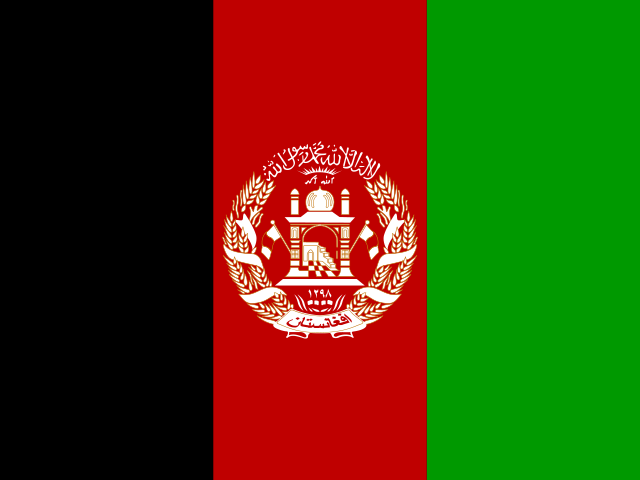 Afghanistan
 Bangladesh
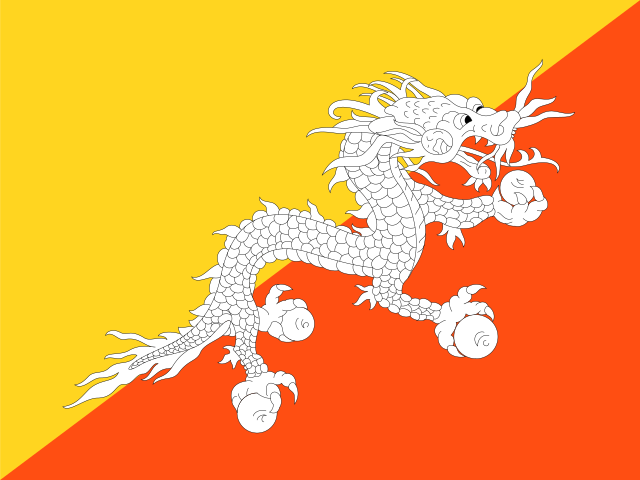 Bhutan
 Sri Lanka
 India
India Iran
Iran Maldives
 Nepal
Nepal Pakistan
Earlier Report Observations
The duck meat market in Southern Asia, particularly India, expanded from 104.4 thousand tons in 2018 to 108.5 thousand tons in 2019. This growth was primarily driven by changing lifestyles and the proliferation of retail outlets with adequate refrigeration, which made frozen and chilled duck products more accessible to consumers. Additionally, the industry saw increased integrated production and a shift from live birds to processed refrigerated and frozen items, especially in regions like Assam, supporting higher market volumes.
The COVID-19 pandemic in 2020 temporarily disrupted supply chains but also accelerated demand for frozen and ready-to-eat meat products as consumers adapted to mobility restrictions. This shift helped maintain market growth, with volume reaching 113.1 thousand tons by 2021. Post-pandemic recovery was aided by the adoption of improved storage and processing technologies, alongside stricter labeling and sanitary controls that bolstered consumer confidence in product safety.
Market expansion continued through 2022 and 2023, with volumes rising to 115.4 and 117.9 thousand tons respectively. This period was characterized by industry consolidation, the entry of new players, and the expansion of production facilities, which increased overall capacity. A growing focus on sustainability and animal welfare also began influencing production practices, contributing to the steady upward trend.
Table of content
- 1. Disclaimer
- 2. Terms of use of the report
- 3. Product codes in the statistical classifications used in the report
-
4. Key Market Indicators and Trends
-
4.1. Key Market Indicators
-
4.1.1. In kind
- 4.1.1.1. Production, 2018-2023
- 4.1.1.2. Imports, 2018-2024
- 4.1.1.3. Exports, 2018-2024
- 4.1.1.4. Market size, 2018-2023
-
4.1.1. In kind
- 4.2. Market Trends and Factors
-
4.1. Key Market Indicators
-
5. Production
-
5.1. Production in Southern Asia
- 5.1.1. Annual dynamics of production in Southern Asia in kind, 2018-2023, K t
-
5.2. Global production by Country, 2018-2023
- 5.2.1. Annual dynamics of production by macroregions in kind, 2018-2023, K t
- 5.2.2. Dynamics of production structure by macroregions in kind, 2018-2023
- 5.2.3. Annual dynamics of production by country in kind, 2018-2023, K t
- 5.2.4. Structure of production by countries in kind, 2018-2023
- 5.2.5. Dynamics of peoduction structure by countries in kind, 2018-2023
-
5.1. Production in Southern Asia
-
6. Imports
-
6.1. Imports (Direct Data*)
- 6.1.1. Imports - Total information
-
6.1.2. Imports in kind, t
- 6.1.2.1. Annual dynamics of product's imports to Afghanistan in kind, 2018-2024, t
- 6.1.2.2. Dynamics of product's imports in kind to Afghanistan by countries, 2018-2024, t
- 6.1.2.3. Structure of product's imports in kind by countries, 2018-2024
-
6.1.3. Imports in value, K $ US
- 6.1.3.1. Annual dynamics of product's imports to Afghanistan in value, 2018-2024, K $ US
- 6.1.3.2. Dynamics of product's imports in value to Afghanistan by countries, 2018-2024, K $ US
- 6.1.3.3. Structure of product's imports in value by countries, 2018-2024
-
6.1.4. Average price of product's imports, $ US/t
- 6.1.4.1. Annual dynamics of average price of product's imports to Afghanistan, 2018-2024, $ US/t
- 6.1.4.2. Dynamics of average price of product's imports to Afghanistan by countries, 2018-2024, $ US/t
-
6.2. Imports (Mirror Data)
- 6.2.1. Imports - Total information
-
6.2.2. Imports in kind, t
- 6.2.2.1. Annual dynamics of product's imports to Afghanistan in kind, 2018-2024, t
- 6.2.2.2. Dynamics of product's imports in kind to Afghanistan by countries, 2018-2024, t
- 6.2.2.3. Structure of product's imports in kind by countries, 2018-2024
-
6.2.3. Imports in value, K $ US
- 6.2.3.1. Annual dynamics of product's imports to Afghanistan in value, 2018-2024, K $ US
- 6.2.3.2. Dynamics of product's imports in value to Afghanistan by countries, 2018-2024, K $ US
- 6.2.3.3. Structure of product's imports in value by countries, 2018-2024
-
6.2.4. Average price of product's imports, $ US/t
- 6.2.4.1. Annual dynamics of average price of product's imports to Afghanistan, 2018-2024, $ US/t
- 6.2.4.2. Dynamics of average price of product's imports to Afghanistan by countries, 2018-2024, $ US/t
-
6.1. Imports (Direct Data*)
-
7. Exports
-
7.1. Exports (Direct Data*)
- 7.1.1. Exports - Total information
-
7.1.2. Exports in kind, t
- 7.1.2.1. Annual dynamics of product's exports from Afghanistan in kind, 2018-2024, t
- 7.1.2.2. Dynamics of product's exports in kind from Afghanistan by countries, 2018-2024, t
- 7.1.2.3. Structure of product's exports in kind by countries, 2018-2024
-
7.1.3. Exports in value, K $ US
- 7.1.3.1. Annual dynamics of product's exports from Afghanistan in value, 2018-2024, K $ US
- 7.1.3.2. Dynamics of product's exports in value from Afghanistan by countries, 2018-2024, K $ US
- 7.1.3.3. Structure of product's exports in value by countries, 2018-2024
-
7.1.4. Average price of product's exports, $ US/t
- 7.1.4.1. Annual dynamics of average price of product's exports from Afghanistan, 2018-2024, $ US/t
- 7.1.4.2. Dynamics of average price of product's exports from Afghanistan by countries, 2018-2024, $ US/t
-
7.2. Exports (Mirror Data)
- 7.2.1. Exports - Total information
-
7.2.2. Exports in kind, t
- 7.2.2.1. Annual dynamics of product's exports from Afghanistan in kind, 2018-2024, t
- 7.2.2.2. Dynamics of product's exports in kind from Afghanistan by countries, 2018-2024, t
- 7.2.2.3. Structure of product's exports in kind by countries, 2018-2024
-
7.2.3. Exports in value, K $ US
- 7.2.3.1. Annual dynamics of product's exports from Afghanistan in value, 2018-2024, K $ US
- 7.2.3.2. Dynamics of product's exports in value from Afghanistan by countries, 2018-2024, K $ US
- 7.2.3.3. Structure of product's exports in value by countries, 2018-2024
-
7.2.4. Average price of product's exports, $ US/t
- 7.2.4.1. Annual dynamics of average price of product's exports from Afghanistan, 2018-2024, $ US/t
- 7.2.4.2. Dynamics of average price of product's exports from Afghanistan by countries, 2018-2024, $ US/t
-
7.1. Exports (Direct Data*)
-
8. Trade balance
-
8.1. Trade balance (Direct Data)
- 8.1.1. In kind, t
- 8.1.2. In value, K $ US
-
8.2. Trade balance (Mirror Data)
- 8.2.1. In kind, t
- 8.2.2. In value, K $ US
-
8.1. Trade balance (Direct Data)
-
9. Top buying and selling countries, 2018-2024
-
9.1. Direct Data
- 9.1.1. Import in Value by Countries-buyers
- 9.1.2. Export in Value by Countries-suppliers
-
9.2. Mirror Data
- 9.2.1. Import in Value by Countries-buyers
- 9.2.2. Export in Value by Countries-suppliers
-
9.1. Direct Data
Production duck meat and offal in Southern Asia
In kind, 2017-2020, K t
Top producers of duck meat and offal, 2017-2020
World map of production of duck meat and offal, 2017-2020
Duck meat and offal production in Southern Asia has grown for the third year in a row. In 2020, the region produced 111.0 K t, marking a modest year-over-year increase of 2.3%. Over the 2017-2020 period, production rose by 10.3%, with an average annual growth rate of 3.3%.
Annual dynamics of production in Southern Asia in kind, 2017-2020, K t
| Parameter | 2018 | 2019 | 2020 | CAGR | |
|---|---|---|---|---|---|
| 1 | Change from last year | 4.0% | 3.6% | 2.3% | 3.3% |
Exports duck meat and offal from Southern Asia
Exports in kind, t
Export volumes showed significant volatility during this period. In 2017, exports hit their lowest point, while 2020 saw the highest levels, representing a 63-fold difference between these years. In 2020, Southern Asia exported 449.7 t of duck meat and offal, an 88.8% increase from 2019. The largest decline occurred in 2019, falling by 40.6%, while the biggest jump was in 2018, with a remarkable 5 520.7% surge.
Annual dynamics of product's exports from Southern Asia in kind, 2017-2020, t
| Parameter | 2018 | 2019 | 2020 | CAGR | |
|---|---|---|---|---|---|
| 1 | Change from last year | 5 520.7% | (40.6%) | 88.8% | 298.0% |
From 2017 to 2020, Vietnam and Hong Kong were the primary export markets in kind, together accounting for 94.7% of total flows, with other partners making up the remainder.
Structure of product's exports in kind by countries, 2017-2020
World map of product's exports from Southern Asia in kind, 2017-2020
Exports in value, K $ US
Export values displayed an unstable pattern over these years. The lowest point was in 2017, and the peak occurred in 2018, showing a 35-fold gap. In 2020, Southern Asia's duck meat and offal exports amounted to 514 K $ US, a gradual 5.5% rise compared to 2019. The maximum value was recorded in 2018 at 687 K $ US. The largest decline was in 2019, dropping by 29.0%, while the biggest increase was in 2018, soaring by 3 440.1%.
Annual dynamics of product's exports from Southern Asia in value, 2017-2020, K $ US
| Parameter | 2018 | 2019 | 2020 | CAGR | |
|---|---|---|---|---|---|
| 1 | Change from last year | 3 440.1% | (29.0%) | 5.5% | 198.2% |
During 2017-2020, Vietnam and Hong Kong dominated exports in value terms, together capturing 88.6% of total flows, with other destinations accounting for the rest.
Structure of product's exports in value by countries, 2017-2020
World map of product's exports from Southern Asia in value, 2017-2020
Imports duck meat and offal to Southern Asia
Imports in kind, t
Import volumes in kind were marked by instability. The lowest point was in 2018, and the peak was in 2020, reflecting a 2.2-fold swing. In 2020, Southern Asia imported 330.8 t of duck meat and offal, a sharp 26.3% year-over-year uptick. The minimum value was 149.2 t in 2018. The largest decline occurred in 2018, falling by 8.9%, while the biggest increase was in 2019, rising by 75.5%.
Annual dynamics of product's imports to Southern Asia in kind, 2017-2020, t
| Parameter | 2018 | 2019 | 2020 | CAGR | |
|---|---|---|---|---|---|
| 1 | Change from last year | (8.9%) | 75.5% | 26.3% | 26.4% |
From 2017 to 2020, imports in kind to Southern Asia were not heavily concentrated. China (26.7% of imports in kind), Malaysia (12.4%), and the United Arab Emirates (10.9%) together accounted for only 49.9% of total flows, indicating a diverse market.
Structure of product's imports in kind by countries, 2017-2020
World map of product's imports to Southern Asia in kind, 2017-2020
Imports in value, K $ US
In 2020, Southern Asia imported approximately 1 053 K $ US of duck meat and offal, a 32.1% decline compared to 2019. Over the 2017-2020 period, imports decreased by 22.6%, with an average annual decline of 8.2%. The maximum value was recorded in 2019 at 1 552 K $ US. The largest increase occurred in 2019, rising by 24.3%.
Annual dynamics of product's imports to Southern Asia in value, 2017-2020, K $ US
| Parameter | 2018 | 2019 | 2020 | CAGR | |
|---|---|---|---|---|---|
| 1 | Change from last year | (8.2%) | 24.3% | (32.1%) | (8.2%) |
From 2017 to 2020, the import structure in value terms was balanced rather than concentrated. The United Arab Emirates (26.1% of imports in value terms), France (14.6%), and Germany (8.6%) together represented 49.3% of total flows, with many other countries accounting for the remaining 50.7%.
Structure of product's imports in value by countries, 2017-2020
World map of product's imports to Southern Asia in value, 2017-2020
Related Reports
Duck meat and offal market in Singapore
2026-03-27
Duck meat and offal market in Hungary
2026-03-27
Duck meat and offal market in Australia
2026-03-27
Duck meat and offal market in Oceania
2026-03-27


2026-03-27


Why Choose Us?
Only Verified Data
No Hidden Costs or Separate Fees
Smarter Subscription Pricing
Contact Our Team
Submit your inquiry using the form below — our team will get back to you within 24 hours.