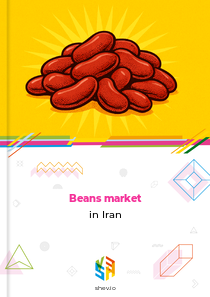







Earlier Report Observations
The market volume for fresh or chilled beans in Iran increased from 52 000 t in 2018 to 55 387 t in 2023, although it experienced a significant contraction to 49 846 t in 2020. This volatility was primarily driven by changes in export volumes, which peaked at 14 665 t in 2020, reducing domestic supply. Throughout the period, recurring drought conditions in major production areas such as Khomein and Zanjan were reported, applying persistent pressure on harvest yields, though overall domestic production remained stable above 64 500 t annually.
Supply constraints and government currency policy significantly shaped market conditions. A notable price surge occurred in 2020, with bean prices rising to 30-46 thousand tomans per kilogram due to reported supply-demand tensions. In subsequent years, prices climbed further, reaching half a million tomans by 2022—on par with meat—driven by a combination of global inflation in food and fuel costs, a reduction in preferential currency allocations for imports, and rising foreign exchange expenses. Policy measures, including a roughly 15% cut in the legume import quota in 2022, reflected broader currency restrictions affecting the market.
The market showed signs of stabilization in 2023, supported by relative improvements in domestic output and timely supply arrivals. However, underlying concerns about currency fluctuations and the lack of preferential foreign exchange allocations continued to pose risks to price stability and availability.
Table of content
- 1. Disclaimer
- 2. Terms of use of the report
- 3. Product codes in the statistical classifications used in the report
-
4. Key Market Indicators and Trends
-
4.1. Key Market Indicators
-
4.1.1. In kind
- 4.1.1.1. Production, 2018-2023
- 4.1.1.2. Imports, 2018-2024
- 4.1.1.3. Exports, 2018-2024
- 4.1.1.4. Market size, 2018-2023
-
4.1.1. In kind
- 4.2. Market Trends and Factors
-
4.1. Key Market Indicators
-
5. Production
-
5.1. Production in Iran
- 5.1.1. Annual dynamics of production in Iran in kind, 2018-2023, t
- 5.1.2. Annual dynamics of production in Iran in value, 2018-2023, $ US
-
5.2. Global production by Country, 2018-2023
- 5.2.1. Annual dynamics of production by macroregions in kind, 2018-2023, t
- 5.2.2. Dynamics of production structure by macroregions in kind, 2018-2023
- 5.2.3. Annual dynamics of production by country in kind, 2018-2023, t
- 5.2.4. Structure of production by countries in kind, 2018-2023
- 5.2.5. Dynamics of peoduction structure by countries in kind, 2018-2023
-
5.1. Production in Iran
-
6. Exports
-
6.1. Exports (Direct Data*)
- 6.1.1. Exports - Total information
-
6.1.2. Exports in kind, t
- 6.1.2.1. Annual dynamics of product's exports from Iran in kind, 2018-2024, t
- 6.1.2.2. Dynamics of product's exports in kind from Iran by countries, 2018-2024, t
- 6.1.2.3. Structure of product's exports in kind by countries, 2018-2024
-
6.1.3. Exports in value, K $ US
- 6.1.3.1. Annual dynamics of product's exports from Iran in value, 2018-2024, K $ US
- 6.1.3.2. Dynamics of product's exports in value from Iran by countries, 2018-2024, K $ US
- 6.1.3.3. Structure of product's exports in value by countries, 2018-2024
-
6.1.4. Average price of product's exports, $ US/t
- 6.1.4.1. Annual dynamics of average price of product's exports from Iran, 2018-2024, $ US/t
- 6.1.4.2. Dynamics of average price of product's exports from Iran by countries, 2018-2024, $ US/t
-
6.2. Exports (Mirror Data)
- 6.2.1. Exports - Total information
-
6.2.2. Exports in kind, t
- 6.2.2.1. Annual dynamics of product's exports from Iran in kind, 2018-2024, t
- 6.2.2.2. Dynamics of product's exports in kind from Iran by countries, 2018-2024, t
- 6.2.2.3. Structure of product's exports in kind by countries, 2018-2024
-
6.2.3. Exports in value, K $ US
- 6.2.3.1. Annual dynamics of product's exports from Iran in value, 2018-2024, K $ US
- 6.2.3.2. Dynamics of product's exports in value from Iran by countries, 2018-2024, K $ US
- 6.2.3.3. Structure of product's exports in value by countries, 2018-2024
-
6.2.4. Average price of product's exports, $ US/t
- 6.2.4.1. Annual dynamics of average price of product's exports from Iran, 2018-2024, $ US/t
- 6.2.4.2. Dynamics of average price of product's exports from Iran by countries, 2018-2024, $ US/t
-
6.1. Exports (Direct Data*)
-
7. Trade balance
-
7.1. Trade balance (Direct Data)
- 7.1.1. In kind, t
- 7.1.2. In value, K $ US
-
7.2. Trade balance (Mirror Data)
- 7.2.1. In kind, t
- 7.2.2. In value, K $ US
-
7.1. Trade balance (Direct Data)
-
8. Top buying and selling countries, 2018-2024
-
8.1. Direct Data
- 8.1.1. Import in Value by Countries-buyers
- 8.1.2. Export in Value by Countries-suppliers
-
8.2. Mirror Data
- 8.2.1. Import in Value by Countries-buyers
- 8.2.2. Export in Value by Countries-suppliers
-
8.1. Direct Data
Production beans in Iran
In kind, 2017-2020, t
From 2017 to 2020, Iran ranked 18th globally in bean production.
Top producers of beans, 2017-2020
World map of production of beans, 2017-2020
Following two years of growth, Iran's bean production volume declined. In 2020, Iran produced 64 511 tons of beans, marking a slight decrease of 2.5% from 2019. Over the 2017-2020 period, production increased by 2.9%, with a compound annual growth rate of 1.0%. The highest production level was recorded in 2019 at 66 135 tons, while the largest annual increase occurred in 2018 at 3.3%.
Annual dynamics of production in Iran in kind, 2017-2020, t
| Parameter | 2018 | 2019 | 2020 | CAGR | |
|---|---|---|---|---|---|
| 1 | Change from last year | 3.3% | 2.2% | (2.5%) | 1.0% |
Exports beans from Iran
Exports in kind, t
The data shows irregular changes, reflecting a volatile market environment. Exports reached their lowest point in 2017 and peaked in 2020, with a 3.7-fold difference between these years. In 2020, Iran's foreign bean supplies totaled 14 665 tons, representing a 28.4% increase compared to 2019. The largest decline was recorded in 2019 at 10.3%, while the most significant increase occurred in 2018 at 218.3%.
Annual dynamics of product's exports from Iran in kind, 2017-2020, t
| Parameter | 2018 | 2019 | 2020 | CAGR | |
|---|---|---|---|---|---|
| 1 | Change from last year | 218.3% | (10.3%) | 28.4% | 54.2% |
From 2017 to 2020, Iraq and the United Arab Emirates were the primary destinations for Iran's bean exports in kind, together accounting for 87.8% of total flows, with the remaining share distributed among other markets.
Structure of product's exports in kind by countries, 2017-2020
World map of product's exports from Iran in kind, 2017-2020
Exports in value, K $ US
Market behavior during these years was characterized by volatility. Export volumes dropped to their lowest point in 2017 and peaked in 2018, with a 4.2-fold difference between these extremes. In 2020, Iran's bean export value was recorded at 4 578 thousand US dollars, reflecting a significant decrease of 14.0% compared to 2019. The highest value was recorded in 2018 at 5 506 thousand US dollars, which also saw the largest increase at 324.1%.
Annual dynamics of product's exports from Iran in value, 2017-2020, K $ US
| Parameter | 2018 | 2019 | 2020 | CAGR | |
|---|---|---|---|---|---|
| 1 | Change from last year | 324.1% | (3.3%) | (14.0%) | 52.2% |
During 2017-2020, Iraq (with 55.0% of total flows) and the United Arab Emirates (33.0%) together accounted for 88.0% of Iran's total bean exports in value terms, while other trading partners made up the remainder.
Structure of product's exports in value by countries, 2017-2020
World map of product's exports from Iran in value, 2017-2020
Imports beans to Iran
Market analysis indicates that Iran did not import any beans from 2017 to 2020.
Related Reports

2026-03-27
2026-03-27
2026-03-27
2026-03-27

2026-03-27
Dried shelled beans market in Iran
2026-03-27

Onions and shallots market in Iran
2026-03-27

2026-03-27
Why Choose Us?
Only Verified Data
No Hidden Costs or Separate Fees
Smarter Subscription Pricing
Contact Our Team
Submit your inquiry using the form below — our team will get back to you within 24 hours.