Italy's Chestnut Crop Set to Fall More Than 25% in 2026 After Record 2025
Italy is expected to harvest 45,000-50,000 tonnes of chestnuts in 2026, down 25-30% from about 65,000 tonnes in 2025, according to Eurocastanea forecasts reported by italiafruit.net. Across six European producing countries the crop is seen at 145,000-165,000 tonnes, with Spain recovering sharply to about 32,000 tonnes. In Cuneo, heat is slowing the fruit drop and traditional varieties still depend on autumn rain.
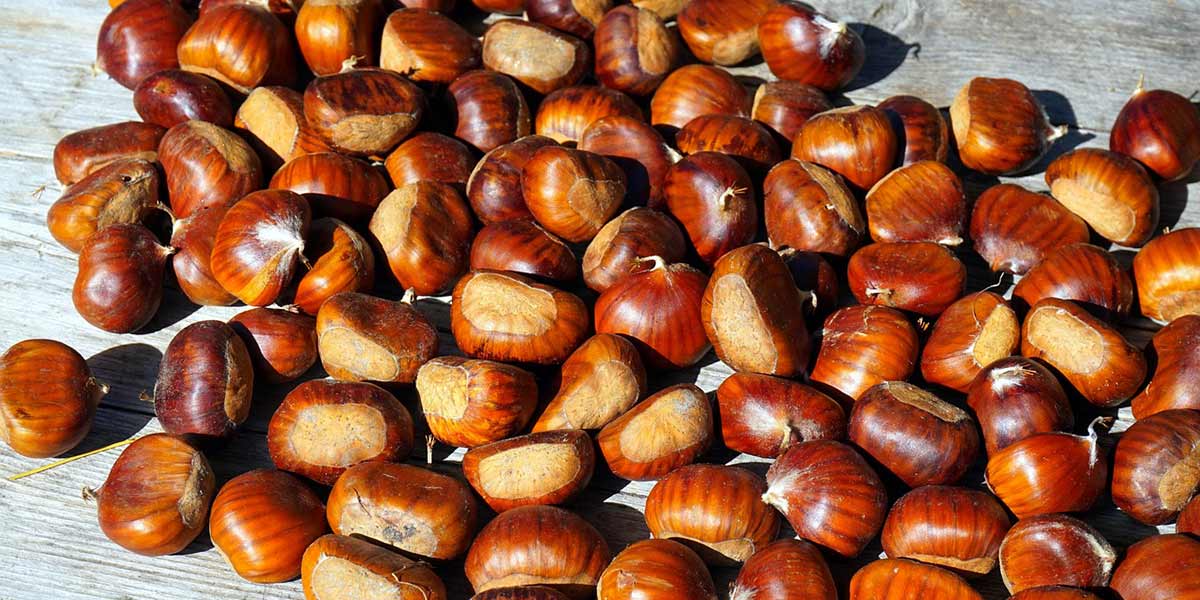
Italy is heading for a chestnut crop of between 45,000 and 50,000 tonnes in 2026, down 25-30% from the roughly 65,000 tonnes harvested in 2025, according to European forecasts presented at a meeting on the Marrone dell'Appennino Emiliano supply chain project and reported by italiafruit.net. Last season Italy was the largest producer among the countries monitored by the Eurocastanea network; this year's volume would bring the country back close to its long-term average.
The figures were presented by Luciano Trentini of the Centro Studi e Documentazione sul Castagno, Italy's representative in Eurocastanea. He stressed that the estimate still has to be verified in the orchards: the heat that marked the season makes actual yields hard to pin down, the harvest is expected earlier than usual, and a clearer picture of available volumes will emerge only as picking advances.
A thinner European crop
Across the six countries covered by Eurocastanea, production normally ranges between 143,000 and 180,000 tonnes. About 164,000 tonnes were harvested in 2025, while estimates for 2026 fall between 145,000 and 165,000 tonnes. The common feature this year is an earlier harvest, often carried out while temperatures are still high. The country forecasts reported by italiafruit.net are as follows:
- Greece: broadly stable, from 33,000 to 34,000 tonnes.
- Portugal: between 35,000 and 40,000 tonnes, after 35,000 tonnes in 2025.
- Spain: a significant recovery, from just 21,000 tonnes last season to about 32,000 tonnes, with the harvest running some ten days early.
- France: down from 10,000 tonnes to about 9,000 tonnes.
Italy remains central to the sector in processing as well as production, Trentini said, with exports above 13,000 tonnes and imports of around 15,000 tonnes. The country also has a category of its own: the marrone, commercially and agronomically distinct from the common chestnut, accounts for 20-30% of national output, and about 70% of those volumes are concentrated in the Emilian-Romagnolo and Tuscan Apennines.
Piedmont: heat holds back the drop
In the province of Cuneo, known as the Granda, picking of hybrid varieties started in line with previous years, myfruit.it reported. High temperatures are slowing the fall of the nuts, so the volumes gathered so far remain limited despite a good fruit load on the trees. According to initial assessments by Coldiretti Cuneo, quality is good: irrigation supported sizing on the hybrids and the fruit collected so far is healthy. Cooler weather would speed up the drop and allow picking to intensify.
The outlook for traditional varieties is less certain. Flowering had set up a favourable season, but the lack of rain and the heat held back fruit development, and rainfall over the coming weeks will be decisive for sizing; it is still too early for reliable volume estimates. "The quality of the first fruit harvested is encouraging, but the evolution of the season has to be followed closely," said Enrico Nada, president of Coldiretti Cuneo, adding that the start needs to be matched on the market by prices that reward growers for tending the groves and bringing in the crop.
Cuneo has more than 4,200 hectares of fruit-bearing chestnut orchards farmed by over 2,400 businesses, with average production of 40,000 quintals (4,000 tonnes), making it Italy's fourth province by area planted to chestnut. Francesco Goffredo, director of Coldiretti Cuneo, described chestnut growing as an economic resource for the area's hill and mountain zones, where farms keep the groves productive and maintain the landscape.
Research and mechanisation on the agenda
Looking further ahead, Trentini argued that commercial promotion alone will not be enough. Eurocastanea has identified two priorities: varietal research, aimed at quality chestnuts suited to multiple uses and carrying stronger genetic resistance to disease; and innovation in orchard management and harvesting. He pointed to Korea, where robotisation is already under discussion, and said European chestnut growing has to start moving in the same direction.
The 2026 campaign therefore opens with less fruit expected in Italy, harvests brought forward and yields still hard to quantify. For growers and processors the question will be not only how much is picked, but how much value can be extracted from what reaches the market.