






"MERCOSUR" region includes following countries:
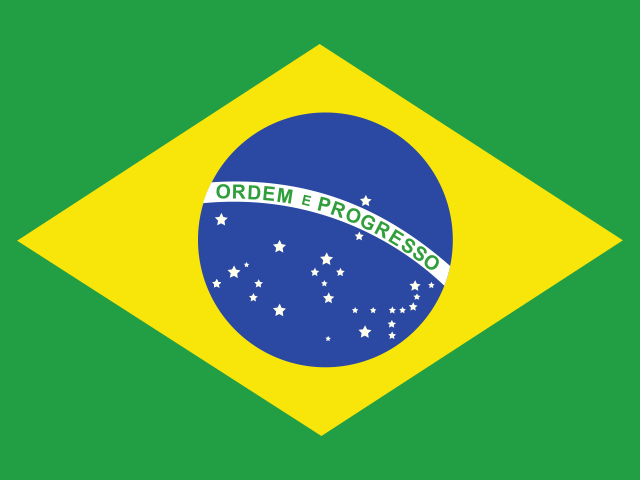 Brazil
 Argentina
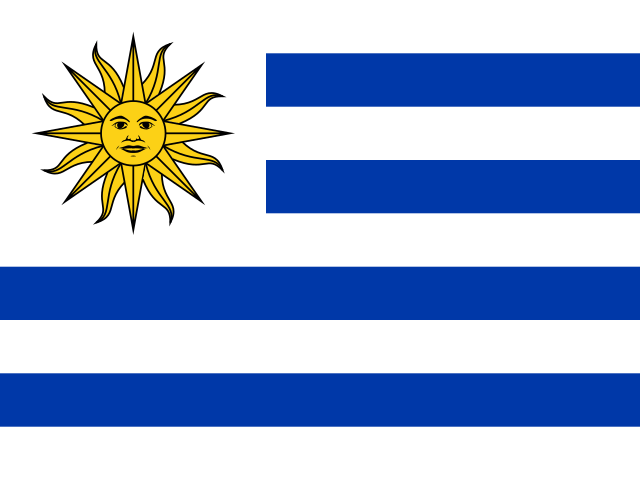 Uruguay
 Paraguay
Earlier Report Observations
The yogurt market volume in MERCOSUR rose consistently from 12.9 thousand tons in 2018 to 14.5 thousand tons in 2022. This growth was driven by evolving consumer preferences for flavored, fruit-included, and healthier yogurt varieties, supported by continuous product innovation including the introduction of new exotic flavors and formulations with natural sweeteners.
After peaking in 2022, the market contracted sharply to 8.2 thousand tons in 2023. During this period, manufacturers continued to launch innovative products such as whole yogurts sweetened with fruit pulp and expanded regional lines with options free from sugar, fat, and additives.
For 2024, factors such as rising cocoa prices affecting cocoa-flavored products, the adoption of sustainable packaging solutions, and sustained consumer preference for flavored yogurts are noted as influential elements in the market landscape.
Table of content
- 1. Disclaimer
- 2. Terms of use of the report
- 3. Product codes in the statistical classifications used in the report
-
4. Key Market Indicators and Trends
-
4.1. Key Market Indicators
-
4.1.1. In kind
- 4.1.1.1. Production, 2018-2023
- 4.1.1.2. Imports, 2018-2024
- 4.1.1.3. Exports, 2018-2024
- 4.1.1.4. Market size, 2018-2023
-
4.1.1. In kind
- 4.2. Market Trends and Factors
-
4.1. Key Market Indicators
-
5. Production
-
5.1. Production in MERCOSUR
- 5.1.1. Annual dynamics of production in MERCOSUR in kind, 2018-2023, K t
-
5.2. Global production by Country, 2018-2023
- 5.2.1. Annual dynamics of production by macroregions in kind, 2018-2023, K t
- 5.2.2. Dynamics of production structure by macroregions in kind, 2018-2023
- 5.2.3. Annual dynamics of production by country in kind, 2018-2023, K t
- 5.2.4. Structure of production by countries in kind, 2018-2023
- 5.2.5. Dynamics of peoduction structure by countries in kind, 2018-2023
-
5.1. Production in MERCOSUR
-
6. Imports
-
6.1. Imports (Direct Data)
- 6.1.1. Imports - Total information
-
6.1.2. Imports in kind, t
- 6.1.2.1. Annual dynamics of product's imports to Brazil in kind, 2018-2024, t
- 6.1.2.2. Dynamics of product's imports in kind to Brazil by countries, 2018-2024, t
- 6.1.2.3. Structure of product's imports in kind by countries, 2018-2024
-
6.1.3. Imports in value, K $ US
- 6.1.3.1. Annual dynamics of product's imports to Brazil in value, 2018-2024, K $ US
- 6.1.3.2. Dynamics of product's imports in value to Brazil by countries, 2018-2024, K $ US
- 6.1.3.3. Structure of product's imports in value by countries, 2018-2024
-
6.1.4. Average price of product's imports, $ US/t
- 6.1.4.1. Annual dynamics of average price of product's imports to Brazil, 2018-2024, $ US/t
- 6.1.4.2. Dynamics of average price of product's imports to Brazil by countries, 2018-2024, $ US/t
-
6.2. Imports (Mirror Data)
- 6.2.1. Imports - Total information
-
6.2.2. Imports in kind, t
- 6.2.2.1. Annual dynamics of product's imports to Brazil in kind, 2018-2024, t
- 6.2.2.2. Dynamics of product's imports in kind to Brazil by countries, 2018-2024, t
- 6.2.2.3. Structure of product's imports in kind by countries, 2018-2024
-
6.2.3. Imports in value, K $ US
- 6.2.3.1. Annual dynamics of product's imports to Brazil in value, 2018-2024, K $ US
- 6.2.3.2. Dynamics of product's imports in value to Brazil by countries, 2018-2024, K $ US
- 6.2.3.3. Structure of product's imports in value by countries, 2018-2024
-
6.2.4. Average price of product's imports, $ US/t
- 6.2.4.1. Annual dynamics of average price of product's imports to Brazil, 2018-2024, $ US/t
- 6.2.4.2. Dynamics of average price of product's imports to Brazil by countries, 2018-2024, $ US/t
-
6.1. Imports (Direct Data)
-
7. Exports
-
7.1. Exports (Direct Data)
- 7.1.1. Exports - Total information
-
7.1.2. Exports in kind, t
- 7.1.2.1. Annual dynamics of product's exports from Brazil in kind, 2018-2024, t
- 7.1.2.2. Dynamics of product's exports in kind from Brazil by countries, 2018-2024, t
- 7.1.2.3. Structure of product's exports in kind by countries, 2018-2024
-
7.1.3. Exports in value, K $ US
- 7.1.3.1. Annual dynamics of product's exports from Brazil in value, 2018-2024, K $ US
- 7.1.3.2. Dynamics of product's exports in value from Brazil by countries, 2018-2024, K $ US
- 7.1.3.3. Structure of product's exports in value by countries, 2018-2024
-
7.1.4. Average price of product's exports, $ US/t
- 7.1.4.1. Annual dynamics of average price of product's exports from Brazil, 2018-2024, $ US/t
- 7.1.4.2. Dynamics of average price of product's exports from Brazil by countries, 2018-2024, $ US/t
-
7.2. Exports (Mirror Data)
- 7.2.1. Exports - Total information
-
7.2.2. Exports in kind, t
- 7.2.2.1. Annual dynamics of product's exports from Brazil in kind, 2018-2024, t
- 7.2.2.2. Dynamics of product's exports in kind from Brazil by countries, 2018-2024, t
- 7.2.2.3. Structure of product's exports in kind by countries, 2018-2024
-
7.2.3. Exports in value, K $ US
- 7.2.3.1. Annual dynamics of product's exports from Brazil in value, 2018-2024, K $ US
- 7.2.3.2. Dynamics of product's exports in value from Brazil by countries, 2018-2024, K $ US
- 7.2.3.3. Structure of product's exports in value by countries, 2018-2024
-
7.2.4. Average price of product's exports, $ US/t
- 7.2.4.1. Annual dynamics of average price of product's exports from Brazil, 2018-2024, $ US/t
- 7.2.4.2. Dynamics of average price of product's exports from Brazil by countries, 2018-2024, $ US/t
-
7.1. Exports (Direct Data)
-
8. Trade balance
-
8.1. Trade balance (Direct Data)
- 8.1.1. In kind, t
- 8.1.2. In value, K $ US
-
8.2. Trade balance (Mirror Data)
- 8.2.1. In kind, t
- 8.2.2. In value, K $ US
-
8.1. Trade balance (Direct Data)
-
9. Top buying and selling countries, 2018-2024
-
9.1. Direct Data
- 9.1.1. Import in Value by Countries-buyers
- 9.1.2. Export in Value by Countries-suppliers
-
9.2. Mirror Data
- 9.2.1. Import in Value by Countries-buyers
- 9.2.2. Export in Value by Countries-suppliers
-
9.1. Direct Data
Production yoghurt in MERCOSUR
In kind, 2017-2020, t
Top producers of yoghurt, 2017-2020
World map of production of yoghurt, 2017-2020
Yoghurt production in MERCOSUR grew for the second year in a row. In 2019, output reached 12 986 tonnes, then increased by 3.1% to 13 386 tonnes in 2020. Over the 2017-2020 period, production rose by 7.7%, with an average annual growth rate of 2.5%. The lowest production volume was recorded in 2018 at 11 638 tonnes, which represented a 6.4% decline from the previous year. In contrast, 2019 saw the largest increase of 11.6%.
Annual dynamics of production in MERCOSUR in kind, 2017-2020, t
| Parameter | 2018 | 2019 | 2020 | CAGR | |
|---|---|---|---|---|---|
| 1 | Change from last year | (6.4%) | 11.6% | 3.1% | 2.5% |
Exports yoghurt from MERCOSUR
Exports in kind, t
Yoghurt exports from MERCOSUR fell for the third consecutive year. In 2020, shipments totaled 300 tonnes, down 36.7% from the previous year. Over the 2017-2020 period, exports dropped by 78.9%, with an average annual decline of 40.4%.
Annual dynamics of product's exports from MERCOSUR in kind, 2017-2020, t
| Parameter | 2018 | 2019 | 2020 | CAGR | |
|---|---|---|---|---|---|
| 1 | Change from last year | (48.6%) | (35.0%) | (36.7%) | (40.4%) |
Between 2017 and 2020, the export structure for yoghurt was fairly balanced rather than concentrated. Panama accounted for 2.8% of exports by volume, the Marshall Islands for 1.6%, and Liberia for 1.6%. Together, these three countries represented 6.0% of total flows, while the remaining 94.0% was spread across many other nations.
Structure of product's exports in kind by countries, 2017-2020
World map of product's exports from MERCOSUR in kind, 2017-2020
Exports in value, K $ US
Yoghurt export revenues from MERCOSUR declined for the third year running. In 2020, exports were valued at 454 thousand US dollars, a 52.4% decrease year-over-year. Between 2017 and 2020, export value fell by 81.1%, equivalent to an average annual drop of 42.6%.
Annual dynamics of product's exports from MERCOSUR in value, 2017-2020, K $ US
| Parameter | 2018 | 2019 | 2020 | CAGR | |
|---|---|---|---|---|---|
| 1 | Change from last year | (31.1%) | (42.3%) | (52.4%) | (42.6%) |
From 2017 to 2020, Panama, the Marshall Islands, and Liberia played a notable but not dominant role as buyers of MERCOSUR yoghurt in value terms. Panama accounted for 2.4% of export value, the Marshall Islands for 1.6%, and Liberia for 1.2%. Their combined share reached just 5.2% of total export value.
Structure of product's exports in value by countries, 2017-2020
World map of product's exports from MERCOSUR in value, 2017-2020
Imports yoghurt to MERCOSUR
Imports in kind, t
The yoghurt import market in MERCOSUR showed significant volatility during the observed period. Imports hit their lowest point in 2017, then peaked in 2018, with a 25-fold difference between these years. In 2020, imports amounted to 752 tonnes, marking a 30.6% drop from the previous year. The highest volume was recorded in 2018 at 2 007 tonnes. The largest decline occurred in 2019, falling by 46.1%, while the biggest increase was in 2018, surging by 2 373.4%.
Annual dynamics of product's imports to MERCOSUR in kind, 2017-2020, t
| Parameter | 2018 | 2019 | 2020 | CAGR | |
|---|---|---|---|---|---|
| 1 | Change from last year | 2 373.4% | (46.1%) | (30.6%) | 110.0% |
Between 2017 and 2020, Chile was the top supplier of yoghurt to MERCOSUR by volume, accounting for 1.7% of total imports.
Structure of product's imports in kind by countries, 2017-2020
World map of product's imports to MERCOSUR in kind, 2017-2020
Imports in value, K $ US
Yoghurt imports into MERCOSUR declined for the second consecutive year. In 2020, imports totaled 1 274 thousand US dollars, a sharp decrease of 43.1% year-over-year. Between 2017 and 2020, import value fell by 49.8%, with an average annual decline of 20.5%. The peak value was recorded in 2018 at 3 549 thousand US dollars, which also saw the largest increase of 39.7%.
Annual dynamics of product's imports to MERCOSUR in value, 2017-2020, K $ US
| Parameter | 2018 | 2019 | 2020 | CAGR | |
|---|---|---|---|---|---|
| 1 | Change from last year | 39.7% | (36.9%) | (43.1%) | (20.5%) |
Over the 2017-2020 period, Chile and Germany consistently accounted for the largest share of yoghurt imports into MERCOSUR in value terms, together representing 3.2% of total flows.
Structure of product's imports in value by countries, 2017-2020
World map of product's imports to MERCOSUR in value, 2017-2020
Related Reports

2026-03-27
2026-03-27
2026-03-27
2026-03-27

2026-03-30

Milk powder market in MERCOSUR
2026-03-30

Milk and cream market in MERCOSUR
2026-03-27

Why Choose Us?
Only Verified Data
No Hidden Costs or Separate Fees
Smarter Subscription Pricing
Contact Our Team
Submit your inquiry using the form below — our team will get back to you within 24 hours.