






"MERCOSUR" region includes following countries:
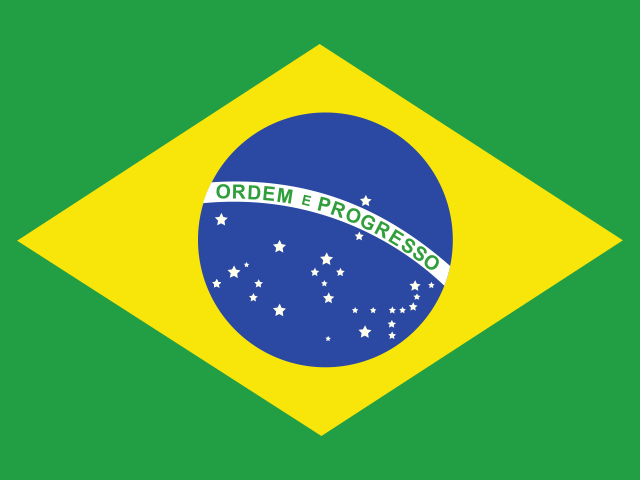 Brazil
 Argentina
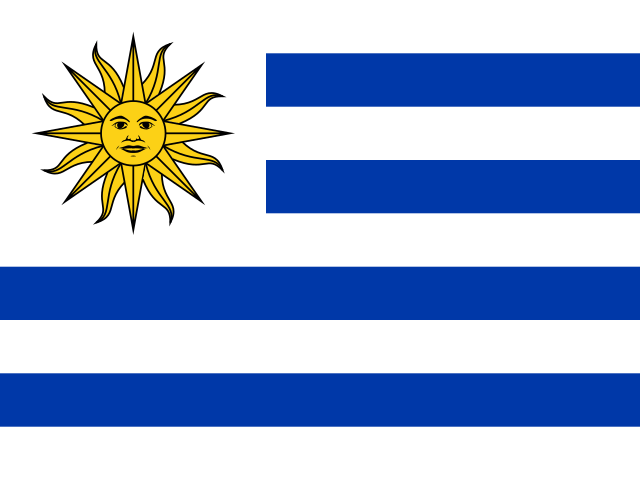 Uruguay
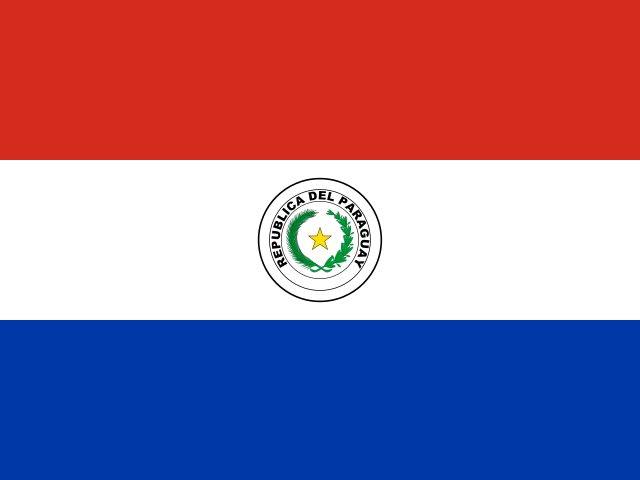 Paraguay
Earlier Report Observations
From 2018 to 2021, the milk and cream market in MERCOSUR saw steady volume growth, rising from 52.1 million tons to 54.8 million tons. This expansion was largely driven by increasing consumption of fresh dairy products in Brazil, where consumer preference for quality items and supportive regulation boosted demand. The trend continued as the hospitality sector recovered, with more dining out and takeaway orders further lifting sales.
In 2022, high inflation in Brazil pushed dairy prices up by 22%, while formal milk production in the country declined by 5%, leading to higher imports to cover domestic needs. That same year, new lactose-free product launches entered the market, catering to health-conscious consumers and expanding product variety. By 2023, adverse La Niña weather conditions in Argentina, Brazil, and Uruguay restrained milk output, slowing volume growth to 55.4 million tons, while the market's monetary value retreated from its 2022 peak as earlier cost pressures eased.
Table of content
- 1. Disclaimer
- 2. Terms of use of the report
- 3. Product codes in the statistical classifications used in the report
-
4. Key Market Indicators and Trends
-
4.1. Key Market Indicators
-
4.1.1. In kind
- 4.1.1.1. Production, 2018-2023
- 4.1.1.2. Imports, 2018-2024
- 4.1.1.3. Exports, 2018-2024
- 4.1.1.4. Market size, 2018-2023
-
4.1.2. In value
- 4.1.2.1. Production, 2018-2023
- 4.1.2.2. Imports, 2018-2024
- 4.1.2.3. Exports, 2018-2024
- 4.1.2.4. Market size, 2018-2023
-
4.1.1. In kind
- 4.2. Market Trends and Factors
-
4.1. Key Market Indicators
-
5. Production
-
5.1. Production in MERCOSUR
- 5.1.1. Annual dynamics of production in MERCOSUR in kind, 2018-2023, K t
-
5.2. Global production by Country, 2018-2023
- 5.2.1. Annual dynamics of production by macroregions in kind, 2018-2023, K t
- 5.2.2. Dynamics of production structure by macroregions in kind, 2018-2023
- 5.2.3. Annual dynamics of production by country in kind, 2018-2023, K t
- 5.2.4. Structure of production by countries in kind, 2018-2023
- 5.2.5. Dynamics of peoduction structure by countries in kind, 2018-2023
-
5.1. Production in MERCOSUR
-
6. Imports
-
6.1. Imports (Direct Data)
- 6.1.1. Imports - Total information
-
6.1.2. Imports in kind, t
- 6.1.2.1. Annual dynamics of product's imports to Brazil in kind, 2018-2024, t
- 6.1.2.2. Dynamics of product's imports in kind to Brazil by countries, 2018-2024, t
- 6.1.2.3. Structure of product's imports in kind by countries, 2018-2024
-
6.1.3. Imports in value, K $ US
- 6.1.3.1. Annual dynamics of product's imports to Brazil in value, 2018-2024, K $ US
- 6.1.3.2. Dynamics of product's imports in value to Brazil by countries, 2018-2024, K $ US
- 6.1.3.3. Structure of product's imports in value by countries, 2018-2024
-
6.1.4. Average price of product's imports, $ US/kg
- 6.1.4.1. Annual dynamics of average price of product's imports to Brazil, 2018-2024, $ US/kg
- 6.1.4.2. Dynamics of average price of product's imports to Brazil by countries, 2018-2024, $ US/kg
-
6.2. Imports (Mirror Data)
- 6.2.1. Imports - Total information
-
6.2.2. Imports in kind, t
- 6.2.2.1. Annual dynamics of product's imports to Brazil in kind, 2018-2024, t
- 6.2.2.2. Dynamics of product's imports in kind to Brazil by countries, 2018-2024, t
- 6.2.2.3. Structure of product's imports in kind by countries, 2018-2024
-
6.2.3. Imports in value, K $ US
- 6.2.3.1. Annual dynamics of product's imports to Brazil in value, 2018-2024, K $ US
- 6.2.3.2. Dynamics of product's imports in value to Brazil by countries, 2018-2024, K $ US
- 6.2.3.3. Structure of product's imports in value by countries, 2018-2024
-
6.2.4. Average price of product's imports, $ US/kg
- 6.2.4.1. Annual dynamics of average price of product's imports to Brazil, 2018-2024, $ US/kg
- 6.2.4.2. Dynamics of average price of product's imports to Brazil by countries, 2018-2024, $ US/kg
-
6.1. Imports (Direct Data)
-
7. Exports
-
7.1. Exports (Direct Data)
- 7.1.1. Exports - Total information
-
7.1.2. Exports in kind, t
- 7.1.2.1. Annual dynamics of product's exports from Brazil in kind, 2018-2024, t
- 7.1.2.2. Dynamics of product's exports in kind from Brazil by countries, 2018-2024, t
- 7.1.2.3. Structure of product's exports in kind by countries, 2018-2024
-
7.1.3. Exports in value, K $ US
- 7.1.3.1. Annual dynamics of product's exports from Brazil in value, 2018-2024, K $ US
- 7.1.3.2. Dynamics of product's exports in value from Brazil by countries, 2018-2024, K $ US
- 7.1.3.3. Structure of product's exports in value by countries, 2018-2024
-
7.1.4. Average price of product's exports, $ US/kg
- 7.1.4.1. Annual dynamics of average price of product's exports from Brazil, 2018-2024, $ US/kg
- 7.1.4.2. Dynamics of average price of product's exports from Brazil by countries, 2018-2024, $ US/kg
-
7.2. Exports (Mirror Data)
- 7.2.1. Exports - Total information
-
7.2.2. Exports in kind, t
- 7.2.2.1. Annual dynamics of product's exports from Brazil in kind, 2018-2024, t
- 7.2.2.2. Dynamics of product's exports in kind from Brazil by countries, 2018-2024, t
- 7.2.2.3. Structure of product's exports in kind by countries, 2018-2024
-
7.2.3. Exports in value, K $ US
- 7.2.3.1. Annual dynamics of product's exports from Brazil in value, 2018-2024, K $ US
- 7.2.3.2. Dynamics of product's exports in value from Brazil by countries, 2018-2024, K $ US
- 7.2.3.3. Structure of product's exports in value by countries, 2018-2024
-
7.2.4. Average price of product's exports, $ US/kg
- 7.2.4.1. Annual dynamics of average price of product's exports from Brazil, 2018-2024, $ US/kg
- 7.2.4.2. Dynamics of average price of product's exports from Brazil by countries, 2018-2024, $ US/kg
-
7.1. Exports (Direct Data)
-
8. Trade balance
-
8.1. Trade balance (Direct Data)
- 8.1.1. In kind, t
- 8.1.2. In value, K $ US
-
8.2. Trade balance (Mirror Data)
- 8.2.1. In kind, t
- 8.2.2. In value, K $ US
-
8.1. Trade balance (Direct Data)
-
9. Top buying and selling countries, 2018-2024
-
9.1. Direct Data
- 9.1.1. Import in Value by Countries-buyers
- 9.1.2. Export in Value by Countries-suppliers
-
9.2. Mirror Data
- 9.2.1. Import in Value by Countries-buyers
- 9.2.2. Export in Value by Countries-suppliers
-
9.1. Direct Data
Production milk and cream in MERCOSUR
In kind, 2017-2020, K t
Top producers of milk and cream, 2017-2020
World map of production of milk and cream, 2017-2020
MERCOSUR's milk and cream production has grown for the third year in a row. In 2020, the region produced 54 365 thousand tons, marking a 2.5% increase from 2019. Looking at the period from 2017 to 2020, production rose by 6.6%, which translates to an average annual growth rate of 2.2%.
Annual dynamics of production in MERCOSUR in kind, 2017-2020, K t
| Parameter | 2018 | 2019 | 2020 | CAGR | |
|---|---|---|---|---|---|
| 1 | Change from last year | 2.1% | 1.8% | 2.5% | 2.2% |
In value, 2017-2020, M $ US
MERCOSUR's milk and cream production value has increased for the second consecutive year. In 2020, the output was valued at 76 654 million US dollars, up 13.4% compared to the previous year. From 2017 to 2020, production value grew by 19.8%, averaging 6.2% per year. The lowest value was recorded in 2018 at 61 286 million US dollars, which also saw the largest decline of 4.2%.
Annual dynamics of production in MERCOSUR in value, 2017-2020, M $ US
| Parameter | 2018 | 2019 | 2020 | CAGR | |
|---|---|---|---|---|---|
| 1 | Change from last year | (4.2%) | 10.3% | 13.4% | 6.2% |
Exports milk and cream from MERCOSUR
Exports in kind, t
Milk and cream exports from MERCOSUR have declined for the third consecutive year. In 2020, exports reached 16 394 tons, a 2.5% decrease from 2019. Over the 2017-2020 period, exports fell by 21.1%, with a compound annual growth rate of -7.6%.
Annual dynamics of product's exports from MERCOSUR in kind, 2017-2020, t
| Parameter | 2018 | 2019 | 2020 | CAGR | |
|---|---|---|---|---|---|
| 1 | Change from last year | (13.5%) | (6.4%) | (2.5%) | (7.6%) |
From 2017 to 2020, MERCOSUR's milk and cream exports in kind were distributed across a wide range of partner countries. The Philippines accounted for 33.4% of exports, China for 6.5%, and the United Arab Emirates for 5.9%, together making up 45.8% of total flows.
Structure of product's exports in kind by countries, 2017-2020
World map of product's exports from MERCOSUR in kind, 2017-2020
Exports in value, K $ US
Milk and cream exports in value terms from MERCOSUR have increased for the second year in a row. In 2020, exports totaled 23 115 thousand US dollars, a 7.8% rise from 2019. However, over the 2017-2020 period, exports decreased by 11.3%, with an average annual decline of 3.9%. The lowest value was recorded in 2018 at 21 151 thousand US dollars, which also experienced the largest drop of 18.8%.
Annual dynamics of product's exports from MERCOSUR in value, 2017-2020, K $ US
| Parameter | 2018 | 2019 | 2020 | CAGR | |
|---|---|---|---|---|---|
| 1 | Change from last year | (18.8%) | 1.4% | 7.8% | (3.9%) |
In the 2017-2020 period, the partner landscape for milk and cream exports in value terms was diverse. The Philippines contributed 31.1% of exports, the United Arab Emirates 13.9%, and the United States 4.8%, together accounting for 49.8% of total flows. The remaining 50.2% was distributed among many other countries.
Structure of product's exports in value by countries, 2017-2020
World map of product's exports from MERCOSUR in value, 2017-2020
Imports milk and cream to MERCOSUR
Imports in kind, t
Milk and cream imports into MERCOSUR showed significant fluctuations during the period. The lowest volume was recorded in 2018 at 1 022 tons, which saw the largest decline of 45.5%. In 2019, imports surged by 82.4%, and in 2020, they reached 2 326 tons, a 24.8% increase year-over-year. From the trough in 2018 to the peak in 2020, imports increased by a factor of 2.3.
Annual dynamics of product's imports to MERCOSUR in kind, 2017-2020, t
| Parameter | 2018 | 2019 | 2020 | CAGR | |
|---|---|---|---|---|---|
| 1 | Change from last year | (45.5%) | 82.4% | 24.8% | 7.4% |
Structure of product's imports in kind by countries, 2017-2020
World map of product's imports to MERCOSUR in kind, 2017-2020
Imports in value, K $ US
Milk and cream imports in value terms into MERCOSUR exhibited irregular changes, reflecting a volatile market. The lowest value was recorded in 2017, while the peak occurred in 2020, with a 2.7-fold difference between these years. In 2020, imports stood at 5 650 thousand US dollars, a sharp 92.1% increase from the previous year. The largest decline was recorded in 2019 at 22.1%.
Annual dynamics of product's imports to MERCOSUR in value, 2017-2020, K $ US
| Parameter | 2018 | 2019 | 2020 | CAGR | |
|---|---|---|---|---|---|
| 1 | Change from last year | 80.4% | (22.1%) | 92.1% | 39.2% |
From 2017 to 2020, Chile was the leading supplier of milk and cream to MERCOSUR, holding a share of 0.8%.
Structure of product's imports in value by countries, 2017-2020
World map of product's imports to MERCOSUR in value, 2017-2020
Related Reports

Milk and cream market in Portugal
2026-03-27
Milk and cream market in Indonesia
2026-03-27
Milk and cream market in Algeria
2026-03-27
Milk and cream market in South America
2026-03-27

2026-03-30

Milk powder market in MERCOSUR
2026-03-30


2026-03-27
Why Choose Us?
Only Verified Data
No Hidden Costs or Separate Fees
Smarter Subscription Pricing
Contact Our Team
Submit your inquiry using the form below — our team will get back to you within 24 hours.