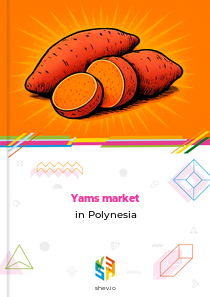







"Polynesia" region includes following countries:
 American Samoa
 Cook Islands
 French Polynesia
 Niue
Niue Pitcairn Islands
 Tokelau
 Tonga
Tonga Tuvalu
 Wallis and Futuna Islands
 Samoa
SamoaEarlier Report Observations
The yam market in Polynesia underwent a major contraction in 2019, with volume falling to 3 297 т from 7 543 т in 2018. This drop was driven by a sharp decline in domestic production alongside a notable rise in exports. A steady recovery followed over the next four years, bringing the market size to 4 935 т by 2023.
Following the 2019 downturn, local production stabilized at approximately 5 000–5 100 т annually. Export volumes, however, showed significant year‑to‑year fluctuations, which directly influenced the amount of yams remaining for domestic consumption, while imports played a negligible role throughout the period.
In 2024, several initiatives aimed at promoting local products were launched, including the reopening of a Polynesian market in Paris for cultural and commercial promotion and the establishment of a new direct‑sale market for local producers in Tahiti. Regulatory texts affecting market access and public procurement were also updated during the year.
Table of content
- 1. Disclaimer
- 2. Terms of use of the report
- 3. Product codes in the statistical classifications used in the report
-
4. Key Market Indicators and Trends
-
4.1. Key Market Indicators
-
4.1.1. In kind
- 4.1.1.1. Production, 2018-2023
- 4.1.1.2. Imports, 2018-2024
- 4.1.1.3. Exports, 2018-2024
- 4.1.1.4. Market size, 2018-2023
-
4.1.1. In kind
- 4.2. Market Trends and Factors
-
4.1. Key Market Indicators
-
5. Production
-
5.1. Production in Polynesia
- 5.1.1. Annual dynamics of production in Polynesia in kind, 2018-2023, t
-
5.2. Global production by Country, 2018-2023
- 5.2.1. Annual dynamics of production by macroregions in kind, 2018-2023, t
- 5.2.2. Dynamics of production structure by macroregions in kind, 2018-2023
- 5.2.3. Annual dynamics of production by country in kind, 2018-2023, t
- 5.2.4. Structure of production by countries in kind, 2018-2023
- 5.2.5. Dynamics of peoduction structure by countries in kind, 2018-2023
-
5.1. Production in Polynesia
-
6. Imports
-
6.1. Imports (Direct Data*)
- 6.1.1. Imports - Total information
-
6.1.2. Imports in kind, t
- 6.1.2.1. Annual dynamics of product's imports to American Samoa in kind, 2018-2024, t
- 6.1.2.2. Dynamics of product's imports in kind to American Samoa by countries, 2018-2024, t
- 6.1.2.3. Structure of product's imports in kind by countries, 2018-2024
-
6.1.3. Imports in value, K $ US
- 6.1.3.1. Annual dynamics of product's imports to American Samoa in value, 2018-2024, K $ US
- 6.1.3.2. Dynamics of product's imports in value to American Samoa by countries, 2018-2024, K $ US
- 6.1.3.3. Structure of product's imports in value by countries, 2018-2024
-
6.1.4. Average price of product's imports, $ US/t
- 6.1.4.1. Annual dynamics of average price of product's imports to American Samoa, 2018-2024, $ US/t
- 6.1.4.2. Dynamics of average price of product's imports to American Samoa by countries, 2018-2024, $ US/t
-
6.2. Imports (Mirror Data)
- 6.2.1. Imports - Total information
-
6.2.2. Imports in kind, t
- 6.2.2.1. Annual dynamics of product's imports to American Samoa in kind, 2018-2024, t
- 6.2.2.2. Dynamics of product's imports in kind to American Samoa by countries, 2018-2024, t
- 6.2.2.3. Structure of product's imports in kind by countries, 2018-2024
-
6.2.3. Imports in value, K $ US
- 6.2.3.1. Annual dynamics of product's imports to American Samoa in value, 2018-2024, K $ US
- 6.2.3.2. Dynamics of product's imports in value to American Samoa by countries, 2018-2024, K $ US
- 6.2.3.3. Structure of product's imports in value by countries, 2018-2024
-
6.2.4. Average price of product's imports, $ US/t
- 6.2.4.1. Annual dynamics of average price of product's imports to American Samoa, 2018-2024, $ US/t
- 6.2.4.2. Dynamics of average price of product's imports to American Samoa by countries, 2018-2024, $ US/t
-
6.1. Imports (Direct Data*)
-
7. Exports
-
7.1. Exports (Direct Data*)
- 7.1.1. Exports - Total information
-
7.1.2. Exports in kind, t
- 7.1.2.1. Annual dynamics of product's exports from American Samoa in kind, 2018-2024, t
- 7.1.2.2. Dynamics of product's exports in kind from American Samoa by countries, 2018-2024, t
- 7.1.2.3. Structure of product's exports in kind by countries, 2018-2024
-
7.1.3. Exports in value, K $ US
- 7.1.3.1. Annual dynamics of product's exports from American Samoa in value, 2018-2024, K $ US
- 7.1.3.2. Dynamics of product's exports in value from American Samoa by countries, 2018-2024, K $ US
- 7.1.3.3. Structure of product's exports in value by countries, 2018-2024
-
7.1.4. Average price of product's exports, $ US/t
- 7.1.4.1. Annual dynamics of average price of product's exports from American Samoa, 2018-2024, $ US/t
- 7.1.4.2. Dynamics of average price of product's exports from American Samoa by countries, 2018-2024, $ US/t
-
7.2. Exports (Mirror Data)
- 7.2.1. Exports - Total information
-
7.2.2. Exports in kind, t
- 7.2.2.1. Annual dynamics of product's exports from American Samoa in kind, 2018-2024, t
- 7.2.2.2. Dynamics of product's exports in kind from American Samoa by countries, 2018-2024, t
- 7.2.2.3. Structure of product's exports in kind by countries, 2018-2024
-
7.2.3. Exports in value, K $ US
- 7.2.3.1. Annual dynamics of product's exports from American Samoa in value, 2018-2024, K $ US
- 7.2.3.2. Dynamics of product's exports in value from American Samoa by countries, 2018-2024, K $ US
- 7.2.3.3. Structure of product's exports in value by countries, 2018-2024
-
7.2.4. Average price of product's exports, $ US/t
- 7.2.4.1. Annual dynamics of average price of product's exports from American Samoa, 2018-2024, $ US/t
- 7.2.4.2. Dynamics of average price of product's exports from American Samoa by countries, 2018-2024, $ US/t
-
7.1. Exports (Direct Data*)
-
8. Trade balance
-
8.1. Trade balance (Direct Data)
- 8.1.1. In kind, t
- 8.1.2. In value, K $ US
-
8.2. Trade balance (Mirror Data)
- 8.2.1. In kind, t
- 8.2.2. In value, K $ US
-
8.1. Trade balance (Direct Data)
-
9. Top buying and selling countries, 2018-2024
-
9.1. Direct Data
- 9.1.1. Import in Value by Countries-buyers
- 9.1.2. Export in Value by Countries-suppliers
-
9.2. Mirror Data
- 9.2.1. Import in Value by Countries-buyers
- 9.2.2. Export in Value by Countries-suppliers
-
9.1. Direct Data
Production yams in Polynesia
In kind, 2017-2020, t
Top producers of yams, 2017-2020
World map of production of yams, 2017-2020
After two years of decline, yam production in Polynesia increased in 2020. That year, 5 117 tonnes of yams were produced, marking a 2.2% rise compared to 2019. However, looking at the broader period from 2017 to 2020, production actually fell by 46.1%, with an average annual decline of 18.6%. The lowest point was in 2019, with only 5 006 tonnes produced, and the sharpest drop occurred that same year at 41.1%.
Annual dynamics of production in Polynesia in kind, 2017-2020, t
| Parameter | 2018 | 2019 | 2020 | CAGR | |
|---|---|---|---|---|---|
| 1 | Change from last year | (10.6%) | (41.1%) | 2.2% | (18.6%) |
In value, 2017-2020, K $ US
Following two years of decrease, the value of yam production in Polynesia rebounded in 2020. Output was valued at 5 840 thousand US dollars, showing a strong year-on-year increase of 12.2%. Despite this recent uptick, over the 2017-2020 period, production value declined by 57.3%, with a compound annual growth rate of -24.7%. The minimum value was recorded in 2019 at 5 204 thousand US dollars, and the largest decline also occurred in 2019, at 48.6%.
Annual dynamics of production in Polynesia in value, 2017-2020, K $ US
| Parameter | 2018 | 2019 | 2020 | CAGR | |
|---|---|---|---|---|---|
| 1 | Change from last year | (25.9%) | (48.6%) | 12.2% | (24.7%) |
Exports yams from Polynesia
Exports in kind, t
The data shows irregular changes, pointing to a volatile market environment. Exports hit their lowest point in 2018 at 951 tonnes, then peaked in 2020 at 2 433 tonnes—a 2.6-fold difference between these years. In 2020, Polynesia exported 2 433 tonnes of yams, representing a significant 42.3% increase from the previous year. The largest decline was in 2018 at 25.2%, while the largest increase occurred in 2019 at 79.7%.
Annual dynamics of product's exports from Polynesia in kind, 2017-2020, t
| Parameter | 2018 | 2019 | 2020 | CAGR | |
|---|---|---|---|---|---|
| 1 | Change from last year | (25.2%) | 79.7% | 42.3% | 24.1% |
From 2017 to 2020, Australia and New Zealand dominated exports in volume, together accounting for 87.8% of total flows. The remaining share was distributed among other countries.
Structure of product's exports in kind by countries, 2017-2020
World map of product's exports from Polynesia in kind, 2017-2020
Exports in value, K $ US
Yam exports from Polynesia increased for the second consecutive year in 2020. Export volume totaled 2 777 thousand US dollars, showing a sharp rise of 56.3% compared to the previous year. Over the 2017-2020 period, exports grew by 51.6%, with an average annual growth rate of 14.9%. The minimum value was in 2018 at 1 135 thousand US dollars, with the largest decline that year at 38.0%. The largest increase was in 2019 at 56.6%.
Annual dynamics of product's exports from Polynesia in value, 2017-2020, K $ US
| Parameter | 2018 | 2019 | 2020 | CAGR | |
|---|---|---|---|---|---|
| 1 | Change from last year | (38.0%) | 56.6% | 56.3% | 14.9% |
Between 2017 and 2020, Australia and New Zealand together captured 94.9% of total exports in value terms, while the rest of the flows were thinly spread across other markets.
Structure of product's exports in value by countries, 2017-2020
World map of product's exports from Polynesia in value, 2017-2020
Imports yams to Polynesia
Imports in kind, t
Volatility characterized the market behavior during these years. Imports bottomed in 2019 at 0.0 tonnes, then peaked in 2020 at 2 tonnes—a 371-fold difference. In 2020, Polynesia's yam import volume reached 2 tonnes, representing a dramatic 36,998.9% uptick compared to 2019. The largest decline was recorded in 2019 at 93.3%.
Annual dynamics of product's imports to Polynesia in kind, 2017-2020, t
| Parameter | 2018 | 2019 | 2020 | CAGR | |
|---|---|---|---|---|---|
| 1 | Change from last year | (44.1%) | (93.3%) | 36 998.9% | 140.1% |
From 2017 to 2020, the United States and Fiji were notable suppliers of yams to Polynesia, jointly accounting for 9.3% of total imports in volume.
Structure of product's imports in kind by countries, 2017-2020
World map of product's imports to Polynesia in kind, 2017-2020
Imports in value, K $ US
Volatility marked the market behavior during these years. Imports reached their lowest point in 2019 at 0.0 thousand US dollars, then peaked in 2020 at 2 thousand US dollars—a 63-fold difference. In 2020, imported yam volumes in Polynesia stood at 2 thousand US dollars, indicating a substantial improvement of 6,247.5% compared to 2019. The largest decline was in 2019 at 87.7%.
Annual dynamics of product's imports to Polynesia in value, 2017-2020, K $ US
| Parameter | 2018 | 2019 | 2020 | CAGR | |
|---|---|---|---|---|---|
| 1 | Change from last year | (56.3%) | (87.7%) | 6 247.5% | 50.6% |
Between 2017 and 2020, the United States and Fiji remained key destinations for imports in value terms, with a combined share of 30.4% of total flows.
Structure of product's imports in value by countries, 2017-2020
World map of product's imports to Polynesia in value, 2017-2020
Related Reports

2026-03-28
2026-03-27
2026-03-27
2026-03-27

Sweet potatoe market in Polynesia
2026-03-27

Aubergines market in Polynesia
2026-03-27

Edible brassicas market in Polynesia
2026-03-27

2026-03-27
Why Choose Us?
Only Verified Data
No Hidden Costs or Separate Fees
Smarter Subscription Pricing
Contact Our Team
Submit your inquiry using the form below — our team will get back to you within 24 hours.