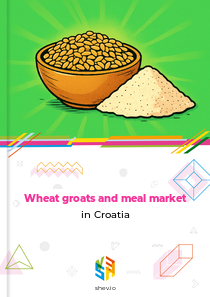







Earlier Report Observations
Between 2018 and 2020, the market volume for wheat groats and meal in Croatia declined from 19 839 t to 18 365 t. This occurred alongside the long-term development of agricultural policy, which had improved wheat yields over the past two decades, supporting domestic production. In 2020, global supply chain disruptions related to the COVID-19 pandemic indirectly pressured the market.
From 2021, growing consumer interest in healthy nutrition stimulated the adjacent wheat bran segment, reflecting broader trends in wheat-based products. A key turning point came in 2023 when increased wheat yields in Croatia directly boosted production to 3 012 t, helping lift the total market volume to 16 869 t after a drop to 15 551 t in 2022.
In 2024, the Better Regulation Law came into force, strengthening the framework for impact assessment and public consultation in the agricultural sector. Simultaneously, global factors including reduced wheat production in the European Union affected market dynamics. The market volume continued its recovery, reaching 17 122 t, even as domestic production fell to 2 348 t.
Table of content
- 1. Disclaimer
- 2. Terms of use of the report
- 3. Product codes in the statistical classifications used in the report
-
4. Key Market Indicators and Trends
-
4.1. Key Market Indicators
-
4.1.1. In kind
- 4.1.1.1. Production, 2018-2024
- 4.1.1.2. Imports, 2018-2024
- 4.1.1.3. Exports, 2018-2024
- 4.1.1.4. Market size, 2018-2024
-
4.1.2. In value
- 4.1.2.1. Production, 2018-2024
- 4.1.2.2. Imports, 2018-2024
- 4.1.2.3. Exports, 2018-2024
- 4.1.2.4. Market size, 2018-2024
-
4.1.1. In kind
- 4.2. Market Trends and Factors
-
4.1. Key Market Indicators
-
5. Production
-
5.1. Production in Croatia
- 5.1.1. In kind, 2018-2024, t
- 5.1.2. In value, 2018-2024, K $ US
-
5.2. Production in the EU, 2018-2024
- 5.2.1. In kind, 2018-2024, t
- 5.2.2. In value, 2018-2024, K $ US
-
5.1. Production in Croatia
-
6. Imports
-
6.1. Imports (Direct Data)
- 6.1.1. Imports - Total information
-
6.1.2. Imports in kind, t
- 6.1.2.1. Annual dynamics of product's imports to Croatia in kind, 2018-2024, t
- 6.1.2.2. Dynamics of product's imports in kind to Croatia by countries, 2018-2024, t
- 6.1.2.3. Structure of product's imports in kind by countries, 2018-2024
-
6.1.3. Imports in value, K $ US
- 6.1.3.1. Annual dynamics of product's imports to Croatia in value, 2018-2024, K $ US
- 6.1.3.2. Dynamics of product's imports in value to Croatia by countries, 2018-2024, K $ US
- 6.1.3.3. Structure of product's imports in value by countries, 2018-2024
-
6.1.4. Average price of product's imports, $ US/t
- 6.1.4.1. Annual dynamics of average price of product's imports to Croatia, 2018-2024, $ US/t
- 6.1.4.2. Dynamics of average price of product's imports to Croatia by countries, 2018-2024, $ US/t
-
6.2. Imports (Mirror Data)
- 6.2.1. Imports - Total information
-
6.2.2. Imports in kind, t
- 6.2.2.1. Annual dynamics of product's imports to Croatia in kind, 2018-2024, t
- 6.2.2.2. Dynamics of product's imports in kind to Croatia by countries, 2018-2024, t
- 6.2.2.3. Structure of product's imports in kind by countries, 2018-2024
-
6.2.3. Imports in value, K $ US
- 6.2.3.1. Annual dynamics of product's imports to Croatia in value, 2018-2024, K $ US
- 6.2.3.2. Dynamics of product's imports in value to Croatia by countries, 2018-2024, K $ US
- 6.2.3.3. Structure of product's imports in value by countries, 2018-2024
-
6.2.4. Average price of product's imports, $ US/t
- 6.2.4.1. Annual dynamics of average price of product's imports to Croatia, 2018-2024, $ US/t
- 6.2.4.2. Dynamics of average price of product's imports to Croatia by countries, 2018-2024, $ US/t
-
6.1. Imports (Direct Data)
-
7. Exports
-
7.1. Exports (Direct Data)
- 7.1.1. Exports - Total information
-
7.1.2. Exports in kind, t
- 7.1.2.1. Annual dynamics of product's exports from Croatia in kind, 2018-2024, t
- 7.1.2.2. Dynamics of product's exports in kind from Croatia by countries, 2018-2024, t
- 7.1.2.3. Structure of product's exports in kind by countries, 2018-2024
-
7.1.3. Exports in value, K $ US
- 7.1.3.1. Annual dynamics of product's exports from Croatia in value, 2018-2024, K $ US
- 7.1.3.2. Dynamics of product's exports in value from Croatia by countries, 2018-2024, K $ US
- 7.1.3.3. Structure of product's exports in value by countries, 2018-2024
-
7.1.4. Average price of product's exports, $ US/t
- 7.1.4.1. Annual dynamics of average price of product's exports from Croatia, 2018-2024, $ US/t
- 7.1.4.2. Dynamics of average price of product's exports from Croatia by countries, 2018-2024, $ US/t
-
7.2. Exports (Mirror Data)
- 7.2.1. Exports - Total information
-
7.2.2. Exports in kind, t
- 7.2.2.1. Annual dynamics of product's exports from Croatia in kind, 2018-2024, t
- 7.2.2.2. Dynamics of product's exports in kind from Croatia by countries, 2018-2024, t
- 7.2.2.3. Structure of product's exports in kind by countries, 2018-2024
-
7.2.3. Exports in value, K $ US
- 7.2.3.1. Annual dynamics of product's exports from Croatia in value, 2018-2024, K $ US
- 7.2.3.2. Dynamics of product's exports in value from Croatia by countries, 2018-2024, K $ US
- 7.2.3.3. Structure of product's exports in value by countries, 2018-2024
-
7.2.4. Average price of product's exports, $ US/t
- 7.2.4.1. Annual dynamics of average price of product's exports from Croatia, 2018-2024, $ US/t
- 7.2.4.2. Dynamics of average price of product's exports from Croatia by countries, 2018-2024, $ US/t
-
7.1. Exports (Direct Data)
-
8. Trade balance
-
8.1. Trade balance (Direct Data)
- 8.1.1. In kind, t
- 8.1.2. In value, K $ US
-
8.2. Trade balance (Mirror Data)
- 8.2.1. In kind, t
- 8.2.2. In value, K $ US
-
8.1. Trade balance (Direct Data)
-
9. Top buying and selling countries, 2018-2024
-
9.1. Direct Data
- 9.1.1. Import in Value by Countries-buyers
- 9.1.2. Export in Value by Countries-suppliers
-
9.2. Mirror Data
- 9.2.1. Import in Value by Countries-buyers
- 9.2.2. Export in Value by Countries-suppliers
-
9.1. Direct Data
Production wheat groats and meal in Croatia
In value, 2017-2020, K $ US
Wheat groats and meal production in Croatia declined for the second consecutive year. In 2020, output was valued at 1 790 thousand US dollars, marking a 1.5% decrease compared to the previous year. The largest increase occurred in 2018, when production rose by 7.6% to reach its peak value of 1 915 thousand US dollars. However, this was followed by the largest decline of 5.1% in 2019.
Annual dynamics of production in Croatia in value, 2017-2020, K $ US
| Parameter | 2018 | 2019 | 2020 | CAGR | |
|---|---|---|---|---|---|
| 1 | Change from last year | 7.6% | (5.1%) | (1.5%) | 0.2% |
In kind, 2017-2020, t
Wheat groats and meal production in Croatia declined for the third consecutive year. In 2020, Croatia produced 2 656 tonnes, reflecting a significant year-on-year decrease of 15.6%. Over the period from 2017 to 2020, production fell by 19%, with a compound annual growth rate of -6.8%.
Annual dynamics of production in Croatia in kind, 2017-2020, t
| Parameter | 2018 | 2019 | 2020 | CAGR | |
|---|---|---|---|---|---|
| 1 | Change from last year | (3.2%) | (0.9%) | (15.6%) | (6.8%) |
Exports wheat groats and meal from Croatia
Exports in kind, t
The market showed signs of volatility during the observed period. Export volumes peaked in 2017 and fell to their lowest point in 2019, with a 7.1-fold difference between these years. In 2020, wheat groats and meal shipments from Croatia reached 299 tonnes, indicating a substantial increase of 393.5% compared to the previous year. The minimum value was recorded in 2019 at 61 tonnes, which also saw the largest decline of 78.4%.
Annual dynamics of product's exports from Croatia in kind, 2017-2020, t
| Parameter | 2018 | 2019 | 2020 | CAGR | |
|---|---|---|---|---|---|
| 1 | Change from last year | (34.9%) | (78.4%) | 393.5% | (11.4%) |
From 2017 to 2020, Serbia, Bosnia and Herzegovina, and Germany formed the main cluster of markets for exports in kind. Serbia accounted for 39.8% of exports, Bosnia and Herzegovina for 36.5%, and Germany for 7.9%, with these three countries together representing 84.1% of total export flows.
Structure of product's exports in kind by countries, 2017-2020
World map of product's exports from Croatia in kind, 2017-2020
Exports in value, K $ US
The market exhibited an unstable trend throughout the timeframe. Export volumes reached their maximum in 2020 and dropped to a minimum in 2019, showing a 12.7-fold shift between these years. In 2020, exported wheat groats and meal from Croatia were valued at 677 thousand US dollars, up by 1 166.0% compared to 2019. The minimum value was recorded in 2019 at 53 thousand US dollars, which also experienced the largest decline of 65.4%.
Annual dynamics of product's exports from Croatia in value, 2017-2020, K $ US
| Parameter | 2018 | 2019 | 2020 | CAGR | |
|---|---|---|---|---|---|
| 1 | Change from last year | (15.9%) | (65.4%) | 1 166.0% | 54.5% |
Over the period from 2017 to 2020, Germany, Bosnia and Herzegovina, and Serbia remained the leading destinations in the country structure of exports in value terms. Germany accounted for 34.9% of exports, Bosnia and Herzegovina for 22.9%, and Serbia for 16.2%, with these three countries together comprising 74.1% of total export flows.
Structure of product's exports in value by countries, 2017-2020
World map of product's exports from Croatia in value, 2017-2020
Imports wheat groats and meal to Croatia
Imports in kind, t
After a two-year contraction, wheat groats and meal imports into Croatia increased. In 2020, imports totaled 16 008 tonnes, up by 2.5% compared to 2019. Between 2017 and 2020, imports decreased by 10.4%, equating to an annualized rate of -3.6%. The minimum value was recorded in 2019 at 15 617 tonnes, which also saw the largest decline of 7.8%.
Annual dynamics of product's imports to Croatia in kind, 2017-2020, t
| Parameter | 2018 | 2019 | 2020 | CAGR | |
|---|---|---|---|---|---|
| 1 | Change from last year | (5.1%) | (7.8%) | 2.5% | (3.6%) |
From 2017 to 2020, Austria, Hungary, and Italy remained the principal suppliers of wheat groats and meal to Croatia. Austria accounted for 34.8% of imports in kind, Hungary for 32.7%, and Italy for 21.4%, with these three countries jointly accounting for 88.8% of total imports.
Structure of product's imports in kind by countries, 2017-2020
World map of product's imports to Croatia in kind, 2017-2020
Imports in value, K $ US
In 2020, wheat groats and meal shipments to Croatia from abroad totaled 7 326 thousand US dollars, which is 14.2% more year-on-year. Over the period from 2017 to 2020, imports increased by 3.4%, with a compound annual growth rate of 1.1%. The minimum value was recorded in 2019 at 6 413 thousand US dollars, which also experienced the largest decline of 11.8%.
Annual dynamics of product's imports to Croatia in value, 2017-2020, K $ US
| Parameter | 2018 | 2019 | 2020 | CAGR | |
|---|---|---|---|---|---|
| 1 | Change from last year | 2.6% | (11.8%) | 14.2% | 1.1% |
From 2017 to 2020, Austria, Hungary, and Italy accounted for the largest share of imports in value terms. Austria represented 34.5% of imports, Hungary 27.3%, and Italy 21.0%, with these three countries together comprising 82.8% of total import flows.
Structure of product's imports in value by countries, 2017-2020
World map of product's imports to Croatia in value, 2017-2020
Related Reports

Wheat groats and meal market in Russia
2026-03-28
Wheat groats and meal market in Romania
2026-03-28
Wheat groats and meal market in Germany
2026-03-28
Wheat groats and meal market in Portugal
2026-03-28

Wheat and meslin flour market in Croatia
2026-03-28

Cereal pellets market in Croatia
2026-03-28
Why Choose Us?
Only Verified Data
No Hidden Costs or Separate Fees
Smarter Subscription Pricing
Contact Our Team
Submit your inquiry using the form below — our team will get back to you within 24 hours.