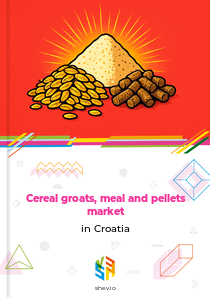







Earlier Report Observations
The removal of production restrictions for cereals in October 2017 allowed freer market access, which contributed to a rise in market volume to 40 878 t in 2019. However, a long-term decline in sown areas for cereals from 2020 onward led to reduced production and a drop in market volume to 35 832 t in 2020.
Despite the ongoing development of new quality regulations for cereals in 2021, market volume recovered to 41 738 t. The enforcement of the new Regulation on Cereals and Cereal Products (NN 101/2022) in September 2022, introducing stricter quality standards, coincided with global shocks from the Russian-Ukrainian conflict and rising energy prices, causing a sharp fall in production to 13 619 t and a decrease in market volume to 38 642 t in 2022.
By 2023, harmonization of national legislation with EU labeling and market surveillance regulations, along with stabilizing cereal prices, supported a recovery in production to 22 703 t and growth in market volume to 44 017 t. In 2024, cereal prices returned to 2020 levels, reducing input costs, while continued application of the 2022 quality rules facilitated further market expansion to 48 274 t.
Table of content
- 1. Disclaimer
- 2. Terms of use of the report
- 3. Product codes in the statistical classifications used in the report
-
4. Key Market Indicators and Trends
-
4.1. Key Market Indicators
-
4.1.1. In kind
- 4.1.1.1. Production, 2018-2024
- 4.1.1.2. Imports, 2018-2024
- 4.1.1.3. Exports, 2018-2024
- 4.1.1.4. Market size, 2018-2024
-
4.1.2. In value
- 4.1.2.1. Production, 2018-2024
- 4.1.2.2. Imports, 2018-2024
- 4.1.2.3. Exports, 2018-2024
- 4.1.2.4. Market size, 2018-2024
-
4.1.1. In kind
- 4.2. Market Trends and Factors
-
4.1. Key Market Indicators
-
5. Production
-
5.1. Production in Croatia
- 5.1.1. In kind, 2018-2024, t
- 5.1.2. In value, 2018-2024, K $ US
-
5.2. Production in the EU, 2018-2024
- 5.2.1. In kind, 2018-2024, t
- 5.2.2. In value, 2018-2024, K $ US
-
5.1. Production in Croatia
-
6. Imports
-
6.1. Imports (Direct Data)
- 6.1.1. Imports - Total information
-
6.1.2. Imports in kind, t
- 6.1.2.1. Annual dynamics of product's imports to Croatia in kind, 2018-2024, t
- 6.1.2.2. Dynamics of product's imports in kind to Croatia by countries, 2018-2024, t
- 6.1.2.3. Structure of product's imports in kind by countries, 2018-2024
-
6.1.3. Imports in value, K $ US
- 6.1.3.1. Annual dynamics of product's imports to Croatia in value, 2018-2024, K $ US
- 6.1.3.2. Dynamics of product's imports in value to Croatia by countries, 2018-2024, K $ US
- 6.1.3.3. Structure of product's imports in value by countries, 2018-2024
-
6.1.4. Average price of product's imports, $ US/t
- 6.1.4.1. Annual dynamics of average price of product's imports to Croatia, 2018-2024, $ US/t
- 6.1.4.2. Dynamics of average price of product's imports to Croatia by countries, 2018-2024, $ US/t
-
6.2. Imports (Mirror Data)
- 6.2.1. Imports - Total information
-
6.2.2. Imports in kind, t
- 6.2.2.1. Annual dynamics of product's imports to Croatia in kind, 2018-2024, t
- 6.2.2.2. Dynamics of product's imports in kind to Croatia by countries, 2018-2024, t
- 6.2.2.3. Structure of product's imports in kind by countries, 2018-2024
-
6.2.3. Imports in value, K $ US
- 6.2.3.1. Annual dynamics of product's imports to Croatia in value, 2018-2024, K $ US
- 6.2.3.2. Dynamics of product's imports in value to Croatia by countries, 2018-2024, K $ US
- 6.2.3.3. Structure of product's imports in value by countries, 2018-2024
-
6.2.4. Average price of product's imports, $ US/t
- 6.2.4.1. Annual dynamics of average price of product's imports to Croatia, 2018-2024, $ US/t
- 6.2.4.2. Dynamics of average price of product's imports to Croatia by countries, 2018-2024, $ US/t
-
6.1. Imports (Direct Data)
-
7. Exports
-
7.1. Exports (Direct Data)
- 7.1.1. Exports - Total information
-
7.1.2. Exports in kind, t
- 7.1.2.1. Annual dynamics of product's exports from Croatia in kind, 2018-2024, t
- 7.1.2.2. Dynamics of product's exports in kind from Croatia by countries, 2018-2024, t
- 7.1.2.3. Structure of product's exports in kind by countries, 2018-2024
-
7.1.3. Exports in value, K $ US
- 7.1.3.1. Annual dynamics of product's exports from Croatia in value, 2018-2024, K $ US
- 7.1.3.2. Dynamics of product's exports in value from Croatia by countries, 2018-2024, K $ US
- 7.1.3.3. Structure of product's exports in value by countries, 2018-2024
-
7.1.4. Average price of product's exports, $ US/t
- 7.1.4.1. Annual dynamics of average price of product's exports from Croatia, 2018-2024, $ US/t
- 7.1.4.2. Dynamics of average price of product's exports from Croatia by countries, 2018-2024, $ US/t
-
7.2. Exports (Mirror Data)
- 7.2.1. Exports - Total information
-
7.2.2. Exports in kind, t
- 7.2.2.1. Annual dynamics of product's exports from Croatia in kind, 2018-2024, t
- 7.2.2.2. Dynamics of product's exports in kind from Croatia by countries, 2018-2024, t
- 7.2.2.3. Structure of product's exports in kind by countries, 2018-2024
-
7.2.3. Exports in value, K $ US
- 7.2.3.1. Annual dynamics of product's exports from Croatia in value, 2018-2024, K $ US
- 7.2.3.2. Dynamics of product's exports in value from Croatia by countries, 2018-2024, K $ US
- 7.2.3.3. Structure of product's exports in value by countries, 2018-2024
-
7.2.4. Average price of product's exports, $ US/t
- 7.2.4.1. Annual dynamics of average price of product's exports from Croatia, 2018-2024, $ US/t
- 7.2.4.2. Dynamics of average price of product's exports from Croatia by countries, 2018-2024, $ US/t
-
7.1. Exports (Direct Data)
-
8. Trade balance
-
8.1. Trade balance (Direct Data)
- 8.1.1. In kind, t
- 8.1.2. In value, K $ US
-
8.2. Trade balance (Mirror Data)
- 8.2.1. In kind, t
- 8.2.2. In value, K $ US
-
8.1. Trade balance (Direct Data)
-
9. Top buying and selling countries, 2018-2024
-
9.1. Direct Data
- 9.1.1. Import in Value by Countries-buyers
- 9.1.2. Export in Value by Countries-suppliers
-
9.2. Mirror Data
- 9.2.1. Import in Value by Countries-buyers
- 9.2.2. Export in Value by Countries-suppliers
-
9.1. Direct Data
Production cereal groats, meal and pellets in Croatia
In value, 2017-2020, K $ US
Croatia's production of cereal groats, meal and pellets declined for the second year in a row. In 2020, output was valued at 10 277 thousand US dollars, marking a gradual decrease of 4.3% compared to 2019. Over the period from 2017 to 2020, production grew by 6.8%, with an average annual growth rate of 2.2%. The highest value was recorded in 2018 at 10 929 thousand US dollars, which also saw the largest increase of 13.6%.
Annual dynamics of production in Croatia in value, 2017-2020, K $ US
| Parameter | 2018 | 2019 | 2020 | CAGR | |
|---|---|---|---|---|---|
| 1 | Change from last year | 13.6% | (1.7%) | (4.3%) | 2.2% |
In kind, 2017-2020, t
Following two years of growth, Croatia's production volume of cereal groats, meal and pellets declined. In 2020, 22 309 tonnes were produced, representing a significant drop of 23.5% year-over-year. From 2017 to 2020, production increased by 11.1%, with an average annual growth rate of 3.6%. The peak volume was reached in 2019 at 29 171 tonnes, which also experienced the largest increase of 38.8%.
Annual dynamics of production in Croatia in kind, 2017-2020, t
| Parameter | 2018 | 2019 | 2020 | CAGR | |
|---|---|---|---|---|---|
| 1 | Change from last year | 4.6% | 38.8% | (23.5%) | 3.6% |
Exports cereal groats, meal and pellets from Croatia
Exports in kind, t
Export volumes showed notable volatility during this period. They reached their lowest point in 2018 at 3 609 tonnes and peaked in 2019 at 6 315 tonnes, marking a 1.7-fold increase between these years. In 2020, Croatia's exports totalled 4 753 tonnes, a substantial decline of 24.7% from the previous year. The largest increase was recorded in 2019 at 75.0%.
Annual dynamics of product's exports from Croatia in kind, 2017-2020, t
| Parameter | 2018 | 2019 | 2020 | CAGR | |
|---|---|---|---|---|---|
| 1 | Change from last year | (22.2%) | 75.0% | (24.7%) | 0.8% |
From 2017 to 2020, Slovenia, Bosnia and Herzegovina, and Italy were the top destinations for Croatia's exports in kind. Slovenia accounted for 55.7% of exports, Bosnia and Herzegovina for 18.6%, and Italy for 12.6%. Together, these three countries represented 86.9% of total export flows.
Structure of product's exports in kind by countries, 2017-2020
World map of product's exports from Croatia in kind, 2017-2020
Exports in value, K $ US
Croatia's export value of cereal groats, meal and pellets increased for the third consecutive year. In 2020, exports amounted to 3 287 thousand US dollars, a significant rise of 49.4% compared to 2019. Over the period from 2017 to 2020, exports grew by 81.7%, with an average annual growth rate of 22.0%.
Annual dynamics of product's exports from Croatia in value, 2017-2020, K $ US
| Parameter | 2018 | 2019 | 2020 | CAGR | |
|---|---|---|---|---|---|
| 1 | Change from last year | 17.2% | 3.7% | 49.4% | 22.0% |
Between 2017 and 2020, Slovenia, Bosnia and Herzegovina, and Germany were the key markets for Croatia's exports in value terms. Slovenia made up 44.2% of exports, Bosnia and Herzegovina 19.6%, and Germany 14.5%. Collectively, these three countries accounted for 78.2% of total export flows.
Structure of product's exports in value by countries, 2017-2020
World map of product's exports from Croatia in value, 2017-2020
Imports cereal groats, meal and pellets to Croatia
Imports in kind, t
After two years of decline, Croatia's import volume of cereal groats, meal and pellets increased. In 2020, imports totalled 18 276 tonnes, a slight rise of 1.4% from 2019. From 2017 to 2020, imports decreased by 17.1%, equivalent to an annualized rate of 6.1%. The lowest volume was recorded in 2019 at 18 023 tonnes, which also saw the largest decline of 15.8%.
Annual dynamics of product's imports to Croatia in kind, 2017-2020, t
| Parameter | 2018 | 2019 | 2020 | CAGR | |
|---|---|---|---|---|---|
| 1 | Change from last year | (3.0%) | (15.8%) | 1.4% | (6.1%) |
From 2017 to 2020, Austria, Hungary, and Italy were the main sources of imports in kind for Croatia. Austria contributed 29.9% of imports, Hungary 29.0%, and Italy 21.5%. Together, these three countries represented 80.4% of total import flows.
Structure of product's imports in kind by countries, 2017-2020
World map of product's imports to Croatia in kind, 2017-2020
Imports in value, K $ US
Following two years of decline, Croatia's import value of cereal groats, meal and pellets increased. In 2020, imports reached 9 490 thousand US dollars, a gradual advance of 6.9% compared to 2019. Between 2017 and 2020, imports decreased by 17.1%, equating to an annualized rate of 6.1%. The lowest value was recorded in 2019 at 8 874 thousand US dollars, which also experienced the largest decline of 16.3%.
Annual dynamics of product's imports to Croatia in value, 2017-2020, K $ US
| Parameter | 2018 | 2019 | 2020 | CAGR | |
|---|---|---|---|---|---|
| 1 | Change from last year | (7.4%) | (16.3%) | 6.9% | (6.1%) |
Over the period from 2017 to 2020, Austria, Hungary, and Germany were the leading suppliers of cereal groats, meal and pellets to Croatia in value terms. Austria accounted for 24.8% of imports, Hungary for 23.4%, and Germany for 21.1%. Their combined share reached 69.2% of total imports.
Structure of product's imports in value by countries, 2017-2020
World map of product's imports to Croatia in value, 2017-2020
Related Reports

Wheat and meslin flour market in Croatia
2026-03-28

Cereal pellets market in Croatia
2026-03-28

Wheat groats and meal market in Croatia
2026-03-28
Why Choose Us?
Only Verified Data
No Hidden Costs or Separate Fees
Smarter Subscription Pricing
Contact Our Team
Submit your inquiry using the form below — our team will get back to you within 24 hours.