






"SADC" region includes following countries:
 Angola
 Botswana
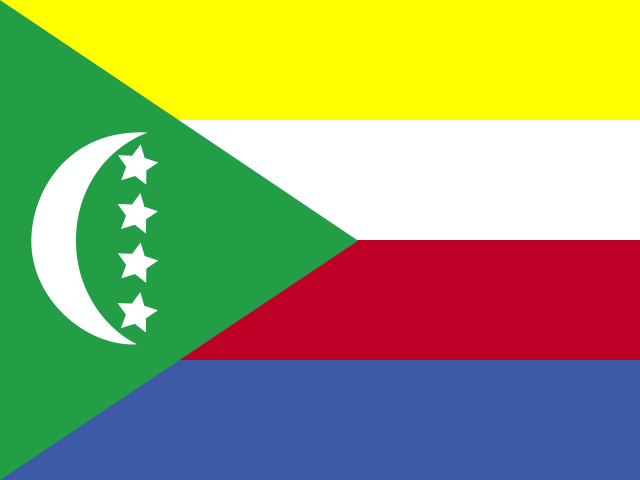 Comoros
 Democratic Republic of the Congo
 Eswatini
 Lesotho
 Madagascar
 Malawi
 Mauritius
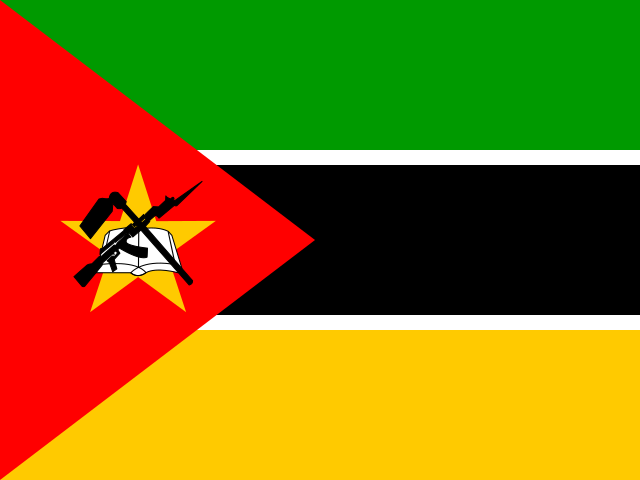 Mozambique
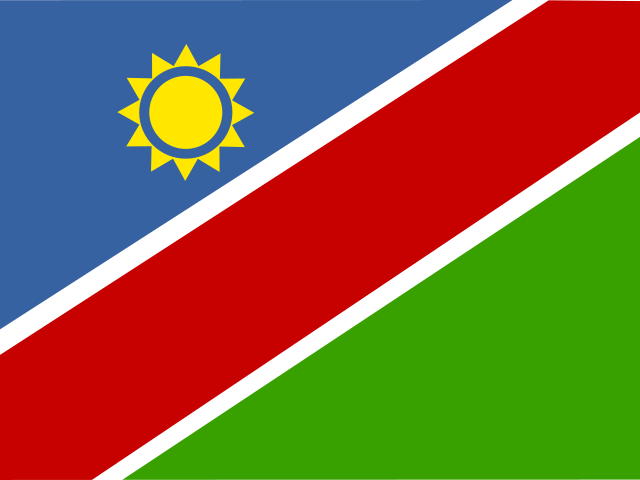 Namibia
 Seychelles
 South Africa
 Tanzania
 Zambia
 Zimbabwe
Earlier Report Observations
The South African unroasted coffee market volume exhibited significant fluctuations from 2018 to 2023. Starting at 174.5 thousand tonnes in 2018, it declined to 153.8 thousand tonnes in 2019 and further to 129.9 thousand tonnes in 2020. A recovery followed, reaching 144.9 thousand tonnes in 2021 and 161.0 thousand tonnes in 2022, before a sharp drop to 126.0 thousand tonnes in 2023.
Export movements were a prominent feature, rising sharply from 34.2 thousand tonnes in 2018 to 90.8 thousand tonnes in 2019 and remaining elevated. After a moderate dip in 2022, exports surged again to 97.9 thousand tonnes in 2023. Imports remained relatively stable, ranging from 20.3 to 26.2 thousand tonnes annually over this period.
In 2024, imports rose to 23.9 thousand tonnes while exports reached 106.7 thousand tonnes. The market was shaped by significant coffee price inflation, with instant coffee prices rising 22.3% year-on-year, which altered consumer purchasing behavior. Concurrently, the launch of new ready-to-drink coffee products, such as by Douwe Egberts, signaled innovation and the emergence of new market segments.
Table of content
- 1. Disclaimer
- 2. Terms of use of the report
- 3. Product codes in the statistical classifications used in the report
-
4. Key Market Indicators and Trends
-
4.1. Key Market Indicators
-
4.1.1. In kind
- 4.1.1.1. Production, 2018-2023
- 4.1.1.2. Imports, 2018-2024
- 4.1.1.3. Exports, 2018-2024
- 4.1.1.4. Market size, 2018-2023
-
4.1.1. In kind
- 4.2. Market Trends and Factors
-
4.1. Key Market Indicators
-
5. Production
-
5.1. Production in SADC
- 5.1.1. Annual dynamics of production in SADC in kind, 2018-2023, K t
-
5.2. Global production by Country, 2018-2023
- 5.2.1. Annual dynamics of production by macroregions in kind, 2018-2023, K t
- 5.2.2. Dynamics of production structure by macroregions in kind, 2018-2023
- 5.2.3. Annual dynamics of production by country in kind, 2018-2023, K t
- 5.2.4. Structure of production by countries in kind, 2018-2023
- 5.2.5. Dynamics of peoduction structure by countries in kind, 2018-2023
-
5.1. Production in SADC
-
6. Imports
-
6.1. Imports (Direct Data*)
- 6.1.1. Imports - Total information
-
6.1.2. Imports in kind, K t
- 6.1.2.1. Annual dynamics of product's imports to Angola in kind, 2018-2024, K t
- 6.1.2.2. Dynamics of product's imports in kind to Angola by countries, 2018-2024, K t
- 6.1.2.3. Structure of product's imports in kind by countries, 2018-2024
-
6.1.3. Imports in value, M $ US
- 6.1.3.1. Annual dynamics of product's imports to Angola in value, 2018-2024, M $ US
- 6.1.3.2. Dynamics of product's imports in value to Angola by countries, 2018-2024, M $ US
- 6.1.3.3. Structure of product's imports in value by countries, 2018-2024
-
6.1.4. Average price of product's imports, $ US/t
- 6.1.4.1. Annual dynamics of average price of product's imports to Angola, 2018-2024, $ US/t
- 6.1.4.2. Dynamics of average price of product's imports to Angola by countries, 2018-2024, $ US/t
-
6.2. Imports (Mirror Data)
- 6.2.1. Imports - Total information
-
6.2.2. Imports in kind, K t
- 6.2.2.1. Annual dynamics of product's imports to Angola in kind, 2018-2024, K t
- 6.2.2.2. Dynamics of product's imports in kind to Angola by countries, 2018-2024, K t
- 6.2.2.3. Structure of product's imports in kind by countries, 2018-2024
-
6.2.3. Imports in value, M $ US
- 6.2.3.1. Annual dynamics of product's imports to Angola in value, 2018-2024, M $ US
- 6.2.3.2. Dynamics of product's imports in value to Angola by countries, 2018-2024, M $ US
- 6.2.3.3. Structure of product's imports in value by countries, 2018-2024
-
6.2.4. Average price of product's imports, $ US/t
- 6.2.4.1. Annual dynamics of average price of product's imports to Angola, 2018-2024, $ US/t
- 6.2.4.2. Dynamics of average price of product's imports to Angola by countries, 2018-2024, $ US/t
-
6.1. Imports (Direct Data*)
-
7. Exports
-
7.1. Exports (Direct Data*)
- 7.1.1. Exports - Total information
-
7.1.2. Exports in kind, K t
- 7.1.2.1. Annual dynamics of product's exports from Angola in kind, 2018-2024, K t
- 7.1.2.2. Dynamics of product's exports in kind from Angola by countries, 2018-2024, K t
- 7.1.2.3. Structure of product's exports in kind by countries, 2018-2024
-
7.1.3. Exports in value, M $ US
- 7.1.3.1. Annual dynamics of product's exports from Angola in value, 2018-2024, M $ US
- 7.1.3.2. Dynamics of product's exports in value from Angola by countries, 2018-2024, M $ US
- 7.1.3.3. Structure of product's exports in value by countries, 2018-2024
-
7.1.4. Average price of product's exports, $ US/t
- 7.1.4.1. Annual dynamics of average price of product's exports from Angola, 2018-2024, $ US/t
- 7.1.4.2. Dynamics of average price of product's exports from Angola by countries, 2018-2024, $ US/t
-
7.2. Exports (Mirror Data)
- 7.2.1. Exports - Total information
-
7.2.2. Exports in kind, K t
- 7.2.2.1. Annual dynamics of product's exports from Angola in kind, 2018-2024, K t
- 7.2.2.2. Dynamics of product's exports in kind from Angola by countries, 2018-2024, K t
- 7.2.2.3. Structure of product's exports in kind by countries, 2018-2024
-
7.2.3. Exports in value, M $ US
- 7.2.3.1. Annual dynamics of product's exports from Angola in value, 2018-2024, M $ US
- 7.2.3.2. Dynamics of product's exports in value from Angola by countries, 2018-2024, M $ US
- 7.2.3.3. Structure of product's exports in value by countries, 2018-2024
-
7.2.4. Average price of product's exports, $ US/t
- 7.2.4.1. Annual dynamics of average price of product's exports from Angola, 2018-2024, $ US/t
- 7.2.4.2. Dynamics of average price of product's exports from Angola by countries, 2018-2024, $ US/t
-
7.1. Exports (Direct Data*)
-
8. Trade balance
-
8.1. Trade balance (Direct Data)
- 8.1.1. In kind, K t
- 8.1.2. In value, M $ US
-
8.2. Trade balance (Mirror Data)
- 8.2.1. In kind, K t
- 8.2.2. In value, M $ US
-
8.1. Trade balance (Direct Data)
-
9. Top buying and selling countries, 2018-2024
-
9.1. Direct Data
- 9.1.1. Import in Value by Countries-buyers
- 9.1.2. Export in Value by Countries-suppliers
-
9.2. Mirror Data
- 9.2.1. Import in Value by Countries-buyers
- 9.2.2. Export in Value by Countries-suppliers
-
9.1. Direct Data
Production unroasted, not decaffeinated coffee in SADC
In kind, 2017-2020, K t
Top producers of unroasted, not decaffeinated coffee, 2017-2020
World map of production of unroasted, not decaffeinated coffee, 2017-2020
SADC's production of unroasted, non-decaffeinated coffee declined after two years of growth. In 2020, production reached 188.1 thousand tons, marking a significant 15.1% decrease from the previous year. Looking at the period from 2017 to 2020, production increased by 4.6% overall, which translates to an average annual growth rate of 1.5%. The highest production level was recorded in 2019 at 221.6 thousand tons, with the largest year-on-year increase of 19.4% also occurring that year.
Annual dynamics of production in SADC in kind, 2017-2020, K t
| Parameter | 2018 | 2019 | 2020 | CAGR | |
|---|---|---|---|---|---|
| 1 | Change from last year | 3.1% | 19.4% | (15.1%) | 1.5% |
Exports unroasted, not decaffeinated coffee from SADC
Exports in kind, t
The market exhibited considerable volatility during this period. Export volumes fluctuated significantly, with a 2.7-fold difference between the low point in 2018 and the peak in 2019. In 2020, SADC exported 84 460 tons of unroasted, non-decaffeinated coffee, showing a modest 7.0% decline compared to the previous year. The minimum export volume was recorded in 2018 at 34 235 tons, while the maximum reached 90 801 tons in 2019. The largest decrease occurred in 2018 with a 40.3% drop, followed by the most substantial increase in 2019 at 165.2%.
Annual dynamics of product's exports from SADC in kind, 2017-2020, t
| Parameter | 2018 | 2019 | 2020 | CAGR | |
|---|---|---|---|---|---|
| 1 | Change from last year | (40.3%) | 165.2% | (7.0%) | 13.8% |
From 2017 to 2020, SADC's exports of unroasted, non-decaffeinated coffee were distributed across multiple destinations rather than concentrated in a few key markets. Japan accounted for 15.8% of exports, Germany for 13.5%, and Italy for 12.5%. Together, these three countries represented just 41.8% of total export flows.
Structure of product's exports in kind by countries, 2017-2020
World map of product's exports from SADC in kind, 2017-2020
Exports in value, M $ US
The market demonstrated notable volatility throughout the observed period. Export values showed a wide range, with a 5.7-fold difference between the trough in 2018 and the peak in 2020. In 2020, SADC's exports of unroasted, non-decaffeinated coffee amounted to 178.5 million US dollars, remaining nearly unchanged from the previous year. The lowest value was recorded in 2018 at 31.5 million US dollars. The most significant decline occurred in 2018 with an 80.5% decrease, while the largest increase was recorded in 2019 at 463.3%.
Annual dynamics of product's exports from SADC in value, 2017-2020, M $ US
| Parameter | 2018 | 2019 | 2020 | CAGR | |
|---|---|---|---|---|---|
| 1 | Change from last year | (80.5%) | 463.3% | 0.4% | 3.3% |
The structure of exports in value terms from 2017 to 2020 was diversified, with no single country holding a dominant position. Japan accounted for 19.3% of export value, Germany for 13.8%, and Italy for 10.0%. Combined, these three countries represented just 43.1% of total export flows.
Structure of product's exports in value by countries, 2017-2020
World map of product's exports from SADC in value, 2017-2020
Imports unroasted, not decaffeinated coffee to SADC
Imports in kind, t
In 2020, SADC imported 26 225 tons of unroasted, non-decaffeinated coffee, representing a substantial 13.9% increase year-over-year. Over the period from 2017 to 2020, imports grew by 13.3%, corresponding to an average annual growth rate of 4.2%. The lowest import volume was recorded in 2019 at 23 023 tons, with a minor decline of 1.1% that year.
Annual dynamics of product's imports to SADC in kind, 2017-2020, t
| Parameter | 2018 | 2019 | 2020 | CAGR | |
|---|---|---|---|---|---|
| 1 | Change from last year | 0.5% | (1.1%) | 13.9% | 4.2% |
From 2017 to 2020, Brazil, Vietnam, and Indonesia were the largest contributors to SADC's imports of unroasted, non-decaffeinated coffee. Brazil accounted for 31.7% of imports, Vietnam for 20.9%, and Indonesia for 9.1%. Together, these three countries represented 61.7% of total import flows.
Structure of product's imports in kind by countries, 2017-2020
World map of product's imports to SADC in kind, 2017-2020
Imports in value, M $ US
SADC's imports of unroasted, non-decaffeinated coffee declined for the third consecutive year. In 2020, imports totaled {value_last_year} million US dollars, reflecting a slight decrease of 1.4% from the previous year. Over the period from 2017 to 2020, imports decreased by 17.2%, with an average annual decline rate of 6.1%.
Annual dynamics of product's imports to SADC in value, 2017-2020, M $ US
| Parameter | 2018 | 2019 | 2020 | CAGR | |
|---|---|---|---|---|---|
| 1 | Change from last year | (4.4%) | (12.2%) | (1.4%) | (6.1%) |
From 2017 to 2020, the geographical structure of imports in value terms was highly diversified. Brazil accounted for 23.6% of import value, Vietnam for 16.0%, and Indonesia for 9.4%. Together, these three countries represented 49.0% of total import flows, while the remaining 51.0% was distributed among numerous smaller trading partners.
Structure of product's imports in value by countries, 2017-2020
World map of product's imports to SADC in value, 2017-2020
Related Reports




Why Choose Us?
Only Verified Data
No Hidden Costs or Separate Fees
Smarter Subscription Pricing
Contact Our Team
Submit your inquiry using the form below — our team will get back to you within 24 hours.