






"Middle Africa" region includes following countries:
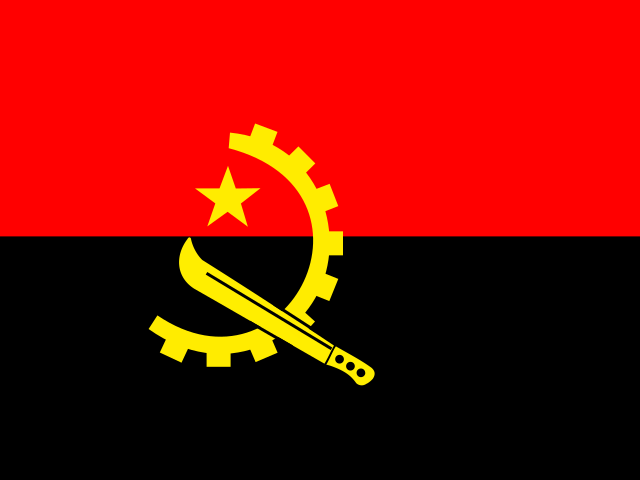 Angola
 Cameroon
 Central African Republic
 Chad
Chad Congo
Congo Democratic Republic of the Congo
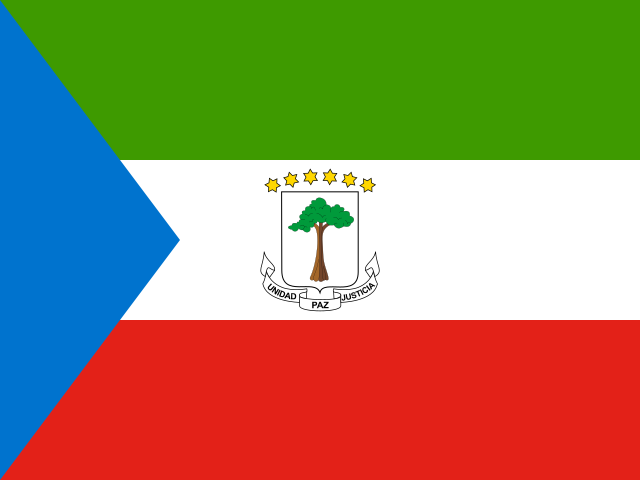 Equatorial Guinea
 Gabon
Gabon Sao Tome and Principe
Earlier Report Observations
Between 2018 and 2020, the market for tapioca and starch substitutes in Middle Africa grew steadily, reaching nearly 11 000 metric tons. The global COVID-19 pandemic in 2020 disrupted worldwide supply chains, which reduced imports of these products into the region. However, this was offset by an increase in local production, supporting continued market expansion.
In 2021, the market volume surged by 55% to 17 042 metric tons. This spike was primarily driven by a tenfold increase in imports, fueled by rising global demand for gluten-free and allergen-free food products, which boosted the use of tapioca as a starch substitute.
The market contracted sharply in 2022 to 11 084 metric tons as imports fell back to minimal levels following the prior year's surge. By 2023, the market recovered to 12 210 metric tons, supported by growing domestic production and a rebound in imports. During this period, worldwide investments in cassava processing infrastructure in Africa and fluctuations in agricultural raw material prices influenced production costs and market dynamics in the region.
Table of content
- 1. Disclaimer
- 2. Terms of use of the report
- 3. Product codes in the statistical classifications used in the report
-
4. Key Market Indicators and Trends
-
4.1. Key Market Indicators
-
4.1.1. In kind
- 4.1.1.1. Production, 2018-2023
- 4.1.1.2. Imports, 2018-2024
- 4.1.1.3. Exports, 2018-2024
- 4.1.1.4. Market size, 2018-2023
-
4.1.1. In kind
- 4.2. Market Trends and Factors
-
4.1. Key Market Indicators
-
5. Production
-
5.1. Production in Middle Africa
- 5.1.1. Annual dynamics of production in Middle Africa in kind, 2018-2023, t
-
5.2. Global production by Country, 2018-2023
- 5.2.1. Annual dynamics of production by macroregions in kind, 2018-2023, t
- 5.2.2. Dynamics of production structure by macroregions in kind, 2018-2023
- 5.2.3. Annual dynamics of production by country in kind, 2018-2023, t
- 5.2.4. Structure of production by countries in kind, 2018-2023
- 5.2.5. Dynamics of peoduction structure by countries in kind, 2018-2023
-
5.1. Production in Middle Africa
-
6. Imports
-
6.1. Imports (Direct Data*)
- 6.1.1. Imports - Total information
-
6.1.2. Imports in kind, t
- 6.1.2.1. Annual dynamics of product's imports to Angola in kind, 2018-2024, t
- 6.1.2.2. Dynamics of product's imports in kind to Angola by countries, 2018-2024, t
- 6.1.2.3. Structure of product's imports in kind by countries, 2018-2024
-
6.1.3. Imports in value, K $ US
- 6.1.3.1. Annual dynamics of product's imports to Angola in value, 2018-2024, K $ US
- 6.1.3.2. Dynamics of product's imports in value to Angola by countries, 2018-2024, K $ US
- 6.1.3.3. Structure of product's imports in value by countries, 2018-2024
-
6.1.4. Average price of product's imports, $ US/t
- 6.1.4.1. Annual dynamics of average price of product's imports to Angola, 2018-2024, $ US/t
- 6.1.4.2. Dynamics of average price of product's imports to Angola by countries, 2018-2024, $ US/t
-
6.2. Imports (Mirror Data)
- 6.2.1. Imports - Total information
-
6.2.2. Imports in kind, t
- 6.2.2.1. Annual dynamics of product's imports to Angola in kind, 2018-2024, t
- 6.2.2.2. Dynamics of product's imports in kind to Angola by countries, 2018-2024, t
- 6.2.2.3. Structure of product's imports in kind by countries, 2018-2024
-
6.2.3. Imports in value, K $ US
- 6.2.3.1. Annual dynamics of product's imports to Angola in value, 2018-2024, K $ US
- 6.2.3.2. Dynamics of product's imports in value to Angola by countries, 2018-2024, K $ US
- 6.2.3.3. Structure of product's imports in value by countries, 2018-2024
-
6.2.4. Average price of product's imports, $ US/t
- 6.2.4.1. Annual dynamics of average price of product's imports to Angola, 2018-2024, $ US/t
- 6.2.4.2. Dynamics of average price of product's imports to Angola by countries, 2018-2024, $ US/t
-
6.1. Imports (Direct Data*)
-
7. Exports
-
7.1. Exports (Direct Data*)
- 7.1.1. Exports - Total information
-
7.1.2. Exports in kind, t
- 7.1.2.1. Annual dynamics of product's exports from Angola in kind, 2018-2024, t
- 7.1.2.2. Dynamics of product's exports in kind from Angola by countries, 2018-2024, t
- 7.1.2.3. Structure of product's exports in kind by countries, 2018-2024
-
7.1.3. Exports in value, K $ US
- 7.1.3.1. Annual dynamics of product's exports from Angola in value, 2018-2024, K $ US
- 7.1.3.2. Dynamics of product's exports in value from Angola by countries, 2018-2024, K $ US
- 7.1.3.3. Structure of product's exports in value by countries, 2018-2024
-
7.1.4. Average price of product's exports, $ US/t
- 7.1.4.1. Annual dynamics of average price of product's exports from Angola, 2018-2024, $ US/t
- 7.1.4.2. Dynamics of average price of product's exports from Angola by countries, 2018-2024, $ US/t
-
7.2. Exports (Mirror Data)
- 7.2.1. Exports - Total information
-
7.2.2. Exports in kind, t
- 7.2.2.1. Annual dynamics of product's exports from Angola in kind, 2018-2024, t
- 7.2.2.2. Dynamics of product's exports in kind from Angola by countries, 2018-2024, t
- 7.2.2.3. Structure of product's exports in kind by countries, 2018-2024
-
7.2.3. Exports in value, K $ US
- 7.2.3.1. Annual dynamics of product's exports from Angola in value, 2018-2024, K $ US
- 7.2.3.2. Dynamics of product's exports in value from Angola by countries, 2018-2024, K $ US
- 7.2.3.3. Structure of product's exports in value by countries, 2018-2024
-
7.2.4. Average price of product's exports, $ US/t
- 7.2.4.1. Annual dynamics of average price of product's exports from Angola, 2018-2024, $ US/t
- 7.2.4.2. Dynamics of average price of product's exports from Angola by countries, 2018-2024, $ US/t
-
7.1. Exports (Direct Data*)
-
8. Trade balance
-
8.1. Trade balance (Direct Data)
- 8.1.1. In kind, t
- 8.1.2. In value, K $ US
-
8.2. Trade balance (Mirror Data)
- 8.2.1. In kind, t
- 8.2.2. In value, K $ US
-
8.1. Trade balance (Direct Data)
-
9. Top buying and selling countries, 2018-2024
-
9.1. Direct Data
- 9.1.1. Import in Value by Countries-buyers
- 9.1.2. Export in Value by Countries-suppliers
-
9.2. Mirror Data
- 9.2.1. Import in Value by Countries-buyers
- 9.2.2. Export in Value by Countries-suppliers
-
9.1. Direct Data
Production tapioca and starch substitutes in Middle Africa
In kind, 2017-2020, t
Top producers of tapioca and starch substitutes, 2017-2020
World map of production of tapioca and starch substitutes, 2017-2020
In 2020, Middle Africa produced 10,623 tonnes of tapioca and starch substitutes, marking a 17.1% increase compared to the previous year. Looking at the period from 2017 to 2020, production grew by 24.1%, which translates to an average annual growth rate of 7.5%. The smallest change occurred in 2019, with production remaining essentially flat.
Annual dynamics of production in Middle Africa in kind, 2017-2020, t
| Parameter | 2018 | 2019 | 2020 | CAGR | |
|---|---|---|---|---|---|
| 1 | Change from last year | 5.9% | 0.0% | 17.1% | 7.5% |
Exports tapioca and starch substitutes from Middle Africa
Exports in kind, t
The market showed significant fluctuations during this period. Exports reached their lowest point in 2018, then peaked in 2020, with a 3.4-fold difference between these years. In 2020, Middle Africa exported 123 tonnes of tapioca and starch substitutes, a substantial increase of 139.7% from the previous year. The minimum export volume was recorded in 2018 at 36 tonnes, while the largest decline of 57.7% also occurred in that year.
Annual dynamics of product's exports from Middle Africa in kind, 2017-2020, t
| Parameter | 2018 | 2019 | 2020 | CAGR | |
|---|---|---|---|---|---|
| 1 | Change from last year | (57.7%) | 41.2% | 139.7% | 12.7% |
From 2017 to 2020, the main destinations for Middle Africa's tapioca and starch substitutes exports were France, accounting for 49.6% of exports in kind, the United States with 27.5%, and Greece at 6.0%. Together, these three countries represented 83.1% of total export flows.
Structure of product's exports in kind by countries, 2017-2020
World map of product's exports from Middle Africa in kind, 2017-2020
Exports in value, K $ US
The data reveals irregular changes, indicating a volatile market environment. Exports in value terms hit their lowest point in 2018, then reached their maximum in 2019, with a 3.5-fold difference between these years. In 2020, tapioca and starch substitutes exports from Middle Africa totaled $18.4 thousand US dollars, showing a sharp contraction of 43.6% compared to the previous year. The minimum value was recorded in 2018 at $9.3 thousand US dollars, while the maximum value of $32.7 thousand US dollars was achieved in 2019. The largest increase of 250.5% also occurred in 2019.
Annual dynamics of product's exports from Middle Africa in value, 2017-2020, K $ US
| Parameter | 2018 | 2019 | 2020 | CAGR | |
|---|---|---|---|---|---|
| 1 | Change from last year | (42.9%) | 250.5% | (43.6%) | 4.1% |
Between 2017 and 2020, three principal markets—France, the United States, and Canada—together accounted for 82.1% of the total value of tapioca and starch substitutes exports from Middle Africa.
Structure of product's exports in value by countries, 2017-2020
World map of product's exports from Middle Africa in value, 2017-2020
Imports tapioca and starch substitutes to Middle Africa
Imports in kind, t
The market experienced noticeable fluctuations during this period. Imports varied significantly, from a low in 2017 to a high in 2019, with a 28-fold difference between these years. In 2020, Middle Africa imported approximately 461 tonnes of tapioca and starch substitutes, down by 61.8% year-over-year. The maximum import volume was recorded in 2019 at 1,208 tonnes, while the largest increase of 2,206.7% occurred in 2018.
Annual dynamics of product's imports to Middle Africa in kind, 2017-2020, t
| Parameter | 2018 | 2019 | 2020 | CAGR | |
|---|---|---|---|---|---|
| 1 | Change from last year | 2 206.7% | 23.0% | (61.8%) | 121.3% |
From 2017 to 2020, three principal markets—Turkey, Togo, and Portugal—together accounted for 83.2% of total imports in kind of tapioca and starch substitutes to Middle Africa.
Structure of product's imports in kind by countries, 2017-2020
World map of product's imports to Middle Africa in kind, 2017-2020
Imports in value, K $ US
Volatility characterized the market behavior during these years. Import values fluctuated 13.4 times between the low of 2017 and the high of 2018. In 2020, Middle Africa imported tapioca and starch substitutes worth a total that declined by 73.3% compared to the previous year. The maximum value was recorded in 2018 at $501.4 thousand US dollars, while the largest increase of 1,236.1% also occurred in that year.
Annual dynamics of product's imports to Middle Africa in value, 2017-2020, K $ US
| Parameter | 2018 | 2019 | 2020 | CAGR | |
|---|---|---|---|---|---|
| 1 | Change from last year | 1 236.1% | (40.9%) | (73.3%) | 28.3% |
Over the period from 2017 to 2020, Turkey, Portugal, and Togo consistently held leading positions in the country structure of imports in value terms. Turkey accounted for 41.2% of imports, Portugal for 20.4%, and Togo for 8.2%, jointly representing 69.9% of total import flows.
Structure of product's imports in value by countries, 2017-2020
World map of product's imports to Middle Africa in value, 2017-2020
Related Reports




Groundnutoil-cake market in Middle Africa
2026-03-29

Alcoholic beer market in Middle Africa
2026-03-29
Why Choose Us?
Only Verified Data
No Hidden Costs or Separate Fees
Smarter Subscription Pricing
Contact Our Team
Submit your inquiry using the form below — our team will get back to you within 24 hours.