






"Middle Africa" region includes following countries:
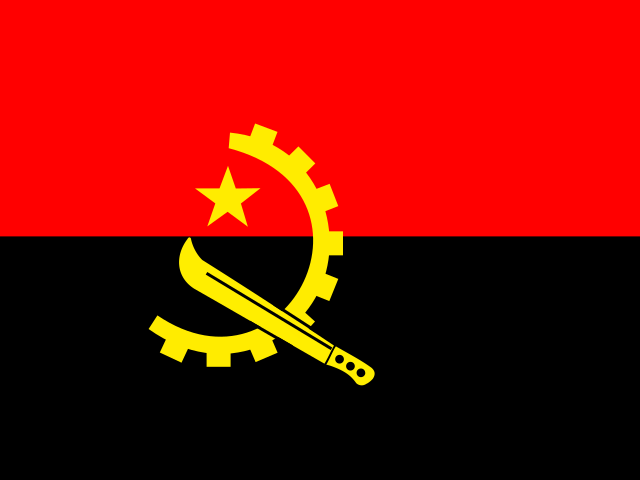 Angola
 Cameroon
 Central African Republic
 Chad
Chad Congo
Congo Democratic Republic of the Congo
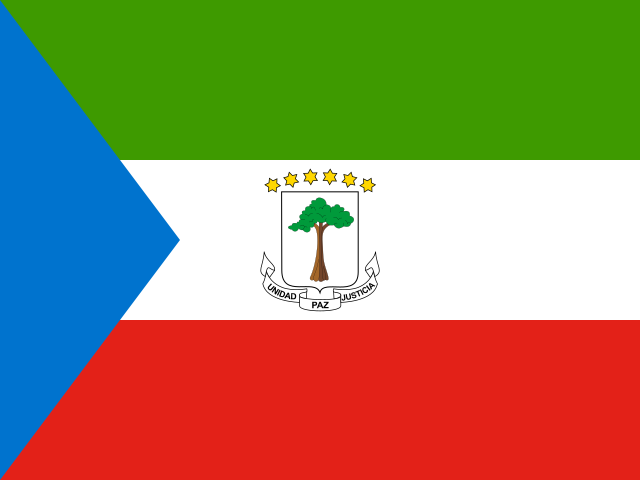 Equatorial Guinea
 Gabon
Gabon Sao Tome and Principe
Earlier Report Observations
Between 2018 and 2021, the wheat bran and residues market in Middle Africa showed volatile growth. Production increased from 286.4 thousand tons to 359.2 thousand tons in 2019, then eased to 336.9 thousand tons in 2020 before leaping to 481.7 thousand tons in 2021. Market volume followed a similar pattern, rising to 165.8 thousand tons in 2019, dropping to 136.9 thousand tons in 2020, and climbing sharply to 221.9 thousand tons in 2021.
In 2022, the Russia-Ukraine war triggered a historic rise in international wheat prices, which elevated local flour costs and increased energy and fuel expenses for millers. This pressure contributed to a reduction in production to 420.6 thousand tons and a market volume decrease to 209.8 thousand tons. During 2023, the government and industry acted to stabilize the sector by maintaining consumer prices for flour and bread, while the National Shippers' Council of Cameroon opened a new logistics office in Garoua to enhance distribution. Subsidies were also directed to agricultural research to strengthen local wheat production and processing.
In 2024, a substantial government and financial partner plan of 417 billion FCFA was launched for wheat production and processing from 2024 to 2028, targeting a 35% cut in imports and the production of 350 000 tons of marketable wheat by 2028. Efforts to keep flour and bread prices stable continued, even as wheat prices experienced moderate fluctuations.
Table of content
- 1. Disclaimer
- 2. Terms of use of the report
- 3. Product codes in the statistical classifications used in the report
-
4. Key Market Indicators and Trends
-
4.1. Key Market Indicators
-
4.1.1. In kind
- 4.1.1.1. Production, 2018-2023
- 4.1.1.2. Imports, 2018-2024
- 4.1.1.3. Exports, 2018-2024
- 4.1.1.4. Market size, 2018-2023
-
4.1.1. In kind
- 4.2. Market Trends and Factors
-
4.1. Key Market Indicators
-
5. Production
-
5.1. Production in Middle Africa
- 5.1.1. Annual dynamics of production in Middle Africa in kind, 2018-2023, K t
-
5.2. Global production by Country, 2018-2023
- 5.2.1. Annual dynamics of production by macroregions in kind, 2018-2023, K t
- 5.2.2. Dynamics of production structure by macroregions in kind, 2018-2023
- 5.2.3. Annual dynamics of production by country in kind, 2018-2023, K t
- 5.2.4. Structure of production by countries in kind, 2018-2023
- 5.2.5. Dynamics of peoduction structure by countries in kind, 2018-2023
-
5.1. Production in Middle Africa
-
6. Imports
-
6.1. Imports (Direct Data*)
- 6.1.1. Imports - Total information
-
6.1.2. Imports in kind, K t
- 6.1.2.1. Annual dynamics of product's imports to Angola in kind, 2018-2024, K t
- 6.1.2.2. Dynamics of product's imports in kind to Angola by countries, 2018-2024, K t
- 6.1.2.3. Structure of product's imports in kind by countries, 2018-2024
-
6.1.3. Imports in value, K $ US
- 6.1.3.1. Annual dynamics of product's imports to Angola in value, 2018-2024, K $ US
- 6.1.3.2. Dynamics of product's imports in value to Angola by countries, 2018-2024, K $ US
- 6.1.3.3. Structure of product's imports in value by countries, 2018-2024
-
6.1.4. Average price of product's imports, $ US/t
- 6.1.4.1. Annual dynamics of average price of product's imports to Angola, 2018-2024, $ US/t
- 6.1.4.2. Dynamics of average price of product's imports to Angola by countries, 2018-2024, $ US/t
-
6.2. Imports (Mirror Data)
- 6.2.1. Imports - Total information
-
6.2.2. Imports in kind, K t
- 6.2.2.1. Annual dynamics of product's imports to Angola in kind, 2018-2024, K t
- 6.2.2.2. Dynamics of product's imports in kind to Angola by countries, 2018-2024, K t
- 6.2.2.3. Structure of product's imports in kind by countries, 2018-2024
-
6.2.3. Imports in value, K $ US
- 6.2.3.1. Annual dynamics of product's imports to Angola in value, 2018-2024, K $ US
- 6.2.3.2. Dynamics of product's imports in value to Angola by countries, 2018-2024, K $ US
- 6.2.3.3. Structure of product's imports in value by countries, 2018-2024
-
6.2.4. Average price of product's imports, $ US/t
- 6.2.4.1. Annual dynamics of average price of product's imports to Angola, 2018-2024, $ US/t
- 6.2.4.2. Dynamics of average price of product's imports to Angola by countries, 2018-2024, $ US/t
-
6.1. Imports (Direct Data*)
-
7. Exports
-
7.1. Exports (Direct Data*)
- 7.1.1. Exports - Total information
-
7.1.2. Exports in kind, K t
- 7.1.2.1. Annual dynamics of product's exports from Angola in kind, 2018-2024, K t
- 7.1.2.2. Dynamics of product's exports in kind from Angola by countries, 2018-2024, K t
- 7.1.2.3. Structure of product's exports in kind by countries, 2018-2024
-
7.1.3. Exports in value, K $ US
- 7.1.3.1. Annual dynamics of product's exports from Angola in value, 2018-2024, K $ US
- 7.1.3.2. Dynamics of product's exports in value from Angola by countries, 2018-2024, K $ US
- 7.1.3.3. Structure of product's exports in value by countries, 2018-2024
-
7.1.4. Average price of product's exports, $ US/t
- 7.1.4.1. Annual dynamics of average price of product's exports from Angola, 2018-2024, $ US/t
- 7.1.4.2. Dynamics of average price of product's exports from Angola by countries, 2018-2024, $ US/t
-
7.2. Exports (Mirror Data)
- 7.2.1. Exports - Total information
-
7.2.2. Exports in kind, K t
- 7.2.2.1. Annual dynamics of product's exports from Angola in kind, 2018-2024, K t
- 7.2.2.2. Dynamics of product's exports in kind from Angola by countries, 2018-2024, K t
- 7.2.2.3. Structure of product's exports in kind by countries, 2018-2024
-
7.2.3. Exports in value, K $ US
- 7.2.3.1. Annual dynamics of product's exports from Angola in value, 2018-2024, K $ US
- 7.2.3.2. Dynamics of product's exports in value from Angola by countries, 2018-2024, K $ US
- 7.2.3.3. Structure of product's exports in value by countries, 2018-2024
-
7.2.4. Average price of product's exports, $ US/t
- 7.2.4.1. Annual dynamics of average price of product's exports from Angola, 2018-2024, $ US/t
- 7.2.4.2. Dynamics of average price of product's exports from Angola by countries, 2018-2024, $ US/t
-
7.1. Exports (Direct Data*)
-
8. Trade balance
-
8.1. Trade balance (Direct Data)
- 8.1.1. In kind, K t
- 8.1.2. In value, K $ US
-
8.2. Trade balance (Mirror Data)
- 8.2.1. In kind, K t
- 8.2.2. In value, K $ US
-
8.1. Trade balance (Direct Data)
-
9. Top buying and selling countries, 2018-2024
-
9.1. Direct Data
- 9.1.1. Import in Value by Countries-buyers
- 9.1.2. Export in Value by Countries-suppliers
-
9.2. Mirror Data
- 9.2.1. Import in Value by Countries-buyers
- 9.2.2. Export in Value by Countries-suppliers
-
9.1. Direct Data
Production wheat bran, sharps and residues in Middle Africa
In kind, 2017-2020, K t
Top producers of wheat bran, sharps and residues, 2017-2020
World map of production of wheat bran, sharps and residues, 2017-2020
Middle Africa's production of wheat bran, sharps, and residues declined after two years of growth. In 2019, production reached its peak at 359.2 K t, representing a 25.4% increase from the previous year. However, in 2020, production fell to 336.9 K t, marking a 6.2% decrease compared to 2019. Over the period from 2017 to 2020, overall production grew by 36%, with a compound annual growth rate (CAGR) of 10.8%.
Annual dynamics of production in Middle Africa in kind, 2017-2020, K t
| Parameter | 2018 | 2019 | 2020 | CAGR | |
|---|---|---|---|---|---|
| 1 | Change from last year | 15.6% | 25.4% | (6.2%) | 10.8% |
In value, 2017-2020, K $ US
In 2020, the value of wheat bran, sharps, and residues production in Middle Africa was 20 641 K $ US, reflecting a 4.0% increase year-over-year. The highest value was recorded in 2018 at 20 645 K $ US, which saw a 31.4% rise. In 2019, the value declined by 3.9%. From 2017 to 2020, the total value increased by 31.4%, with a CAGR of 9.5%.
Annual dynamics of production in Middle Africa in value, 2017-2020, K $ US
| Parameter | 2018 | 2019 | 2020 | CAGR | |
|---|---|---|---|---|---|
| 1 | Change from last year | 31.4% | (3.9%) | 4.0% | 9.5% |
Exports wheat bran, sharps and residues from Middle Africa
Exports in kind, K t
Exports of wheat bran, sharps, and residues from Middle Africa increased for the third consecutive year. In 2020, exports totaled 200.0 K t, showing a moderate gain of 3.4% compared to 2019. Over the period from 2017 to 2020, exports surged by 135.6%, with a CAGR of 33.1%.
Annual dynamics of product's exports from Middle Africa in kind, 2017-2020, K t
| Parameter | 2018 | 2019 | 2020 | CAGR | |
|---|---|---|---|---|---|
| 1 | Change from last year | 54.6% | 47.4% | 3.4% | 33.1% |
From 2017 to 2020, Morocco and Turkey were the dominant buyers of wheat bran, sharps, and residues from Middle Africa, together accounting for 80.7% of total exports in kind. Other destinations each held relatively small shares.
Structure of product's exports in kind by countries, 2017-2020
World map of product's exports from Middle Africa in kind, 2017-2020
Exports in value, K $ US
Middle Africa's export value of wheat bran, sharps, and residues rose for the third year in a row. In 2020, exports reached 12 253 K $ US, indicating a robust uptick of 14.7% over the previous year. Between 2017 and 2020, export value increased by 127.6%, with a CAGR of 31.5%.
Annual dynamics of product's exports from Middle Africa in value, 2017-2020, K $ US
| Parameter | 2018 | 2019 | 2020 | CAGR | |
|---|---|---|---|---|---|
| 1 | Change from last year | 75.7% | 13.0% | 14.7% | 31.5% |
During 2017–2020, Morocco accounted for 70.3% of the total export value of wheat bran, sharps, and residues from Middle Africa. The remaining flows were distributed among multiple smaller partners.
Structure of product's exports in value by countries, 2017-2020
World map of product's exports from Middle Africa in value, 2017-2020
Imports wheat bran, sharps and residues to Middle Africa
Imports in kind, K t
Imports of wheat bran, sharps, and residues into Middle Africa declined for the third consecutive year. In 2019, imports were at a higher level, but by 2020, they dropped to 0.0 K t, representing a 70.6% decrease compared to 2019. From 2017 to 2020, imports fell by 99.8%, equating to an annualized rate of 87.3%.
Annual dynamics of product's imports to Middle Africa in kind, 2017-2020, K t
| Parameter | 2018 | 2019 | 2020 | CAGR | |
|---|---|---|---|---|---|
| 1 | Change from last year | (93.4%) | (89.3%) | (70.6%) | (87.3%) |
Over 2017–2020, Côte d'Ivoire was the dominant source for imports in kind, taking 85.5% of total flows. Other countries together accounted for the remaining share.
Structure of product's imports in kind by countries, 2017-2020
World map of product's imports to Middle Africa in kind, 2017-2020
Imports in value, K $ US
The market for wheat bran, sharps, and residues imports into Middle Africa showed significant volatility during these years. In 2018, imports peaked at 224 K $ US, with a 30.0% increase. However, in 2019, they plummeted by 99.0%. By 2020, imports totaled just 1 K $ US, marking a sharp drop of 37.0% year-over-year. From the high in 2018 to the low in 2020, import volumes varied 152 times.
Annual dynamics of product's imports to Middle Africa in value, 2017-2020, K $ US
| Parameter | 2018 | 2019 | 2020 | CAGR | |
|---|---|---|---|---|---|
| 1 | Change from last year | 30.0% | (99.0%) | (37.0%) | (79.6%) |
From 2017 to 2020, South Africa (39.5% of imports in value terms), Côte d'Ivoire (35.4%), and France (13.9%) led as the top suppliers of wheat bran, sharps, and residues to Middle Africa. Their combined share reached 88.8% of total imports in value terms.
Structure of product's imports in value by countries, 2017-2020
World map of product's imports to Middle Africa in value, 2017-2020
Related Reports


Cottonseed oil-cake market in Middle Africa
2026-03-29

Groundnutoil-cake market in Middle Africa
2026-03-29

Coconut oilcake market in Middle Africa
2026-03-29
Why Choose Us?
Only Verified Data
No Hidden Costs or Separate Fees
Smarter Subscription Pricing
Contact Our Team
Submit your inquiry using the form below — our team will get back to you within 24 hours.