






"MERCOSUR" region includes following countries:
 Brazil
 Argentina
 Uruguay
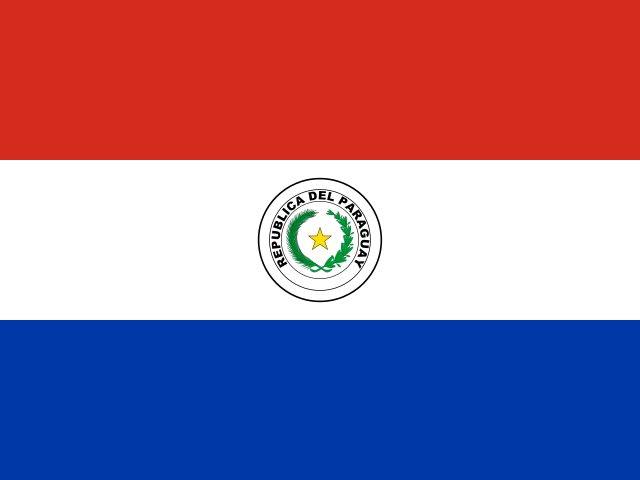 Paraguay
Earlier Report Observations
The market for tapioca and starch substitutes in MERCOSUR demonstrated relative stability in physical volume from 2018 to 2023, with annual consumption hovering around 52 000 t. It reached a peak of 52 555 t in 2021 before a gradual decline to 50 283 t by 2023. In value terms, the market was more volatile, contracting sharply to $78.0 million in 2020 before recovering and growing to $89.2 million by 2023.
The volume growth in 2021 coincided with developments in the global supply chain for tapioca starch. In April of that year, Cargill Inc. partnered with Starpro, a major food-grade tapioca starch producer in Thailand, to expand its offering of specialty tapioca starch in the Asia-Pacific region. This partnership likely enhanced the availability and supply of tapioca-based ingredients in related markets, including MERCOSUR, supporting the increase in domestic market volume that year.
Moving towards the end of the period, the market landscape began to be shaped by significant product innovation and shifting consumer trends. In 2024, Cargill launched its NatureFresh Professional line with modified tapioca starches for sauces and dressings, while Roquette introduced its CLEARAM TR line of hydroxypropylated botanical tapioca starches. Concurrently, the rising consumer preference for gluten-free and vegan products, amplified by the popularity of Bubble Tea featuring tapioca pearls, has positioned tapioca as a versatile alternative, driving demand and product diversification within the region.
Table of content
- 1. Disclaimer
- 2. Terms of use of the report
- 3. Product codes in the statistical classifications used in the report
-
4. Key Market Indicators and Trends
-
4.1. Key Market Indicators
-
4.1.1. In kind
- 4.1.1.1. Production, 2018-2023
- 4.1.1.2. Imports, 2018-2024
- 4.1.1.3. Exports, 2018-2024
- 4.1.1.4. Market size, 2018-2023
-
4.1.2. In value
- 4.1.2.1. Production, 2018-2023
- 4.1.2.2. Imports, 2018-2024
- 4.1.2.3. Exports, 2018-2024
- 4.1.2.4. Market size, 2018-2023
-
4.1.1. In kind
- 4.2. Market Trends and Factors
-
4.1. Key Market Indicators
-
5. Production
-
5.1. Production in MERCOSUR
- 5.1.1. Annual dynamics of production in MERCOSUR in kind, 2018-2023, t
-
5.2. Global production by Country, 2018-2023
- 5.2.1. Annual dynamics of production by macroregions in kind, 2018-2023, t
- 5.2.2. Dynamics of production structure by macroregions in kind, 2018-2023
- 5.2.3. Annual dynamics of production by country in kind, 2018-2023, t
- 5.2.4. Structure of production by countries in kind, 2018-2023
- 5.2.5. Dynamics of peoduction structure by countries in kind, 2018-2023
-
5.1. Production in MERCOSUR
-
6. Imports
-
6.1. Imports (Direct Data)
- 6.1.1. Imports - Total information
-
6.1.2. Imports in kind, t
- 6.1.2.1. Annual dynamics of product's imports to Brazil in kind, 2018-2024, t
- 6.1.2.2. Dynamics of product's imports in kind to Brazil by countries, 2018-2024, t
- 6.1.2.3. Structure of product's imports in kind by countries, 2018-2024
-
6.1.3. Imports in value, K $ US
- 6.1.3.1. Annual dynamics of product's imports to Brazil in value, 2018-2024, K $ US
- 6.1.3.2. Dynamics of product's imports in value to Brazil by countries, 2018-2024, K $ US
- 6.1.3.3. Structure of product's imports in value by countries, 2018-2024
-
6.1.4. Average price of product's imports, $ US/t
- 6.1.4.1. Annual dynamics of average price of product's imports to Brazil, 2018-2024, $ US/t
- 6.1.4.2. Dynamics of average price of product's imports to Brazil by countries, 2018-2024, $ US/t
-
6.2. Imports (Mirror Data)
- 6.2.1. Imports - Total information
-
6.2.2. Imports in kind, t
- 6.2.2.1. Annual dynamics of product's imports to Brazil in kind, 2018-2024, t
- 6.2.2.2. Dynamics of product's imports in kind to Brazil by countries, 2018-2024, t
- 6.2.2.3. Structure of product's imports in kind by countries, 2018-2024
-
6.2.3. Imports in value, K $ US
- 6.2.3.1. Annual dynamics of product's imports to Brazil in value, 2018-2024, K $ US
- 6.2.3.2. Dynamics of product's imports in value to Brazil by countries, 2018-2024, K $ US
- 6.2.3.3. Structure of product's imports in value by countries, 2018-2024
-
6.2.4. Average price of product's imports, $ US/t
- 6.2.4.1. Annual dynamics of average price of product's imports to Brazil, 2018-2024, $ US/t
- 6.2.4.2. Dynamics of average price of product's imports to Brazil by countries, 2018-2024, $ US/t
-
6.1. Imports (Direct Data)
-
7. Exports
-
7.1. Exports (Direct Data)
- 7.1.1. Exports - Total information
-
7.1.2. Exports in kind, t
- 7.1.2.1. Annual dynamics of product's exports from Brazil in kind, 2018-2024, t
- 7.1.2.2. Dynamics of product's exports in kind from Brazil by countries, 2018-2024, t
- 7.1.2.3. Structure of product's exports in kind by countries, 2018-2024
-
7.1.3. Exports in value, K $ US
- 7.1.3.1. Annual dynamics of product's exports from Brazil in value, 2018-2024, K $ US
- 7.1.3.2. Dynamics of product's exports in value from Brazil by countries, 2018-2024, K $ US
- 7.1.3.3. Structure of product's exports in value by countries, 2018-2024
-
7.1.4. Average price of product's exports, $ US/t
- 7.1.4.1. Annual dynamics of average price of product's exports from Brazil, 2018-2024, $ US/t
- 7.1.4.2. Dynamics of average price of product's exports from Brazil by countries, 2018-2024, $ US/t
-
7.2. Exports (Mirror Data)
- 7.2.1. Exports - Total information
-
7.2.2. Exports in kind, t
- 7.2.2.1. Annual dynamics of product's exports from Brazil in kind, 2018-2024, t
- 7.2.2.2. Dynamics of product's exports in kind from Brazil by countries, 2018-2024, t
- 7.2.2.3. Structure of product's exports in kind by countries, 2018-2024
-
7.2.3. Exports in value, K $ US
- 7.2.3.1. Annual dynamics of product's exports from Brazil in value, 2018-2024, K $ US
- 7.2.3.2. Dynamics of product's exports in value from Brazil by countries, 2018-2024, K $ US
- 7.2.3.3. Structure of product's exports in value by countries, 2018-2024
-
7.2.4. Average price of product's exports, $ US/t
- 7.2.4.1. Annual dynamics of average price of product's exports from Brazil, 2018-2024, $ US/t
- 7.2.4.2. Dynamics of average price of product's exports from Brazil by countries, 2018-2024, $ US/t
-
7.1. Exports (Direct Data)
-
8. Trade balance
-
8.1. Trade balance (Direct Data)
- 8.1.1. In kind, t
- 8.1.2. In value, K $ US
-
8.2. Trade balance (Mirror Data)
- 8.2.1. In kind, t
- 8.2.2. In value, K $ US
-
8.1. Trade balance (Direct Data)
-
9. Top buying and selling countries, 2018-2024
-
9.1. Direct Data
- 9.1.1. Import in Value by Countries-buyers
- 9.1.2. Export in Value by Countries-suppliers
-
9.2. Mirror Data
- 9.2.1. Import in Value by Countries-buyers
- 9.2.2. Export in Value by Countries-suppliers
-
9.1. Direct Data
Production tapioca and starch substitutes in MERCOSUR
In kind, 2017-2020, t
Top producers of tapioca and starch substitutes, 2017-2020
World map of production of tapioca and starch substitutes, 2017-2020
In 2020, MERCOSUR produced 54 679 tonnes of tapioca and starch substitutes, showing virtually no change from the previous year. Looking at the period from 2017 to 2020, production increased by 2.2%, which translates to an annualized growth rate of 0.7%. The highest production level was recorded in 2018 at 54 740 tonnes, with the largest annual increase of 2.3% occurring that same year. In contrast, 2019 saw the most significant decline, with production dropping by 0.4%.
Annual dynamics of production in MERCOSUR in kind, 2017-2020, t
| Parameter | 2018 | 2019 | 2020 | CAGR | |
|---|---|---|---|---|---|
| 1 | Change from last year | 2.3% | (0.4%) | 0.3% | 0.7% |
In value, 2017-2020, K $ US
MERCOSUR's tapioca and starch substitutes production declined for the second consecutive year in 2020, with output valued at 82 485 thousand US dollars. This represented a 6.0% decrease compared to the previous year. Over the 2017-2020 period, production fell by 6.2%, equivalent to an annualized decline of 2.1%. The peak value was recorded in 2018 at 89 402 thousand US dollars, which also saw the largest annual increase of 1.7%.
Annual dynamics of production in MERCOSUR in value, 2017-2020, K $ US
| Parameter | 2018 | 2019 | 2020 | CAGR | |
|---|---|---|---|---|---|
| 1 | Change from last year | 1.7% | (1.9%) | (6.0%) | (2.1%) |
Exports tapioca and starch substitutes from MERCOSUR
Exports in kind, t
In 2020, MERCOSUR's exports of tapioca and starch substitutes totaled 3 065 tonnes, marking a significant 40.5% increase year-over-year. From 2017 to 2020, exports grew by 64.7%, with a compound annual growth rate of 18.1%. The largest decline occurred in 2019, when exports fell by 8.4%.
Annual dynamics of product's exports from MERCOSUR in kind, 2017-2020, t
| Parameter | 2018 | 2019 | 2020 | CAGR | |
|---|---|---|---|---|---|
| 1 | Change from last year | 28.1% | (8.4%) | 40.5% | 18.1% |
Between 2017 and 2020, the United States, Mexico, and Portugal were the main buyers of tapioca and starch substitutes from MERCOSUR, accounting for 33.3%, 20.2%, and 12.8% of exports in kind respectively. Together, these three markets comprised 66.4% of total exports in kind during this period.
Structure of product's exports in kind by countries, 2017-2020
World map of product's exports from MERCOSUR in kind, 2017-2020
Exports in value, K $ US
MERCOSUR's tapioca and starch substitutes exports reached 4 623 thousand US dollars in 2020, representing a sharp 31.7% increase compared to the previous year. Over the 2017-2020 period, exports grew by 51.3%, with a compound annual growth rate of 14.8%. The most significant decline was recorded in 2019, when exports dropped by 9.8%.
Annual dynamics of product's exports from MERCOSUR in value, 2017-2020, K $ US
| Parameter | 2018 | 2019 | 2020 | CAGR | |
|---|---|---|---|---|---|
| 1 | Change from last year | 27.3% | (9.8%) | 31.7% | 14.8% |
From 2017 to 2020, the United States, Mexico, and Spain were the principal destinations for MERCOSUR's tapioca and starch substitutes exports in value terms. The United States accounted for 34.2% of exports, Mexico for 15.8%, and Spain for 14.7%. Collectively, these three countries represented 64.6% of total export value during this period.
Structure of product's exports in value by countries, 2017-2020
World map of product's exports from MERCOSUR in value, 2017-2020
Imports tapioca and starch substitutes to MERCOSUR
Imports in kind, t
Import volumes showed considerable volatility during these years. The lowest point occurred in 2017, while imports peaked in 2019, with a 2.9-fold difference between these two years. In 2020, MERCOSUR imported 85 tonnes of tapioca and starch substitutes, representing an 8.3% decrease from 2019. The maximum import volume was recorded in 2019 at 93 tonnes, while the largest annual increase of 96.2% occurred in 2018.
Annual dynamics of product's imports to MERCOSUR in kind, 2017-2020, t
| Parameter | 2018 | 2019 | 2020 | CAGR | |
|---|---|---|---|---|---|
| 1 | Change from last year | 96.2% | 46.5% | (8.3%) | 38.2% |
Between 2017 and 2020, Asia (not elsewhere specified), France, and Spain were the largest suppliers of tapioca and starch substitutes to MERCOSUR in kind, though none dominated the market. Asia accounted for 19.9% of imports, France for 11.2%, and Spain for 3.5%. Together, these three sources represented 34.6% of total imports in kind, with numerous smaller partners making up the remainder.
Structure of product's imports in kind by countries, 2017-2020
World map of product's imports to MERCOSUR in kind, 2017-2020
Imports in value, K $ US
The import market displayed notable volatility during the observed period. From the low point in 2017 to the peak in 2019, import values varied by a factor of four. In 2020, MERCOSUR's imports of tapioca and starch substitutes stood at 135 thousand US dollars, representing a substantial 23.1% reduction compared to the previous year. The maximum import value was recorded in 2019 at 176 thousand US dollars, while the largest annual increase of 197.1% occurred in 2018.
Annual dynamics of product's imports to MERCOSUR in value, 2017-2020, K $ US
| Parameter | 2018 | 2019 | 2020 | CAGR | |
|---|---|---|---|---|---|
| 1 | Change from last year | 197.1% | 33.4% | (23.1%) | 45.0% |
Between 2017 and 2020, imports of tapioca and starch substitutes to MERCOSUR in value terms were not heavily concentrated. Spain accounted for 16.0% of imports, Asia (not elsewhere specified) for 14.6%, and France for 12.4%. Together, these three sources captured only 43.0% of total import value, indicating a diverse supplier base.
Structure of product's imports in value by countries, 2017-2020
World map of product's imports to MERCOSUR in value, 2017-2020
Related Reports


2026-03-30

Sucrose in solid form market in MERCOSUR
2026-03-28

Cocoa powder and cake market in MERCOSUR
2026-03-30

Why Choose Us?
Only Verified Data
No Hidden Costs or Separate Fees
Smarter Subscription Pricing
Contact Our Team
Submit your inquiry using the form below — our team will get back to you within 24 hours.