






"Middle Africa" region includes following countries:
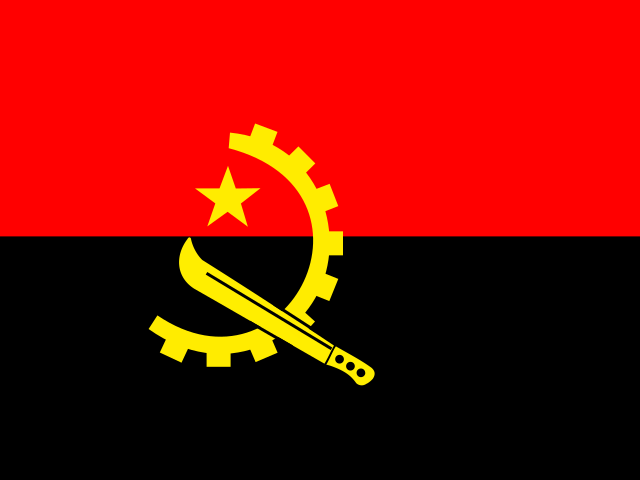 Angola
 Cameroon
 Central African Republic
 Chad
Chad Congo
Congo Democratic Republic of the Congo
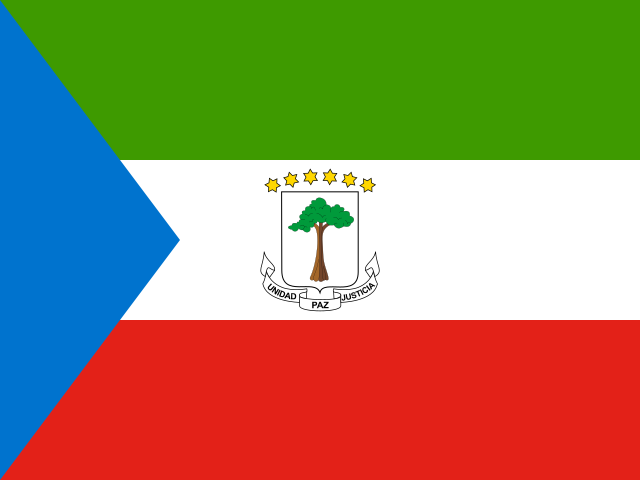 Equatorial Guinea
 Gabon
Gabon Sao Tome and Principe
Earlier Report Observations
In 2018, the market for maize bran, sharps and residues in Middle Africa reached 223 thousand tons. Trade flows that year were influenced by state-owned or major milling companies, as Zimbabwe exported these products mainly to South Africa, indicating active regional trade activity. The market volume then stabilized around 220-224 thousand tons through 2020.
From 2020 to 2022, the market entered a phase of consistent expansion, growing by over 5% to reach 235.2 thousand tons in 2022. This upward trend reversed in 2023, with the volume declining by 3.5% to 226.9 thousand tons.
Table of content
- 1. Disclaimer
- 2. Terms of use of the report
- 3. Product codes in the statistical classifications used in the report
-
4. Key Market Indicators and Trends
-
4.1. Key Market Indicators
-
4.1.1. In kind
- 4.1.1.1. Production, 2018-2023
- 4.1.1.2. Imports, 2018-2024
- 4.1.1.3. Exports, 2018-2024
- 4.1.1.4. Market size, 2018-2023
-
4.1.1. In kind
- 4.2. Market Trends and Factors
-
4.1. Key Market Indicators
-
5. Production
-
5.1. Production in Middle Africa
- 5.1.1. Annual dynamics of production in Middle Africa in kind, 2018-2023, K t
-
5.2. Global production by Country, 2018-2023
- 5.2.1. Annual dynamics of production by macroregions in kind, 2018-2023, K t
- 5.2.2. Dynamics of production structure by macroregions in kind, 2018-2023
- 5.2.3. Annual dynamics of production by country in kind, 2018-2023, K t
- 5.2.4. Structure of production by countries in kind, 2018-2023
- 5.2.5. Dynamics of peoduction structure by countries in kind, 2018-2023
-
5.1. Production in Middle Africa
-
6. Imports
-
6.1. Imports (Direct Data*)
- 6.1.1. Imports - Total information
-
6.1.2. Imports in kind, t
- 6.1.2.1. Annual dynamics of product's imports to Angola in kind, 2018-2024, t
- 6.1.2.2. Dynamics of product's imports in kind to Angola by countries, 2018-2024, t
- 6.1.2.3. Structure of product's imports in kind by countries, 2018-2024
-
6.1.3. Imports in value, K $ US
- 6.1.3.1. Annual dynamics of product's imports to Angola in value, 2018-2024, K $ US
- 6.1.3.2. Dynamics of product's imports in value to Angola by countries, 2018-2024, K $ US
- 6.1.3.3. Structure of product's imports in value by countries, 2018-2024
-
6.1.4. Average price of product's imports, $ US/t
- 6.1.4.1. Annual dynamics of average price of product's imports to Angola, 2018-2024, $ US/t
- 6.1.4.2. Dynamics of average price of product's imports to Angola by countries, 2018-2024, $ US/t
-
6.2. Imports (Mirror Data)
- 6.2.1. Imports - Total information
-
6.2.2. Imports in kind, t
- 6.2.2.1. Annual dynamics of product's imports to Angola in kind, 2018-2024, t
- 6.2.2.2. Dynamics of product's imports in kind to Angola by countries, 2018-2024, t
- 6.2.2.3. Structure of product's imports in kind by countries, 2018-2024
-
6.2.3. Imports in value, K $ US
- 6.2.3.1. Annual dynamics of product's imports to Angola in value, 2018-2024, K $ US
- 6.2.3.2. Dynamics of product's imports in value to Angola by countries, 2018-2024, K $ US
- 6.2.3.3. Structure of product's imports in value by countries, 2018-2024
-
6.2.4. Average price of product's imports, $ US/t
- 6.2.4.1. Annual dynamics of average price of product's imports to Angola, 2018-2024, $ US/t
- 6.2.4.2. Dynamics of average price of product's imports to Angola by countries, 2018-2024, $ US/t
-
6.1. Imports (Direct Data*)
-
7. Exports
-
7.1. Exports (Direct Data*)
- 7.1.1. Exports - Total information
-
7.1.2. Exports in kind, t
- 7.1.2.1. Annual dynamics of product's exports from Angola in kind, 2018-2024, t
- 7.1.2.2. Dynamics of product's exports in kind from Angola by countries, 2018-2024, t
- 7.1.2.3. Structure of product's exports in kind by countries, 2018-2024
-
7.1.3. Exports in value, K $ US
- 7.1.3.1. Annual dynamics of product's exports from Angola in value, 2018-2024, K $ US
- 7.1.3.2. Dynamics of product's exports in value from Angola by countries, 2018-2024, K $ US
- 7.1.3.3. Structure of product's exports in value by countries, 2018-2024
-
7.1.4. Average price of product's exports, $ US/t
- 7.1.4.1. Annual dynamics of average price of product's exports from Angola, 2018-2024, $ US/t
- 7.1.4.2. Dynamics of average price of product's exports from Angola by countries, 2018-2024, $ US/t
-
7.2. Exports (Mirror Data)
- 7.2.1. Exports - Total information
-
7.2.2. Exports in kind, t
- 7.2.2.1. Annual dynamics of product's exports from Angola in kind, 2018-2024, t
- 7.2.2.2. Dynamics of product's exports in kind from Angola by countries, 2018-2024, t
- 7.2.2.3. Structure of product's exports in kind by countries, 2018-2024
-
7.2.3. Exports in value, K $ US
- 7.2.3.1. Annual dynamics of product's exports from Angola in value, 2018-2024, K $ US
- 7.2.3.2. Dynamics of product's exports in value from Angola by countries, 2018-2024, K $ US
- 7.2.3.3. Structure of product's exports in value by countries, 2018-2024
-
7.2.4. Average price of product's exports, $ US/t
- 7.2.4.1. Annual dynamics of average price of product's exports from Angola, 2018-2024, $ US/t
- 7.2.4.2. Dynamics of average price of product's exports from Angola by countries, 2018-2024, $ US/t
-
7.1. Exports (Direct Data*)
-
8. Trade balance
-
8.1. Trade balance (Direct Data)
- 8.1.1. In kind, t
- 8.1.2. In value, K $ US
-
8.2. Trade balance (Mirror Data)
- 8.2.1. In kind, t
- 8.2.2. In value, K $ US
-
8.1. Trade balance (Direct Data)
-
9. Top buying and selling countries, 2018-2024
-
9.1. Direct Data
- 9.1.1. Import in Value by Countries-buyers
- 9.1.2. Export in Value by Countries-suppliers
-
9.2. Mirror Data
- 9.2.1. Import in Value by Countries-buyers
- 9.2.2. Export in Value by Countries-suppliers
-
9.1. Direct Data
Production maize bran, sharps and residues in Middle Africa
In kind, 2017-2020, K t
Top producers of maize bran, sharps and residues, 2017-2020
World map of production of maize bran, sharps and residues, 2017-2020
In Middle Africa, 224.9 thousand tons of maize bran, sharps and residues were produced in 2020, marking a slight increase of 2.3% compared to the previous year. Looking at the period from 2017 to 2020, production grew by 4.4%, which translates to an average annual growth rate of 1.5%. The most significant decline occurred in 2019, with a drop of 1.6%, while the largest increase was recorded in 2018 at 3.7%.
Annual dynamics of production in Middle Africa in kind, 2017-2020, K t
| Parameter | 2018 | 2019 | 2020 | CAGR | |
|---|---|---|---|---|---|
| 1 | Change from last year | 3.7% | (1.6%) | 2.3% | 1.5% |
Exports maize bran, sharps and residues from Middle Africa
Exports in kind, t
The market exhibited considerable volatility during these years. Export volumes reached their lowest point in 2019 at 92 tons, then surged to a high of 1,159 tons in 2020, representing a dramatic 12.6-fold increase between these two years. In 2020, exports from Middle Africa showed a sudden gain of 1,158.2% compared to 2019. The largest decline was recorded in 2019 at 76.2%.
Annual dynamics of product's exports from Middle Africa in kind, 2017-2020, t
| Parameter | 2018 | 2019 | 2020 | CAGR | |
|---|---|---|---|---|---|
| 1 | Change from last year | n/a | (76.2%) | 1 158.2% | - |
From 2017 to 2020, the export market structure was highly concentrated, with Turkey alone accounting for 90.7% of total exports in kind.
Structure of product's exports in kind by countries, 2017-2020
World map of product's exports from Middle Africa in kind, 2017-2020
Exports in value, K $ US
The market demonstrated volatility over the observed period. Export values hit their lowest point in 2019 at 77.9 thousand US dollars, then rose to a peak of 191.5 thousand US dollars in 2020, showing a 2.5-fold increase. In 2020, shipments from Middle Africa amounted to 191.5 thousand US dollars, marking an abrupt increase of 145.9% compared to the previous year. The largest decline was recorded in 2019 at 15.4%.
Annual dynamics of product's exports from Middle Africa in value, 2017-2020, K $ US
| Parameter | 2018 | 2019 | 2020 | CAGR | |
|---|---|---|---|---|---|
| 1 | Change from last year | n/a | (15.4%) | 145.9% | - |
During the 2017–2020 period, Turkey, Namibia, and Belgium consistently remained the main destinations for exports in value terms. Turkey accounted for 41.7% of exports, Namibia for 22.0%, and Belgium for 4.9%, together representing 68.7% of total export flows.
Structure of product's exports in value by countries, 2017-2020
World map of product's exports from Middle Africa in value, 2017-2020
Imports maize bran, sharps and residues to Middle Africa
Imports in kind, t
Market performance showed noticeable fluctuations during this period. Import volumes reached their lowest point in 2020 at 18 tons, after peaking at 895 tons in 2019, resulting in a 51-fold decrease between these years. In 2020, imports to Middle Africa totaled 18 tons, constituting a decrease of 98.0% compared to 2019. The largest increase was recorded in 2019 at 837.1%.
Annual dynamics of product's imports to Middle Africa in kind, 2017-2020, t
| Parameter | 2018 | 2019 | 2020 | CAGR | |
|---|---|---|---|---|---|
| 1 | Change from last year | (27.9%) | 837.1% | (98.0%) | (48.9%) |
From 2017 to 2020, Turkey, Argentina, and Belgium were the principal sources for imports in kind. Turkey accounted for 46.0% of imports, Argentina for 6.6%, and Belgium for 3.0%, jointly making up 55.6% of total import flows.
Structure of product's imports in kind by countries, 2017-2020
World map of product's imports to Middle Africa in kind, 2017-2020
Imports in value, K $ US
Volatility characterized the market behavior during these years. Import values peaked in 2019 at 141.4 thousand US dollars, then fell to their lowest point in 2020 at 8.9 thousand US dollars, representing a 16-fold decrease. In 2020, Middle Africa imported 8.9 thousand US dollars worth of maize bran, sharps and residues, marking a reduction of 93.7% compared to the previous year. The largest increase was recorded in 2019 at 518.2%.
Annual dynamics of product's imports to Middle Africa in value, 2017-2020, K $ US
| Parameter | 2018 | 2019 | 2020 | CAGR | |
|---|---|---|---|---|---|
| 1 | Change from last year | (71.4%) | 518.2% | (93.7%) | (52.0%) |
In the 2017–2020 period, three main markets—Turkey, Argentina, and Belgium—together absorbed 74.2% of total imports in value terms of maize bran, sharps and residues to Middle Africa.
Structure of product's imports in value by countries, 2017-2020
World map of product's imports to Middle Africa in value, 2017-2020
Related Reports


Cottonseed oil-cake market in Middle Africa
2026-03-29

Groundnutoil-cake market in Middle Africa
2026-03-29

Palm-kernel oilcake market in Middle Africa
2026-03-29

Why Choose Us?
Only Verified Data
No Hidden Costs or Separate Fees
Smarter Subscription Pricing
Contact Our Team
Submit your inquiry using the form below — our team will get back to you within 24 hours.