






"MENA" region includes following countries:
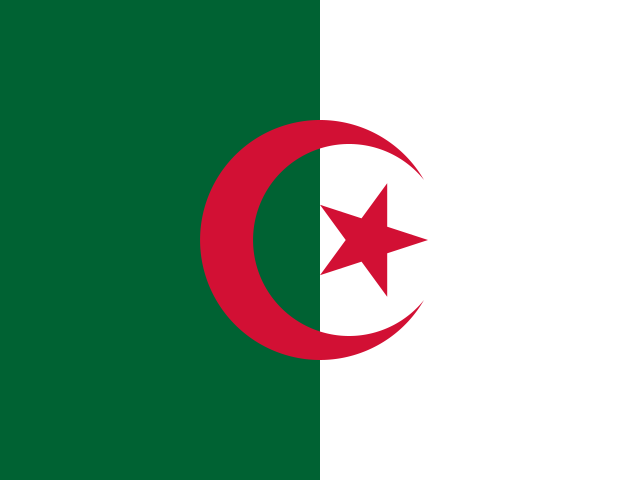 Algeria
 Bahrain
 Djibouti
 Egypt
Egypt Israel
 Jordan
 Iran
Iran Iraq
Iraq Qatar
Qatar Kuwait
 Lebanon
 Libya
Libya Malta
Malta Morocco
 the United Arab Emirates
 Oman
Oman Saudi Arabia
 Syria
Syria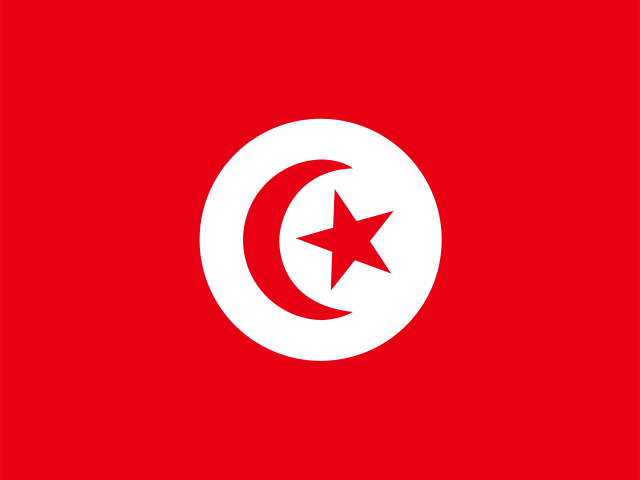 Tunisia
 Yemen
YemenEarlier Report Observations
The market for sunflower, safflower, or cottonseed oil in the MENA region grew from 2 426 thousand tons in 2018 to a peak of 2 546 thousand tons in 2020, before entering a sustained downward trend that brought volumes to 1 981 thousand tons by 2023. The initial growth period was followed by a significant contraction starting in 2021.
The market decline in 2021 coincided with the strategic expansion of major players like Bunge Loders Croklaan, which entered the market with an increased supply of organic oils. In 2022, supply constraints emerged due to weather-related risks and climate impacts in key sunflower seed producing regions, notably Ukraine and Russia, which affected raw material availability for the import-dependent MENA market and contributed to a period of stabilization.
The downward movement continued through 2023. By 2024, the market environment was shaped by global factors including a stabilized world sunflower seed harvest, sustained high price pressures linked to geopolitical conflict, and the ongoing expansion of international agribusinesses within the region.
Table of content
- 1. Disclaimer
- 2. Terms of use of the report
- 3. Product codes in the statistical classifications used in the report
-
4. Key Market Indicators and Trends
-
4.1. Key Market Indicators
-
4.1.1. In kind
- 4.1.1.1. Production, 2018-2023
- 4.1.1.2. Imports, 2018-2024
- 4.1.1.3. Exports, 2018-2024
- 4.1.1.4. Market size, 2018-2023
-
4.1.1. In kind
- 4.2. Market Trends and Factors
-
4.1. Key Market Indicators
-
5. Production
-
5.1. Production in MENA
- 5.1.1. Annual dynamics of production in MENA in kind, 2018-2023, K t
-
5.2. Global production by Country, 2018-2023
- 5.2.1. Annual dynamics of production by macroregions in kind, 2018-2023, K t
- 5.2.2. Dynamics of production structure by macroregions in kind, 2018-2023
- 5.2.3. Annual dynamics of production by country in kind, 2018-2023, K t
- 5.2.4. Structure of production by countries in kind, 2018-2023
- 5.2.5. Dynamics of peoduction structure by countries in kind, 2018-2023
-
5.1. Production in MENA
-
6. Imports
-
6.1. Imports (Direct Data*)
- 6.1.1. Imports - Total information
-
6.1.2. Imports in kind, K t
- 6.1.2.1. Annual dynamics of product's imports to Algeria in kind, 2018-2024, K t
- 6.1.2.2. Dynamics of product's imports in kind to Algeria by countries, 2018-2024, K t
- 6.1.2.3. Structure of product's imports in kind by countries, 2018-2024
-
6.1.3. Imports in value, M $ US
- 6.1.3.1. Annual dynamics of product's imports to Algeria in value, 2018-2024, M $ US
- 6.1.3.2. Dynamics of product's imports in value to Algeria by countries, 2018-2024, M $ US
- 6.1.3.3. Structure of product's imports in value by countries, 2018-2024
-
6.1.4. Average price of product's imports, $ US/t
- 6.1.4.1. Annual dynamics of average price of product's imports to Algeria, 2018-2024, $ US/t
- 6.1.4.2. Dynamics of average price of product's imports to Algeria by countries, 2018-2024, $ US/t
-
6.2. Imports (Mirror Data)
- 6.2.1. Imports - Total information
-
6.2.2. Imports in kind, K t
- 6.2.2.1. Annual dynamics of product's imports to Algeria in kind, 2018-2024, K t
- 6.2.2.2. Dynamics of product's imports in kind to Algeria by countries, 2018-2024, K t
- 6.2.2.3. Structure of product's imports in kind by countries, 2018-2024
-
6.2.3. Imports in value, M $ US
- 6.2.3.1. Annual dynamics of product's imports to Algeria in value, 2018-2024, M $ US
- 6.2.3.2. Dynamics of product's imports in value to Algeria by countries, 2018-2024, M $ US
- 6.2.3.3. Structure of product's imports in value by countries, 2018-2024
-
6.2.4. Average price of product's imports, $ US/t
- 6.2.4.1. Annual dynamics of average price of product's imports to Algeria, 2018-2024, $ US/t
- 6.2.4.2. Dynamics of average price of product's imports to Algeria by countries, 2018-2024, $ US/t
-
6.1. Imports (Direct Data*)
-
7. Exports
-
7.1. Exports (Direct Data*)
- 7.1.1. Exports - Total information
-
7.1.2. Exports in kind, K t
- 7.1.2.1. Annual dynamics of product's exports from Algeria in kind, 2018-2024, K t
- 7.1.2.2. Dynamics of product's exports in kind from Algeria by countries, 2018-2024, K t
- 7.1.2.3. Structure of product's exports in kind by countries, 2018-2024
-
7.1.3. Exports in value, M $ US
- 7.1.3.1. Annual dynamics of product's exports from Algeria in value, 2018-2024, M $ US
- 7.1.3.2. Dynamics of product's exports in value from Algeria by countries, 2018-2024, M $ US
- 7.1.3.3. Structure of product's exports in value by countries, 2018-2024
-
7.1.4. Average price of product's exports, $ US/t
- 7.1.4.1. Annual dynamics of average price of product's exports from Algeria, 2018-2024, $ US/t
- 7.1.4.2. Dynamics of average price of product's exports from Algeria by countries, 2018-2024, $ US/t
-
7.2. Exports (Mirror Data)
- 7.2.1. Exports - Total information
-
7.2.2. Exports in kind, K t
- 7.2.2.1. Annual dynamics of product's exports from Algeria in kind, 2018-2024, K t
- 7.2.2.2. Dynamics of product's exports in kind from Algeria by countries, 2018-2024, K t
- 7.2.2.3. Structure of product's exports in kind by countries, 2018-2024
-
7.2.3. Exports in value, M $ US
- 7.2.3.1. Annual dynamics of product's exports from Algeria in value, 2018-2024, M $ US
- 7.2.3.2. Dynamics of product's exports in value from Algeria by countries, 2018-2024, M $ US
- 7.2.3.3. Structure of product's exports in value by countries, 2018-2024
-
7.2.4. Average price of product's exports, $ US/t
- 7.2.4.1. Annual dynamics of average price of product's exports from Algeria, 2018-2024, $ US/t
- 7.2.4.2. Dynamics of average price of product's exports from Algeria by countries, 2018-2024, $ US/t
-
7.1. Exports (Direct Data*)
-
8. Trade balance
-
8.1. Trade balance (Direct Data)
- 8.1.1. In kind, K t
- 8.1.2. In value, M $ US
-
8.2. Trade balance (Mirror Data)
- 8.2.1. In kind, K t
- 8.2.2. In value, M $ US
-
8.1. Trade balance (Direct Data)
-
9. Top buying and selling countries, 2018-2024
-
9.1. Direct Data
- 9.1.1. Import in Value by Countries-buyers
- 9.1.2. Export in Value by Countries-suppliers
-
9.2. Mirror Data
- 9.2.1. Import in Value by Countries-buyers
- 9.2.2. Export in Value by Countries-suppliers
-
9.1. Direct Data
Production sunflower, safflower or cottonseed oil and fractions in MENA
In kind, 2017-2020, K t
Top producers of sunflower, safflower or cottonseed oil and fractions, 2017-2020
World map of production of sunflower, safflower or cottonseed oil and fractions, 2017-2020
Production of sunflower, safflower, or cottonseed oil and fractions in the MENA region declined for the second year in a row. In 2020, the region produced 149.4 K t, marking a gradual decrease of 4.6% compared to the previous year. Over the period from 2017 to 2020, production fell by 16.8%, with a compound annual growth rate of -6.0%. The highest production volume was recorded in 2018 at 181.5 K t. The largest year-on-year decline occurred in 2019, with a drop of 13.7%, while the largest increase was in 2018, at 1.1%.
Annual dynamics of production in MENA in kind, 2017-2020, K t
| Parameter | 2018 | 2019 | 2020 | CAGR | |
|---|---|---|---|---|---|
| 1 | Change from last year | 1.1% | (13.7%) | (4.6%) | (6.0%) |
In value, 2017-2020, M $ US
The value of sunflower, safflower, or cottonseed oil and fractions production in the MENA region fell for the second consecutive year. In 2020, output was valued at 712 M $ US, representing a decline of 25.9% from the year before. Between 2017 and 2020, production value decreased by 21.4%, equating to an annualized rate of -7.7%. The peak value was recorded in 2018 at 1 131 M $ US. The largest increase in value occurred in 2018, with a rise of 24.8%.
Annual dynamics of production in MENA in value, 2017-2020, M $ US
| Parameter | 2018 | 2019 | 2020 | CAGR | |
|---|---|---|---|---|---|
| 1 | Change from last year | 24.8% | (15.0%) | (25.9%) | (7.7%) |
Exports sunflower, safflower or cottonseed oil and fractions from MENA
Exports in kind, K t
In 2020, cross-border shipments of sunflower, safflower, or cottonseed oil and fractions from the MENA region totaled 103 K t, showing a significant decline of 21.0% year-on-year. Over the period from 2017 to 2020, exports decreased by 30.1%, with a compound annual growth rate of -11.3%. The largest increase in exports was recorded in 2019, at 9.8%.
Annual dynamics of product's exports from MENA in kind, 2017-2020, K t
| Parameter | 2018 | 2019 | 2020 | CAGR | |
|---|---|---|---|---|---|
| 1 | Change from last year | (19.5%) | 9.8% | (21.0%) | (11.3%) |
From 2017 to 2020, exports in kind of sunflower, safflower, or cottonseed oil and fractions from the MENA region were distributed across a wide range of partner countries. Ethiopia accounted for 4.0% of exports in kind, Afghanistan for 2.3%, and Rwanda for 2.0%, together making up just 8.2% of total flows.
Structure of product's exports in kind by countries, 2017-2020
World map of product's exports from MENA in kind, 2017-2020
Exports in value, M $ US
Foreign supplies of sunflower, safflower, or cottonseed oil and fractions from the MENA region increased for the second year in a row. In 2020, the region exported 202 M $ US worth of these products, which is 12.6% higher than in 2019. Between 2017 and 2020, exports grew by 16.6%, equating to an annualized rate of 5.2%. The lowest value was recorded in 2018 at 173 M $ US. The largest decline occurred in 2018, with a drop of 0.1%.
Annual dynamics of product's exports from MENA in value, 2017-2020, M $ US
| Parameter | 2018 | 2019 | 2020 | CAGR | |
|---|---|---|---|---|---|
| 1 | Change from last year | (0.1%) | 3.7% | 12.6% | 5.2% |
From 2017 to 2020, the partner landscape for exports in value terms was diverse. Ethiopia accounted for 3.1% of exports in value terms, Afghanistan for 3.1%, and Rwanda for 1.6%, together forming only 7.8% of total flows. The remaining 92.2% was supplied to or from many other countries.
Structure of product's exports in value by countries, 2017-2020
World map of product's exports from MENA in value, 2017-2020
Imports sunflower, safflower or cottonseed oil and fractions to MENA
Imports in kind, K t
Foreign supplies of sunflower, safflower, or cottonseed oil and fractions to the MENA region increased for the third consecutive year. In 2020, imports amounted to 2 499 K t, corresponding to an uptick of 3.6% from the previous year. Over the period from 2017 to 2020, imports rose by 8.7%, with a compound annual growth rate of 2.8%.
Annual dynamics of product's imports to MENA in kind, 2017-2020, K t
| Parameter | 2018 | 2019 | 2020 | CAGR | |
|---|---|---|---|---|---|
| 1 | Change from last year | 2.8% | 2.1% | 3.6% | 2.8% |
Throughout 2017 to 2020, Ukraine, Russia, and Turkey formed the core group of markets for imports in kind of sunflower, safflower, or cottonseed oil and fractions to the MENA region. Ukraine accounted for 31.3% of imports in kind, Russia for 25.6%, and Turkey for 21.8%, together representing 78.7% of total flows.
Structure of product's imports in kind by countries, 2017-2020
World map of product's imports to MENA in kind, 2017-2020
Imports in value, M $ US
In 2020, deliveries of sunflower, safflower, or cottonseed oil and fractions to the MENA region stood at 2 247 M $ US, which is 14.4% higher than in 2019. Between 2017 and 2020, imports increased by 8.2%, equating to an annualized rate of 2.7%. The lowest value was recorded in 2019 at 1 963 M $ US. The largest decline occurred in 2019, with a drop of 6.5%.
Annual dynamics of product's imports to MENA in value, 2017-2020, M $ US
| Parameter | 2018 | 2019 | 2020 | CAGR | |
|---|---|---|---|---|---|
| 1 | Change from last year | 1.1% | (6.5%) | 14.4% | 2.7% |
From 2017 to 2020, Ukraine, Russia, and Turkey formed the key group of partners for imports in value terms of sunflower, safflower, or cottonseed oil and fractions to the MENA region. Ukraine accounted for 29.0% of imports in value terms, Russia for 24.6%, and Turkey for 23.4%, jointly representing 77.1% of total flows.
Structure of product's imports in value by countries, 2017-2020
World map of product's imports to MENA in value, 2017-2020
Related Reports


Castor oil and fractions market in MENA
2026-03-28

Soybean oil and fractions market in MENA
2026-03-28

Cottonseed oil and fractions market in MENA
2026-03-28

In-depth market research on this product
Global Sunflower Seeds Market 2021–2031: Size, Share, Trends and Forecast
Global market report: size, trends and forecast to 2031 · 184 pages
Global Cottonseed Oil Market 2021–2031: Size, Share, Trends and Forecast
Global market report: size, trends and forecast to 2031 · 186 pages
Why Choose Us?
Only Verified Data
No Hidden Costs or Separate Fees
Smarter Subscription Pricing
Contact Our Team
Submit your inquiry using the form below — our team will get back to you within 24 hours.