






"SADC" region includes following countries:
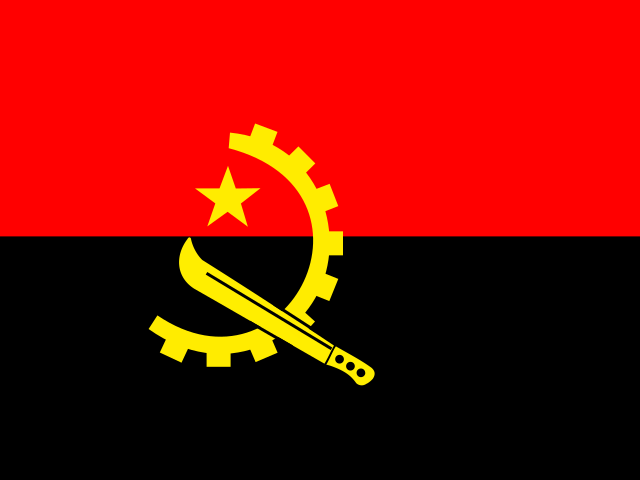 Angola
 Botswana
 Comoros
 Democratic Republic of the Congo
 Eswatini
 Lesotho
 Madagascar
 Malawi
 Mauritius
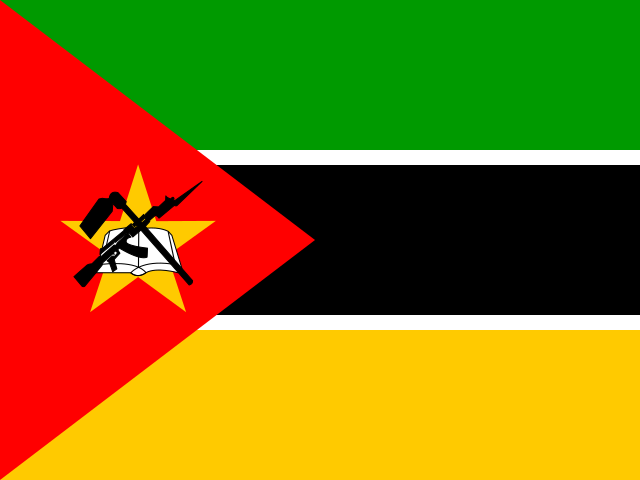 Mozambique
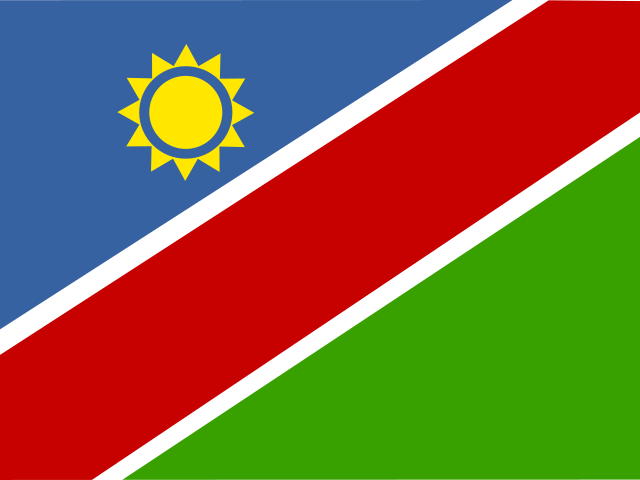 Namibia
 Seychelles
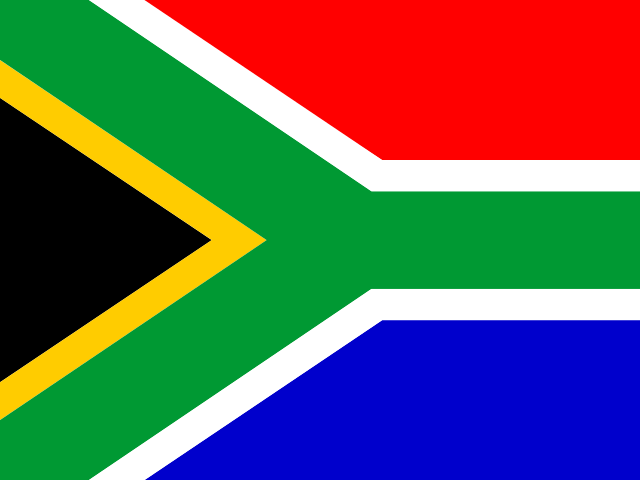 South Africa
 Tanzania
 Zambia
 Zimbabwe
Earlier Report Observations
From 2018 to 2023, soybean oil production in the SADC region increased steadily from 260 thousand tons to 447 thousand tons. This growth was primarily driven by rising demand for animal feed and high-protein food products from the expanding middle class, which stimulated consumption of oilcake and oil. By 2023, sustained investments in soybean breeding and technology levies further enhanced processing capacity and supported sustainable cultivation practices.
The total market volume for soybean oil experienced significant fluctuations, reaching a peak of 1.27 million tons in 2023. The sharp increase that year was largely attributable to a surge in imports to 924 thousand tons, as local drought conditions and port challenges hindered domestic supply growth. Additionally, global supply chain disruptions and geopolitical events, such as the Russia-Ukraine war, tightened worldwide vegetable oil availability, impacting South African market dynamics and import dependency.
Table of content
- 1. Disclaimer
- 2. Terms of use of the report
- 3. Product codes in the statistical classifications used in the report
-
4. Key Market Indicators and Trends
-
4.1. Key Market Indicators
-
4.1.1. In kind
- 4.1.1.1. Production, 2018-2023
- 4.1.1.2. Imports, 2018-2024
- 4.1.1.3. Exports, 2018-2024
- 4.1.1.4. Market size, 2018-2023
-
4.1.1. In kind
- 4.2. Market Trends and Factors
-
4.1. Key Market Indicators
-
5. Production
-
5.1. Production in SADC
- 5.1.1. Annual dynamics of production in SADC in kind, 2018-2023, K t
-
5.2. Global production by Country, 2018-2023
- 5.2.1. Annual dynamics of production by macroregions in kind, 2018-2023, K t
- 5.2.2. Dynamics of production structure by macroregions in kind, 2018-2023
- 5.2.3. Annual dynamics of production by country in kind, 2018-2023, K t
- 5.2.4. Structure of production by countries in kind, 2018-2023
- 5.2.5. Dynamics of peoduction structure by countries in kind, 2018-2023
-
5.1. Production in SADC
-
6. Imports
-
6.1. Imports (Direct Data*)
- 6.1.1. Imports - Total information
-
6.1.2. Imports in kind, K t
- 6.1.2.1. Annual dynamics of product's imports to Angola in kind, 2018-2024, K t
- 6.1.2.2. Dynamics of product's imports in kind to Angola by countries, 2018-2024, K t
- 6.1.2.3. Structure of product's imports in kind by countries, 2018-2024
-
6.1.3. Imports in value, M $ US
- 6.1.3.1. Annual dynamics of product's imports to Angola in value, 2018-2024, M $ US
- 6.1.3.2. Dynamics of product's imports in value to Angola by countries, 2018-2024, M $ US
- 6.1.3.3. Structure of product's imports in value by countries, 2018-2024
-
6.1.4. Average price of product's imports, $ US/t
- 6.1.4.1. Annual dynamics of average price of product's imports to Angola, 2018-2024, $ US/t
- 6.1.4.2. Dynamics of average price of product's imports to Angola by countries, 2018-2024, $ US/t
-
6.2. Imports (Mirror Data)
- 6.2.1. Imports - Total information
-
6.2.2. Imports in kind, K t
- 6.2.2.1. Annual dynamics of product's imports to Angola in kind, 2018-2024, K t
- 6.2.2.2. Dynamics of product's imports in kind to Angola by countries, 2018-2024, K t
- 6.2.2.3. Structure of product's imports in kind by countries, 2018-2024
-
6.2.3. Imports in value, M $ US
- 6.2.3.1. Annual dynamics of product's imports to Angola in value, 2018-2024, M $ US
- 6.2.3.2. Dynamics of product's imports in value to Angola by countries, 2018-2024, M $ US
- 6.2.3.3. Structure of product's imports in value by countries, 2018-2024
-
6.2.4. Average price of product's imports, $ US/t
- 6.2.4.1. Annual dynamics of average price of product's imports to Angola, 2018-2024, $ US/t
- 6.2.4.2. Dynamics of average price of product's imports to Angola by countries, 2018-2024, $ US/t
-
6.1. Imports (Direct Data*)
-
7. Exports
-
7.1. Exports (Direct Data*)
- 7.1.1. Exports - Total information
-
7.1.2. Exports in kind, K t
- 7.1.2.1. Annual dynamics of product's exports from Angola in kind, 2018-2024, K t
- 7.1.2.2. Dynamics of product's exports in kind from Angola by countries, 2018-2024, K t
- 7.1.2.3. Structure of product's exports in kind by countries, 2018-2024
-
7.1.3. Exports in value, M $ US
- 7.1.3.1. Annual dynamics of product's exports from Angola in value, 2018-2024, M $ US
- 7.1.3.2. Dynamics of product's exports in value from Angola by countries, 2018-2024, M $ US
- 7.1.3.3. Structure of product's exports in value by countries, 2018-2024
-
7.1.4. Average price of product's exports, $ US/t
- 7.1.4.1. Annual dynamics of average price of product's exports from Angola, 2018-2024, $ US/t
- 7.1.4.2. Dynamics of average price of product's exports from Angola by countries, 2018-2024, $ US/t
-
7.2. Exports (Mirror Data)
- 7.2.1. Exports - Total information
-
7.2.2. Exports in kind, K t
- 7.2.2.1. Annual dynamics of product's exports from Angola in kind, 2018-2024, K t
- 7.2.2.2. Dynamics of product's exports in kind from Angola by countries, 2018-2024, K t
- 7.2.2.3. Structure of product's exports in kind by countries, 2018-2024
-
7.2.3. Exports in value, M $ US
- 7.2.3.1. Annual dynamics of product's exports from Angola in value, 2018-2024, M $ US
- 7.2.3.2. Dynamics of product's exports in value from Angola by countries, 2018-2024, M $ US
- 7.2.3.3. Structure of product's exports in value by countries, 2018-2024
-
7.2.4. Average price of product's exports, $ US/t
- 7.2.4.1. Annual dynamics of average price of product's exports from Angola, 2018-2024, $ US/t
- 7.2.4.2. Dynamics of average price of product's exports from Angola by countries, 2018-2024, $ US/t
-
7.1. Exports (Direct Data*)
-
8. Trade balance
-
8.1. Trade balance (Direct Data)
- 8.1.1. In kind, K t
- 8.1.2. In value, M $ US
-
8.2. Trade balance (Mirror Data)
- 8.2.1. In kind, K t
- 8.2.2. In value, M $ US
-
8.1. Trade balance (Direct Data)
-
9. Top buying and selling countries, 2018-2024
-
9.1. Direct Data
- 9.1.1. Import in Value by Countries-buyers
- 9.1.2. Export in Value by Countries-suppliers
-
9.2. Mirror Data
- 9.2.1. Import in Value by Countries-buyers
- 9.2.2. Export in Value by Countries-suppliers
-
9.1. Direct Data
Production soybean oil and fractions in SADC
In kind, 2017-2020, K t
Top producers of soybean oil and fractions, 2017-2020
World map of production of soybean oil and fractions, 2017-2020
Soybean oil and fractions production in SADC has increased for the third consecutive year. In 2020, production reached 307.6 K t, marking a gradual year-over-year rise of 6.0%. Between 2017 and 2020, production grew by 40.5%, which translates to an annualized growth rate of 12.0%.
Annual dynamics of production in SADC in kind, 2017-2020, K t
| Parameter | 2018 | 2019 | 2020 | CAGR | |
|---|---|---|---|---|---|
| 1 | Change from last year | 18.6% | 11.7% | 6.0% | 12.0% |
Exports soybean oil and fractions from SADC
Exports in kind, K t
The market exhibited significant volatility during this period. Exports reached their lowest point in 2020 at 3.7 K t, which represents a 93.7% decrease compared to 2019. In contrast, the highest export volume was recorded in 2019 at 58.3 K t, creating a 16-fold gap between these two years. The most substantial increase occurred in 2019, with a remarkable growth of 1 342.4%.
Annual dynamics of product's exports from SADC in kind, 2017-2020, K t
| Parameter | 2018 | 2019 | 2020 | CAGR | |
|---|---|---|---|---|---|
| 1 | Change from last year | (92.9%) | 1 342.4% | (93.7%) | (59.9%) |
From 2017 to 2020, Special Categories accounted for the main share of soybean oil and fractions exports from SADC in kind, representing 2.2% of total flows.
Structure of product's exports in kind by countries, 2017-2020
World map of product's exports from SADC in kind, 2017-2020
Exports in value, M $ US
In 2020, SADC exported soybean oil and fractions worth 58.6 M $ US, showing a strong uptick of 18.6% compared to the previous year. Over the 2017-2020 period, exports increased by 9.2%, with a compound annual growth rate (CAGR) of 3.0%. The minimum value was recorded in 2019 at 49.4 M $ US, while the maximum value occurred in 2018 at 59.0 M $ US. The largest decline took place in 2019, with a decrease of 16.3%.
Annual dynamics of product's exports from SADC in value, 2017-2020, M $ US
| Parameter | 2018 | 2019 | 2020 | CAGR | |
|---|---|---|---|---|---|
| 1 | Change from last year | 10.0% | (16.3%) | 18.6% | 3.0% |
During 2017–2020, Special Categories served as the core market for exports in value terms, accounting for 2.6% of total flows.
Structure of product's exports in value by countries, 2017-2020
World map of product's exports from SADC in value, 2017-2020
Imports soybean oil and fractions to SADC
Imports in kind, K t
After a two-year decline, foreign soybean oil and fractions supplies to SADC increased. In 2020, imports amounted to 552.0 K t, equivalent to a steep improvement of 32.2% compared to the previous year. Over the 2017-2020 period, imports decreased by 4.2%, with a CAGR of 1.4%. The minimum value was recorded in 2019 at 417.7 K t, and the largest decline occurred in the same year, with a drop of 26.8%.
Annual dynamics of product's imports to SADC in kind, 2017-2020, K t
| Parameter | 2018 | 2019 | 2020 | CAGR | |
|---|---|---|---|---|---|
| 1 | Change from last year | (1.0%) | (26.8%) | 32.2% | (1.4%) |
Throughout 2017–2020, Argentina (28.4% of imports in kind), the Netherlands (14.4% of imports in kind), and Portugal (7.9% of imports in kind) remained the main markets for soybean oil and fractions imports to SADC in kind, jointly accounting for 50.7% of total flows.
Structure of product's imports in kind by countries, 2017-2020
World map of product's imports to SADC in kind, 2017-2020
Imports in value, M $ US
In 2020, SADC's soybean oil and fractions import volume reached 481.4 M $ US, corresponding to a strong increase of 21.7% compared with 2019. Over the 2017-2020 period, imports increased by 16.7%, with a CAGR of 5.3%. The minimum value was recorded in 2019 at 395.6 M $ US, and the largest decline occurred in the same year, with a decrease of 16.1%.
Annual dynamics of product's imports to SADC in value, 2017-2020, M $ US
| Parameter | 2018 | 2019 | 2020 | CAGR | |
|---|---|---|---|---|---|
| 1 | Change from last year | 14.3% | (16.1%) | 21.7% | 5.3% |
Over 2017–2020, Argentina (26.0% of imports in value terms), the Netherlands (12.0% of imports in value terms), and Portugal (12.0% of imports in value terms) stood out as the main markets for imports in value terms, together representing 50.1% of total flows.
Structure of product's imports in value by countries, 2017-2020
World map of product's imports to SADC in value, 2017-2020
Related Reports
Soybean oil and fractions market in Colombia
2026-03-28
Soybean oil and fractions market in Nigeria
2026-03-28
Soybean oil and fractions market in Benin
2026-03-28
Cottonseed oil and fractions market in SADC
2026-03-28


Coconut oil and fractions market in SADC
2026-03-28

Non-vegetable waxes market in SADC
2026-03-28
Why Choose Us?
Only Verified Data
No Hidden Costs or Separate Fees
Smarter Subscription Pricing
Contact Our Team
Submit your inquiry using the form below — our team will get back to you within 24 hours.