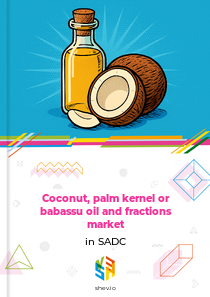







"SADC" region includes following countries:
 Angola
 Botswana
 Comoros
 Democratic Republic of the Congo
 Eswatini
 Lesotho
 Madagascar
 Malawi
 Mauritius
 Mozambique
 Namibia
 Seychelles
 South Africa
 Tanzania
 Zambia
 Zimbabwe
Earlier Report Observations
From 2018 to 2023, the market volume for coconut, palm kernel or babassu oil and fractions in SADC saw moderate growth, rising from 106 841 t to 113 020 t. This period was marked by notable volatility, with a sharp expansion in 2021 when market size reached 114 040 t, followed by a slight contraction in 2022. Local production demonstrated a stronger upward trend, increasing by nearly 20% in 2021 and continuing to grow through 2023, which helped offset a significant decline in imports after 2021.
A key development in 2021 was Pick n Pay Group's commitment to source 100% sustainable palm oil by the end of that year, reflecting a broader industry shift toward certified supplies that likely supported demand. Subsequently, global supply constraints and geopolitical tensions tightened palm oil availability worldwide, impacting import-dependent SADC markets from 2023 onward. Concurrently, the International Trade Administration Commission of South Africa (ITAC) introduced manufacturing rebate facilities for refined, bleached, and deodorised palm oil used in soap and organic surface-active products, creating a regulatory incentive that supported local production volumes.
Market dynamics were further shaped by the diversification of local manufacturers like SOILL and Southern Oil into various edible oil products, which altered competitive landscapes. Consumer awareness and skepticism toward sustainability certifications such as RSPO also grew, influencing labeling practices and purchasing behavior within the region.
Table of content
- 1. Disclaimer
- 2. Terms of use of the report
- 3. Product codes in the statistical classifications used in the report
-
4. Key Market Indicators and Trends
-
4.1. Key Market Indicators
-
4.1.1. In kind
- 4.1.1.1. Production, 2018-2023
- 4.1.1.2. Imports, 2018-2024
- 4.1.1.3. Exports, 2018-2024
- 4.1.1.4. Market size, 2018-2023
-
4.1.1. In kind
- 4.2. Market Trends and Factors
-
4.1. Key Market Indicators
-
5. Production
-
5.1. Production in SADC
- 5.1.1. Annual dynamics of production in SADC in kind, 2018-2023, t
-
5.2. Global production by Country, 2018-2023
- 5.2.1. Annual dynamics of production by macroregions in kind, 2018-2023, t
- 5.2.2. Dynamics of production structure by macroregions in kind, 2018-2023
- 5.2.3. Annual dynamics of production by country in kind, 2018-2023, t
- 5.2.4. Structure of production by countries in kind, 2018-2023
- 5.2.5. Dynamics of peoduction structure by countries in kind, 2018-2023
-
5.1. Production in SADC
-
6. Imports
-
6.1. Imports (Direct Data*)
- 6.1.1. Imports - Total information
-
6.1.2. Imports in kind, t
- 6.1.2.1. Annual dynamics of product's imports to Angola in kind, 2018-2024, t
- 6.1.2.2. Dynamics of product's imports in kind to Angola by countries, 2018-2024, t
- 6.1.2.3. Structure of product's imports in kind by countries, 2018-2024
-
6.1.3. Imports in value, K $ US
- 6.1.3.1. Annual dynamics of product's imports to Angola in value, 2018-2024, K $ US
- 6.1.3.2. Dynamics of product's imports in value to Angola by countries, 2018-2024, K $ US
- 6.1.3.3. Structure of product's imports in value by countries, 2018-2024
-
6.1.4. Average price of product's imports, $ US/kg
- 6.1.4.1. Annual dynamics of average price of product's imports to Angola, 2018-2024, $ US/kg
- 6.1.4.2. Dynamics of average price of product's imports to Angola by countries, 2018-2024, $ US/kg
-
6.2. Imports (Mirror Data)
- 6.2.1. Imports - Total information
-
6.2.2. Imports in kind, t
- 6.2.2.1. Annual dynamics of product's imports to Angola in kind, 2018-2024, t
- 6.2.2.2. Dynamics of product's imports in kind to Angola by countries, 2018-2024, t
- 6.2.2.3. Structure of product's imports in kind by countries, 2018-2024
-
6.2.3. Imports in value, K $ US
- 6.2.3.1. Annual dynamics of product's imports to Angola in value, 2018-2024, K $ US
- 6.2.3.2. Dynamics of product's imports in value to Angola by countries, 2018-2024, K $ US
- 6.2.3.3. Structure of product's imports in value by countries, 2018-2024
-
6.2.4. Average price of product's imports, $ US/kg
- 6.2.4.1. Annual dynamics of average price of product's imports to Angola, 2018-2024, $ US/kg
- 6.2.4.2. Dynamics of average price of product's imports to Angola by countries, 2018-2024, $ US/kg
-
6.1. Imports (Direct Data*)
-
7. Exports
-
7.1. Exports (Direct Data*)
- 7.1.1. Exports - Total information
-
7.1.2. Exports in kind, t
- 7.1.2.1. Annual dynamics of product's exports from Angola in kind, 2018-2024, t
- 7.1.2.2. Dynamics of product's exports in kind from Angola by countries, 2018-2024, t
- 7.1.2.3. Structure of product's exports in kind by countries, 2018-2024
-
7.1.3. Exports in value, K $ US
- 7.1.3.1. Annual dynamics of product's exports from Angola in value, 2018-2024, K $ US
- 7.1.3.2. Dynamics of product's exports in value from Angola by countries, 2018-2024, K $ US
- 7.1.3.3. Structure of product's exports in value by countries, 2018-2024
-
7.1.4. Average price of product's exports, $ US/kg
- 7.1.4.1. Annual dynamics of average price of product's exports from Angola, 2018-2024, $ US/kg
- 7.1.4.2. Dynamics of average price of product's exports from Angola by countries, 2018-2024, $ US/kg
-
7.2. Exports (Mirror Data)
- 7.2.1. Exports - Total information
-
7.2.2. Exports in kind, t
- 7.2.2.1. Annual dynamics of product's exports from Angola in kind, 2018-2024, t
- 7.2.2.2. Dynamics of product's exports in kind from Angola by countries, 2018-2024, t
- 7.2.2.3. Structure of product's exports in kind by countries, 2018-2024
-
7.2.3. Exports in value, K $ US
- 7.2.3.1. Annual dynamics of product's exports from Angola in value, 2018-2024, K $ US
- 7.2.3.2. Dynamics of product's exports in value from Angola by countries, 2018-2024, K $ US
- 7.2.3.3. Structure of product's exports in value by countries, 2018-2024
-
7.2.4. Average price of product's exports, $ US/kg
- 7.2.4.1. Annual dynamics of average price of product's exports from Angola, 2018-2024, $ US/kg
- 7.2.4.2. Dynamics of average price of product's exports from Angola by countries, 2018-2024, $ US/kg
-
7.1. Exports (Direct Data*)
-
8. Trade balance
-
8.1. Trade balance (Direct Data)
- 8.1.1. In kind, t
- 8.1.2. In value, K $ US
-
8.2. Trade balance (Mirror Data)
- 8.2.1. In kind, t
- 8.2.2. In value, K $ US
-
8.1. Trade balance (Direct Data)
-
9. Top buying and selling countries, 2018-2024
-
9.1. Direct Data
- 9.1.1. Import in Value by Countries-buyers
- 9.1.2. Export in Value by Countries-suppliers
-
9.2. Mirror Data
- 9.2.1. Import in Value by Countries-buyers
- 9.2.2. Export in Value by Countries-suppliers
-
9.1. Direct Data
Production coconut, palm kernel or babassu oil and fractions in SADC
In kind, 2017-2020, t
Top producers of coconut, palm kernel or babassu oil and fractions, 2017-2020
World map of production of coconut, palm kernel or babassu oil and fractions, 2017-2020
In 2020, SADC produced 61 927 tonnes of coconut, palm kernel, or babassu oil and fractions, representing a modest 5.2% contraction compared to the previous year. Over the period from 2017 to 2020, production decreased by 14.4%, with a compound annual growth rate of -5.1%. The largest decline occurred in 2018, at 10.7%, while the largest increase was recorded in 2019, at 1.0%.
Annual dynamics of production in SADC in kind, 2017-2020, t
| Parameter | 2018 | 2019 | 2020 | CAGR | |
|---|---|---|---|---|---|
| 1 | Change from last year | (10.7%) | 1.0% | (5.2%) | (5.1%) |
Exports coconut, palm kernel or babassu oil and fractions from SADC
Exports in kind, t
After a two-year decline, exports of coconut, palm kernel, or babassu oil and fractions from SADC increased in 2020, reaching 643 tonnes—a sharp 27.9% advance relative to the prior year. Between 2017 and 2020, exports decreased by 65.2%, equating to an annualized rate of -29.6%. The minimum value was recorded in 2019 at 503 tonnes, which also saw the largest decline of 53.8%.
Annual dynamics of product's exports from SADC in kind, 2017-2020, t
| Parameter | 2018 | 2019 | 2020 | CAGR | |
|---|---|---|---|---|---|
| 1 | Change from last year | (41.0%) | (53.8%) | 27.9% | (29.6%) |
From 2017 to 2020, Switzerland (12.0% of exports in kind), Kenya (7.1% of exports in kind), and Burundi (1.6% of exports in kind) continued to lead as the top buyers of coconut, palm kernel, or babassu oil and fractions from SADC, jointly accounting for 20.7% of total exports in kind.
Structure of product's exports in kind by countries, 2017-2020
World map of product's exports from SADC in kind, 2017-2020
Exports in value, K $ US
Exports of coconut, palm kernel, or babassu oil and fractions from SADC declined for the third consecutive year in 2020, with a volume of 1 322 thousand US dollars, marking a dramatic 42.2% fall compared to the previous year. Over the period from 2017 to 2020, exports decreased by 64.1%, with a compound annual growth rate of -29.0%.
Annual dynamics of product's exports from SADC in value, 2017-2020, K $ US
| Parameter | 2018 | 2019 | 2020 | CAGR | |
|---|---|---|---|---|---|
| 1 | Change from last year | (6.7%) | (33.5%) | (42.2%) | (29.0%) |
During 2017–2020, exports in value terms of coconut, palm kernel, or babassu oil and fractions from SADC were relatively evenly distributed. Switzerland (11.0% of exports in value terms), Kenya (7.5% of exports in value terms), and Oman (6.2% of exports in value terms) jointly accounted for only 24.7% of total flows.
Structure of product's exports in value by countries, 2017-2020
World map of product's exports from SADC in value, 2017-2020
Imports coconut, palm kernel or babassu oil and fractions to SADC
Imports in kind, t
In 2020, foreign supplies of coconut, palm kernel, or babassu oil and fractions to SADC stood at 44 144 tonnes, up by 4.2% relative to the prior year. Over the period from 2017 to 2020, imports increased by 16.7%, with a compound annual growth rate of 5.3%. The largest decline was recorded in 2019 at 2.1%, while the largest increase occurred in 2018 at 14.4%.
Annual dynamics of product's imports to SADC in kind, 2017-2020, t
| Parameter | 2018 | 2019 | 2020 | CAGR | |
|---|---|---|---|---|---|
| 1 | Change from last year | 14.4% | (2.1%) | 4.2% | 5.3% |
From 2017 to 2020, Indonesia and Malaysia were the dominant sources for imports in kind of coconut, palm kernel, or babassu oil and fractions to SADC, jointly accounting for 92.8% of total flows, with the remaining volume distributed among smaller markets.
Structure of product's imports in kind by countries, 2017-2020
World map of product's imports to SADC in kind, 2017-2020
Imports in value, K $ US
After a two-year fall, SADC's imports of coconut, palm kernel, or babassu oil and fractions increased in 2020, totalling 38 846 thousand US dollars—a rise of 12.0% relative to the prior year. Between 2017 and 2020, imports decreased by 25.4%, equating to an annualized rate of -9.3%. The minimum value was recorded in 2019 at 34 673 thousand US dollars, which also saw the largest decline of 23.6%.
Annual dynamics of product's imports to SADC in value, 2017-2020, K $ US
| Parameter | 2018 | 2019 | 2020 | CAGR | |
|---|---|---|---|---|---|
| 1 | Change from last year | (12.9%) | (23.6%) | 12.0% | (9.3%) |
Over 2017–2020, Indonesia and Malaysia concentrated the majority of imports in value terms of coconut, palm kernel, or babassu oil and fractions to SADC, while other markets formed a less significant portion.
Structure of product's imports in value by countries, 2017-2020
World map of product's imports to SADC in value, 2017-2020
Related Reports


Soybean oil and fractions market in SADC
2026-03-28

Corn oil and fractions market in SADC
2026-03-28
Cottonseed oil and fractions market in SADC
2026-03-28

Why Choose Us?
Only Verified Data
No Hidden Costs or Separate Fees
Smarter Subscription Pricing
Contact Our Team
Submit your inquiry using the form below — our team will get back to you within 24 hours.