






"Middle Africa" region includes following countries:
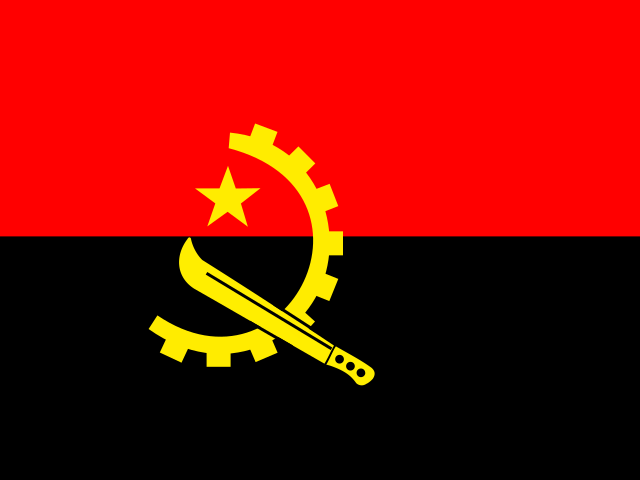 Angola
 Cameroon
 Central African Republic
 Chad
Chad Congo
Congo Democratic Republic of the Congo
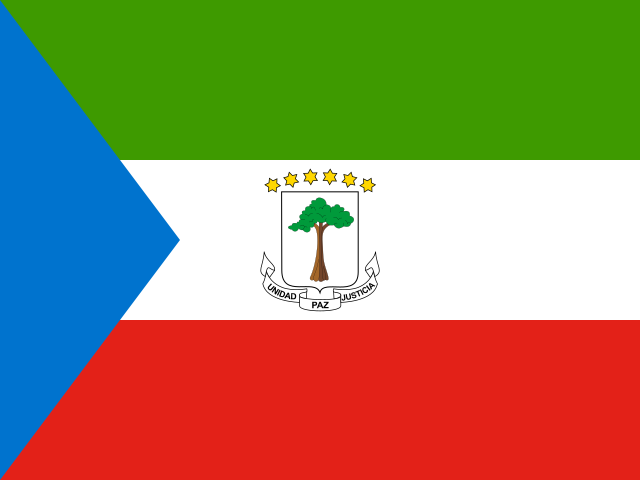 Equatorial Guinea
 Gabon
Gabon Sao Tome and Principe
Earlier Report Observations
The goat meat market in Middle Africa expanded consistently from 203.5 thousand tons in 2018 to 242.7 thousand tons in 2023. At the start of the period, goat meat was noted as a rare product with an unstructured market, lacking precise pricing, which highlighted the segment's underdevelopment yet potential for growth.
Production continued to rise despite identified challenges in the regional meat sector, including regulatory and logistical issues within the Economic Community of Central African States in 2020. Growth accelerated from 2021 onward, supported by infrastructure modernization efforts such as the project to build a modern slaughter chain for pork in Yaoundé, which likely improved overall meat processing capacity and efficiency, benefiting goat meat production.
By 2023, goat meat output reached 242.5 thousand tons, even though official statistics remained focused on beef, pork, and poultry, indicating that the segment grew steadily despite limited attention in regional monitoring.
Table of content
- 1. Disclaimer
- 2. Terms of use of the report
- 3. Product codes in the statistical classifications used in the report
-
4. Key Market Indicators and Trends
-
4.1. Key Market Indicators
-
4.1.1. In kind
- 4.1.1.1. Production, 2018-2023
- 4.1.1.2. Imports, 2018-2024
- 4.1.1.3. Exports, 2018-2024
- 4.1.1.4. Market size, 2018-2023
-
4.1.1. In kind
- 4.2. Market Trends and Factors
-
4.1. Key Market Indicators
-
5. Production
-
5.1. Production in Middle Africa
- 5.1.1. Annual dynamics of production in Middle Africa in kind, 2018-2023, K t
-
5.2. Global production by Country, 2018-2023
- 5.2.1. Annual dynamics of production by macroregions in kind, 2018-2023, K t
- 5.2.2. Dynamics of production structure by macroregions in kind, 2018-2023
- 5.2.3. Annual dynamics of production by country in kind, 2018-2023, K t
- 5.2.4. Structure of production by countries in kind, 2018-2023
- 5.2.5. Dynamics of peoduction structure by countries in kind, 2018-2023
-
5.1. Production in Middle Africa
-
6. Imports
-
6.1. Imports (Direct Data*)
- 6.1.1. Imports - Total information
-
6.1.2. Imports in kind, t
- 6.1.2.1. Annual dynamics of product's imports to Angola in kind, 2018-2024, t
- 6.1.2.2. Dynamics of product's imports in kind to Angola by countries, 2018-2024, t
- 6.1.2.3. Structure of product's imports in kind by countries, 2018-2024
-
6.1.3. Imports in value, K $ US
- 6.1.3.1. Annual dynamics of product's imports to Angola in value, 2018-2024, K $ US
- 6.1.3.2. Dynamics of product's imports in value to Angola by countries, 2018-2024, K $ US
- 6.1.3.3. Structure of product's imports in value by countries, 2018-2024
-
6.1.4. Average price of product's imports, $ US/kg
- 6.1.4.1. Annual dynamics of average price of product's imports to Angola, 2018-2024, $ US/kg
- 6.1.4.2. Dynamics of average price of product's imports to Angola by countries, 2018-2024, $ US/kg
-
6.2. Imports (Mirror Data)
- 6.2.1. Imports - Total information
-
6.2.2. Imports in kind, t
- 6.2.2.1. Annual dynamics of product's imports to Angola in kind, 2018-2024, t
- 6.2.2.2. Dynamics of product's imports in kind to Angola by countries, 2018-2024, t
- 6.2.2.3. Structure of product's imports in kind by countries, 2018-2024
-
6.2.3. Imports in value, K $ US
- 6.2.3.1. Annual dynamics of product's imports to Angola in value, 2018-2024, K $ US
- 6.2.3.2. Dynamics of product's imports in value to Angola by countries, 2018-2024, K $ US
- 6.2.3.3. Structure of product's imports in value by countries, 2018-2024
-
6.2.4. Average price of product's imports, $ US/kg
- 6.2.4.1. Annual dynamics of average price of product's imports to Angola, 2018-2024, $ US/kg
- 6.2.4.2. Dynamics of average price of product's imports to Angola by countries, 2018-2024, $ US/kg
-
6.1. Imports (Direct Data*)
-
7. Exports
-
7.1. Exports (Direct Data*)
- 7.1.1. Exports - Total information
-
7.1.2. Exports in kind, t
- 7.1.2.1. Annual dynamics of product's exports from Angola in kind, 2018-2024, t
- 7.1.2.2. Dynamics of product's exports in kind from Angola by countries, 2018-2024, t
- 7.1.2.3. Structure of product's exports in kind by countries, 2018-2024
-
7.1.3. Exports in value, K $ US
- 7.1.3.1. Annual dynamics of product's exports from Angola in value, 2018-2024, K $ US
- 7.1.3.2. Dynamics of product's exports in value from Angola by countries, 2018-2024, K $ US
- 7.1.3.3. Structure of product's exports in value by countries, 2018-2024
-
7.1.4. Average price of product's exports, $ US/kg
- 7.1.4.1. Annual dynamics of average price of product's exports from Angola, 2018-2024, $ US/kg
- 7.1.4.2. Dynamics of average price of product's exports from Angola by countries, 2018-2024, $ US/kg
-
7.2. Exports (Mirror Data)
- 7.2.1. Exports - Total information
-
7.2.2. Exports in kind, t
- 7.2.2.1. Annual dynamics of product's exports from Angola in kind, 2018-2024, t
- 7.2.2.2. Dynamics of product's exports in kind from Angola by countries, 2018-2024, t
- 7.2.2.3. Structure of product's exports in kind by countries, 2018-2024
-
7.2.3. Exports in value, K $ US
- 7.2.3.1. Annual dynamics of product's exports from Angola in value, 2018-2024, K $ US
- 7.2.3.2. Dynamics of product's exports in value from Angola by countries, 2018-2024, K $ US
- 7.2.3.3. Structure of product's exports in value by countries, 2018-2024
-
7.2.4. Average price of product's exports, $ US/kg
- 7.2.4.1. Annual dynamics of average price of product's exports from Angola, 2018-2024, $ US/kg
- 7.2.4.2. Dynamics of average price of product's exports from Angola by countries, 2018-2024, $ US/kg
-
7.1. Exports (Direct Data*)
-
8. Trade balance
-
8.1. Trade balance (Direct Data)
- 8.1.1. In kind, t
- 8.1.2. In value, K $ US
-
8.2. Trade balance (Mirror Data)
- 8.2.1. In kind, t
- 8.2.2. In value, K $ US
-
8.1. Trade balance (Direct Data)
-
9. Top buying and selling countries, 2018-2024
-
9.1. Direct Data
- 9.1.1. Import in Value by Countries-buyers
- 9.1.2. Export in Value by Countries-suppliers
-
9.2. Mirror Data
- 9.2.1. Import in Value by Countries-buyers
- 9.2.2. Export in Value by Countries-suppliers
-
9.1. Direct Data
Production goat meat in Middle Africa
In kind, 2017-2020, K t
Top producers of goat meat, 2017-2020
World map of production of goat meat, 2017-2020
Goat meat production in Middle Africa has grown for the third year in a row. In 2020, the region produced 213.7 thousand tons of goat meat, representing a 3.7% increase compared to the previous year. From 2017 to 2020, production rose by 7.3%, with an average annual growth rate of 2.4%.
Annual dynamics of production in Middle Africa in kind, 2017-2020, K t
| Parameter | 2018 | 2019 | 2020 | CAGR | |
|---|---|---|---|---|---|
| 1 | Change from last year | 2.1% | 1.4% | 3.7% | 2.4% |
Exports goat meat from Middle Africa
Exports in kind, t
Export volumes showed significant volatility throughout the period. The peak was reached in 2019, while the lowest point occurred in 2018, creating a fifteen-fold difference between these two years. In 2020, Middle Africa's goat meat exports dropped to zero tons, an 87.3% decrease from 2019. The minimum export volume of zero tons was recorded in 2018, while the maximum of 0.3 tons occurred in 2019. The most substantial decline of 93.3% took place in 2018, followed by a dramatic recovery with a 1 440.8% increase in 2019.
Annual dynamics of product's exports from Middle Africa in kind, 2017-2020, t
| Parameter | 2018 | 2019 | 2020 | CAGR | |
|---|---|---|---|---|---|
| 1 | Change from last year | (93.3%) | 1 440.8% | (87.3%) | (49.3%) |
Between 2017 and 2020, France dominated Middle Africa's goat meat exports, accounting for 61.3% of the volume. India followed with 8.2%, and the United Kingdom with 4.3%. Together, these three countries represented 73.9% of all goat meat exports from the region during this period.
Structure of product's exports in kind by countries, 2017-2020
World map of product's exports from Middle Africa in kind, 2017-2020
Exports in value, K $ US
The export market demonstrated considerable instability during these years, with values fluctuating fifty-four times between the 2017 high and the 2018 low. In 2020, Middle Africa's goat meat export value amounted to 0.1 thousand US dollars, marking a substantial 95.4% decline from 2019. The lowest value of 0.1 thousand US dollars was recorded in 2018. The most significant drop of 98.2% occurred in 2018, while 2019 saw a remarkable recovery with a 2 677.1% increase.
Annual dynamics of product's exports from Middle Africa in value, 2017-2020, K $ US
| Parameter | 2018 | 2019 | 2020 | CAGR | |
|---|---|---|---|---|---|
| 1 | Change from last year | (98.2%) | 2 677.1% | (95.4%) | (71.4%) |
From 2017 to 2020, France remained the primary destination for Middle Africa's goat meat exports in value terms, representing 63.8% of the total. Malta accounted for 1.3%, and the United Kingdom for 1.2%. Collectively, these three markets received 66.2% of the region's goat meat export value during this timeframe.
Structure of product's exports in value by countries, 2017-2020
World map of product's exports from Middle Africa in value, 2017-2020
Imports goat meat to Middle Africa
Imports in kind, t
Middle Africa's goat meat imports have increased for three consecutive years. In 2020, imports reached 451.6 tons, showing a notable 26.2% rise compared to 2019. Between 2017 and 2020, import volumes grew by 357.7%, equivalent to an average annual growth rate of 66.0%.
Annual dynamics of product's imports to Middle Africa in kind, 2017-2020, t
| Parameter | 2018 | 2019 | 2020 | CAGR | |
|---|---|---|---|---|---|
| 1 | Change from last year | 212.5% | 16.1% | 26.2% | 66.0% |
During the 2017-2020 period, Middle Africa sourced its goat meat imports from a diverse range of countries. Spain led with 20.9% of import volume, followed by Argentina with 9.0%, and Portugal with 5.5%. However, these three suppliers together accounted for only 35.4% of total imports, indicating a highly fragmented supply structure.
Structure of product's imports in kind by countries, 2017-2020
World map of product's imports to Middle Africa in kind, 2017-2020
Imports in value, K $ US
Goat meat imports to Middle Africa have grown for the third straight year. In 2020, import value reached 2 612 thousand US dollars, reflecting a sharp 27.6% increase from the previous year. Over the 2017-2020 period, import values surged by 428.9%, translating to an average annual growth rate of 74.2%.
Annual dynamics of product's imports to Middle Africa in value, 2017-2020, K $ US
| Parameter | 2018 | 2019 | 2020 | CAGR | |
|---|---|---|---|---|---|
| 1 | Change from last year | 223.9% | 28.0% | 27.6% | 74.2% |
Between 2017 and 2020, Spain was the leading supplier of goat meat to Middle Africa in value terms, representing 20.8% of imports. Argentina contributed 6.2%, and Portugal 5.3%. While these were important sources, their combined share reached just 32.3% of total import value, with the remaining 67.7% distributed across numerous other trading partners.
Structure of product's imports in value by countries, 2017-2020
World map of product's imports to Middle Africa in value, 2017-2020
Related Reports





Why Choose Us?
Only Verified Data
No Hidden Costs or Separate Fees
Smarter Subscription Pricing
Contact Our Team
Submit your inquiry using the form below — our team will get back to you within 24 hours.