






"Middle Africa" region includes following countries:
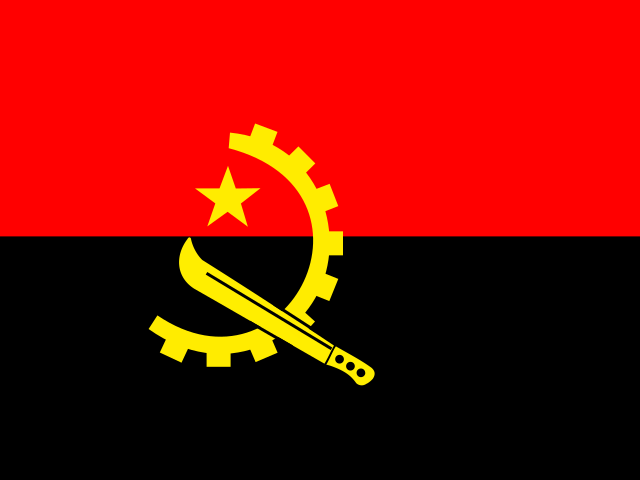 Angola
 Cameroon
 Central African Republic
 Chad
Chad Congo
Congo Democratic Republic of the Congo
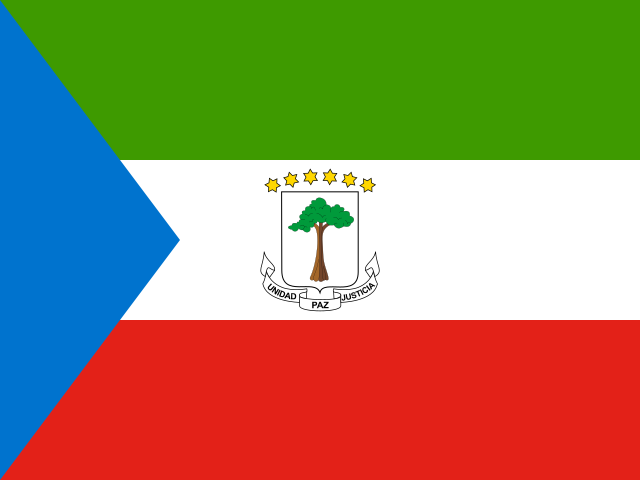 Equatorial Guinea
 Gabon
Gabon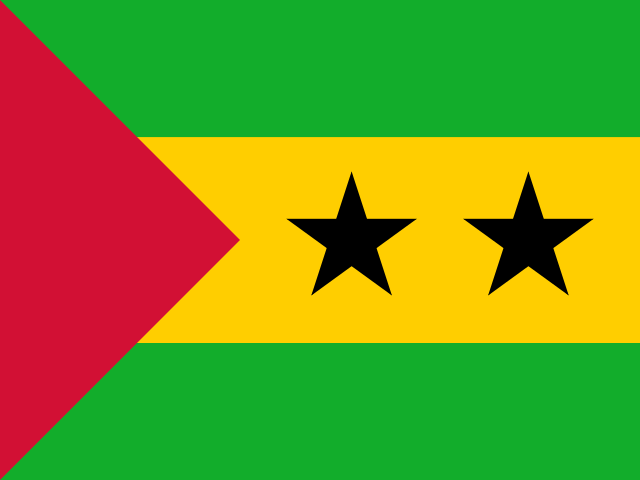 Sao Tome and Principe
Earlier Report Observations
Between 2018 and 2020, the pig offal market volume in Middle Africa contracted from 45,605 t to 35,053 t. The most pronounced decrease occurred in 2020, when the market shrank by 20% compared to the previous year.
Market volume partially recovered to 41,613 t in 2021 but fell again to 37,278 t in 2022. This decline coincided with the implementation of the UEMOA Common External Tariff (TEC), which applied specific customs duties to fresh, chilled, or frozen pig offal imports. The tariff structure, with variable rates for different subcategories, increased import costs and contributed to reduced import volumes, tightening the overall market supply.
In 2023, the market rebounded to 41,526 t, approaching the level seen in 2021 as imports recovered. The UEMOA tariff regime remained in place, indicating ongoing regulatory influence on market access and regional pricing conditions.
Table of content
- 1. Disclaimer
- 2. Terms of use of the report
- 3. Product codes in the statistical classifications used in the report
-
4. Key Market Indicators and Trends
-
4.1. Key Market Indicators
-
4.1.1. In kind
- 4.1.1.1. Production, 2018-2023
- 4.1.1.2. Imports, 2018-2024
- 4.1.1.3. Exports, 2018-2024
- 4.1.1.4. Market size, 2018-2023
-
4.1.1. In kind
- 4.2. Market Trends and Factors
-
4.1. Key Market Indicators
-
5. Production
-
5.1. Production in Middle Africa
- 5.1.1. Annual dynamics of production in Middle Africa in kind, 2018-2023, t
-
5.2. Global production by Country, 2018-2023
- 5.2.1. Annual dynamics of production by macroregions in kind, 2018-2023, t
- 5.2.2. Dynamics of production structure by macroregions in kind, 2018-2023
- 5.2.3. Annual dynamics of production by country in kind, 2018-2023, t
- 5.2.4. Structure of production by countries in kind, 2018-2023
- 5.2.5. Dynamics of peoduction structure by countries in kind, 2018-2023
-
5.1. Production in Middle Africa
-
6. Imports
-
6.1. Imports (Direct Data*)
- 6.1.1. Imports - Total information
-
6.1.2. Imports in kind, t
- 6.1.2.1. Annual dynamics of product's imports to Angola in kind, 2018-2024, t
- 6.1.2.2. Dynamics of product's imports in kind to Angola by countries, 2018-2024, t
- 6.1.2.3. Structure of product's imports in kind by countries, 2018-2024
-
6.1.3. Imports in value, K $ US
- 6.1.3.1. Annual dynamics of product's imports to Angola in value, 2018-2024, K $ US
- 6.1.3.2. Dynamics of product's imports in value to Angola by countries, 2018-2024, K $ US
- 6.1.3.3. Structure of product's imports in value by countries, 2018-2024
-
6.1.4. Average price of product's imports, $ US/t
- 6.1.4.1. Annual dynamics of average price of product's imports to Angola, 2018-2024, $ US/t
- 6.1.4.2. Dynamics of average price of product's imports to Angola by countries, 2018-2024, $ US/t
-
6.2. Imports (Mirror Data)
- 6.2.1. Imports - Total information
-
6.2.2. Imports in kind, t
- 6.2.2.1. Annual dynamics of product's imports to Angola in kind, 2018-2024, t
- 6.2.2.2. Dynamics of product's imports in kind to Angola by countries, 2018-2024, t
- 6.2.2.3. Structure of product's imports in kind by countries, 2018-2024
-
6.2.3. Imports in value, K $ US
- 6.2.3.1. Annual dynamics of product's imports to Angola in value, 2018-2024, K $ US
- 6.2.3.2. Dynamics of product's imports in value to Angola by countries, 2018-2024, K $ US
- 6.2.3.3. Structure of product's imports in value by countries, 2018-2024
-
6.2.4. Average price of product's imports, $ US/t
- 6.2.4.1. Annual dynamics of average price of product's imports to Angola, 2018-2024, $ US/t
- 6.2.4.2. Dynamics of average price of product's imports to Angola by countries, 2018-2024, $ US/t
-
6.1. Imports (Direct Data*)
-
7. Exports
-
7.1. Exports (Direct Data*)
- 7.1.1. Exports - Total information
-
7.1.2. Exports in kind, t
- 7.1.2.1. Annual dynamics of product's exports from Angola in kind, 2018-2024, t
- 7.1.2.2. Dynamics of product's exports in kind from Angola by countries, 2018-2024, t
- 7.1.2.3. Structure of product's exports in kind by countries, 2018-2024
-
7.1.3. Exports in value, K $ US
- 7.1.3.1. Annual dynamics of product's exports from Angola in value, 2018-2024, K $ US
- 7.1.3.2. Dynamics of product's exports in value from Angola by countries, 2018-2024, K $ US
- 7.1.3.3. Structure of product's exports in value by countries, 2018-2024
-
7.1.4. Average price of product's exports, $ US/t
- 7.1.4.1. Annual dynamics of average price of product's exports from Angola, 2018-2024, $ US/t
- 7.1.4.2. Dynamics of average price of product's exports from Angola by countries, 2018-2024, $ US/t
-
7.2. Exports (Mirror Data)
- 7.2.1. Exports - Total information
-
7.2.2. Exports in kind, t
- 7.2.2.1. Annual dynamics of product's exports from Angola in kind, 2018-2024, t
- 7.2.2.2. Dynamics of product's exports in kind from Angola by countries, 2018-2024, t
- 7.2.2.3. Structure of product's exports in kind by countries, 2018-2024
-
7.2.3. Exports in value, K $ US
- 7.2.3.1. Annual dynamics of product's exports from Angola in value, 2018-2024, K $ US
- 7.2.3.2. Dynamics of product's exports in value from Angola by countries, 2018-2024, K $ US
- 7.2.3.3. Structure of product's exports in value by countries, 2018-2024
-
7.2.4. Average price of product's exports, $ US/t
- 7.2.4.1. Annual dynamics of average price of product's exports from Angola, 2018-2024, $ US/t
- 7.2.4.2. Dynamics of average price of product's exports from Angola by countries, 2018-2024, $ US/t
-
7.1. Exports (Direct Data*)
-
8. Trade balance
-
8.1. Trade balance (Direct Data)
- 8.1.1. In kind, t
- 8.1.2. In value, K $ US
-
8.2. Trade balance (Mirror Data)
- 8.2.1. In kind, t
- 8.2.2. In value, K $ US
-
8.1. Trade balance (Direct Data)
-
9. Top buying and selling countries, 2018-2024
-
9.1. Direct Data
- 9.1.1. Import in Value by Countries-buyers
- 9.1.2. Export in Value by Countries-suppliers
-
9.2. Mirror Data
- 9.2.1. Import in Value by Countries-buyers
- 9.2.2. Export in Value by Countries-suppliers
-
9.1. Direct Data
Production pig offal in Middle Africa
In kind, 2017-2020, t
Top producers of pig offal, 2017-2020
World map of production of pig offal, 2017-2020
Pig offal production in Middle Africa declined for the second year in a row. In 2020, the region produced 13,463 tons, representing a slight decrease of 0.6% from the previous year. Looking at the period from 2017 to 2020, production fell by 6.1%, which translates to an average annual decline of 2.1%. The highest production level was recorded in 2018 at 14,675 tons, with a 2.3% increase that year. The most significant drop occurred in 2019, when production fell by 7.7%.
Annual dynamics of production in Middle Africa in kind, 2017-2020, t
| Parameter | 2018 | 2019 | 2020 | CAGR | |
|---|---|---|---|---|---|
| 1 | Change from last year | 2.3% | (7.7%) | (0.6%) | (2.1%) |
Exports pig offal from Middle Africa
Exports in kind, t
In 2020, Middle Africa exported 7 tons of pig offal, a substantial increase of 222.6% compared to 2019. From 2017 to 2020, exports grew by 450.4%, with an average annual growth rate of 76.6%.
Annual dynamics of product's exports from Middle Africa in kind, 2017-2020, t
| Parameter | 2018 | 2019 | 2020 | CAGR | |
|---|---|---|---|---|---|
| 1 | Change from last year | n/a | n/a | 222.6% | 76.6% |
Between 2017 and 2020, China and the Bahamas were the main destinations for Middle Africa's pig offal exports in volume terms, together accounting for 67.1% of total exports.
Structure of product's exports in kind by countries, 2017-2020
World map of product's exports from Middle Africa in kind, 2017-2020
Exports in value, K $ US
In 2020, Middle Africa's pig offal exports reached 34,000 US dollars, showing a dramatic rise of 1,230.2% from the year before. Over the 2017-2020 period, export value increased by 2,379.6%, with an average annual growth rate of 191.6%.
Annual dynamics of product's exports from Middle Africa in value, 2017-2020, K $ US
| Parameter | 2018 | 2019 | 2020 | CAGR | |
|---|---|---|---|---|---|
| 1 | Change from last year | n/a | n/a | 1 230.2% | 191.6% |
From 2017 to 2020, China and the Bahamas dominated Middle Africa's pig offal exports in value terms, forming a duopoly that represented 90.9% of total export value.
Structure of product's exports in value by countries, 2017-2020
World map of product's exports from Middle Africa in value, 2017-2020
Imports pig offal to Middle Africa
Imports in kind, t
Pig offal imports into Middle Africa fell for the second consecutive year. In 2020, the region imported 21,596 tons, which was 28.8% lower than in 2019. Between 2017 and 2020, imports decreased by 24.1%, with an average annual decline of 8.8%. The peak import volume was in 2018 at 30,930 tons, when imports increased by 8.7%.
Annual dynamics of product's imports to Middle Africa in kind, 2017-2020, t
| Parameter | 2018 | 2019 | 2020 | CAGR | |
|---|---|---|---|---|---|
| 1 | Change from last year | 8.7% | (2.0%) | (28.8%) | (8.8%) |
During 2017-2020, Argentina, Brazil, and the United States were the key sources for Middle Africa's pig offal imports in volume terms. Argentina contributed 44.3% of imports, Brazil 31.0%, and the United States 3.7%, together making up 79.0% of total import volume.
Structure of product's imports in kind by countries, 2017-2020
World map of product's imports to Middle Africa in kind, 2017-2020
Imports in value, K $ US
Pig offal imports into Middle Africa declined in value for the second year in a row. In 2020, import value stood at 23,018,000 US dollars, marking a 33.1% decrease year-over-year. From 2017 to 2020, import value fell by 35.3%, with an average annual decline of 13.5%. The highest import value was recorded in 2018 at 40,344,000 US dollars, when it increased by 13.4%.
Annual dynamics of product's imports to Middle Africa in value, 2017-2020, K $ US
| Parameter | 2018 | 2019 | 2020 | CAGR | |
|---|---|---|---|---|---|
| 1 | Change from last year | 13.4% | (14.7%) | (33.1%) | (13.5%) |
In the 2017-2020 period, Argentina, Brazil, and Malta were the largest suppliers of pig offal to Middle Africa in value terms. Argentina accounted for 42.5% of import value, Brazil for 32.1%, and Malta for 4.0%, together representing 78.6% of total import value.
Structure of product's imports in value by countries, 2017-2020
World map of product's imports to Middle Africa in value, 2017-2020
Related Reports

Pig offal market in Brunei Darussalam
2026-03-30
2026-03-30
2026-03-30
2026-03-30




Goat meat market in Middle Africa
2026-03-27
Why Choose Us?
Only Verified Data
No Hidden Costs or Separate Fees
Smarter Subscription Pricing
Contact Our Team
Submit your inquiry using the form below — our team will get back to you within 24 hours.