






"Sub-Saharan Africa" region includes following countries:
 Cabo Verde
 Benin
Benin Gambia
 Ghana
Ghana Guinea
 Côte d'Ivoire
 Liberia
 Mali
Mali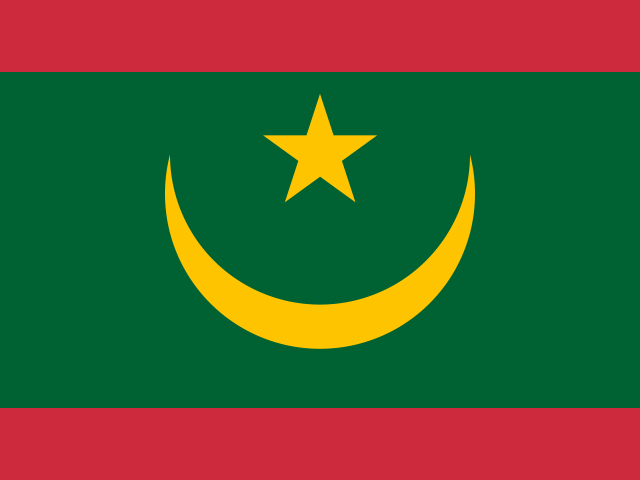 Mauritania
 Niger
Niger Nigeria
 Guinea-Bissau
 Saint Helena, Ascension and Tristan da Cunha
 Senegal
 Sierra Leone
 Togo
Togo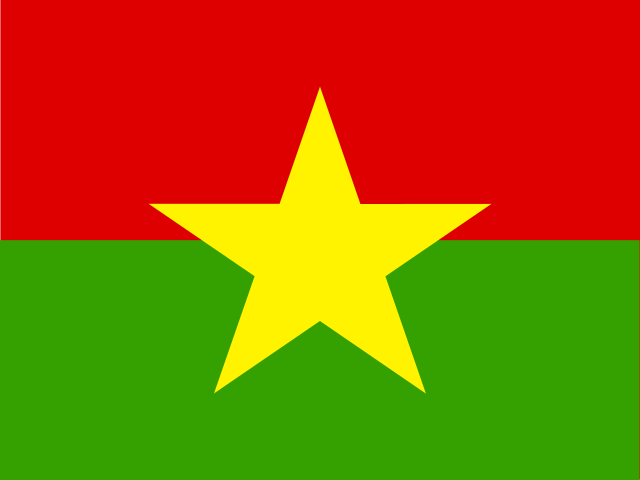 Burkina Faso
 British Indian Ocean Territory
 Burundi
 Comoros
 Mayotte
 Ethiopia
 Eritrea
 French Southern Territories
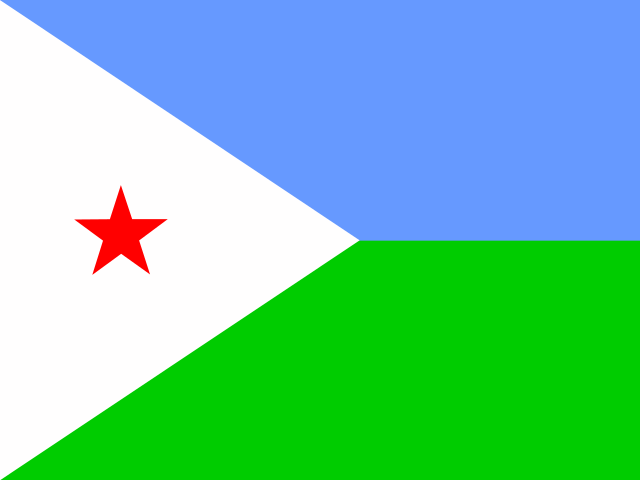 Djibouti
 Kenya
Kenya Madagascar
 Malawi
 Mauritius
 Mozambique
 Reunion
 Rwanda
 Seychelles
 Somalia
 Zimbabwe
 South Sudan
 Uganda
 Tanzania
 Zambia
 Angola
 Cameroon
 Central African Republic
 Chad
Chad Congo
Congo Democratic Republic of the Congo
 Equatorial Guinea
 Gabon
Gabon Sao Tome and Principe
 Botswana
 Lesotho
 Namibia
 South Africa
 Eswatini
Earlier Report Observations
The rapeseed oilcake market in Sub-Saharan Africa expanded significantly from 2018 to 2023, with market volume growing from 61.7 thousand tons to 118.0 thousand tons, an increase of 91%. Domestic production mirrored this rise, reaching 117.7 thousand tons in 2023 from 62.4 thousand tons in 2018, while imports and exports both declined, indicating a shift toward greater self-sufficiency.
This growth was supported by investments in new production facilities. In 2020, the construction of large-scale edible oil complexes in Ethiopia aimed to satisfy most of the national demand for cooking oil, with by-products like oilcake boosting feed ingredient output. The expansion of crushing capacity directly increased the supply of rapeseed oilcake as a co-product.
By 2024, the market's development continued with policy-driven investments in oilseed processing, such as tax exemptions and subsidies for farmers in Egypt, which encouraged domestic crushing. Additionally, the entry of global agribusiness player Bunge into a Nigerian joint venture for advanced biodiesel blends highlighted diversification into value-added uses, further integrating oilcake production into the regional bioeconomy.
Table of content
- 1. Disclaimer
- 2. Terms of use of the report
- 3. Product codes in the statistical classifications used in the report
-
4. Key Market Indicators and Trends
-
4.1. Key Market Indicators
-
4.1.1. In kind
- 4.1.1.1. Production, 2018-2023
- 4.1.1.2. Imports, 2018-2024
- 4.1.1.3. Exports, 2018-2024
- 4.1.1.4. Market size, 2018-2023
-
4.1.1. In kind
- 4.2. Market Trends and Factors
-
4.1. Key Market Indicators
-
5. Production
-
5.1. Production in Sub-Saharan Africa
- 5.1.1. Annual dynamics of production in Sub-Saharan Africa in kind, 2018-2023, K t
-
5.2. Global production by Country, 2018-2023
- 5.2.1. Annual dynamics of production by macroregions in kind, 2018-2023, K t
- 5.2.2. Dynamics of production structure by macroregions in kind, 2018-2023
- 5.2.3. Annual dynamics of production by country in kind, 2018-2023, K t
- 5.2.4. Structure of production by countries in kind, 2018-2023
- 5.2.5. Dynamics of peoduction structure by countries in kind, 2018-2023
-
5.1. Production in Sub-Saharan Africa
-
6. Imports
-
6.1. Imports (Direct Data*)
- 6.1.1. Imports - Total information
-
6.1.2. Imports in kind, t
- 6.1.2.1. Annual dynamics of product's imports to Cabo Verde in kind, 2018-2024, t
- 6.1.2.2. Dynamics of product's imports in kind to Cabo Verde by countries, 2018-2024, t
- 6.1.2.3. Structure of product's imports in kind by countries, 2018-2024
-
6.1.3. Imports in value, K $ US
- 6.1.3.1. Annual dynamics of product's imports to Cabo Verde in value, 2018-2024, K $ US
- 6.1.3.2. Dynamics of product's imports in value to Cabo Verde by countries, 2018-2024, K $ US
- 6.1.3.3. Structure of product's imports in value by countries, 2018-2024
-
6.1.4. Average price of product's imports, $ US/t
- 6.1.4.1. Annual dynamics of average price of product's imports to Cabo Verde, 2018-2024, $ US/t
- 6.1.4.2. Dynamics of average price of product's imports to Cabo Verde by countries, 2018-2024, $ US/t
-
6.2. Imports (Mirror Data)
- 6.2.1. Imports - Total information
-
6.2.2. Imports in kind, t
- 6.2.2.1. Annual dynamics of product's imports to Cabo Verde in kind, 2018-2024, t
- 6.2.2.2. Dynamics of product's imports in kind to Cabo Verde by countries, 2018-2024, t
- 6.2.2.3. Structure of product's imports in kind by countries, 2018-2024
-
6.2.3. Imports in value, K $ US
- 6.2.3.1. Annual dynamics of product's imports to Cabo Verde in value, 2018-2024, K $ US
- 6.2.3.2. Dynamics of product's imports in value to Cabo Verde by countries, 2018-2024, K $ US
- 6.2.3.3. Structure of product's imports in value by countries, 2018-2024
-
6.2.4. Average price of product's imports, $ US/t
- 6.2.4.1. Annual dynamics of average price of product's imports to Cabo Verde, 2018-2024, $ US/t
- 6.2.4.2. Dynamics of average price of product's imports to Cabo Verde by countries, 2018-2024, $ US/t
-
6.1. Imports (Direct Data*)
-
7. Exports
-
7.1. Exports (Direct Data*)
- 7.1.1. Exports - Total information
-
7.1.2. Exports in kind, t
- 7.1.2.1. Annual dynamics of product's exports from Cabo Verde in kind, 2018-2024, t
- 7.1.2.2. Dynamics of product's exports in kind from Cabo Verde by countries, 2018-2024, t
- 7.1.2.3. Structure of product's exports in kind by countries, 2018-2024
-
7.1.3. Exports in value, K $ US
- 7.1.3.1. Annual dynamics of product's exports from Cabo Verde in value, 2018-2024, K $ US
- 7.1.3.2. Dynamics of product's exports in value from Cabo Verde by countries, 2018-2024, K $ US
- 7.1.3.3. Structure of product's exports in value by countries, 2018-2024
-
7.1.4. Average price of product's exports, $ US/t
- 7.1.4.1. Annual dynamics of average price of product's exports from Cabo Verde, 2018-2024, $ US/t
- 7.1.4.2. Dynamics of average price of product's exports from Cabo Verde by countries, 2018-2024, $ US/t
-
7.2. Exports (Mirror Data)
- 7.2.1. Exports - Total information
-
7.2.2. Exports in kind, t
- 7.2.2.1. Annual dynamics of product's exports from Cabo Verde in kind, 2018-2024, t
- 7.2.2.2. Dynamics of product's exports in kind from Cabo Verde by countries, 2018-2024, t
- 7.2.2.3. Structure of product's exports in kind by countries, 2018-2024
-
7.2.3. Exports in value, K $ US
- 7.2.3.1. Annual dynamics of product's exports from Cabo Verde in value, 2018-2024, K $ US
- 7.2.3.2. Dynamics of product's exports in value from Cabo Verde by countries, 2018-2024, K $ US
- 7.2.3.3. Structure of product's exports in value by countries, 2018-2024
-
7.2.4. Average price of product's exports, $ US/t
- 7.2.4.1. Annual dynamics of average price of product's exports from Cabo Verde, 2018-2024, $ US/t
- 7.2.4.2. Dynamics of average price of product's exports from Cabo Verde by countries, 2018-2024, $ US/t
-
7.1. Exports (Direct Data*)
-
8. Trade balance
-
8.1. Trade balance (Direct Data)
- 8.1.1. In kind, t
- 8.1.2. In value, K $ US
-
8.2. Trade balance (Mirror Data)
- 8.2.1. In kind, t
- 8.2.2. In value, K $ US
-
8.1. Trade balance (Direct Data)
-
9. Top buying and selling countries, 2018-2024
-
9.1. Direct Data
- 9.1.1. Import in Value by Countries-buyers
- 9.1.2. Export in Value by Countries-suppliers
-
9.2. Mirror Data
- 9.2.1. Import in Value by Countries-buyers
- 9.2.2. Export in Value by Countries-suppliers
-
9.1. Direct Data
Production rapeseed oilcake in Sub-Saharan Africa
In kind, 2017-2020, t
Top producers of rapeseed oilcake, 2017-2020
World map of production of rapeseed oilcake, 2017-2020
Sub-Saharan Africa's rapeseed oilcake production has increased for the second year in a row. In 2020, the region produced 75,700 tonnes of rapeseed oilcake, marking a 6.2% year-over-year rise. Looking at the period from 2017 to 2020, overall production declined by 3.4%, with an average annual growth rate of 1.1%. The lowest production level was in 2018 at 62,380 tonnes. That year also saw the largest drop of 20.4%, while 2019 experienced the biggest increase at 14.3%.
Annual dynamics of production in Sub-Saharan Africa in kind, 2017-2020, t
| Parameter | 2018 | 2019 | 2020 | CAGR | |
|---|---|---|---|---|---|
| 1 | Change from last year | (20.4%) | 14.3% | 6.2% | (1.1%) |
In value, 2017-2020, K $ US
Sub-Saharan Africa's rapeseed oilcake production value has risen for the second consecutive year. In 2020, the output was valued at $17,605,000, reflecting a controlled gain of 9.5% compared to the previous year. Over the 2017-2020 period, production value increased by 6.2%, with an average annual growth rate of 2.0%. The lowest value was recorded in 2018 at $11,226,000. That year saw the largest decline of 32.2%, while 2019 had the biggest increase at 43.3%.
Annual dynamics of production in Sub-Saharan Africa in value, 2017-2020, K $ US
| Parameter | 2018 | 2019 | 2020 | CAGR | |
|---|---|---|---|---|---|
| 1 | Change from last year | (32.2%) | 43.3% | 9.5% | 2.0% |
Exports rapeseed oilcake from Sub-Saharan Africa
Exports in kind, t
Rapeseed oilcake exports from Sub-Saharan Africa have declined for the third year in a row. In 2020, the region exported 3,437 tonnes, showing a modest fall of 7.7% from the previous year. From 2017 to 2020, exports decreased by 82.3%, with an average annual decline of 43.8%.
Annual dynamics of product's exports from Sub-Saharan Africa in kind, 2017-2020, t
| Parameter | 2018 | 2019 | 2020 | CAGR | |
|---|---|---|---|---|---|
| 1 | Change from last year | (72.9%) | (29.1%) | (7.7%) | (43.8%) |
Between 2017 and 2020, Vietnam, China, and the United Arab Emirates were the largest buyers of rapeseed oilcake from Sub-Saharan Africa in volume terms, but they did not dominate the market. Vietnam accounted for 18.3% of exports, China for 17.3%, and the UAE for 6.5%. Together, these three countries made up 42.1% of total exports, with the rest distributed among numerous smaller partners.
Structure of product's exports in kind by countries, 2017-2020
World map of product's exports from Sub-Saharan Africa in kind, 2017-2020
Exports in value, K $ US
Exported rapeseed oilcake values from Sub-Saharan Africa have fallen for the third consecutive year. In 2020, exports were valued at $799,000, down by 4.8% from the previous year. Between 2017 and 2020, exports decreased by 80.5%, equating to an average annual decline of 42.0%.
Annual dynamics of product's exports from Sub-Saharan Africa in value, 2017-2020, K $ US
| Parameter | 2018 | 2019 | 2020 | CAGR | |
|---|---|---|---|---|---|
| 1 | Change from last year | (77.0%) | (11.1%) | (4.8%) | (42.0%) |
From 2017 to 2020, the geographical structure of rapeseed oilcake exports in value terms was highly diversified. Vietnam accounted for 15.7% of exports, China for 15.2%, and the United Arab Emirates for 7.5%. Together, these three countries represented only 38.4% of total export value, while the remaining 61.6% was spread across many smaller partner countries.
Structure of product's exports in value by countries, 2017-2020
World map of product's exports from Sub-Saharan Africa in value, 2017-2020
Imports rapeseed oilcake to Sub-Saharan Africa
Imports in kind, t
Market performance showed noticeable fluctuations during this period. Import levels varied significantly, with a 4-fold difference between the high in 2018 and the low in 2020. In 2020, Sub-Saharan Africa imported 1,137 tonnes of rapeseed oilcake, indicating a sharp decrease of 38.9% year-over-year. The peak was in 2018 at 4,532 tonnes. The largest decline occurred in 2019 at 59.0%, while the biggest increase was in 2018 at 87.4%.
Annual dynamics of product's imports to Sub-Saharan Africa in kind, 2017-2020, t
| Parameter | 2018 | 2019 | 2020 | CAGR | |
|---|---|---|---|---|---|
| 1 | Change from last year | 87.4% | (59.0%) | (38.9%) | (22.2%) |
Throughout 2017 to 2020, Portugal, the United Arab Emirates, and Indonesia were the three largest markets for rapeseed oilcake imports in volume terms, together accounting for 8.0% of total imports.
Structure of product's imports in kind by countries, 2017-2020
World map of product's imports to Sub-Saharan Africa in kind, 2017-2020
Imports in value, K $ US
Market performance exhibited noticeable fluctuations during this period. Imports varied by 4.6 times from a high in 2018 to a low in 2020. In 2020, Sub-Saharan Africa's rapeseed oilcake import value reached $549,000, showing a sharp drop of 69.2% year-over-year. The maximum value was recorded in 2018 at $2,550,000. The largest increase occurred in 2018 at 273.4%.
Annual dynamics of product's imports to Sub-Saharan Africa in value, 2017-2020, K $ US
| Parameter | 2018 | 2019 | 2020 | CAGR | |
|---|---|---|---|---|---|
| 1 | Change from last year | 273.4% | (30.2%) | (69.2%) | (7.0%) |
From 2017 to 2020, Portugal, the United Arab Emirates, and India were the main markets for rapeseed oilcake imports in value terms. Portugal accounted for 53.2% of imports, the UAE for 3.3%, and India for 3.3%. Together, these three countries made up 59.9% of total import value.
Structure of product's imports in value by countries, 2017-2020
World map of product's imports to Sub-Saharan Africa in value, 2017-2020
Related Reports

Rapeseed oilcake market in CIS
2026-03-29
Rapeseed oilcake market in Americas
2026-03-29
Rapeseed oilcake market in Northern Europe
2026-03-29
Rapeseed oilcake market in Slovakia
2026-03-29



Why Choose Us?
Only Verified Data
No Hidden Costs or Separate Fees
Smarter Subscription Pricing
Contact Our Team
Submit your inquiry using the form below — our team will get back to you within 24 hours.