






"Eastern Africa" region includes following countries:
 British Indian Ocean Territory
 Burundi
 Comoros
 Mayotte
 Ethiopia
 Eritrea
 French Southern Territories
 Djibouti
 Kenya
Kenya Madagascar
 Malawi
 Mauritius
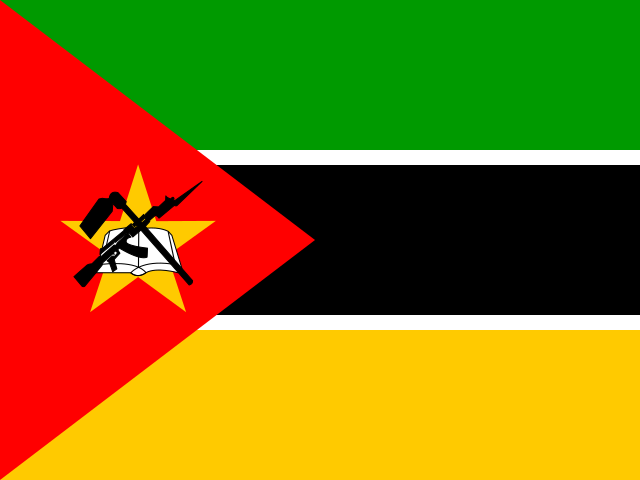 Mozambique
 Reunion
 Rwanda
 Seychelles
 Somalia
 Zimbabwe
 South Sudan
 Uganda
 Tanzania
 Zambia
Earlier Report Observations
The poultry meat and offal market volume in Eastern Africa declined from 2 013 thousand tons in 2018 to 1 877 thousand tons in 2019, before stabilizing at 1 895 thousand tons in 2020. Kenya Meat Commission, as the largest licensed export abattoir, influenced the market through its export operations. The growth of commercial poultry farming to meet demand for affordable animal protein and the emergence of value-added products like cut portions laid the market foundation. By 2020, the expansion of processed product segments, including sausages and nuggets, coupled with rising urban demand, contributed to a moderate recovery.
From 2021 onward, the market showed consistent growth, reaching 2 233 thousand tons by 2023. The expansion of broiler farming, with a focus on production cost control and efficient management, became a key driver to meet demand in urban and hospitality sectors. Kenya Meat Commission maintained significant export volumes, supporting market stability. Furthermore, Eastern Africa's comparative advantages within the African Continental Free Trade Area (AfCFTA) enhanced market access and export opportunities. Continued demand for processed poultry products and diversification into alternative poultry species sustained this positive trajectory.
Table of content
- 1. Disclaimer
- 2. Terms of use of the report
- 3. Product codes in the statistical classifications used in the report
-
4. Key Market Indicators and Trends
-
4.1. Key Market Indicators
-
4.1.1. In kind
- 4.1.1.1. Production, 2018-2023
- 4.1.1.2. Imports, 2018-2024
- 4.1.1.3. Exports, 2018-2024
- 4.1.1.4. Market size, 2018-2023
-
4.1.2. In value
- 4.1.2.1. Production, 2018-2023
- 4.1.2.2. Imports, 2018-2024
- 4.1.2.3. Exports, 2018-2024
- 4.1.2.4. Market size, 2018-2023
-
4.1.1. In kind
- 4.2. Market Trends and Factors
-
4.1. Key Market Indicators
-
5. Production
-
5.1. Production in Eastern Africa
- 5.1.1. Annual dynamics of production in Eastern Africa in kind, 2018-2023, K t
-
5.2. Global production by Country, 2018-2023
- 5.2.1. Annual dynamics of production by macroregions in kind, 2018-2023, K t
- 5.2.2. Dynamics of production structure by macroregions in kind, 2018-2023
- 5.2.3. Annual dynamics of production by country in kind, 2018-2023, K t
- 5.2.4. Structure of production by countries in kind, 2018-2023
- 5.2.5. Dynamics of peoduction structure by countries in kind, 2018-2023
-
5.1. Production in Eastern Africa
-
6. Imports
-
6.1. Imports (Direct Data*)
- 6.1.1. Imports - Total information
-
6.1.2. Imports in kind, K t
- 6.1.2.1. Annual dynamics of product's imports to British Indian Ocean Territory in kind, 2018-2024, K t
- 6.1.2.2. Dynamics of product's imports in kind to British Indian Ocean Territory by countries, 2018-2024, K t
- 6.1.2.3. Structure of product's imports in kind by countries, 2018-2024
-
6.1.3. Imports in value, M $ US
- 6.1.3.1. Annual dynamics of product's imports to British Indian Ocean Territory in value, 2018-2024, M $ US
- 6.1.3.2. Dynamics of product's imports in value to British Indian Ocean Territory by countries, 2018-2024, M $ US
- 6.1.3.3. Structure of product's imports in value by countries, 2018-2024
-
6.1.4. Average price of product's imports, $ US/t
- 6.1.4.1. Annual dynamics of average price of product's imports to British Indian Ocean Territory, 2018-2024, $ US/t
- 6.1.4.2. Dynamics of average price of product's imports to British Indian Ocean Territory by countries, 2018-2024, $ US/t
-
6.2. Imports (Mirror Data)
- 6.2.1. Imports - Total information
-
6.2.2. Imports in kind, K t
- 6.2.2.1. Annual dynamics of product's imports to British Indian Ocean Territory in kind, 2018-2024, K t
- 6.2.2.2. Dynamics of product's imports in kind to British Indian Ocean Territory by countries, 2018-2024, K t
- 6.2.2.3. Structure of product's imports in kind by countries, 2018-2024
-
6.2.3. Imports in value, M $ US
- 6.2.3.1. Annual dynamics of product's imports to British Indian Ocean Territory in value, 2018-2024, M $ US
- 6.2.3.2. Dynamics of product's imports in value to British Indian Ocean Territory by countries, 2018-2024, M $ US
- 6.2.3.3. Structure of product's imports in value by countries, 2018-2024
-
6.2.4. Average price of product's imports, $ US/t
- 6.2.4.1. Annual dynamics of average price of product's imports to British Indian Ocean Territory, 2018-2024, $ US/t
- 6.2.4.2. Dynamics of average price of product's imports to British Indian Ocean Territory by countries, 2018-2024, $ US/t
-
6.1. Imports (Direct Data*)
-
7. Exports
-
7.1. Exports (Direct Data*)
- 7.1.1. Exports - Total information
-
7.1.2. Exports in kind, K t
- 7.1.2.1. Annual dynamics of product's exports from British Indian Ocean Territory in kind, 2018-2024, K t
- 7.1.2.2. Dynamics of product's exports in kind from British Indian Ocean Territory by countries, 2018-2024, K t
- 7.1.2.3. Structure of product's exports in kind by countries, 2018-2024
-
7.1.3. Exports in value, M $ US
- 7.1.3.1. Annual dynamics of product's exports from British Indian Ocean Territory in value, 2018-2024, M $ US
- 7.1.3.2. Dynamics of product's exports in value from British Indian Ocean Territory by countries, 2018-2024, M $ US
- 7.1.3.3. Structure of product's exports in value by countries, 2018-2024
-
7.1.4. Average price of product's exports, $ US/t
- 7.1.4.1. Annual dynamics of average price of product's exports from British Indian Ocean Territory, 2018-2024, $ US/t
- 7.1.4.2. Dynamics of average price of product's exports from British Indian Ocean Territory by countries, 2018-2024, $ US/t
-
7.2. Exports (Mirror Data)
- 7.2.1. Exports - Total information
-
7.2.2. Exports in kind, K t
- 7.2.2.1. Annual dynamics of product's exports from British Indian Ocean Territory in kind, 2018-2024, K t
- 7.2.2.2. Dynamics of product's exports in kind from British Indian Ocean Territory by countries, 2018-2024, K t
- 7.2.2.3. Structure of product's exports in kind by countries, 2018-2024
-
7.2.3. Exports in value, M $ US
- 7.2.3.1. Annual dynamics of product's exports from British Indian Ocean Territory in value, 2018-2024, M $ US
- 7.2.3.2. Dynamics of product's exports in value from British Indian Ocean Territory by countries, 2018-2024, M $ US
- 7.2.3.3. Structure of product's exports in value by countries, 2018-2024
-
7.2.4. Average price of product's exports, $ US/t
- 7.2.4.1. Annual dynamics of average price of product's exports from British Indian Ocean Territory, 2018-2024, $ US/t
- 7.2.4.2. Dynamics of average price of product's exports from British Indian Ocean Territory by countries, 2018-2024, $ US/t
-
7.1. Exports (Direct Data*)
-
8. Trade balance
-
8.1. Trade balance (Direct Data)
- 8.1.1. In kind, K t
- 8.1.2. In value, M $ US
-
8.2. Trade balance (Mirror Data)
- 8.2.1. In kind, K t
- 8.2.2. In value, M $ US
-
8.1. Trade balance (Direct Data)
-
9. Top buying and selling countries, 2018-2024
-
9.1. Direct Data
- 9.1.1. Import in Value by Countries-buyers
- 9.1.2. Export in Value by Countries-suppliers
-
9.2. Mirror Data
- 9.2.1. Import in Value by Countries-buyers
- 9.2.2. Export in Value by Countries-suppliers
-
9.1. Direct Data
Production poultry meat and offal in Eastern Africa
In kind, 2017-2020, K t
Top producers of poultry meat and offal, 2017-2020
World map of production of poultry meat and offal, 2017-2020
In 2020, Eastern Africa produced 1 836 K t of poultry meat and offal, marking a slight increase of 1.2% compared to the previous year. Over the period from 2017 to 2020, production grew by 3.8%, which translates to an annualized rate of 1.3%. The highest production level was achieved in 2018, reaching 1 971 K t. That same year saw the largest increase at 11.4%, while 2019 experienced the most significant decline of 8.0%.
Annual dynamics of production in Eastern Africa in kind, 2017-2020, K t
| Parameter | 2018 | 2019 | 2020 | CAGR | |
|---|---|---|---|---|---|
| 1 | Change from last year | 11.4% | (8.0%) | 1.2% | 1.3% |
In value, 2017-2020, M $ US
Eastern Africa's poultry meat and offal production value declined for the second year in a row. In 2020, the output was valued at 2 447 M $ US, reflecting a modest year-over-year drop of 3.5%. From 2017 to 2020, production value decreased by 17.1%, with a compound annual growth rate of -6.1%. The peak value was recorded in 2018 at 3 039 M $ US. The largest decline occurred in 2019 at 16.5%, while the biggest increase was in 2018 at 3.0%.
Annual dynamics of production in Eastern Africa in value, 2017-2020, M $ US
| Parameter | 2018 | 2019 | 2020 | CAGR | |
|---|---|---|---|---|---|
| 1 | Change from last year | 3.0% | (16.5%) | (3.5%) | (6.1%) |
Exports poultry meat and offal from Eastern Africa
Exports in kind, t
Eastern Africa's poultry meat and offal exports have increased for the third consecutive year. In 2020, the region exported 10 829 t, showing a 4.9% rise compared to the previous year. Between 2017 and 2020, exports surged by 550.2%, equating to an annualized growth rate of 86.6%.
Annual dynamics of product's exports from Eastern Africa in kind, 2017-2020, t
| Parameter | 2018 | 2019 | 2020 | CAGR | |
|---|---|---|---|---|---|
| 1 | Change from last year | 115.0% | 188.3% | 4.9% | 86.6% |
From 2017 to 2020, the Democratic Republic of the Congo was the dominant buyer of poultry meat and offal from Eastern Africa, accounting for 82.0% of total exports in volume terms.
Structure of product's exports in kind by countries, 2017-2020
World map of product's exports from Eastern Africa in kind, 2017-2020
Exports in value, K $ US
The market exhibited volatility during these years. Exports varied significantly, with a 5.2-fold difference between the low in 2017 and the high in 2019. In 2020, Eastern Africa exported 14 429 K $ US of poultry meat and offal, showing little change from the previous year. The maximum value was recorded in 2019 at 14 436 K $ US, which also saw the largest increase of 161.4%.
Annual dynamics of product's exports from Eastern Africa in value, 2017-2020, K $ US
| Parameter | 2018 | 2019 | 2020 | CAGR | |
|---|---|---|---|---|---|
| 1 | Change from last year | 98.7% | 161.4% | (0.0%) | 73.2% |
Over the 2017–2020 period, the Democratic Republic of the Congo and Benin together accounted for the majority of exports in value terms, representing 74.7% of total flows.
Structure of product's exports in value by countries, 2017-2020
World map of product's exports from Eastern Africa in value, 2017-2020
Imports poultry meat and offal to Eastern Africa
Imports in kind, t
In 2020, poultry meat and offal imports into Eastern Africa totaled 69 376 t, indicating a moderate year-over-year decline of 4.8%. Between 2017 and 2020, imports decreased by 9.3%, with an annualized rate of -3.2%. The lowest volume was recorded in 2018 at 45 076 t, which also saw the largest decline of 41.1%. In contrast, 2019 experienced the biggest increase at 61.7%.
Annual dynamics of product's imports to Eastern Africa in kind, 2017-2020, t
| Parameter | 2018 | 2019 | 2020 | CAGR | |
|---|---|---|---|---|---|
| 1 | Change from last year | (41.1%) | 61.7% | (4.8%) | (3.2%) |
During 2017–2020, imports of poultry meat and offal to Eastern Africa were distributed across numerous markets. Brazil (22.2% of imports in volume), the United States (9.9%), and the Netherlands (9.0%) together accounted for only 41.1% of total flows.
Structure of product's imports in kind by countries, 2017-2020
World map of product's imports to Eastern Africa in kind, 2017-2020
Imports in value, K $ US
Following a two-year increase, poultry meat and offal imports into Eastern Africa declined. In 2020, the import value amounted to 76 369 K $ US, showing a measured year-over-year drop of 4.7%. From 2017 to 2020, imports grew by 46.8%, with an annualized rate of 13.7%. The peak value was recorded in 2019 at 80 176 K $ US, which also saw the largest increase of 44.3%.
Annual dynamics of product's imports to Eastern Africa in value, 2017-2020, K $ US
| Parameter | 2018 | 2019 | 2020 | CAGR | |
|---|---|---|---|---|---|
| 1 | Change from last year | 6.8% | 44.3% | (4.7%) | 13.7% |
In the 2017–2020 period, the partner landscape for imports in value terms was diverse. Brazil (21.6% of imports in value), South Africa (9.2%), and the United States (8.9%) together formed only 39.8% of total flows, while a substantial 60.2% came from many other countries.
Structure of product's imports in value by countries, 2017-2020
World map of product's imports to Eastern Africa in value, 2017-2020
Related Reports

Poultry meat and offal market in New Zealand
2026-03-27
Poultry meat and offal market in Madagascar
2026-03-27
Poultry meat and offal market in Canada
2026-03-27




Why Choose Us?
Only Verified Data
No Hidden Costs or Separate Fees
Smarter Subscription Pricing
Contact Our Team
Submit your inquiry using the form below — our team will get back to you within 24 hours.