






"Eastern Africa" region includes following countries:
 British Indian Ocean Territory
 Burundi
 Comoros
 Mayotte
 Ethiopia
 Eritrea
 French Southern Territories
 Djibouti
 Kenya
Kenya Madagascar
 Malawi
 Mauritius
 Mozambique
 Reunion
 Rwanda
 Seychelles
 Somalia
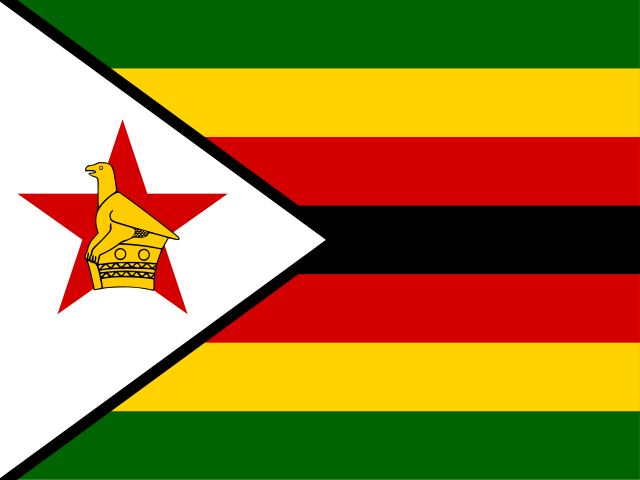 Zimbabwe
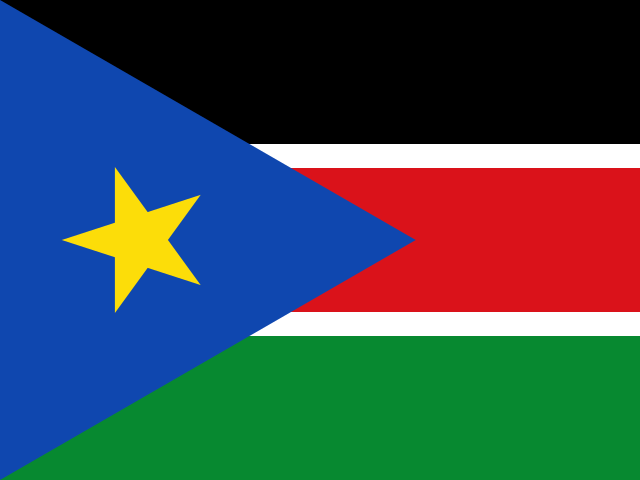 South Sudan
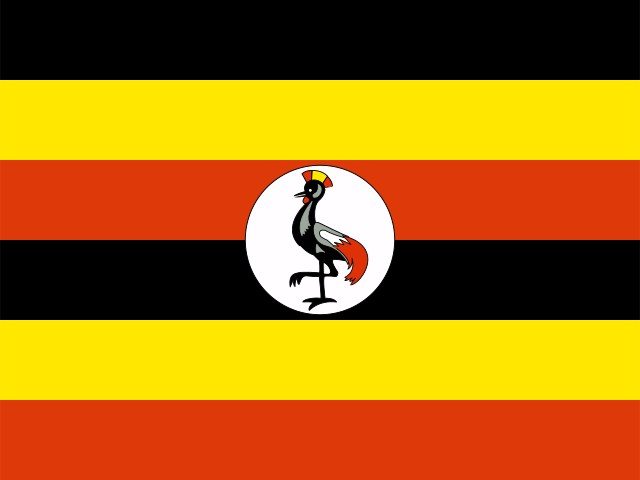 Uganda
 Tanzania
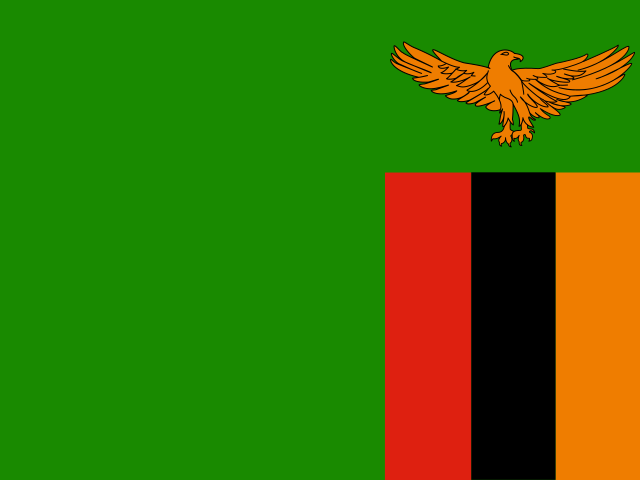 Zambia
Earlier Report Observations
The beef and buffalo meat market in Eastern Africa saw production rise from 2 458 thousand tonnes in 2018 to 2 657 thousand tonnes in 2019, with market volume expanding similarly, despite recurring droughts, foot and mouth disease outbreaks, and cattle theft that constrained local supply and pushed prices higher. This growth was interrupted in 2020 when a ban on cattle transportation from the Ankole sub-region contributed to a decline, reducing production to 2 594 thousand tonnes and market size to 2 600 thousand tonnes.
From 2021 to 2022, the market recovered gradually, reaching 2 690 thousand tonnes of production, though persistent dry spells, high feed costs, and expensive transport continued to pressure supply chains. A significant expansion occurred in 2023, with production jumping to 2 870 thousand tonnes and market volume hitting 2 876 thousand tonnes, driven by rising global demand and increased investment in feedlot systems and commercial farming, which enhanced production capacity and market coordination.
In 2024, industry efforts focused on forming strategic partnerships to improve production sustainability and reduce carbon emissions, while consumer preferences shifted towards healthier, organic, and ethically sourced meat. Government and private sector initiatives aimed to comply with international standards to boost export potential, although no major new production facilities or legislative changes were reported.
Table of content
- 1. Disclaimer
- 2. Terms of use of the report
- 3. Product codes in the statistical classifications used in the report
-
4. Key Market Indicators and Trends
-
4.1. Key Market Indicators
-
4.1.1. In kind
- 4.1.1.1. Production, 2018-2023
- 4.1.1.2. Imports, 2018-2024
- 4.1.1.3. Exports, 2018-2024
- 4.1.1.4. Market size, 2018-2023
-
4.1.1. In kind
- 4.2. Market Trends and Factors
-
4.1. Key Market Indicators
-
5. Production
-
5.1. Production in Eastern Africa
- 5.1.1. Annual dynamics of production in Eastern Africa in kind, 2018-2023, K t
-
5.2. Global production by Country, 2018-2023
- 5.2.1. Annual dynamics of production by macroregions in kind, 2018-2023, K t
- 5.2.2. Dynamics of production structure by macroregions in kind, 2018-2023
- 5.2.3. Annual dynamics of production by country in kind, 2018-2023, K t
- 5.2.4. Structure of production by countries in kind, 2018-2023
- 5.2.5. Dynamics of peoduction structure by countries in kind, 2018-2023
-
5.1. Production in Eastern Africa
-
6. Imports
-
6.1. Imports (Direct Data*)
- 6.1.1. Imports - Total information
-
6.1.2. Imports in kind, t
- 6.1.2.1. Annual dynamics of product's imports to British Indian Ocean Territory in kind, 2018-2024, t
- 6.1.2.2. Dynamics of product's imports in kind to British Indian Ocean Territory by countries, 2018-2024, t
- 6.1.2.3. Structure of product's imports in kind by countries, 2018-2024
-
6.1.3. Imports in value, K $ US
- 6.1.3.1. Annual dynamics of product's imports to British Indian Ocean Territory in value, 2018-2024, K $ US
- 6.1.3.2. Dynamics of product's imports in value to British Indian Ocean Territory by countries, 2018-2024, K $ US
- 6.1.3.3. Structure of product's imports in value by countries, 2018-2024
-
6.1.4. Average price of product's imports, $ US/t
- 6.1.4.1. Annual dynamics of average price of product's imports to British Indian Ocean Territory, 2018-2024, $ US/t
- 6.1.4.2. Dynamics of average price of product's imports to British Indian Ocean Territory by countries, 2018-2024, $ US/t
-
6.2. Imports (Mirror Data)
- 6.2.1. Imports - Total information
-
6.2.2. Imports in kind, t
- 6.2.2.1. Annual dynamics of product's imports to British Indian Ocean Territory in kind, 2018-2024, t
- 6.2.2.2. Dynamics of product's imports in kind to British Indian Ocean Territory by countries, 2018-2024, t
- 6.2.2.3. Structure of product's imports in kind by countries, 2018-2024
-
6.2.3. Imports in value, K $ US
- 6.2.3.1. Annual dynamics of product's imports to British Indian Ocean Territory in value, 2018-2024, K $ US
- 6.2.3.2. Dynamics of product's imports in value to British Indian Ocean Territory by countries, 2018-2024, K $ US
- 6.2.3.3. Structure of product's imports in value by countries, 2018-2024
-
6.2.4. Average price of product's imports, $ US/t
- 6.2.4.1. Annual dynamics of average price of product's imports to British Indian Ocean Territory, 2018-2024, $ US/t
- 6.2.4.2. Dynamics of average price of product's imports to British Indian Ocean Territory by countries, 2018-2024, $ US/t
-
6.1. Imports (Direct Data*)
-
7. Exports
-
7.1. Exports (Direct Data*)
- 7.1.1. Exports - Total information
-
7.1.2. Exports in kind, t
- 7.1.2.1. Annual dynamics of product's exports from British Indian Ocean Territory in kind, 2018-2024, t
- 7.1.2.2. Dynamics of product's exports in kind from British Indian Ocean Territory by countries, 2018-2024, t
- 7.1.2.3. Structure of product's exports in kind by countries, 2018-2024
-
7.1.3. Exports in value, K $ US
- 7.1.3.1. Annual dynamics of product's exports from British Indian Ocean Territory in value, 2018-2024, K $ US
- 7.1.3.2. Dynamics of product's exports in value from British Indian Ocean Territory by countries, 2018-2024, K $ US
- 7.1.3.3. Structure of product's exports in value by countries, 2018-2024
-
7.1.4. Average price of product's exports, $ US/t
- 7.1.4.1. Annual dynamics of average price of product's exports from British Indian Ocean Territory, 2018-2024, $ US/t
- 7.1.4.2. Dynamics of average price of product's exports from British Indian Ocean Territory by countries, 2018-2024, $ US/t
-
7.2. Exports (Mirror Data)
- 7.2.1. Exports - Total information
-
7.2.2. Exports in kind, t
- 7.2.2.1. Annual dynamics of product's exports from British Indian Ocean Territory in kind, 2018-2024, t
- 7.2.2.2. Dynamics of product's exports in kind from British Indian Ocean Territory by countries, 2018-2024, t
- 7.2.2.3. Structure of product's exports in kind by countries, 2018-2024
-
7.2.3. Exports in value, K $ US
- 7.2.3.1. Annual dynamics of product's exports from British Indian Ocean Territory in value, 2018-2024, K $ US
- 7.2.3.2. Dynamics of product's exports in value from British Indian Ocean Territory by countries, 2018-2024, K $ US
- 7.2.3.3. Structure of product's exports in value by countries, 2018-2024
-
7.2.4. Average price of product's exports, $ US/t
- 7.2.4.1. Annual dynamics of average price of product's exports from British Indian Ocean Territory, 2018-2024, $ US/t
- 7.2.4.2. Dynamics of average price of product's exports from British Indian Ocean Territory by countries, 2018-2024, $ US/t
-
7.1. Exports (Direct Data*)
-
8. Trade balance
-
8.1. Trade balance (Direct Data)
- 8.1.1. In kind, t
- 8.1.2. In value, K $ US
-
8.2. Trade balance (Mirror Data)
- 8.2.1. In kind, t
- 8.2.2. In value, K $ US
-
8.1. Trade balance (Direct Data)
-
9. Top buying and selling countries, 2018-2024
-
9.1. Direct Data
- 9.1.1. Import in Value by Countries-buyers
- 9.1.2. Export in Value by Countries-suppliers
-
9.2. Mirror Data
- 9.2.1. Import in Value by Countries-buyers
- 9.2.2. Export in Value by Countries-suppliers
-
9.1. Direct Data
Production beef and buffalo meat in Eastern Africa
In kind, 2017-2020, K t
Top producers of beef and buffalo meat, 2017-2020
World map of production of beef and buffalo meat, 2017-2020
Beef and buffalo meat production in Eastern Africa saw a two-year increase before declining. In 2020, production reached 2 594 K t, representing a 2.4% decrease from the previous year. Over the period from 2017 to 2020, production grew by 10.6%, which translates to an annualized rate of 3.4%. The highest production level was recorded in 2019 at 2 657 K t, with the largest annual increase of 8.1% also occurring that year.
Annual dynamics of production in Eastern Africa in kind, 2017-2020, K t
| Parameter | 2018 | 2019 | 2020 | CAGR | |
|---|---|---|---|---|---|
| 1 | Change from last year | 4.8% | 8.1% | (2.4%) | 3.4% |
Exports beef and buffalo meat from Eastern Africa
Exports in kind, t
The market exhibited significant volatility during these years. In 2019, exports hit their lowest point at 1 510 t, while the peak was reached in 2018 with 4 626 t, resulting in a 3.1-fold difference between these extremes. In 2020, Eastern Africa exported 1 796 t of beef and buffalo meat, marking an 18.9% increase compared to the previous year. The largest decline occurred in 2019 at 67.3%, whereas the largest increase was recorded in 2018 at 21.8%.
Annual dynamics of product's exports from Eastern Africa in kind, 2017-2020, t
| Parameter | 2018 | 2019 | 2020 | CAGR | |
|---|---|---|---|---|---|
| 1 | Change from last year | 21.8% | (67.3%) | 18.9% | (22.1%) |
From 2017 to 2020, beef and buffalo meat exports from Eastern Africa were not heavily concentrated among a few key destinations. The United Arab Emirates accounted for 28.5% of exports in kind, Vietnam for 10.9%, and Bahrain for 9.6%. Together, these three countries represented just 49.0% of total export flows.
Structure of product's exports in kind by countries, 2017-2020
World map of product's exports from Eastern Africa in kind, 2017-2020
Exports in value, K $ US
Beef and buffalo meat exports from Eastern Africa declined for the second year in a row. In 2020, exports totaled 7 017 K $ US, a 31.8% drop from 2019. Over the 2017-2020 period, exports decreased by 57.2%, with a compound annual growth rate of -24.7%. The highest value was recorded in 2018 at 18 656 K $ US. The largest decline occurred in 2019 at 44.9%, while the largest increase was in 2018 at 13.7%.
Annual dynamics of product's exports from Eastern Africa in value, 2017-2020, K $ US
| Parameter | 2018 | 2019 | 2020 | CAGR | |
|---|---|---|---|---|---|
| 1 | Change from last year | 13.7% | (44.9%) | (31.8%) | (24.7%) |
Between 2017 and 2020, beef and buffalo meat exports from Eastern Africa in value terms were not highly concentrated. The United Arab Emirates contributed 27.3% of exports in value terms, the Democratic Republic of the Congo 10.4%, and Bahrain 9.2%. Collectively, these three destinations accounted for only 46.8% of total export flows.
Structure of product's exports in value by countries, 2017-2020
World map of product's exports from Eastern Africa in value, 2017-2020
Imports beef and buffalo meat to Eastern Africa
Imports in kind, t
Beef and buffalo meat imports into Eastern Africa declined for the second consecutive year. In 2020, imports stood at 7 911 t, showing a significant decrease of 12.3% from 2019. Over the 2017-2020 period, imports fell by 9%, with a compound annual growth rate of -3.1%. The peak was recorded in 2018 at 9 659 t, with the largest increase of 11.1% also occurring that year.
Annual dynamics of product's imports to Eastern Africa in kind, 2017-2020, t
| Parameter | 2018 | 2019 | 2020 | CAGR | |
|---|---|---|---|---|---|
| 1 | Change from last year | 11.1% | (6.6%) | (12.3%) | (3.1%) |
From 2017 to 2020, the main sources for beef and buffalo meat imports into Eastern Africa in kind were India with 38.5%, South Africa with 27.9%, and Australia with 10.1%. Together, these three countries accounted for 76.6% of total import flows.
Structure of product's imports in kind by countries, 2017-2020
World map of product's imports to Eastern Africa in kind, 2017-2020
Imports in value, K $ US
Eastern Africa's beef and buffalo meat imports declined for the second year in a row. In 2020, imports amounted to 35 732 K $ US, which is 13.9% lower than in 2019. Between 2017 and 2020, imports decreased by 16.5%, equating to an annualized rate of -5.8%. The highest value was recorded in 2018 at 45 915 K $ US, with the largest increase of 7.3% also occurring that year.
Annual dynamics of product's imports to Eastern Africa in value, 2017-2020, K $ US
| Parameter | 2018 | 2019 | 2020 | CAGR | |
|---|---|---|---|---|---|
| 1 | Change from last year | 7.3% | (9.6%) | (13.9%) | (5.8%) |
Over the 2017-2020 period, the primary suppliers of beef and buffalo meat to Eastern Africa in value terms were South Africa with 33.9%, India with 27.2%, and Australia with 19.9%. These three countries jointly accounted for 81.0% of total imports in value terms.
Structure of product's imports in value by countries, 2017-2020
World map of product's imports to Eastern Africa in value, 2017-2020
Related Reports

Beef and buffalo meat market in Madagascar
2026-03-30
Beef and buffalo meat market in Laos
2026-03-30
Beef and buffalo meat market in Bangladesh
2026-03-30

Pig offal market in Eastern Africa
2026-03-30


Sheep and goat meat market in Eastern Africa
2026-03-27

Why Choose Us?
Only Verified Data
No Hidden Costs or Separate Fees
Smarter Subscription Pricing
Contact Our Team
Submit your inquiry using the form below — our team will get back to you within 24 hours.