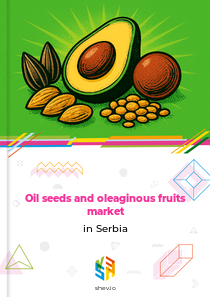







Earlier Report Observations
The market for oil seeds and oleaginous fruits in Serbia contracted significantly from 4,797 t in 2018 to 1,663 t in 2022, before recovering to 2,216 t in 2023. This overall decline was primarily driven by the disruptive impact of the COVID-19 pandemic on supply chains and consumption, followed by the implementation of stricter EU-aligned labeling and traceability regulations that affected market access and production volumes.
The pandemic in 2020 caused logistical challenges and altered consumer habits, reducing overall market volume. Regulatory tightening in 2021, including enhanced origin-tracking requirements, created additional compliance barriers for producers and importers, further compressing the market. These pressures coincided with a shift in consumer preference toward organic and locally sourced products, which stimulated niche segment growth but did not offset the broader contraction.
By 2023, the market showed recovery, increasing to 2,216 t, as the industry adapted to the new regulatory environment. State-owned companies played a key role in stabilizing supply and focusing on export strategies amid evolving geopolitical conditions, supporting the market's partial rebound.
Table of content
- 1. Disclaimer
- 2. Terms of use of the report
- 3. Product codes in the statistical classifications used in the report
-
4. Key Market Indicators and Trends
-
4.1. Key Market Indicators
-
4.1.1. In kind
- 4.1.1.1. Production, 2018-2023
- 4.1.1.2. Imports, 2018-2024
- 4.1.1.3. Exports, 2018-2024
- 4.1.1.4. Market size, 2018-2023
-
4.1.1. In kind
- 4.2. Market Trends and Factors
-
4.1. Key Market Indicators
-
5. Production
-
5.1. Production in Serbia
- 5.1.1. Annual dynamics of production in Serbia in kind, 2018-2023, t
- 5.1.2. Annual dynamics of production in Serbia in value, 2018-2023, $ US
-
5.2. Global production by Country, 2018-2023
- 5.2.1. Annual dynamics of production by macroregions in kind, 2018-2023, t
- 5.2.2. Dynamics of production structure by macroregions in kind, 2018-2023
- 5.2.3. Annual dynamics of production by country in kind, 2018-2023, t
- 5.2.4. Structure of production by countries in kind, 2018-2023
- 5.2.5. Dynamics of peoduction structure by countries in kind, 2018-2023
-
5.1. Production in Serbia
-
6. Exports
-
6.1. Exports (Direct Data)
- 6.1.1. Exports - Total information
-
6.1.2. Exports in kind, t
- 6.1.2.1. Annual dynamics of product's exports from Serbia in kind, 2018-2024, t
- 6.1.2.2. Dynamics of product's exports in kind from Serbia by countries, 2018-2024, t
- 6.1.2.3. Structure of product's exports in kind by countries, 2018-2024
-
6.1.3. Exports in value, K $ US
- 6.1.3.1. Annual dynamics of product's exports from Serbia in value, 2018-2024, K $ US
- 6.1.3.2. Dynamics of product's exports in value from Serbia by countries, 2018-2024, K $ US
- 6.1.3.3. Structure of product's exports in value by countries, 2018-2024
-
6.1.4. Average price of product's exports, $ US/t
- 6.1.4.1. Annual dynamics of average price of product's exports from Serbia, 2018-2024, $ US/t
- 6.1.4.2. Dynamics of average price of product's exports from Serbia by countries, 2018-2024, $ US/t
-
6.2. Exports (Mirror Data)
- 6.2.1. Exports - Total information
-
6.2.2. Exports in kind, t
- 6.2.2.1. Annual dynamics of product's exports from Serbia in kind, 2018-2024, t
- 6.2.2.2. Dynamics of product's exports in kind from Serbia by countries, 2018-2024, t
- 6.2.2.3. Structure of product's exports in kind by countries, 2018-2024
-
6.2.3. Exports in value, K $ US
- 6.2.3.1. Annual dynamics of product's exports from Serbia in value, 2018-2024, K $ US
- 6.2.3.2. Dynamics of product's exports in value from Serbia by countries, 2018-2024, K $ US
- 6.2.3.3. Structure of product's exports in value by countries, 2018-2024
-
6.2.4. Average price of product's exports, $ US/t
- 6.2.4.1. Annual dynamics of average price of product's exports from Serbia, 2018-2024, $ US/t
- 6.2.4.2. Dynamics of average price of product's exports from Serbia by countries, 2018-2024, $ US/t
-
6.1. Exports (Direct Data)
-
7. Imports
-
7.1. Imports (Direct Data)
- 7.1.1. Imports - Total information
-
7.1.2. Imports in kind, t
- 7.1.2.1. Annual dynamics of product's imports to Serbia in kind, 2018-2024, t
- 7.1.2.2. Dynamics of product's imports in kind to Serbia by countries, 2018-2024, t
- 7.1.2.3. Structure of product's imports in kind by countries, 2018-2024
-
7.1.3. Imports in value, K $ US
- 7.1.3.1. Annual dynamics of product's imports to Serbia in value, 2018-2024, K $ US
- 7.1.3.2. Dynamics of product's imports in value to Serbia by countries, 2018-2024, K $ US
- 7.1.3.3. Structure of product's imports in value by countries, 2018-2024
-
7.1.4. Average price of product's imports, $ US/t
- 7.1.4.1. Annual dynamics of average price of product's imports to Serbia, 2018-2024, $ US/t
- 7.1.4.2. Dynamics of average price of product's imports to Serbia by countries, 2018-2024, $ US/t
-
7.2. Imports (Mirror Data)
- 7.2.1. Imports - Total information
-
7.2.2. Imports in kind, t
- 7.2.2.1. Annual dynamics of product's imports to Serbia in kind, 2018-2024, t
- 7.2.2.2. Dynamics of product's imports in kind to Serbia by countries, 2018-2024, t
- 7.2.2.3. Structure of product's imports in kind by countries, 2018-2024
-
7.2.3. Imports in value, K $ US
- 7.2.3.1. Annual dynamics of product's imports to Serbia in value, 2018-2024, K $ US
- 7.2.3.2. Dynamics of product's imports in value to Serbia by countries, 2018-2024, K $ US
- 7.2.3.3. Structure of product's imports in value by countries, 2018-2024
-
7.2.4. Average price of product's imports, $ US/t
- 7.2.4.1. Annual dynamics of average price of product's imports to Serbia, 2018-2024, $ US/t
- 7.2.4.2. Dynamics of average price of product's imports to Serbia by countries, 2018-2024, $ US/t
-
7.1. Imports (Direct Data)
-
8. Trade balance
-
8.1. Trade balance (Direct Data)
- 8.1.1. In kind, t
- 8.1.2. In value, K $ US
-
8.2. Trade balance (Mirror Data)
- 8.2.1. In kind, t
- 8.2.2. In value, K $ US
-
8.1. Trade balance (Direct Data)
-
9. Top buying and selling countries, 2018-2024
-
9.1. Direct Data
- 9.1.1. Import in Value by Countries-buyers
- 9.1.2. Export in Value by Countries-suppliers
-
9.2. Mirror Data
- 9.2.1. Import in Value by Countries-buyers
- 9.2.2. Export in Value by Countries-suppliers
-
9.1. Direct Data
Production oil seeds and oleaginous fruits in Serbia
In kind, 2017-2020, t
Top producers of oil seeds and oleaginous fruits, 2017-2020
World map of production of oil seeds and oleaginous fruits, 2017-2020
The market exhibited significant volatility during these years. Production reached its lowest point in 2017, then peaked in 2018 with a 1.7-fold increase between these two years. In 2020, Serbia produced 2 738 tonnes of oil seeds and oleaginous fruits, marking a 1.8% year-over-year decline. The highest production volume was recorded in 2018 at 3 140 tonnes. The largest annual decrease occurred in 2019 with an 11.2% drop, while the biggest increase was seen in 2018 with a substantial 70.2% rise.
Annual dynamics of production in Serbia in kind, 2017-2020, t
| Parameter | 2018 | 2019 | 2020 | CAGR | |
|---|---|---|---|---|---|
| 1 | Change from last year | 70.2% | (11.2%) | (1.8%) | 14.1% |
Exports oil seeds and oleaginous fruits from Serbia
Exports in kind, t
The market demonstrated notable volatility throughout the observed period. Export volumes hit their lowest point in 2019, then surged to a peak in 2020, representing a 5.6-fold increase between these years. In 2020, Serbia exported 672 tonnes of oil seeds and oleaginous fruits, showing a dramatic 455.1% increase compared to the previous year. The minimum export volume was recorded in 2019 at just 121 tonnes. The most significant decline occurred in 2019 with a 48.1% drop.
Annual dynamics of product's exports from Serbia in kind, 2017-2020, t
| Parameter | 2018 | 2019 | 2020 | CAGR | |
|---|---|---|---|---|---|
| 1 | Change from last year | 15.3% | (48.1%) | 455.1% | 49.2% |
From 2017 to 2020, Hungary (40.1% of exports in kind), Germany (30.1% of exports in kind), and Montenegro (9.9% of exports in kind) consistently held the top positions in Serbia's export structure for oil seeds and oleaginous fruits. Together, these three countries accounted for 80.0% of total export flows during this period.
Structure of product's exports in kind by countries, 2017-2020
World map of product's exports from Serbia in kind, 2017-2020
Exports in value, K $ US
The market experienced noticeable fluctuations during this period. Export values reached their lowest point in 2019, then climbed to a peak in 2020, representing a 3.6-fold increase between these years. In 2020, Serbia exported oil seeds and oleaginous fruits worth 1 131 thousand US dollars, reflecting a substantial 255.7% increase year-over-year. The minimum export value was recorded in 2019 at 318 thousand US dollars. The most significant decline occurred in 2019 with a 16.2% decrease.
Annual dynamics of product's exports from Serbia in value, 2017-2020, K $ US
| Parameter | 2018 | 2019 | 2020 | CAGR | |
|---|---|---|---|---|---|
| 1 | Change from last year | 16.4% | (16.2%) | 255.7% | 51.4% |
Between 2017 and 2020, Hungary (34.1% of exports in value terms), Germany (20.5% of exports in value terms), and Montenegro (17.6% of exports in value terms) remained the leading buyers of Serbian oil seeds and oleaginous fruits. Collectively, these three markets accounted for 72.3% of total export value during this four-year period.
Structure of product's exports in value by countries, 2017-2020
World map of product's exports from Serbia in value, 2017-2020
Imports oil seeds and oleaginous fruits to Serbia
Imports in kind, t
Following two consecutive years of growth, Serbia's imports of oil seeds and oleaginous fruits declined. In 2020, import volume reached 1 469 tonnes, representing a 27.3% decrease compared to the previous year. Over the 2017-2020 period, imports decreased by 11.5%, with a compound annual growth rate of 4.0%. The highest import volume was recorded in 2019 at 2 020 tonnes. The largest annual increase occurred in 2018 with a 13.9% rise.
Annual dynamics of product's imports to Serbia in kind, 2017-2020, t
| Parameter | 2018 | 2019 | 2020 | CAGR | |
|---|---|---|---|---|---|
| 1 | Change from last year | 13.9% | 6.9% | (27.3%) | (4.0%) |
From 2017 to 2020, Ukraine (45.5% of imports in kind), Hungary (18.1% of imports in kind), and China (13.5% of imports in kind) were the primary sources for Serbia's imports of oil seeds and oleaginous fruits. Together, these three countries supplied 77.1% of total import flows during this period.
Structure of product's imports in kind by countries, 2017-2020
World map of product's imports to Serbia in kind, 2017-2020
Imports in value, K $ US
After two years of consecutive growth, Serbia's imports of oil seeds and oleaginous fruits declined in value terms. In 2020, imports amounted to 3 725 thousand US dollars, reflecting a significant 23.8% decrease compared to the previous year. Over the 2017-2020 period, import values increased by 12.4%, with a compound annual growth rate of 4.0%. The highest import value was recorded in 2019 at 4 888 thousand US dollars. The largest annual increase occurred in 2018 with a substantial 46.1% rise.
Annual dynamics of product's imports to Serbia in value, 2017-2020, K $ US
| Parameter | 2018 | 2019 | 2020 | CAGR | |
|---|---|---|---|---|---|
| 1 | Change from last year | 46.1% | 1.0% | (23.8%) | 4.0% |
Between 2017 and 2020, Ukraine (43.1% of imports in value terms), Hungary (20.7% of imports in value terms), and China (15.2% of imports in value terms) formed the core group of markets for Serbia's imports of oil seeds and oleaginous fruits. Collectively, these three sources accounted for 78.9% of total import value during this four-year period.
Structure of product's imports in value by countries, 2017-2020
World map of product's imports to Serbia in value, 2017-2020
Related Reports
2026-03-28

Primary sugar crops market in Serbia
2026-03-30

Sunflower seeds market in Serbia
2026-03-28

2026-03-28
Why Choose Us?
Only Verified Data
No Hidden Costs or Separate Fees
Smarter Subscription Pricing
Contact Our Team
Submit your inquiry using the form below — our team will get back to you within 24 hours.