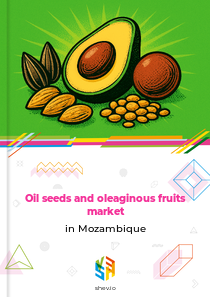







Earlier Report Observations
Between 2018 and 2020, the market volume for oil seeds and oleaginous fruits in Mozambique gradually declined from 32.2 thousand tons to 31.5 thousand tons, while production eased from 32.3 thousand tons to 31.7 thousand tons. This period saw foundational efforts to bolster the sector, including the launch of the Oleaginous Production Program to reduce import dependency and the provision of subsidized credit for seed imports and agricultural campaigns. Concurrently, a significant increase in the use of fertilizers and pesticides, alongside growing output of certified seeds in key provinces, helped sustain the production base against the downward trend.
A sharp contraction occurred in 2021, with market volume falling to 29.1 thousand tons. This was primarily driven by a spike in exports, which leapt to 2.2 thousand tons. The surge was facilitated by the SUSTENTA program, which stimulated demand and production of certified seeds, leading to an output of around 12 thousand tons in the 2021-2022 season. The Institute of Cotton and Oilseeds (IAOM) also prioritized seed certification and production during this period, enhancing the quality and quantity available for export.
Market volume recovered to 30.5 thousand tons by 2023, supported by a normalization of exports and stronger domestic value chains. Increased private sector participation was evident in the growing seed business for crops like maize, rice, cowpeas, and soy. Investments in modern processing technology, such as new factories in Mocuba, and the expansion of financing mechanisms like the Agricultural Marketing Revolving Fund (FRCA) and Agricultural Marketing Credit Line (LCCA) improved commercialization and processing capacity, fostering greater market stability.
Table of content
- 1. Disclaimer
- 2. Terms of use of the report
- 3. Product codes in the statistical classifications used in the report
-
4. Key Market Indicators and Trends
-
4.1. Key Market Indicators
-
4.1.1. In kind
- 4.1.1.1. Production, 2018-2023
- 4.1.1.2. Imports, 2018-2024
- 4.1.1.3. Exports, 2018-2024
- 4.1.1.4. Market size, 2018-2023
-
4.1.1. In kind
- 4.2. Market Trends and Factors
-
4.1. Key Market Indicators
-
5. Production
-
5.1. Production in Mozambique
- 5.1.1. Annual dynamics of production in Mozambique in kind, 2018-2023, t
- 5.1.2. Annual dynamics of production in Mozambique in value, 2018-2023, $ US
-
5.2. Global production by Country, 2018-2023
- 5.2.1. Annual dynamics of production by macroregions in kind, 2018-2023, t
- 5.2.2. Dynamics of production structure by macroregions in kind, 2018-2023
- 5.2.3. Annual dynamics of production by country in kind, 2018-2023, t
- 5.2.4. Structure of production by countries in kind, 2018-2023
- 5.2.5. Dynamics of peoduction structure by countries in kind, 2018-2023
-
5.1. Production in Mozambique
-
6. Imports
-
6.1. Imports (Direct Data)
- 6.1.1. Imports - Total information
-
6.1.2. Imports in kind, t
- 6.1.2.1. Annual dynamics of product's imports to Mozambique in kind, 2018-2024, t
- 6.1.2.2. Dynamics of product's imports in kind to Mozambique by countries, 2018-2024, t
- 6.1.2.3. Structure of product's imports in kind by countries, 2018-2024
-
6.1.3. Imports in value, K $ US
- 6.1.3.1. Annual dynamics of product's imports to Mozambique in value, 2018-2024, K $ US
- 6.1.3.2. Dynamics of product's imports in value to Mozambique by countries, 2018-2024, K $ US
- 6.1.3.3. Structure of product's imports in value by countries, 2018-2024
-
6.1.4. Average price of product's imports, $ US/kg
- 6.1.4.1. Annual dynamics of average price of product's imports to Mozambique, 2018-2024, $ US/kg
- 6.1.4.2. Dynamics of average price of product's imports to Mozambique by countries, 2018-2024, $ US/kg
-
6.2. Imports (Mirror Data)
- 6.2.1. Imports - Total information
-
6.2.2. Imports in kind, t
- 6.2.2.1. Annual dynamics of product's imports to Mozambique in kind, 2018-2024, t
- 6.2.2.2. Dynamics of product's imports in kind to Mozambique by countries, 2018-2024, t
- 6.2.2.3. Structure of product's imports in kind by countries, 2018-2024
-
6.2.3. Imports in value, K $ US
- 6.2.3.1. Annual dynamics of product's imports to Mozambique in value, 2018-2024, K $ US
- 6.2.3.2. Dynamics of product's imports in value to Mozambique by countries, 2018-2024, K $ US
- 6.2.3.3. Structure of product's imports in value by countries, 2018-2024
-
6.2.4. Average price of product's imports, $ US/kg
- 6.2.4.1. Annual dynamics of average price of product's imports to Mozambique, 2018-2024, $ US/kg
- 6.2.4.2. Dynamics of average price of product's imports to Mozambique by countries, 2018-2024, $ US/kg
-
6.1. Imports (Direct Data)
-
7. Exports
-
7.1. Exports (Direct Data)
- 7.1.1. Exports - Total information
-
7.1.2. Exports in kind, t
- 7.1.2.1. Annual dynamics of product's exports from Mozambique in kind, 2018-2024, t
- 7.1.2.2. Dynamics of product's exports in kind from Mozambique by countries, 2018-2024, t
- 7.1.2.3. Structure of product's exports in kind by countries, 2018-2024
-
7.1.3. Exports in value, K $ US
- 7.1.3.1. Annual dynamics of product's exports from Mozambique in value, 2018-2024, K $ US
- 7.1.3.2. Dynamics of product's exports in value from Mozambique by countries, 2018-2024, K $ US
- 7.1.3.3. Structure of product's exports in value by countries, 2018-2024
-
7.1.4. Average price of product's exports, $ US/kg
- 7.1.4.1. Annual dynamics of average price of product's exports from Mozambique, 2018-2024, $ US/kg
- 7.1.4.2. Dynamics of average price of product's exports from Mozambique by countries, 2018-2024, $ US/kg
-
7.2. Exports (Mirror Data)
- 7.2.1. Exports - Total information
-
7.2.2. Exports in kind, t
- 7.2.2.1. Annual dynamics of product's exports from Mozambique in kind, 2018-2024, t
- 7.2.2.2. Dynamics of product's exports in kind from Mozambique by countries, 2018-2024, t
- 7.2.2.3. Structure of product's exports in kind by countries, 2018-2024
-
7.2.3. Exports in value, K $ US
- 7.2.3.1. Annual dynamics of product's exports from Mozambique in value, 2018-2024, K $ US
- 7.2.3.2. Dynamics of product's exports in value from Mozambique by countries, 2018-2024, K $ US
- 7.2.3.3. Structure of product's exports in value by countries, 2018-2024
-
7.2.4. Average price of product's exports, $ US/kg
- 7.2.4.1. Annual dynamics of average price of product's exports from Mozambique, 2018-2024, $ US/kg
- 7.2.4.2. Dynamics of average price of product's exports from Mozambique by countries, 2018-2024, $ US/kg
-
7.1. Exports (Direct Data)
-
8. Trade balance
-
8.1. Trade balance (Direct Data)
- 8.1.1. In kind, t
- 8.1.2. In value, K $ US
-
8.2. Trade balance (Mirror Data)
- 8.2.1. In kind, t
- 8.2.2. In value, K $ US
-
8.1. Trade balance (Direct Data)
-
9. Top buying and selling countries, 2018-2024
-
9.1. Direct Data
- 9.1.1. Import in Value by Countries-buyers
- 9.1.2. Export in Value by Countries-suppliers
-
9.2. Mirror Data
- 9.2.1. Import in Value by Countries-buyers
- 9.2.2. Export in Value by Countries-suppliers
-
9.1. Direct Data
Production oil seeds and oleaginous fruits in Mozambique
In kind, 2017-2020, t
Between 2017 and 2020, Mozambique ranked 27th globally in the production of oil seeds and oleaginous fruits.
Top producers of oil seeds and oleaginous fruits, 2017-2020
World map of production of oil seeds and oleaginous fruits, 2017-2020
Mozambique's production of oil seeds and oleaginous fruits declined for the second year in a row. In 2020, the country produced 31 720 tonnes, which was 1.1% lower than in 2019. Production peaked in 2018 at 32 345 tonnes, marking the largest annual increase of 3.9%.
Annual dynamics of production in Mozambique in kind, 2017-2020, t
| Parameter | 2018 | 2019 | 2020 | CAGR | |
|---|---|---|---|---|---|
| 1 | Change from last year | 3.9% | (0.8%) | (1.1%) | 0.6% |
Exports oil seeds and oleaginous fruits from Mozambique
Exports in kind, t
The market experienced noticeable fluctuations during this period. Exports dropped to a low of 171 tonnes in 2018, which was 94.9% lower than the previous year. They then rebounded sharply in 2019, increasing by 77.7%. In 2020, Mozambique exported 279 tonnes, representing a moderate decrease of 8.2% from 2019.
Annual dynamics of product's exports from Mozambique in kind, 2017-2020, t
| Parameter | 2018 | 2019 | 2020 | CAGR | |
|---|---|---|---|---|---|
| 1 | Change from last year | (94.9%) | 77.7% | (8.2%) | (56.4%) |
From 2017 to 2020, China and Japan were the dominant destinations for Mozambique's exports of oil seeds and oleaginous fruits in kind, jointly accounting for 85.2% of total flows. The remaining volume was distributed among smaller markets.
Structure of product's exports in kind by countries, 2017-2020
World map of product's exports from Mozambique in kind, 2017-2020
Exports in value, K $ US
The market exhibited significant volatility during these years. Export values fell to a low of 49 000 US dollars in 2019, which was 92.2% lower than in 2018. In 2020, exports rebounded to 53 000 US dollars, up by 8.3% year-on-year.
Annual dynamics of product's exports from Mozambique in value, 2017-2020, K $ US
| Parameter | 2018 | 2019 | 2020 | CAGR | |
|---|---|---|---|---|---|
| 1 | Change from last year | (92.2%) | (82.0%) | 8.3% | (75.2%) |
Over the 2017–2020 period, China and Japan consistently accounted for 95.7% of Mozambique's total export value for oil seeds and oleaginous fruits, indicating a highly concentrated market with a long tail of smaller participants.
Structure of product's exports in value by countries, 2017-2020
World map of product's exports from Mozambique in value, 2017-2020
Imports oil seeds and oleaginous fruits to Mozambique
Imports in kind, t
Import volumes showed considerable volatility. They reached a peak of 83 tonnes in 2019, which was a dramatic increase of 1 492.4% from the previous year. However, imports then fell sharply to 30 tonnes in 2020, down by 63.9% compared to 2019, after hitting a low of 5 tonnes in 2018 with a decline of 79.1%.
Annual dynamics of product's imports to Mozambique in kind, 2017-2020, t
| Parameter | 2018 | 2019 | 2020 | CAGR | |
|---|---|---|---|---|---|
| 1 | Change from last year | (79.1%) | 1 492.4% | (63.9%) | 6.3% |
Between 2017 and 2020, South Africa and Portugal were the dominant suppliers of oil seeds and oleaginous fruits to Mozambique in kind, together accounting for 93.8% of total imports. Other sources each held relatively small shares.
Structure of product's imports in kind by countries, 2017-2020
World map of product's imports to Mozambique in kind, 2017-2020
Imports in value, K $ US
The import market demonstrated volatility over the observed period. Values dropped to a low of 11 000 US dollars in 2018, declining by 76.6%. They then surged by 586.8% in 2019 before reaching 156 000 US dollars in 2020, up by 114.1% from the previous year.
Annual dynamics of product's imports to Mozambique in value, 2017-2020, K $ US
| Parameter | 2018 | 2019 | 2020 | CAGR | |
|---|---|---|---|---|---|
| 1 | Change from last year | (76.6%) | 586.8% | 114.1% | 51.1% |
Throughout 2017–2020, South Africa (48.6% of import value), the Netherlands (26.9%), and Portugal (20.5%) remained the key sources for Mozambique's imports of oil seeds and oleaginous fruits in value terms, collectively accounting for 96.0% of total flows.
Structure of product's imports in value by countries, 2017-2020
World map of product's imports to Mozambique in value, 2017-2020
Related Reports


Cotton seeds market in Mozambique
2026-03-28

Castor seeds market in Mozambique
2026-03-28
2026-03-28

Primary sugar crops market in Mozambique
2026-03-30
Why Choose Us?
Only Verified Data
No Hidden Costs or Separate Fees
Smarter Subscription Pricing
Contact Our Team
Submit your inquiry using the form below — our team will get back to you within 24 hours.