






"Eastern Africa" region includes following countries:
 British Indian Ocean Territory
 Burundi
 Comoros
 Mayotte
 Ethiopia
 Eritrea
 French Southern Territories
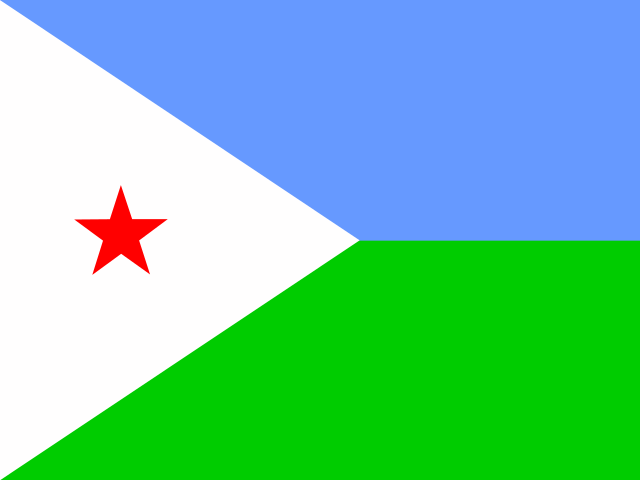 Djibouti
 Kenya
Kenya Madagascar
 Malawi
 Mauritius
 Mozambique
 Reunion
 Rwanda
 Seychelles
 Somalia
 Zimbabwe
 South Sudan
 Uganda
 Tanzania
 Zambia
Earlier Report Observations
The market for nutmeg, mace and cardamoms in Eastern Africa saw its volume decrease from 1 433 t in 2018 to 1 186 t in 2020. During this period, the sector experienced new investments in processing capacity, including the launch of a state-of-the-art macadamia processing factory in Kenya. A government ban on raw nut exports aimed to boost local value addition. However, quality challenges emerged, with over 60% of nuts failing to meet global standards, and tighter European Union import regulations affected market access.
From 2021 to 2022, market volume further contracted to 1 078 t. High input costs for farmers pressured production economics. Export patterns shifted notably, with increased direct shipments of unprocessed nuts to China, which prompted concerns from traditional buyers in Europe and the USA. The industry association urged the government to reinstate a ban on unprocessed exports to safeguard market reputation and farmer incomes.
A sharp recovery followed in 2023, with market volume jumping to 1 404 t. The Kenyan Ministry of Agriculture released specific harvesting and export guidelines to address quality issues and immature nut exports, helping stabilize trade. Strong demand, supported by over 30 local processing industries buying for export, met with limited production capacity, pushing prices upward. In 2024, the sector's growth continued, bolstered by government support for local processing and rising consumer demand for health-oriented superfoods.
Table of content
- 1. Disclaimer
- 2. Terms of use of the report
- 3. Product codes in the statistical classifications used in the report
-
4. Key Market Indicators and Trends
-
4.1. Key Market Indicators
-
4.1.1. In kind
- 4.1.1.1. Production, 2018-2023
- 4.1.1.2. Imports, 2018-2024
- 4.1.1.3. Exports, 2018-2024
- 4.1.1.4. Market size, 2018-2023
-
4.1.1. In kind
- 4.2. Market Trends and Factors
-
4.1. Key Market Indicators
-
5. Production
-
5.1. Production in Eastern Africa
- 5.1.1. Annual dynamics of production in Eastern Africa in kind, 2018-2023, t
-
5.2. Global production by Country, 2018-2023
- 5.2.1. Annual dynamics of production by macroregions in kind, 2018-2023, t
- 5.2.2. Dynamics of production structure by macroregions in kind, 2018-2023
- 5.2.3. Annual dynamics of production by country in kind, 2018-2023, t
- 5.2.4. Structure of production by countries in kind, 2018-2023
- 5.2.5. Dynamics of peoduction structure by countries in kind, 2018-2023
-
5.1. Production in Eastern Africa
-
6. Imports
-
6.1. Imports (Direct Data*)
- 6.1.1. Imports - Total information
-
6.1.2. Imports in kind, t
- 6.1.2.1. Annual dynamics of product's imports to British Indian Ocean Territory in kind, 2018-2024, t
- 6.1.2.2. Dynamics of product's imports in kind to British Indian Ocean Territory by countries, 2018-2024, t
- 6.1.2.3. Structure of product's imports in kind by countries, 2018-2024
-
6.1.3. Imports in value, K $ US
- 6.1.3.1. Annual dynamics of product's imports to British Indian Ocean Territory in value, 2018-2024, K $ US
- 6.1.3.2. Dynamics of product's imports in value to British Indian Ocean Territory by countries, 2018-2024, K $ US
- 6.1.3.3. Structure of product's imports in value by countries, 2018-2024
-
6.1.4. Average price of product's imports, $ US/kg
- 6.1.4.1. Annual dynamics of average price of product's imports to British Indian Ocean Territory, 2018-2024, $ US/kg
- 6.1.4.2. Dynamics of average price of product's imports to British Indian Ocean Territory by countries, 2018-2024, $ US/kg
-
6.2. Imports (Mirror Data)
- 6.2.1. Imports - Total information
-
6.2.2. Imports in kind, t
- 6.2.2.1. Annual dynamics of product's imports to British Indian Ocean Territory in kind, 2018-2024, t
- 6.2.2.2. Dynamics of product's imports in kind to British Indian Ocean Territory by countries, 2018-2024, t
- 6.2.2.3. Structure of product's imports in kind by countries, 2018-2024
-
6.2.3. Imports in value, K $ US
- 6.2.3.1. Annual dynamics of product's imports to British Indian Ocean Territory in value, 2018-2024, K $ US
- 6.2.3.2. Dynamics of product's imports in value to British Indian Ocean Territory by countries, 2018-2024, K $ US
- 6.2.3.3. Structure of product's imports in value by countries, 2018-2024
-
6.2.4. Average price of product's imports, $ US/kg
- 6.2.4.1. Annual dynamics of average price of product's imports to British Indian Ocean Territory, 2018-2024, $ US/kg
- 6.2.4.2. Dynamics of average price of product's imports to British Indian Ocean Territory by countries, 2018-2024, $ US/kg
-
6.1. Imports (Direct Data*)
-
7. Exports
-
7.1. Exports (Direct Data*)
- 7.1.1. Exports - Total information
-
7.1.2. Exports in kind, t
- 7.1.2.1. Annual dynamics of product's exports from British Indian Ocean Territory in kind, 2018-2024, t
- 7.1.2.2. Dynamics of product's exports in kind from British Indian Ocean Territory by countries, 2018-2024, t
- 7.1.2.3. Structure of product's exports in kind by countries, 2018-2024
-
7.1.3. Exports in value, K $ US
- 7.1.3.1. Annual dynamics of product's exports from British Indian Ocean Territory in value, 2018-2024, K $ US
- 7.1.3.2. Dynamics of product's exports in value from British Indian Ocean Territory by countries, 2018-2024, K $ US
- 7.1.3.3. Structure of product's exports in value by countries, 2018-2024
-
7.1.4. Average price of product's exports, $ US/kg
- 7.1.4.1. Annual dynamics of average price of product's exports from British Indian Ocean Territory, 2018-2024, $ US/kg
- 7.1.4.2. Dynamics of average price of product's exports from British Indian Ocean Territory by countries, 2018-2024, $ US/kg
-
7.2. Exports (Mirror Data)
- 7.2.1. Exports - Total information
-
7.2.2. Exports in kind, t
- 7.2.2.1. Annual dynamics of product's exports from British Indian Ocean Territory in kind, 2018-2024, t
- 7.2.2.2. Dynamics of product's exports in kind from British Indian Ocean Territory by countries, 2018-2024, t
- 7.2.2.3. Structure of product's exports in kind by countries, 2018-2024
-
7.2.3. Exports in value, K $ US
- 7.2.3.1. Annual dynamics of product's exports from British Indian Ocean Territory in value, 2018-2024, K $ US
- 7.2.3.2. Dynamics of product's exports in value from British Indian Ocean Territory by countries, 2018-2024, K $ US
- 7.2.3.3. Structure of product's exports in value by countries, 2018-2024
-
7.2.4. Average price of product's exports, $ US/kg
- 7.2.4.1. Annual dynamics of average price of product's exports from British Indian Ocean Territory, 2018-2024, $ US/kg
- 7.2.4.2. Dynamics of average price of product's exports from British Indian Ocean Territory by countries, 2018-2024, $ US/kg
-
7.1. Exports (Direct Data*)
-
8. Trade balance
-
8.1. Trade balance (Direct Data)
- 8.1.1. In kind, t
- 8.1.2. In value, K $ US
-
8.2. Trade balance (Mirror Data)
- 8.2.1. In kind, t
- 8.2.2. In value, K $ US
-
8.1. Trade balance (Direct Data)
-
9. Top buying and selling countries, 2018-2024
-
9.1. Direct Data
- 9.1.1. Import in Value by Countries-buyers
- 9.1.2. Export in Value by Countries-suppliers
-
9.2. Mirror Data
- 9.2.1. Import in Value by Countries-buyers
- 9.2.2. Export in Value by Countries-suppliers
-
9.1. Direct Data
Production nutmeg, mace and cardamoms in Eastern Africa
In kind, 2017-2020, t
Top producers of nutmeg, mace and cardamoms, 2017-2020
World map of production of nutmeg, mace and cardamoms, 2017-2020
Eastern Africa's production of nutmeg, mace, and cardamoms declined after two years of growth. In 2019, output reached its highest level at 1 142 tonnes, but then fell slightly by 1.2% year-over-year to 1 128 tonnes in 2020. The most significant increase occurred in 2018, with production rising by 1.8%.
Annual dynamics of production in Eastern Africa in kind, 2017-2020, t
| Parameter | 2018 | 2019 | 2020 | CAGR | |
|---|---|---|---|---|---|
| 1 | Change from last year | 1.8% | 1.2% | (1.2%) | 0.6% |
Exports nutmeg, mace and cardamoms from Eastern Africa
Exports in kind, t
The export market for nutmeg, mace, and cardamoms from Eastern Africa has been highly volatile. In 2018, exports hit their lowest point at just 19.9 tonnes, with a sharp decline of 15.0% that year. However, 2019 saw a dramatic rebound, with exports surging by 691.7%. By 2020, exports reached 297.2 tonnes, an 88.8% increase compared to the previous year. Overall, from 2018 to 2020, exports fluctuated significantly, with a peak-to-trough difference of 15 times.
Annual dynamics of product's exports from Eastern Africa in kind, 2017-2020, t
| Parameter | 2018 | 2019 | 2020 | CAGR | |
|---|---|---|---|---|---|
| 1 | Change from last year | (15.0%) | 691.7% | 88.8% | 133.3% |
From 2017 to 2020, Eastern Africa's exports of nutmeg, mace, and cardamoms were distributed across numerous countries. The top three destinations were the United Kingdom (20.6% of exports in kind), India (11.7%), and Israel (10.7%), which together accounted for 43.0% of total export volumes.
Structure of product's exports in kind by countries, 2017-2020
World map of product's exports from Eastern Africa in kind, 2017-2020
Exports in value, K $ US
Cross-border shipments of nutmeg, mace, and cardamoms from Eastern Africa have increased for the third consecutive year. In 2020, exports amounted to 2 251 thousand US dollars, marking a 58.4% advance compared to 2019. Over the period from 2017 to 2020, exports grew by 938.4%, equivalent to an annualized rate of 118.2%.
Annual dynamics of product's exports from Eastern Africa in value, 2017-2020, K $ US
| Parameter | 2018 | 2019 | 2020 | CAGR | |
|---|---|---|---|---|---|
| 1 | Change from last year | 299.0% | 64.3% | 58.4% | 118.2% |
From 2017 to 2020, the key destinations for Eastern Africa's exports of nutmeg, mace, and cardamoms in value terms were the United Kingdom (28.4% of exports in value terms), Qatar (11.4%), and India (11.3%). Together, these three countries accounted for 51.2% of total export value.
Structure of product's exports in value by countries, 2017-2020
World map of product's exports from Eastern Africa in value, 2017-2020
Imports nutmeg, mace and cardamoms to Eastern Africa
Imports in kind, t
In 2019, imports of nutmeg, mace, and cardamoms into Eastern Africa reached their lowest point at 253.0 tonnes, with a decline of 22.0% that year. However, in 2020, imports surged to 355.1 tonnes, a dramatic increase of 40.3% compared to 2019. Over the period from 2017 to 2020, imports grew by 10%, equating to an annualized rate of 3.2%.
Annual dynamics of product's imports to Eastern Africa in kind, 2017-2020, t
| Parameter | 2018 | 2019 | 2020 | CAGR | |
|---|---|---|---|---|---|
| 1 | Change from last year | 0.4% | (22.0%) | 40.3% | 3.2% |
From 2017 to 2020, India (39.3% of imports in kind), Guatemala (26.9%), and the United Arab Emirates (19.3%) consistently led as the main sources for Eastern Africa's imports of nutmeg, mace, and cardamoms. Together, these three countries accounted for 85.5% of total import volumes.
Structure of product's imports in kind by countries, 2017-2020
World map of product's imports to Eastern Africa in kind, 2017-2020
Imports in value, K $ US
The import market for nutmeg, mace, and cardamoms into Eastern Africa showed volatility from 2017 to 2020. In 2017, imports were at their lowest, but by 2020, they peaked at 2 003 thousand US dollars, representing a 73.7% year-over-year advance. The largest decline occurred in 2019, with a drop of 3.1%. Overall, there was a 2.1-fold variation between the minimum in 2017 and the maximum in 2020.
Annual dynamics of product's imports to Eastern Africa in value, 2017-2020, K $ US
| Parameter | 2018 | 2019 | 2020 | CAGR | |
|---|---|---|---|---|---|
| 1 | Change from last year | 27.1% | (3.1%) | 73.7% | 28.9% |
From 2017 to 2020, India (38.8% of imports in value terms), Guatemala (33.3%), and the United Arab Emirates (15.5%) remained the primary sources for Eastern Africa's imports of nutmeg, mace, and cardamoms in value terms. Collectively, these three countries accounted for 87.7% of total import value.
Structure of product's imports in value by countries, 2017-2020
World map of product's imports to Eastern Africa in value, 2017-2020
Related Reports

Nutmeg, mace and cardamoms market in ASEAN
2026-03-28
Nutmeg, mace and cardamoms market in Kenya
2026-03-28
Nutmeg, mace and cardamoms market in India
2026-03-28
Nutmeg, mace and cardamoms market in Oceania
2026-03-28


2026-03-28

Pepper market in Eastern Africa
2026-03-28

In-depth market research on this product
Global Nutmeg Market 2021–2031: Size, Share, Trends and Forecast
Global market report: size, trends and forecast to 2031 · 184 pages
Global Cardamom Market 2021–2031: Size, Share, Trends and Forecast
Global market report: size, trends and forecast to 2031 · 184 pages
Global Mace Market 2021–2031: Size, Share, Trends and Forecast
Global market report: size, trends and forecast to 2031 · 184 pages
Why Choose Us?
Only Verified Data
No Hidden Costs or Separate Fees
Smarter Subscription Pricing
Contact Our Team
Submit your inquiry using the form below — our team will get back to you within 24 hours.