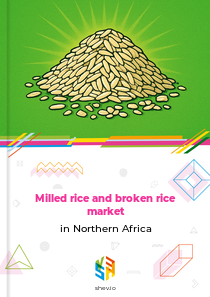







"Northern Africa" region includes following countries:
 Algeria
 Libya
Libya Morocco
 Sudan
Sudan Western Sahara
 Tunisia
 Egypt
EgyptEarlier Report Observations
The milled rice and broken rice market in Northern Africa expanded significantly from 2.6 million tons in 2018 to 3.6 million tons in 2019. This growth coincided with the launch of the BRISPI project in Côte d'Ivoire in 2018, an initiative to enhance rice sector value chains that signaled broader investment in African rice production. Simultaneously, strong unmet demand for rice in West Africa led to increased imports of Asian rice, a trend that contributed to higher import volumes in Northern Africa as well.
From 2020 to 2022, market volume showed variability. It stabilized at 3.6 million tons in 2020 as a rise in local production offset a decline in imports. A contraction to 3.3 million tons followed in 2021, primarily due to a drop in production, before the market remained nearly unchanged at 3.3 million tons in 2022 with modest import growth.
The market surged to 4.2 million tons in 2023, driven by a notable increase in local rice production across Africa that boosted domestic supply. Production in Northern Africa reached 3.5 million tons, while imports also rose. The launch of the second phase of the AGGRi Alliance provided improved rice varieties to support yields. In 2024, export restrictions in India pushed global rice prices above $600 per ton, affecting import costs, while Egypt maintained full self-sufficiency in production thanks to Nile irrigation.
Table of content
- 1. Disclaimer
- 2. Terms of use of the report
- 3. Product codes in the statistical classifications used in the report
-
4. Key Market Indicators and Trends
-
4.1. Key Market Indicators
-
4.1.1. In kind
- 4.1.1.1. Production, 2018-2023
- 4.1.1.2. Imports, 2018-2024
- 4.1.1.3. Exports, 2018-2024
- 4.1.1.4. Market size, 2018-2023
-
4.1.1. In kind
- 4.2. Market Trends and Factors
-
4.1. Key Market Indicators
-
5. Production
-
5.1. Production in Northern Africa
- 5.1.1. Annual dynamics of production in Northern Africa in kind, 2018-2023, K t
-
5.2. Global production by Country, 2018-2023
- 5.2.1. Annual dynamics of production by macroregions in kind, 2018-2023, K t
- 5.2.2. Dynamics of production structure by macroregions in kind, 2018-2023
- 5.2.3. Annual dynamics of production by country in kind, 2018-2023, K t
- 5.2.4. Structure of production by countries in kind, 2018-2023
- 5.2.5. Dynamics of peoduction structure by countries in kind, 2018-2023
-
5.1. Production in Northern Africa
-
6. Imports
-
6.1. Imports (Direct Data*)
- 6.1.1. Imports - Total information
-
6.1.2. Imports in kind, K t
- 6.1.2.1. Annual dynamics of product's imports to Algeria in kind, 2018-2024, K t
- 6.1.2.2. Dynamics of product's imports in kind to Algeria by countries, 2018-2024, K t
- 6.1.2.3. Structure of product's imports in kind by countries, 2018-2024
-
6.1.3. Imports in value, M $ US
- 6.1.3.1. Annual dynamics of product's imports to Algeria in value, 2018-2024, M $ US
- 6.1.3.2. Dynamics of product's imports in value to Algeria by countries, 2018-2024, M $ US
- 6.1.3.3. Structure of product's imports in value by countries, 2018-2024
-
6.1.4. Average price of product's imports, $ US/t
- 6.1.4.1. Annual dynamics of average price of product's imports to Algeria, 2018-2024, $ US/t
- 6.1.4.2. Dynamics of average price of product's imports to Algeria by countries, 2018-2024, $ US/t
-
6.2. Imports (Mirror Data)
- 6.2.1. Imports - Total information
-
6.2.2. Imports in kind, K t
- 6.2.2.1. Annual dynamics of product's imports to Algeria in kind, 2018-2024, K t
- 6.2.2.2. Dynamics of product's imports in kind to Algeria by countries, 2018-2024, K t
- 6.2.2.3. Structure of product's imports in kind by countries, 2018-2024
-
6.2.3. Imports in value, M $ US
- 6.2.3.1. Annual dynamics of product's imports to Algeria in value, 2018-2024, M $ US
- 6.2.3.2. Dynamics of product's imports in value to Algeria by countries, 2018-2024, M $ US
- 6.2.3.3. Structure of product's imports in value by countries, 2018-2024
-
6.2.4. Average price of product's imports, $ US/t
- 6.2.4.1. Annual dynamics of average price of product's imports to Algeria, 2018-2024, $ US/t
- 6.2.4.2. Dynamics of average price of product's imports to Algeria by countries, 2018-2024, $ US/t
-
6.1. Imports (Direct Data*)
-
7. Exports
-
7.1. Exports (Direct Data*)
- 7.1.1. Exports - Total information
-
7.1.2. Exports in kind, K t
- 7.1.2.1. Annual dynamics of product's exports from Algeria in kind, 2018-2024, K t
- 7.1.2.2. Dynamics of product's exports in kind from Algeria by countries, 2018-2024, K t
- 7.1.2.3. Structure of product's exports in kind by countries, 2018-2024
-
7.1.3. Exports in value, M $ US
- 7.1.3.1. Annual dynamics of product's exports from Algeria in value, 2018-2024, M $ US
- 7.1.3.2. Dynamics of product's exports in value from Algeria by countries, 2018-2024, M $ US
- 7.1.3.3. Structure of product's exports in value by countries, 2018-2024
-
7.1.4. Average price of product's exports, $ US/t
- 7.1.4.1. Annual dynamics of average price of product's exports from Algeria, 2018-2024, $ US/t
- 7.1.4.2. Dynamics of average price of product's exports from Algeria by countries, 2018-2024, $ US/t
-
7.2. Exports (Mirror Data)
- 7.2.1. Exports - Total information
-
7.2.2. Exports in kind, K t
- 7.2.2.1. Annual dynamics of product's exports from Algeria in kind, 2018-2024, K t
- 7.2.2.2. Dynamics of product's exports in kind from Algeria by countries, 2018-2024, K t
- 7.2.2.3. Structure of product's exports in kind by countries, 2018-2024
-
7.2.3. Exports in value, M $ US
- 7.2.3.1. Annual dynamics of product's exports from Algeria in value, 2018-2024, M $ US
- 7.2.3.2. Dynamics of product's exports in value from Algeria by countries, 2018-2024, M $ US
- 7.2.3.3. Structure of product's exports in value by countries, 2018-2024
-
7.2.4. Average price of product's exports, $ US/t
- 7.2.4.1. Annual dynamics of average price of product's exports from Algeria, 2018-2024, $ US/t
- 7.2.4.2. Dynamics of average price of product's exports from Algeria by countries, 2018-2024, $ US/t
-
7.1. Exports (Direct Data*)
-
8. Trade balance
-
8.1. Trade balance (Direct Data)
- 8.1.1. In kind, K t
- 8.1.2. In value, M $ US
-
8.2. Trade balance (Mirror Data)
- 8.2.1. In kind, K t
- 8.2.2. In value, M $ US
-
8.1. Trade balance (Direct Data)
-
9. Top buying and selling countries, 2018-2024
-
9.1. Direct Data
- 9.1.1. Import in Value by Countries-buyers
- 9.1.2. Export in Value by Countries-suppliers
-
9.2. Mirror Data
- 9.2.1. Import in Value by Countries-buyers
- 9.2.2. Export in Value by Countries-suppliers
-
9.1. Direct Data
Production milled rice and broken rice in Northern Africa
In kind, 2017-2020, K t
Top producers of milled rice and broken rice, 2017-2020
World map of production of milled rice and broken rice, 2017-2020
Northern Africa's production of milled rice and broken rice has grown for the second year in a row. In 2020, the region produced 3 220 thousand tonnes, marking a 10.4% increase from the previous year. However, looking back from 2017 to 2020, overall production fell by 12.7%, which averages out to a 4.4% annual decline. The lowest point was in 2018, with just 2 243 thousand tonnes produced, representing the largest drop of 39.2% during this period. On the upside, 2019 saw the biggest gain, with production jumping by 30.0%.
Annual dynamics of production in Northern Africa in kind, 2017-2020, K t
| Parameter | 2018 | 2019 | 2020 | CAGR | |
|---|---|---|---|---|---|
| 1 | Change from last year | (39.2%) | 30.0% | 10.4% | (4.4%) |
Exports milled rice and broken rice from Northern Africa
Exports in kind, K t
The market displayed noticeable volatility over the years observed. Exports hit their lowest point in 2017 and peaked in 2019, with a dramatic 12-fold difference between these extremes. In 2020, milled rice and broken rice exports from Northern Africa totaled 1.0 thousand tonnes, a sharp decline of 80.7% compared to the year before. The highest export volume was recorded in 2019 at 5.2 thousand tonnes, while the largest increase occurred in 2018, surging by 254.1%.
Annual dynamics of product's exports from Northern Africa in kind, 2017-2020, K t
| Parameter | 2018 | 2019 | 2020 | CAGR | |
|---|---|---|---|---|---|
| 1 | Change from last year | 254.1% | 239.5% | (80.7%) | 32.4% |
From 2017 to 2020, Turkey, Gambia, and Ghana were the key markets for Northern Africa's milled rice and broken rice exports in volume terms. Turkey led with 39.8% of exports, followed by Gambia at 7.6% and Ghana at 6.7%. Together, these three countries accounted for 54.1% of all export flows during this period.
Structure of product's exports in kind by countries, 2017-2020
World map of product's exports from Northern Africa in kind, 2017-2020
Exports in value, M $ US
The market experienced significant volatility in these years. Export values fluctuated widely, with a 13.8-fold difference from the peak in 2019 to the low in 2020. In 2020, foreign supplies of milled rice and broken rice from Northern Africa were valued at 0.3 million US dollars, a steep drop of 92.7% from the previous year. The highest value was in 2019 at 3.8 million US dollars, and the largest increase happened in 2018, rising by 360.2%.
Annual dynamics of product's exports from Northern Africa in value, 2017-2020, M $ US
| Parameter | 2018 | 2019 | 2020 | CAGR | |
|---|---|---|---|---|---|
| 1 | Change from last year | 360.2% | 154.9% | (92.7%) | (5.2%) |
Between 2017 and 2020, Turkey, Benin, and Gambia were the top three markets for Northern Africa's milled rice and broken rice exports in value terms. Collectively, they absorbed 60.8% of the total export value during these years.
Structure of product's exports in value by countries, 2017-2020
World map of product's exports from Northern Africa in value, 2017-2020
Imports milled rice and broken rice to Northern Africa
Imports in kind, K t
The import market showed signs of volatility throughout the observed period. Imports reached their lowest point in 2018 and peaked in 2019, with a 2.1-fold swing between these years. In 2020, foreign supplies of milled rice and broken rice to Northern Africa amounted to 427.3 thousand tonnes, an abrupt decrease of 35.9% compared to 2019. The minimum volume was 315.6 thousand tonnes in 2018, while the maximum was 666.8 thousand tonnes in 2019, which also saw the largest increase of 111.3%.
Annual dynamics of product's imports to Northern Africa in kind, 2017-2020, K t
| Parameter | 2018 | 2019 | 2020 | CAGR | |
|---|---|---|---|---|---|
| 1 | Change from last year | (8.5%) | 111.3% | (35.9%) | 7.4% |
From 2017 to 2020, India, China, and Thailand were the primary sources for milled rice and broken rice imports to Northern Africa in volume terms. India accounted for 43.2% of imports, China for 20.6%, and Thailand for 15.8%. Together, these three countries made up 79.5% of total import volumes, establishing them as the main suppliers.
Structure of product's imports in kind by countries, 2017-2020
World map of product's imports to Northern Africa in kind, 2017-2020
Imports in value, M $ US
The market trend was unstable over this timeframe. Import values hit their lowest point in 2018 and peaked in 2019, with a 2.3-fold variation between these years. In 2020, milled rice and broken rice shipments to Northern Africa from abroad reached 217.3 million US dollars, down by 51.6% from the previous year. The minimum value was 196.4 million US dollars in 2018, while the maximum was 449.1 million US dollars in 2019, which also recorded the largest increase of 128.7%.
Annual dynamics of product's imports to Northern Africa in value, 2017-2020, M $ US
| Parameter | 2018 | 2019 | 2020 | CAGR | |
|---|---|---|---|---|---|
| 1 | Change from last year | (6.8%) | 128.7% | (51.6%) | 1.0% |
During 2017–2020, India, China, and Thailand remained the leading suppliers of milled rice and broken rice to Northern Africa in value terms. India contributed 42.6% of import value, China 23.3%, and Thailand 14.4%. Combined, these three countries formed 80.2% of total import value over this period.
Structure of product's imports in value by countries, 2017-2020
World map of product's imports to Northern Africa in value, 2017-2020
Related Reports


Brown rice market in Northern Africa
2026-03-28

Paddy rice market in Northern Africa
2026-03-28

2026-03-28
In-depth market research on this product
Global Broken Rice Market 2021–2031: Size, Share, Trends and Forecast
Global market report: size, trends and forecast to 2031 · 192 pages
Why Choose Us?
Only Verified Data
No Hidden Costs or Separate Fees
Smarter Subscription Pricing
Contact Our Team
Submit your inquiry using the form below — our team will get back to you within 24 hours.